Taking an Idaho Machine to Montana
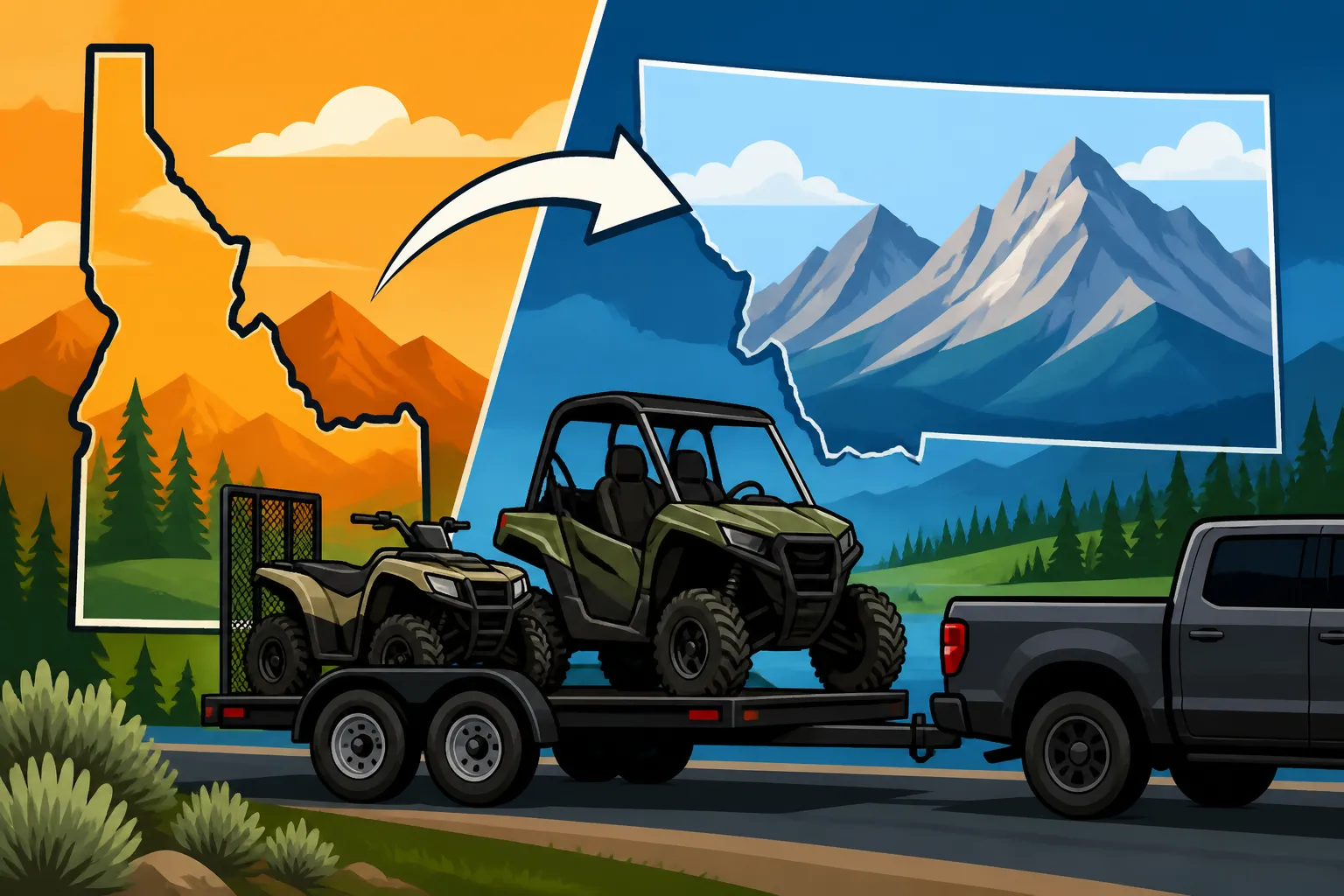
Taking an Idaho ATV or UTV into Montana can involve more than crossing a state line with the machine loaded. Idaho paperwork does not automatically settle Montana’s permit, registration or road-use requirements. The practical first step is to identify how the machine is documented and where you plan to ride, then check the rules that apply to each.
Start with the machine’s paperwork, not just its Idaho sticker
An Idaho OHV sticker is not a universal pass for public land in other states. It relates to Idaho requirements; Montana has its own rules for operating OHVs. Before your trip, check whether Montana requires a nonresident permit for your machine or whether its current rules recognize the machine’s Idaho registration or another qualifying document.
The difference between an Idaho OHV sticker and a vehicle registration matters. A sticker alone may not establish that the machine is registered in a way Montana accepts. Idaho titles, stickers and restricted-use plates serve different purposes, so gather the documents you have rather than assuming one stands in for the others. If you need a refresher on the Idaho side, Idaho’s Non-Resident OHV Sticker explains the sticker system, while Why Idaho Ended OHV Reciprocity provides context on why riders should not assume state rules work both ways.
A restricted-use plate can also cause confusion. Idaho’s R plate is tied to Idaho rules and does not automatically make a machine street legal in Montana. A plate, registration and OHV permit are not interchangeable, and a document that helps with one kind of travel may not satisfy a different state’s requirements. See Idaho’s Restricted Vehicle Plate Explained for what the Idaho plate does and does not cover.
Before leaving, make a simple inventory:
- Machine identity: Write down the make, model and vehicle identification number. Confirm the VIN on the machine matches the paperwork.
- Ownership: Bring the title or another appropriate proof of ownership. If the machine is financed, make sure you understand which ownership documents you can access.
- Idaho documents: Note whether the machine has an Idaho OHV sticker, an Idaho restricted-use plate, or other registration documents. Don’t treat those as equivalent.
- Montana requirements: Check Montana’s current nonresident OHV permit and registration rules for the machine’s category and your situation.
- Road-use documents: If you intend to use public roads, confirm the requirements for that exact road and vehicle, including any licensing, insurance and equipment rules.
If the machine has an Idaho plate or registration beyond an OHV sticker, that may affect which Montana rules apply. The key is to confirm the applicable Montana provision directly before riding. If the machine carries only an Idaho OHV sticker, don’t assume that alone satisfies Montana’s requirements for a nonresident machine.
For a clear answer, describe the machine accurately when contacting the relevant Montana agency: ATV or side-by-side, its Idaho documents, whether it has a highway-use registration, and whether you plan to ride on trails, public roads or both. A general question such as “Does my Idaho sticker work?” may not give enough detail to determine the rule.
Separate trail access from road access
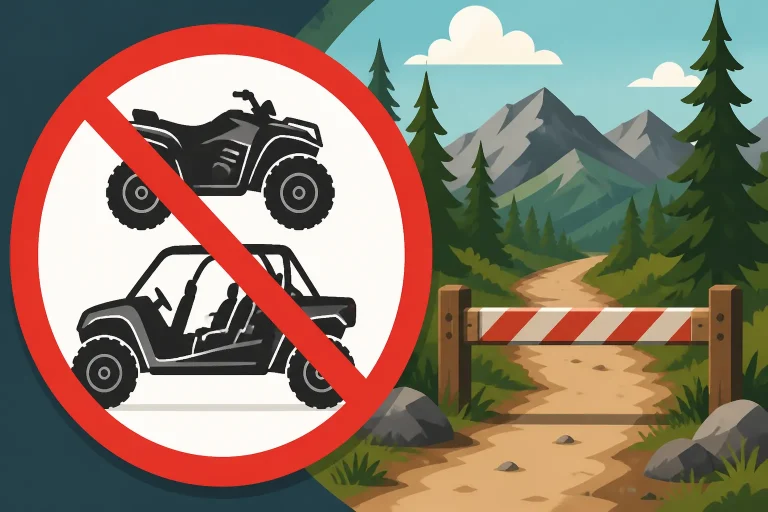
A machine may be allowed on one route and prohibited on another, even within the same trip. A permit or registration addresses only part of the question: the route must also be open to that type of vehicle.
For trails and public land, check the land manager’s current maps, signs and closure notices. Routes can be limited by vehicle width, seasonal closures, construction, fire conditions or other local restrictions. On federal land, consult the relevant managing agency’s information for the specific route. Don’t assume an Idaho map, trail pass or open-road designation applies after crossing into Montana.
Public-road use is a separate check. Montana’s rules and local road designations determine whether an OHV may use a given road. An Idaho restricted plate does not make every Montana county road open, and it does not convert an OHV into a highway-registered vehicle. A route may be open only to certain vehicle types, or only when the rider meets requirements for equipment, insurance or operator qualifications.
For the Idaho part of your journey, remember that Idaho road access is also route-specific. What Idaho Requires to Ride a County Road explains why having the right machine documents does not by itself establish that a county road is open. Similarly, Idaho Rules on Forest Service Roads can help you separate Idaho-side forest-road access from rules that apply after you cross the state line.
Use this distinction when planning:
| Where you plan to ride | What to verify |
|---|---|
| Montana trail or public-land route | Whether the route is open to your machine, plus any Montana OHV permit or registration requirement |
| Montana county or local road | Whether that particular road is designated for OHV use and what operating rules apply |
| Montana state or federal highway | Whether OHV use is prohibited or specifically allowed at the route or crossing |
| Idaho road before the border | Idaho’s road designation and the requirements for the machine and rider |
| Private land | The landowner’s permission and any other applicable requirements |
A route shown on an app or old map is a useful lead, not definitive permission. A road may have changed status, and online route layers may not show every closure or local restriction. Check current official maps and posted signs, especially where a trail meets a road or where a route enters a town.
Check the rules before loading and again before riding
A few targeted checks can prevent a frustrating stop at the trailhead. Do them while you still have time to change the plan, not after the machine is unloaded.
- Identify the route and the land manager. Write down the trail, road or riding area you expect to use. Determine whether the land is managed by a federal agency, the state, a county or a private owner.
- Ask about Montana permit and registration requirements. Explain which Idaho documents the machine carries. Confirm whether those documents satisfy Montana’s current rules or whether a Montana nonresident OHV permit or other paperwork is needed.
- Confirm each road segment. If you expect to ride from a staging area to a trail, check that every connector is open to OHVs. A legal trailhead destination does not necessarily make the connecting road legal.
- Review rider and equipment rules. Ask about requirements that could apply to the operator, passengers, helmet use, lights, insurance or other equipment. Requirements may vary with vehicle type, rider age and road status.
- Save proof of the answer. Keep permit records and relevant registration documents accessible. Save official route information or contact details so you can verify a question while travelling.
- Recheck for closures before unloading. Fire activity, maintenance, weather and seasonal restrictions can alter access after you make your original plan.
For an official answer on a Montana permit or registration question, contact the relevant Montana agency, such as Montana Fish, Wildlife & Parks or the state motor vehicle authority, and be ready to explain the machine’s exact documents. For route access, contact the land manager or local authority responsible for that road or riding area. If the question concerns a particular county road, a statewide answer may not confirm that road is open.
Keep paperwork secure and available, but don’t carry the machine’s original title on a trail ride unless an agency or specific circumstance requires it. A practical approach is to keep ownership documents safely stored and carry the documents needed to show the machine’s registration or permit status. Make sure the VIN is readable and matches the paperwork in case an officer or land manager asks to verify the machine.
Common trip scenarios and how to avoid a wrong assumption
The machine has an Idaho OHV sticker but no Idaho plate
Treat the sticker as evidence of the Idaho requirement it addresses, not as automatic permission to ride in Montana. Confirm whether Montana requires a nonresident OHV permit for your circumstances and whether any Idaho document you do have qualifies under Montana’s rules.
If you cannot confirm that the Idaho sticker is accepted, don’t gamble on the assumption. Ask Montana’s appropriate agency whether you need a Montana permit and how to obtain it before using public riding areas.
The machine has an Idaho R plate
An R plate relates to Idaho’s restricted-use system. It does not automatically authorize road use in Montana or prove that a Montana route is open to OHVs. Check Montana’s requirements for the vehicle and the exact road. If the planned trip includes public-road travel, verify the machine’s road status and the operator’s obligations separately from trail permits.
You are bringing a highway-registered machine
A highway registration may change how the machine is treated under a state’s laws, but it still does not guarantee that every trail or road is open to it. Confirm that the registration is valid for the machine and that the route allows its vehicle type. Also check insurance and operator requirements for the road sections you plan to use.
You are riding only on private property
Private land can change which public-land permit rules apply, but it does not mean every other requirement disappears. Get permission from the landowner and ask whether the property connects to public roads or public riding areas. The moment your route uses public land or a public road, the rules for that route may apply.
You are borrowing or towing someone else’s machine
Ask the owner for the machine’s paperwork and make sure you have permission to use it. Confirm that any permit or registration is valid for that machine and applies to your trip. Don’t rely on the owner’s description of the paperwork if you have not seen what the machine actually carries.
Your route crosses between Idaho and Montana more than once
Treat each state crossing as a fresh check, not as one continuous permit area. A document that satisfies a requirement in Idaho may not satisfy Montana’s, and an open route in one state does not make its continuation open on the other side. Mark the border crossing and any changes in land management on your route plan.
The safest rule is straightforward: match the machine’s documents to Montana’s current permit rules, then verify access for every route you intend to ride. That takes more checking than relying on an Idaho sticker or plate, but it is the practical way to avoid arriving at a closed route or discovering a paperwork issue after unloading.
Disclaimer
This article is for general informational purposes only and does not constitute professional advice. Laws, prices and regulations vary by location and change over time. Consult a qualified professional for guidance on your specific situation.