Dispersed Camping Near Idaho Trailheads
Finding a place to camp near an Idaho ATV or UTV trailhead can be harder than choosing the ride itself. A pullout that looks quiet may be private land, a closed route, or a poor place to leave a trailer. This guide explains how to check camping rules, choose a practical site, protect your machine and plan for the realities of Idaho backcountry travel.
Start with the land manager, not the map pin
Identify who manages the ground
A spot that appears open on a phone map is not automatically a legal campsite. In Idaho, land around a trailhead may be managed by the U.S. Forest Service, the Bureau of Land Management, a state or local agency, or a private owner. Boundaries can run close together, so a campsite and the road leading to it may even fall under different rules.
Before you settle on a site, identify the land manager and check its current rules for the exact area. Look for posted restrictions, seasonal closures, fire orders, stay limits, and any limits on camping near roads, water, or developed facilities. If you cannot establish who manages the land, don’t assume dispersed camping is allowed. Move to a clearly identified location or contact the relevant agency office.
This matters around popular riding areas such as the Boise National Forest, the Idaho Panhandle, and the Sawtooth region, where rules and access can vary from one road or trail to the next. The broad landscape may look continuous, but an open patch beside a forest road does not tell you whether it is public, whether overnight camping is permitted, or whether the access route is open to your vehicle.
For an overview of the basic land-use issue, start with [Dispersed Camping Rules on Idaho Forest Land]. If you are deciding between a dispersed site and a developed option, [Idaho Campgrounds With Trail Access] can help you think through what amenities and access you actually need.
Confirm that the access route is open to your vehicle
A campsite may be legal to occupy but difficult or unlawful to reach with a pickup, trailer, or UTV. Check the route as carefully as the destination. Forest roads may have seasonal closures, vehicle-width limits, or restrictions on motorized use. A line drawn on a map can also be a hiking trail, a road closed to public motor vehicles, or a route unsuitable for a large trailer.
Use the applicable Motor Vehicle Use Map to verify which roads are open to motorized travel and what vehicle designations apply. These maps can be especially useful when a route passes through several junctions or when a tempting spur appears to lead toward a flat camping area. [Reading an Idaho Motor Vehicle Use Map] explains how to interpret this type of map, while [Finding the Right Motor Vehicle Use Map] is useful when you need to locate the map for the specific land unit.
A navigation app can help you follow a route, but it should not replace the land manager’s travel map or posted signs. For example, a trail visible in onX Offroad may help you understand the shape of a route, but confirm motorized access and camping rules through the responsible agency. Download your maps before leaving town, save the relevant route, and note a second way out. Cell coverage can disappear well before you reach a remote campsite.
Choose a campsite that works for both camping and riding
Check space for the whole setup
When you camp near an Idaho trailhead, the campsite has to work for more than a tent. Think about the pickup, trailer, ATV or UTV, turning room, unloading space, and a safe place to store gear. A site that fits a tent may not fit a long trailer, and a narrow spur that seems manageable on the way in can become stressful when you have to back out around rocks, trees, or other parked vehicles.
If you are bringing a trailer, assess the approach before committing. Look for a place to turn around without driving over vegetation or into an unmarked area. Avoid blocking gates, road junctions, trail access, or the space other riders need to unload. If the only available pullout is crowded or awkward, it may be safer to use a developed campground or a larger designated staging area rather than squeeze into a marginal spot.
Trailhead parking and camping are not always the same thing. A staging area may be intended for day-use parking, loading, or unloading, rather than overnight camping. Check signs and local rules before treating it as a base camp. [Idaho Trailhead Parking and Staging] covers the practical distinction, and [Camping Beside Idaho OHV Trails] offers another perspective on staying close to riding routes without assuming every trailhead allows overnight use.
Match the site to the machine and the ride
A nearby campsite is convenient only if the route from camp suits your machine and riding group. Consider trail width, surface, elevation, exposed sections, and the skill level of the least experienced rider. A narrow trail that is comfortable on a small ATV may be a poor choice for a wider side-by-side. Don’t plan to solve a mismatch by leaving the designated route or pushing onto a closed spur.
Before you go, use the official travel map to confirm that your planned route is open to your vehicle type. A mapping app such as onX Offroad can help you review route options and keep track of your position, but compare what you see with current agency information. If your group includes several machines, discuss a turnaround point before anyone reaches a section that feels too narrow or difficult.
Build a backup plan into the trip. If the campsite is occupied, the access road is rougher than expected, or a route is closed, you should know where you can legally go next. [Idaho Trail Difficulty Ratings] can help you think beyond mileage when choosing a ride, while [Checking Idaho Trail Status Before You Drive] is a reminder to check access conditions before towing a rig into the backcountry.
| Trip need | What to check before leaving | Why it matters |
|---|---|---|
| Land status | Which agency or owner manages the campsite | Rules may change at a boundary |
| Road access | Motorized-use designation, closures, and vehicle limits | A campsite can be open while its access route is not |
| Trailer space | Turning room, parking space, and unloading area | Prevents blocked roads and difficult backing |
| Ride suitability | Trail width, difficulty, and machine restrictions | Keeps the route appropriate for the whole group |
| Overnight conditions | Fire rules, stay limits, sanitation, and quiet hours | Avoids preventable problems at camp |
| Emergency plan | Offline maps, alternate exit, and communication method | Helps when cell service is unavailable |
Set up camp with low impact and clear boundaries
Use established, durable sites
When dispersed camping is allowed, choose a previously used, durable site rather than making a new clearing. A worn, level surface is generally a better place for a tent or vehicle than fragile vegetation, wet ground, or an open meadow. Keep vehicles on established roads and parking areas. Do not widen a site by driving around brush, cutting branches, or making a new path for a trailer.
Be thoughtful about where you park and unload. Keep machines out of streambanks and other sensitive areas, and avoid blocking access for other visitors or land managers. A tempting shortcut across a patch of open ground can leave tracks that remain visible long after camp is gone. If a site does not have enough room for your group, use a different site rather than expanding it.
Leave the campsite as clean as you found it—or cleaner. Pack out food scraps, packaging, cans, and anything else you brought in. Don’t leave trash in a fire ring or assume someone else will take it away. Before departing, walk the whole area, including the spot where the trailer was parked and the path between vehicles and tents. Small items such as zip ties, food wrappers, and broken straps are easy to overlook.
Make sanitation and fires part of the plan
Dispersed sites may not have restrooms, water, trash collection, or fire facilities. Plan for that before arriving, not after dark. Carry enough drinking water for camp and riding, and bring a way to manage waste that follows the local land manager’s rules. Keep soap, food, and waste away from water sources. If your group is unsure about local sanitation requirements, check with the agency before the trip rather than improvising at camp.
Fire rules can change with conditions and may prohibit fires even where a fire ring is present. Check current restrictions for the location and date, and be ready to use a stove or another permitted option instead. If fires are allowed, use an existing appropriate fire ring where available, keep the fire manageable, and never leave it unattended. Before leaving camp, make sure it is fully out and cold to the touch; a fire that looks finished can still hold heat.
Carry out everything you carry in, including ash or food waste if local rules require it. Don’t burn cans, foil, plastic, or packaging. These materials can remain in the fire pit and create a mess for the next visitor. For riders camping during a dry or windy spell, the safest plan may be to skip a campfire entirely and bring warm layers and a suitable stove.
Plan around changing conditions and backcountry limitations
Recheck closures, weather, and seasonal access
Conditions in Idaho’s mountains and forests can change quickly. A road that was passable on a previous visit may be muddy, blocked by snow, damaged by runoff, or closed for repairs. Fire restrictions and closures can also affect where you can camp or ride. Check agency notices close to departure and again when you arrive in the area, paying attention to signs at road junctions and trailheads.
Don’t treat a closure as a navigation inconvenience. If a road or trail is closed, do not ride around the barrier or create a new route to reach a campsite. That can damage land and put you in violation of the closure. Choose a different legal route or move to another camping area. [Idaho Trail Closures in Fire Season] is relevant when planning summer travel, and the broader [Checking Idaho Trail Status Before You Drive] topic can help you build a pre-trip checking routine.
Weather planning should include more than the forecast for the nearest town. Conditions can differ at higher elevations, and a remote road may become difficult after rain or a storm. Ask whether the route has steep grades, narrow sections, or places where a trailer could be hard to turn around. If the trip depends on a single road, consider what you will do if it becomes impassable before you reach camp.
Prepare for limited service and self-rescue
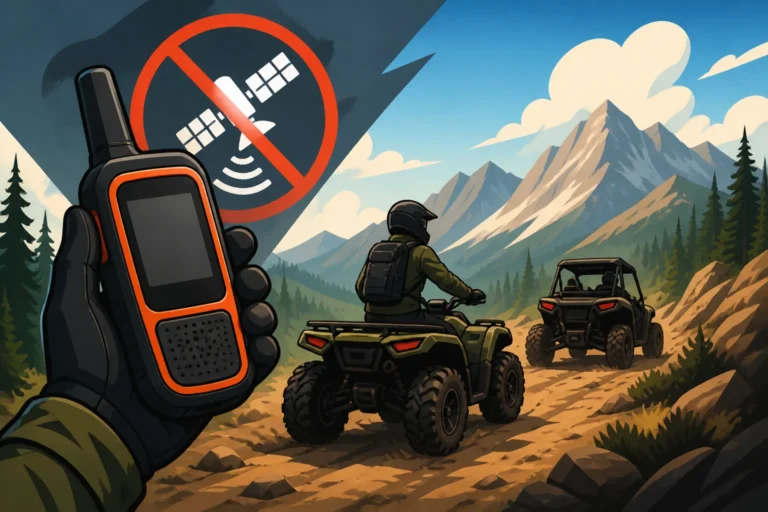
Do not count on being able to call for help from a dispersed campsite or trail. Cell service can be inconsistent in central Idaho and other remote areas, so tell someone your route and expected return time. Save maps for offline use, keep a paper map as a backup, and carry a charged power bank. A satellite messenger or similar device may be worth considering for a trip where reliable communication is important.
Pack for the possibility of delays. Bring first-aid supplies, food and water beyond what you expect to use, basic machine tools, tire repair equipment suited to your vehicle, and warm or waterproof layers. A minor mechanical issue can become a long wait if you are far from a repair shop or the nearest paved road. Make sure each rider knows where the group is meeting if machines get separated.
Before setting out, agree on simple group rules: ride within the least experienced person’s comfort level, stop at confusing junctions, and don’t leave a rider behind without confirming who is with them. [Cell Service in the Idaho Backcountry] explains why communication deserves a place in your plan, and [What to Carry on a Remote Ride] can help you review your gear. If you use onX Offroad to keep track of a planned route, download the map in advance and make sure someone in the group knows how to use it.
Make the trip comfortable for the people as well as the machines
Decide whether dispersed camping is the right fit
Dispersed camping can be a good fit when your group wants a quiet base, is comfortable without facilities, and can handle a little uncertainty. It may be less suitable when you need potable water, a restroom, a guaranteed place to park a large trailer, or easy access for children or someone with mobility needs. A developed campground can make the logistics simpler, even if it means a longer drive to the trail.
Think through the whole day rather than focusing only on the campsite. After a dusty ride, will your group have enough water to clean up? Is there room to cook without interfering with other campers? Can you keep food secured and animals from getting into it? If the answer to several of these is no, a campground with facilities may make the trip more enjoyable and reduce pressure to improvise.
You can also split the difference: camp at a developed site and drive to a designated trailhead in the morning, or choose a dispersed location that is near—but not inside—a busy staging area. The best choice depends on the rules, the group, and the parking space available. [Idaho Trail Towns Worth a Base Camp] may help you consider staying in a nearby community when remote camping is not the right fit.
Keep camp orderly and respectful
A trailhead campsite is a shared space, even when it feels remote. Keep voices and music low, especially at night and early in the morning. Avoid letting machines idle longer than necessary, and don’t use a narrow access road as a workshop or storage area. If another group arrives, leave enough room for them to park and turn around rather than treating the whole pullout as private camp.
Keep riding separate from camp chores. Don’t use the campsite as a place to test top speed, spin tires, or take repeated laps. Start and load machines thoughtfully, and check that straps, fuel containers, and tools are secured before moving. Good camp habits reduce noise, dust, and the chance of a preventable spill or injury.
Before you leave, verify that the machine is secured for the drive and that no equipment has been left behind. Check the fire area, food storage, and parking spot. If the route out looks different from the route in because of weather or traffic, pause to reassess instead of rushing onto a road that may not suit your trailer. A little patience at camp can prevent the most frustrating part of the trip from happening at the end.
Disclaimer
This article is for general informational purposes only and does not constitute professional advice. Laws, prices and regulations vary by location and change over time. Consult a qualified professional for guidance on your specific situation.