Idaho OHV Clubs and Trail Adoption
Idaho’s best-known OHV routes can look effortless on a map, but trail signs, drainage work, cleanup, and local knowledge all take people and time. If you want to help care for a route—or simply find a club before your next ride—this guide explains how Idaho OHV clubs and trail adoption work, what volunteers typically do, and how to get involved responsibly.
What Idaho OHV clubs do
More than organize group rides
An OHV club can be a place to meet riding partners, but its contribution often reaches beyond the ride itself. Members may help share route information, attend public meetings, report damaged signs, coordinate volunteer days, and work with land managers on access and maintenance priorities. The exact role varies by club, location, and the land involved.
That local connection is useful when you are new to an area. Someone familiar with the Boise National Forest near Idaho City may know that a route has a seasonal closure, a confusing junction, or a staging-area concern that is not obvious from a quick map check. In the Panhandle, local riders may have practical observations about a muddy section, a storm-damaged crossing, or a road shared with other recreation users. A club’s firsthand knowledge can help you ask better questions before unloading your machine.
Clubs also give riders a more organized way to raise concerns. If a route is repeatedly blocked or a sign has disappeared, a club may be able to collect details and bring them to the appropriate land manager. That does not mean a club controls public land or can promise a trail will remain open. Decisions about access, closures, and permitted uses belong to the agency or landowner responsible for that area.
What trail adoption means
Trail adoption is usually a cooperative arrangement in which a club or volunteer group helps monitor and care for a particular route or area. Depending on the agreement and the land manager’s needs, work may include picking up litter, reporting hazards, checking signs, documenting erosion, or helping with approved maintenance. The group’s responsibilities should be clear before work begins.
Adoption is not a license to alter a trail. Volunteers should not independently reroute a muddy section, cut trees, install signs, build structures, or use equipment on public land without authorization. Even work that seems minor can affect drainage, wildlife, cultural resources, or another user group. When a route needs substantial repair, the right first step is to report the problem and ask the managing agency what help is appropriate.
If you want to understand how community groups can support trail work, [Idaho Trail Adoption and Volunteer Days] is a useful related topic. For the bigger picture of who handles damage beyond a volunteer group’s scope, see [Who Fixes a Washed-Out Idaho Trail].
Finding a club and choosing a good fit
Start with the area you actually ride
The most practical club for you is often one connected to the region where you ride most. If you live in the Treasure Valley, you might look for groups that work around Boise, Idaho City, or nearby national forest access points. Riders based near Coeur d’Alene may want to ask about Panhandle routes and staging areas. Those who head toward McCall, Stanley, or the Silver Valley can look for groups with connections to those areas.
A club’s riding focus matters, too. Some groups may concentrate on ATVs and side-by-sides, while others may include dirt-bike riders, trail users with a range of machine sizes, or families looking for easier outings. Ask what kinds of routes and volunteer activities the group supports. A club that spends much of its time on narrow single-track may not be the right match if your primary interest is a full-size side-by-side, and vice versa.
You do not need to commit immediately. Ask whether a prospective club welcomes visitors to a meeting or volunteer day, how it communicates closures, and whether members ride together or focus more on stewardship. A conversation can reveal the group’s tone and expectations before you pay dues, join a work party, or bring your family along.
Check information before treating it as current
A club’s social media post or ride report can be helpful, but it is not a substitute for checking the land manager’s current notices. Routes may close because of fire danger, snow, road damage, wildlife protections, or other restrictions. A trail that was open on a friend’s last trip may not be open on the day you arrive.
For planning, compare local club information with agency maps and notices. Tools such as onX Offroad can help you examine route networks and orient yourself, but a map layer is not permission to ride a route. Check the applicable Motor Vehicle Use Map and current agency guidance, especially where routes meet a county road, private property, or a restricted area. For a deeper look at map reading, [Reading an Idaho Motor Vehicle Use Map] explains why route designation and seasonal dates matter.
Before a club ride, confirm the meeting location, machine-width limits, permitted vehicle types, fuel plan, and expected pace. In mountain areas, a seemingly short route can take longer than expected because of elevation, rough surfaces, or frequent stops. If you are using onX Offroad or another mapping tool, download or prepare the information you need before entering a cell dead zone, and carry a backup navigation plan for remote routes.
How trail adoption usually gets started
Identify the responsible land manager
The first step is finding out who manages the route. Idaho OHV riding areas can involve the U.S. Forest Service, Bureau of Land Management, Idaho Department of Parks and Recreation, counties, municipalities, or private landowners. A route may pass through more than one jurisdiction, so a club’s familiarity with a general area does not automatically mean it has authority to work everywhere along it.
Look at the signs, maps, and agency information associated with the specific trail or road. If you are unsure, contact the relevant local office and describe the route by its name, number, trailhead, or nearby landmark. A useful question is: “Who manages this segment, and is there an established volunteer or adoption program for it?” That is more likely to get you to the right person than asking broadly where to volunteer.
The process can vary. A land manager may already have a volunteer coordinator, a club partnership, or scheduled work days. In another area, the agency may need to review a proposed project before anyone can begin. For funding and partnership context, [Idaho Trail Grants and Where They Come From] and [How Idaho Clubs Apply for Trail Money] cover related topics.
Agree on the work before arriving with tools
Once a club or individual volunteer has made contact, clarify the task, location, timing, and limits. Ask whether volunteers need to sign an agreement, attend a safety briefing, use specific tools, or check in with an agency representative. Confirm whether the work is inspection and reporting, litter removal, brushing, sign support, or a different approved activity. Do not assume that a previous year’s project has the same authorization this year.
A written task description can prevent misunderstandings. Imagine a group finds water flowing across a trail near a staging area outside Idaho City. One rider suggests digging a channel to move the water. That may sound sensible, but changing drainage can send water and sediment somewhere harmful. The group should photograph the issue, record its location, and ask the land manager whether there is an approved fix.
It is also worth settling the practical details: who brings tools, where vehicles can park, how the group will handle trash, and what happens if weather makes the work unsafe. A properly planned volunteer day is not just a good deed; it is coordinated work on land that may have sensitive resources and multiple users. If the issue is damage rather than a scheduled project, [Reporting Trail Damage in Idaho] offers a useful starting point.
| Activity | What volunteers may be able to do | What to confirm first |
|---|---|---|
| Trail observation | Note fallen trees, damaged signs, erosion, or access concerns | Which agency manages the segment and how it wants reports submitted |
| Litter cleanup | Collect accessible trash during an approved work day | Where waste should be taken and whether special items should be left for agency staff |
| Sign support | Help identify missing, damaged, or confusing signs | Whether volunteers may handle signs or should only document the problem |
| Trail maintenance | Assist with a defined task under the appropriate authorization | Approved tools, work limits, safety requirements, and project boundaries |
| Public education | Share route etiquette, closure notices, and stewardship practices | Whether the information matches current agency rules |
What a volunteer day can look like
Prepare for the work, not just the ride
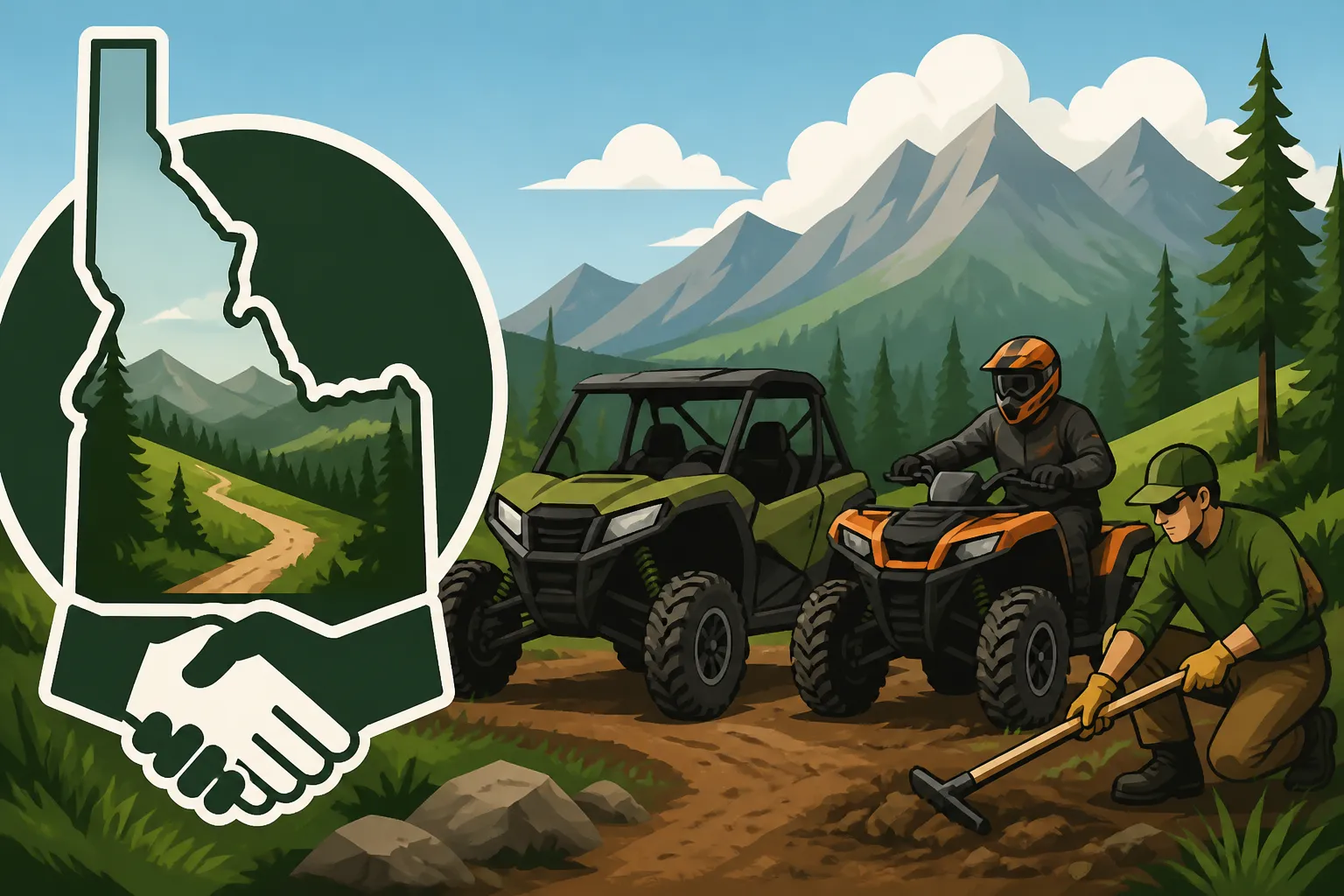
A volunteer day may involve less riding than expected. The group might meet at a staging area, review boundaries and safety procedures, then travel to a work site to inspect a route or complete a specific task. Some days are mostly observation and documentation. Others involve carrying hand tools, gathering litter, or assisting with maintenance under agency direction.
Wear practical clothing for the terrain and weather, and bring water, food, personal medications, and protective gear appropriate to the task. For a remote work site, plan for poor cell coverage and a delayed return. Confirm whether machines are needed or whether the group will reach the site by truck or on foot. A side-by-side can be helpful in some settings but inappropriate or too wide for others, so do not assume that every adopted route is suitable for every machine.
The day also calls for patience. A useful result may be a well-documented list of hazards rather than a dramatic repair. If a club finds a damaged drainage feature or a large fallen tree, the best contribution may be precise location information and clear photographs, not an improvised fix. That kind of report helps staff prioritize work and keeps volunteers from accidentally creating a second problem.
Make reports useful to the people who will act on them
A report is much easier to use when it includes the route or trail name, a recognizable location, the date observed, a concise description, and photos taken safely from an appropriate place. If you can record a map pin or coordinates, include them in the format the land manager requests. Avoid moving a hazard or stepping into unstable terrain just to get a better picture.
Separate what you observed from what you suspect. “A tree blocks the full width of the route about half a mile east of the staging area” is more actionable than “the trail is in terrible shape.” If you see active erosion, describe where water is moving and whether the route is passable, but do not claim a cause unless you know it. A simple, factual report helps an agency decide whether a site visit is needed.
Clubs can also encourage riders to report issues consistently rather than posting only in a group chat. A social post may alert other riders, but it can be missed by the agency responsible for the trail. If a closure is in effect, share the official notice when possible instead of relying on an old screenshot or secondhand message. For information about agency and community repair efforts, see [Trail Crews and Summer Repairs].
Why adoption matters and how riders can help
Small actions add up across a large trail network
Idaho has riding opportunities spread across very different landscapes: dry, open terrain in the southwest; forest routes north of Boise; high-country trails near Stanley; and routes through the Panhandle and Silver Valley. Conditions, management priorities, and seasonal restrictions differ across those places. A local club can help turn broad stewardship goals into practical attention to a specific route, junction, or staging area.
That local attention matters because small problems are easier to address when they are noticed early. A missing sign can send a rider down the wrong route. Trash at a busy trailhead can make a recreation area less welcoming. A recurring drainage issue may worsen if nobody reports it. Volunteers do not replace professional staff, but their observations can help land managers understand what riders are encountering on the ground.
A club also helps build habits that protect access over time. Riders who learn to stay on designated routes, respect closures, avoid creating bypasses around muddy sections, and share space with hikers, cyclists, stock users, and other vehicles are less likely to cause avoidable damage. Good stewardship is not limited to formal work days; it shows up every time someone chooses not to widen a trail or ride around a closure sign.
Keep expectations realistic and participate consistently
Joining a club does not guarantee that a favorite route will stay open, receive immediate repairs, or get a new sign. Funding, staffing, weather, environmental review, land ownership, and competing needs all affect what can happen. An adopted route may still need agency work, and some proposed maintenance may not be approved. A club’s role is to contribute information, labor, and community coordination within the limits set by the land manager.
If a formal project interests you, ask about the club’s ongoing commitments rather than judging it by a single event. Does it communicate clearly? Does it coordinate with the appropriate agency? Are volunteers briefed about safety and work boundaries? Does the group welcome new members and explain how it handles reports? These questions help you find a responsible organization and make your time useful.
Even if you cannot attend a work day, you can still contribute. Ride legally, check restrictions before you leave, carry out your trash, avoid spinning tires on soft ground, and report damage through the right channel. If you use onX Offroad to prepare for a trip, pair it with agency information and follow posted signs on the ground. For another look at club-supported funding and trail work, explore [Idaho Trail Grants to Local Clubs]. The most valuable contribution is often steady, informed participation—not a one-time effort to fix something without permission.
Disclaimer
This article is for general informational purposes only and does not constitute professional advice. Laws, prices and regulations vary by location and change over time. Consult a qualified professional for guidance on your specific situation.