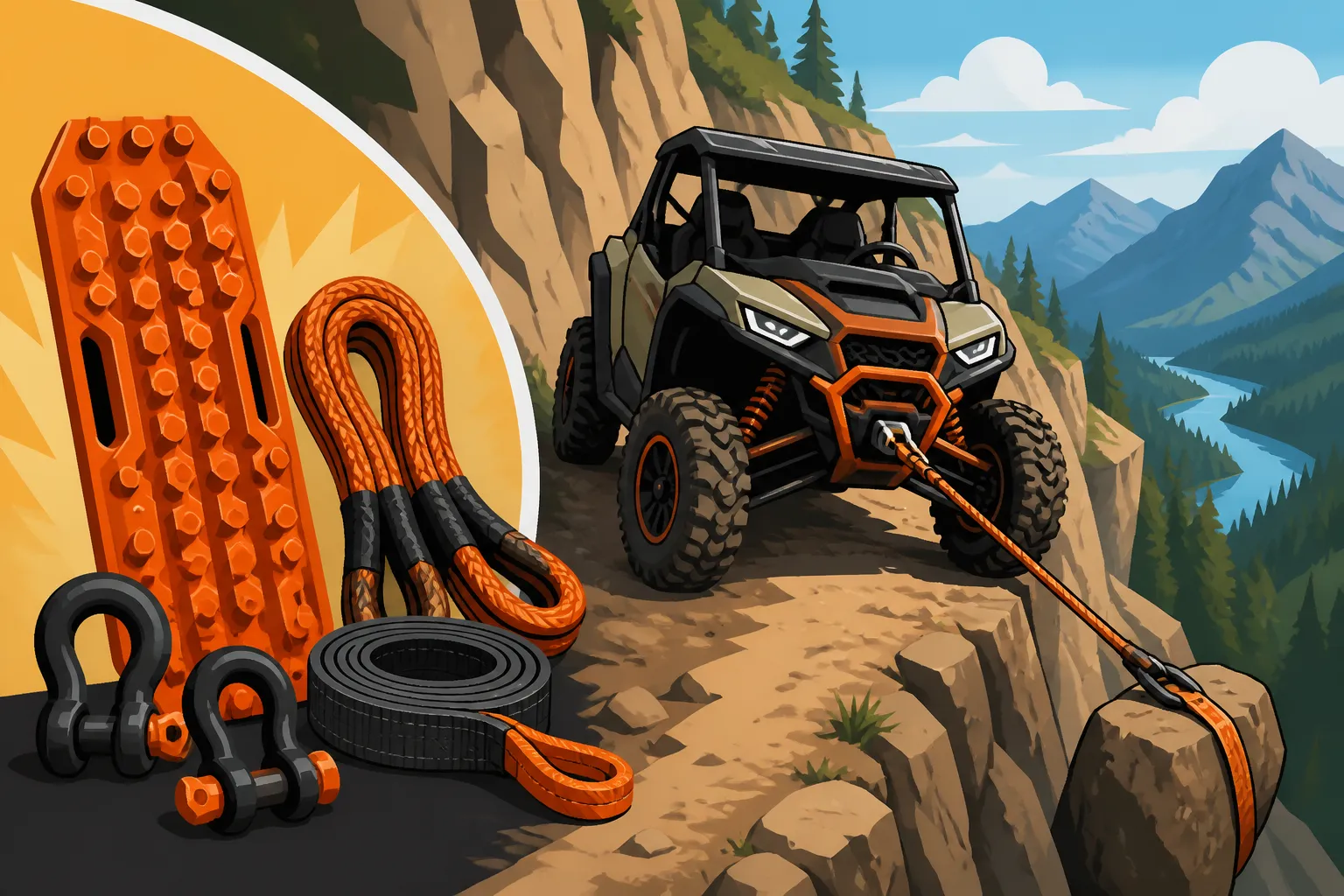
Recovery Gear for a Narrow Shelf Road
A UTV sliding toward the outside edge of a narrow Idaho shelf road can turn a routine ride into a frightening recovery problem fast. The right gear helps, but knowing when not to pull is just as important. This guide explains what to carry, how to assess a stuck machine, and how to reduce risk on remote, exposed routes.
Prepare before you reach a narrow shelf road
Match your recovery kit to the route
A small kit that you know how to use is more useful than a cargo box full of unfamiliar equipment. Before leaving, consider the machine’s weight, the terrain, the number of riders, and how far you may be from help. A light ATV on a broad forest road presents a different recovery challenge than a loaded side-by-side on a steep, rocky track.
For a basic self-recovery kit, consider carrying:
| Gear | What it can help with | Important limitation |
|---|---|---|
| Rated recovery strap | Pulling a machine a short distance when the path is clear | Do not use a strap that is damaged, knotted, or meant only for tie-downs |
| Winch and compatible line | Controlled pulling when there is a suitable anchor and stable setup | A winch cannot make an unsafe anchor or unstable slope safe |
| Tree-saver strap | Protecting a suitable tree when it is an appropriate anchor | Do not attach directly to a tree with a narrow wire rope or chain |
| Rated soft shackles or connectors | Joining compatible recovery components | Use only components rated for the expected load and in good condition |
| Winch-line damper | Reducing the danger of a line or strap recoiling if it fails | It does not make standing near a loaded line safe |
| Shovel | Clearing packed dirt, snow, or loose material around tires | Digging can undermine the road edge or destabilize the machine |
| Traction boards | Helping tires gain purchase on a firm, accessible surface | They are not a substitute for safe footing or a stable road |
| Gloves and eye protection | Protecting hands and eyes during setup | They do not remove the hazards of tensioned gear |
| Headlamp and first-aid kit | Supporting work after dark or following a minor injury | Neither replaces communication or a plan for getting help |
Check equipment before every trip, not after the first strap has already been dragged through mud. Look for cuts, fraying, heat damage, bent hooks, cracked connectors, and winch-line wear. Make sure the kit fits the machine and that its attachment points are approved for recovery. A cargo rack, bumper trim, or hitch ball may look sturdy but can fail under a pulling load.
If your route could leave you hours from a repair shop or a tow vehicle, read What to Carry on a Remote Ride and First Aid Hours From Help before packing. Those topics help put recovery gear in context: a winch may free a machine, but food, water, warmth, communication, and first aid matter if the recovery takes longer than expected.
Check the route and conditions first
A narrow shelf road may be passable in one direction and uncomfortable in the other, particularly when it has loose rock, a washed-out edge, steep cross-slope, or limited room to turn around. Recent rain, spring runoff, snowmelt, dust, and traffic from larger vehicles can change the surface. A route that looked straightforward on a map may feel very different when the outside edge drops away beside your tires.
Review route information before setting out, and compare it with signs and conditions on the ground. Idaho Trail Difficulty Ratings can help you think through the kind of terrain a route involves, while Reading an Idaho Motor Vehicle Use Map is useful for checking motorized routes and route designations. Maps do not guarantee that a road is open or suitable for your particular machine, so look for current closure information too.
An app such as onX Offroad can be part of route planning, but do not make your whole plan depend on cellular service. Download the relevant maps before you leave coverage, save a route that includes a reasonable turnaround point, and carry a backup navigation method. Tell someone your planned route and when you expect to check in. For a closer look at preparation when reception disappears, see Cell Service in the Idaho Backcountry.
Most importantly, agree as a group that anyone can call for a stop. If a rider is unsure about a shelf road, do not let the pressure to keep up make the decision for them. Walking a short section from a safe place, checking the width and surface, and turning around before the difficult part is often the best recovery plan.
Assess the machine before pulling
Stop, secure, and read the situation
When a machine becomes stuck or starts sliding, pause before reaching for the winch. An abrupt pull can worsen the position, especially if a tire is close to a drop-off or the machine is leaning. Keep people away from the downhill side, the outside edge, and any area where the vehicle might move if tension changes. Do not stand between a machine and its likely travel path.
If the vehicle is stable, put it in park or the appropriate gear, set the brake, and follow the manufacturer’s instructions. Shut it off if continued operation creates a hazard. Keep riders and bystanders in a safe location while one person assesses the problem. A stuck vehicle can shift unexpectedly as the tires settle, the ground crumbles, or a strap tightens.
Look at the road surface and the machine’s position from a safe vantage point. Ask whether the vehicle can move without crossing the road edge, whether the tires are on firm ground, and whether there is room for a recovery vehicle or anchor. Check for damaged steering or suspension, a leaking fluid, a hung-up undercarriage, or a wheel that is no longer supported. If the machine is leaning toward an exposed edge, or the road itself is failing, do not improvise a pull.
This is where good route notes can help. If you are using onX Offroad, refer to the route and nearby terrain to understand where you are and whether a safer turnaround or alternate route may be available. The map can support decision-making, but it cannot tell you whether the ground under a tire is stable. Treat what you see and feel on site as the deciding information.
Decide whether to recover, reposition, or call for help
Some situations are suitable for a cautious self-recovery: for example, a machine that is slightly bogged down on a broad, level surface with firm footing and a clear pull direction. Others are not. A vehicle near a steep drop, a crumbling road edge, a deep rut with a strong sideways lean, or an unstable anchor calls for restraint.
Consider these questions before applying tension:
- Is the machine stable and likely to remain stable?
- Is there a clear path for it to move without reaching the edge or striking a person?
- Are all people outside the likely path of the machine, strap, and line?
- Is the anchor suitable, and are all components rated and compatible?
- Can the pull be stopped immediately if the machine shifts?
- Does the operator understand the winch and the vehicle’s recovery points?
If you cannot answer yes with confidence, stop. A recovery attempt can turn one stuck machine into a machine down the slope, a broken line, or an injured rider. Use a phone, satellite messenger, or other available communication method to request help if the situation is beyond your group’s equipment or experience. For a more detailed discussion of the decision to winch on steep terrain, read Winching on a Narrow Mountain Trail.
When a vehicle is close to an edge, avoid using another ATV or UTV as an anchor unless a qualified person has assessed the setup and the machines can be positioned safely. A second machine can slide, roll, or be pulled toward the first. The same caution applies to trees, rocks, and roadside structures: an anchor that looks solid may be loose, rotten, or poorly positioned.
Use recovery gear with controlled tension
Set up a low-risk pull
A recovery setup should be simple, deliberate, and within the limits of every component. Use the vehicle’s designated recovery point and follow the manufacturer’s guidance. Do not attach a winch line or strap to a ball hitch, axle, suspension arm, or unapproved part just because it is easy to reach. If the proper point is inaccessible or damaged, pause and get help rather than choosing a convenient substitute.
When using a winch, keep hands clear of the fairlead and line, wear gloves, and avoid standing in line with a tensioned cable or strap. Use a line damper if appropriate, and keep everyone else well away. Operate the winch smoothly. Jerking a loaded strap with a second vehicle can create shock loads that damage equipment or pull the anchor free. A recovery strap designed for dynamic use is not interchangeable with a static winch line or a tie-down strap.
On a shelf road, the direction of pull is critical. A pull aimed toward the outside edge can make the situation worse even if the machine starts moving. If there is no safe direction that brings the vehicle back onto stable ground, do not pull. Avoid multiple people shouting instructions at once; designate one person to direct the operation, and make sure the operator can stop immediately.
Clear only what is necessary. A shovel may help free a tire or remove loose material from in front of a wheel, but digging close to the edge can weaken the road. Do not use a traction board where it could slide downhill, or reach beneath a machine that is not securely supported. If the vehicle is hung on its undercarriage, a simple pull may drag it rather than lift it. That can damage the machine or destabilize the road surface.
Know when a second machine makes things riskier
It is tempting to use the nearest vehicle as a recovery anchor. On a broad, level road with firm footing, a properly equipped second machine may sometimes assist under the manufacturers’ instructions. On a narrow shelf road, however, the helper vehicle may have nowhere safe to sit. A pull can shift its weight, drag its tires toward the edge, or place both machines in danger.
Never assume that a machine’s weight alone makes it a reliable anchor. Positioning matters, ground conditions matter, and the connection point matters. If the helper must sit on loose gravel, near the road edge, or at an angle that exposes it to a sideways pull, do not proceed. A winch line can also transfer force abruptly if the stuck machine breaks free, so the operator of the helper vehicle needs to understand the setup and have a clear escape plan.
If a recovery requires multiple anchors, a change in pull direction, lifting, or rigging beyond a basic winch setup, it is a sign to stop and seek experienced assistance. You can also review Towing Off a Remote Mountain Trail for the different challenges involved when a machine needs to be moved rather than simply freed. Towing is not automatically safer: a disabled vehicle can roll, steer unpredictably, or put extra load on a narrow road.
After any recovery, inspect the line, strap, shackles, winch, and attachment points before packing them away. Check the machine for damage and confirm that the road ahead is still passable. If the incident has left the vehicle unreliable, continuing deeper into remote terrain may compound the problem.
Reduce the chance of a recovery emergency
Travel with a realistic turnaround plan
A good route plan includes a point at which you will turn around if the road becomes too narrow, the weather changes, or a machine develops a problem. A turnaround is not a failure. It is a planned response to conditions that are different from what you expected.
Use onX Offroad or another navigation method to review your route and note places where the road may widen or connect with another route, then confirm those details against current information and signs. Do not assume that every line shown on a map is open, legal for your vehicle, or passable in current conditions. Checking Idaho Trail Status Before You Drive is a useful companion when closures, seasonal conditions, or changing access could affect the trip.
Travel at a pace that leaves room to stop before an obstacle. On a narrow road, leave enough distance between machines that one rider can pause without forcing the next rider to stop at the edge. If dust blocks visibility, wait until it settles. When meeting another vehicle, communicate clearly and use the safest available turnout rather than squeezing past on unstable ground. Avoid backing toward an edge if a safer option is to stop and guide the movement from a protected position.
Riding alone raises the stakes because there may be no one to help assess a recovery, call for assistance, or watch the machine while you work. If you do ride alone, share your route and return plan, carry a communication device suited to the area, and choose routes that match your experience and equipment. Riding Alone in the Idaho Backcountry offers more planning considerations for solo travel.
Practice before a real recovery
Read the owner’s manual for the machine and winch, and learn how to use the controls in a safe, open area. Practice identifying the approved recovery points, operating the winch, and inspecting straps and connectors before you need them. A roadside emergency is a poor time to discover that the winch remote is missing or that a connector does not fit.
Make sure everyone in the group understands basic recovery boundaries: nobody stands in the bight of a strap, nobody steps over a tensioned line, and nobody approaches a moving vehicle to guide it by hand. Agree on a stop signal that can be heard or seen. The operator should stop the pull if the machine shifts, the anchor moves, the line binds, or anyone enters the hazard area.
Finally, treat recovery equipment as a last part of preparation rather than permission to attempt harder terrain. A winch does not make an exposed road safe, and a full recovery kit cannot compensate for poor visibility, a failing road edge, or an unsuitable route. When the safe choice is to turn around or call for help, make that choice before a small problem becomes a serious one.
Disclaimer
This article is for general informational purposes only and does not constitute professional advice. Laws, prices and regulations vary by location and change over time. Consult a qualified professional for guidance on your specific situation.