Hot Springs You Can Ride To in Idaho
A day of riding followed by a soak sounds simple until you discover the hot spring is a hike from the road, the route crosses land with different rules, or the parking area cannot accommodate a trailer. This guide explains how to plan an Idaho ATV or UTV trip around hot springs without assuming you can ride right to the water.
What “ride to a hot spring” really means in Idaho
Most soaks are a stop after the ride, not a place to drive into
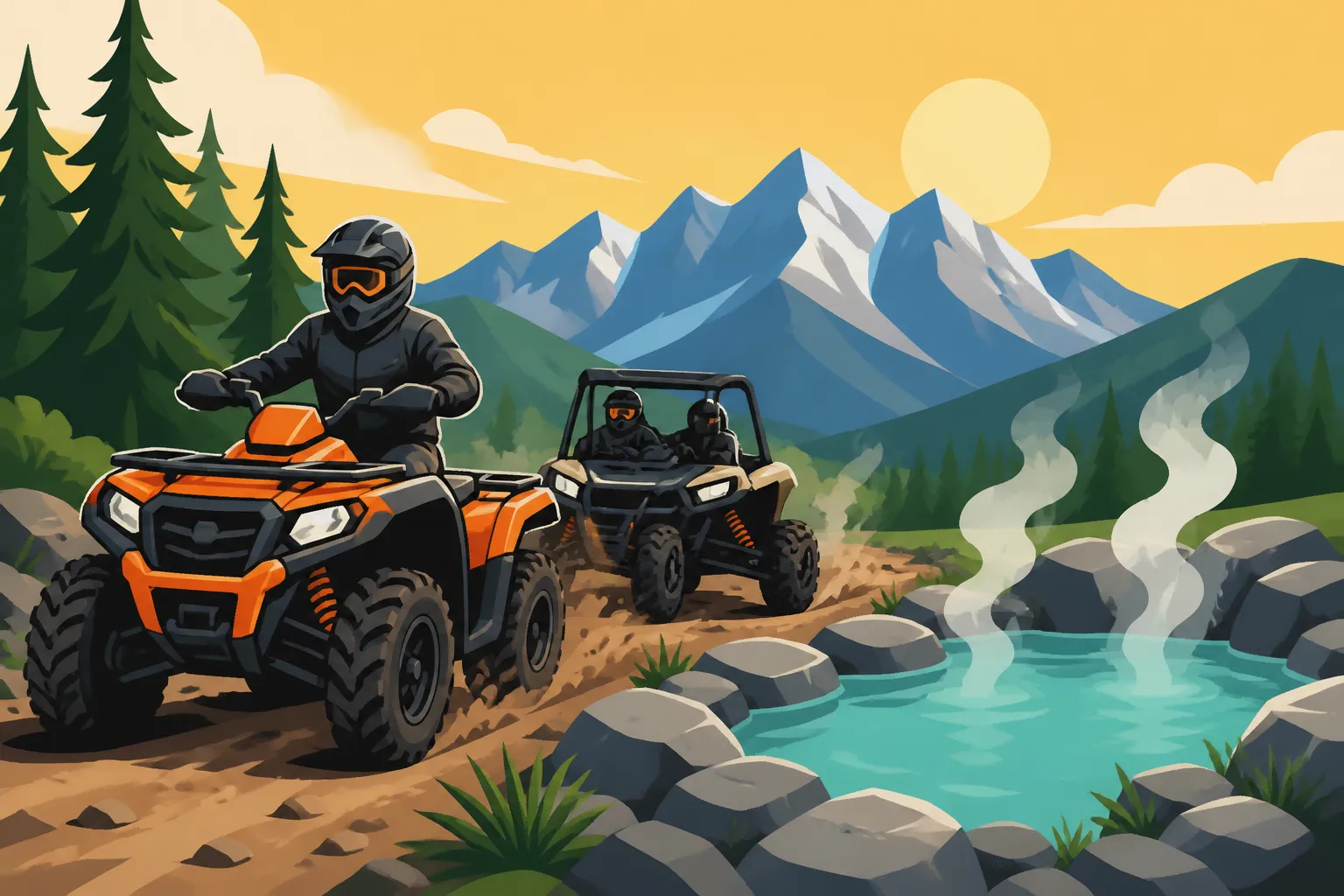
In Idaho, “ride to a hot spring” often means riding in the surrounding area, then parking legally and walking to the pools—or driving to a developed soak after your ride. Many well-known springs sit beside highways, rivers, or hiking trails, not at the end of an OHV route. A map showing a nearby forest road does not mean that road connects legally or safely to the spring.
That distinction matters for both access and the land itself. Riding off a designated route can damage sensitive ground, disturb other visitors, and put you on private property or in an area closed to motorized use. Treat the spring and its immediate access trail as pedestrian territory unless signs and the responsible land manager clearly say otherwise.
It is also worth separating a nearby ride from a rideable approach. You might be able to plan a day of OHV riding in the Boise National Forest and finish at a spring near Lowman, for example, but that does not mean a machine can travel from the trail system to the pool. You may need a street-legal vehicle, a legal road connection, or a separate drive between the riding area and the soak.
Check the whole route, not just the hot spring pin
Before leaving home, trace the route from your staging area to the riding area, then from the riding area to the hot spring. Check land boundaries, road access, trail designations, parking, and any walking distance between the parking area and the water. For motorized public-land routes, a designated map is more useful than a general navigation map alone. Reading an Idaho Motor Vehicle Use Map can help you understand why a line on a map may not mean a road is open to your machine.
A navigation app such as onX Offroad can help you inspect route connections and identify land boundaries while planning. Still, don’t treat a digital map as permission to ride. Compare it with the current official map and closure information for the area, and pay attention to posted signs at the trailhead or road.
A useful planning check is to confirm three separate things: the route is open to the type and width of your machine, the road or trail allows the way you intend to travel, and you have somewhere legal to park while you soak. If any one of those is uncertain, plan a different route or make the spring a separate stop by car.
Idaho hot springs to pair with an OHV outing
The places below are useful starting points for planning a soak alongside a riding trip. They are not promises of a direct ATV or UTV route to the pools. Access, parking, seasonal conditions, and nearby motorized routes can vary, so verify details before you go.
| Hot spring area | Nearby context | How to think about the OHV connection |
|---|---|---|
| Kirkham Hot Springs near Lowman | Along the South Fork Payette River corridor | Plan a separate, legal ride nearby; expect to walk from the designated access area |
| Pine Flats Hot Springs near Garden Valley | Near the Banks-Lowman Road and the Payette River | Pair with a broader area ride, but check parking and road rules before combining stops |
| Bonneville Hot Springs near Lowman | In the Lowman area of the Boise National Forest | Confirm access and conditions; don’t assume nearby forest roads reach the pools |
| Burgdorf Hot Springs north of McCall | Reached from the McCall area by road | Treat the soak as a destination reached by an appropriate vehicle, not as an OHV trail endpoint |
| Goldbug Hot Springs near Salmon | Requires a hike from its trailhead | A riding trip nearby does not remove the walk; plan for a separate hike and check trail access |
Kirkham and Bonneville near Lowman
Kirkham Hot Springs is a familiar stop along the South Fork Payette River near Lowman. Its location can make it tempting to assume that an ATV or UTV route will lead straight there. In practice, plan on using the designated access and walking to the pools. Do not ride along a highway shoulder or onto a footpath just to shorten the distance.
Bonneville Hot Springs is also in the Lowman area. Both springs can be considered as part of a wider outing in the region, but map the riding portion as its own activity. Check which Boise National Forest routes are open to your machine and whether you need to travel between the ride and the soak in a separate vehicle. Idaho’s Sawtooth National Forest Trails and Boise National Forest Trail Access offer useful starting points for exploring nearby riding options, but the route you choose still needs to be checked against official access information.
Pine Flats near Garden Valley
Pine Flats is another Payette River-area soak to consider when planning around Garden Valley and the Banks-Lowman Road corridor. The presence of forest roads in the wider area can make the map look promising, but the spring’s access point and the legal OHV route network are separate questions. Confirm the designated parking and walking access before building the day around a soak.
If your group has a trailer, think through the logistics before setting out. A small access area that works for a passenger vehicle may be awkward for a truck and trailer, especially when it is busy. Idaho Trailhead Parking and Staging is a helpful topic to review when comparing launch points and making sure the trailer has a suitable place to wait.
Burgdorf and Goldbug need a different kind of plan
Burgdorf Hot Springs, north of McCall, is best treated as a destination reached by a suitable road vehicle, with riding planned separately in the broader region. Road conditions and seasonal access can affect the trip, and a road suitable for one vehicle is not automatically an approved OHV route. Check the access details for the spring as well as the route rules for any ride you plan to add.
Goldbug Hot Springs near Salmon involves a hike from its trailhead. It is not a place to count as an easy roadside soak at the end of an ATV ride. Be honest about the walking distance, elevation, footwear, daylight, and the abilities of everyone in your group. If the hike sounds like too much after a full ride, choose one activity for the day rather than trying to squeeze both in.
Plan the ride, the soak, and the return trip
Build a two-part itinerary
A practical hot-spring riding day has two distinct parts: a ride on an approved route, then a soak reached through its legal access point. Start by choosing the OHV area that suits your machine and experience. Then look at the spring as a separate destination and decide whether you can connect the two by a legal road or whether you need to drive between them.
For example, a group planning around Lowman might choose a suitable ride in the surrounding forest, return to the staging area, and then travel to a designated spring access point. That can feel less spontaneous than riding directly to the water, but it avoids relying on an unverified route or leaving a machine where it blocks other visitors.
Write down a simple backup plan, too. A route may be closed, a parking area may be full, or the walking approach may not suit someone in your group. Planning an Idaho Riding Trip can help you organize the route, timing, and logistics, while Checking Idaho Trail Status Before You Drive is a useful reminder to verify conditions before committing to a long drive.
Match the route to your machine and your group
A narrow trail that looks close to a spring on the map may not be appropriate for a wide side-by-side. Confirm route width, machine restrictions, terrain, and access rules before you go. Also consider how the ride will feel for the least experienced rider in the group. A technical route followed by a hike can turn a fun day into an exhausting one, particularly if someone is already uncomfortable with rocky or steep terrain.
Leave enough time for more than the ride itself. Loading and unloading, checking the machine, navigating, walking to the pools, and changing clothes all take longer than they seem when you are planning from the kitchen table. If the soak is a popular stop, allow for the possibility that you may need to wait or choose another plan.
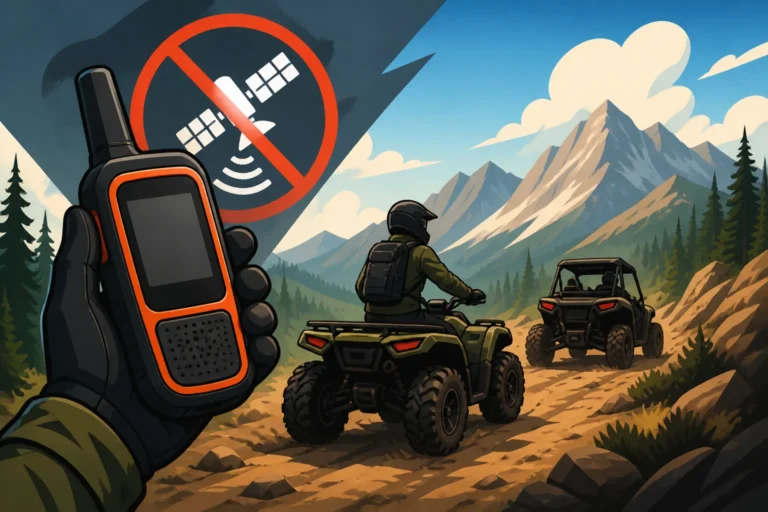
Keep the map available offline where possible, and don’t rely on a phone signal to find your way back. An app such as onX Offroad can be useful for checking your planned route before the trip and keeping track of your position, but download what you need ahead of time and carry a backup navigation method. Cell coverage can be limited in remote Idaho areas; Cell Service in the Idaho Backcountry is worth considering when planning a route away from town.
Access, safety, and hot-spring etiquette
Verify land rules and closures before you ride
Idaho riding areas can include a mix of Forest Service land, BLM land, private property, and roads managed under different rules. A route that appears continuous on a screen may cross a boundary or connect to a road that is closed to motorized use. Use official maps and signs to confirm access. Idaho Rules on Forest Service Roads and Idaho Rules on BLM Roads explain why it is important to check the managing agency rather than relying on a general route line.
Look for seasonal closures, fire restrictions, washouts, and other conditions that could change your route. Spring runoff can make roads or crossings unsafe, while fire activity may bring closures with little notice. Idaho Trail Conditions After Runoff is a useful companion when you are planning a shoulder-season trip.
If you are riding a route that uses a county road, confirm that OHVs are allowed there and that your machine and paperwork meet the applicable requirements. A restricted plate or an OHV sticker does not automatically authorize travel on every public road. What Idaho Requires to Ride a County Road is a good place to start checking those distinctions.
Protect the spring and leave the access area usable
Hot springs are fragile, and the approach areas can be crowded or muddy. Park only where allowed, keep machines away from pools and pedestrian trails, and avoid spinning tires or creating new tracks near the water. Pack out trash and leave the site as you found it. If facilities, signs, or local rules set limits on use, follow them even when the area seems quiet.
Heat can catch people off guard, particularly after a dusty or strenuous ride. Drink water, take breaks, and be cautious about entering very hot water when you are tired or overheated. Conditions at natural pools can vary, and a spot that looks inviting may be deeper or hotter than expected. Keep children close, supervise them near the water, and do not assume every pool is safe for every person.
Finally, be considerate of other visitors. A loud group arriving on machines, spreading gear across a narrow access point, or leaving helmets and muddy boots in the way can sour the experience for everyone. Keep the soak portion low-key and make the ride the ride—not a reason to crowd or disturb a sensitive site.
A pre-trip checklist
Before you leave, confirm the following:
- The ride is legal for your machine. Check route designations, width limits, road rules, land boundaries, and closures.
- The spring has a defined access plan. Know where you will park and whether the final approach is on foot.
- Your vehicle can handle the whole outing. Bring fuel, water, warm or dry clothing, a first-aid kit, and recovery basics appropriate to the route.
- You have a backup. Identify another ride or soak plan in case of a closure, full parking area, or unsuitable conditions.
- Someone knows your plan. Share your route and expected return time, especially if you are traveling beyond reliable cell coverage.
The most enjoyable Idaho hot-spring outings are usually not the ones with the tightest schedule. Give the ride and the soak enough room to be separate experiences, follow marked access, and be willing to change plans when conditions call for it.
Disclaimer
This article is for general informational purposes only and does not constitute professional advice. Laws, prices and regulations vary by location and change over time. Consult a qualified professional for guidance on your specific situation.