Oregon Riders Coming to Idaho Trails
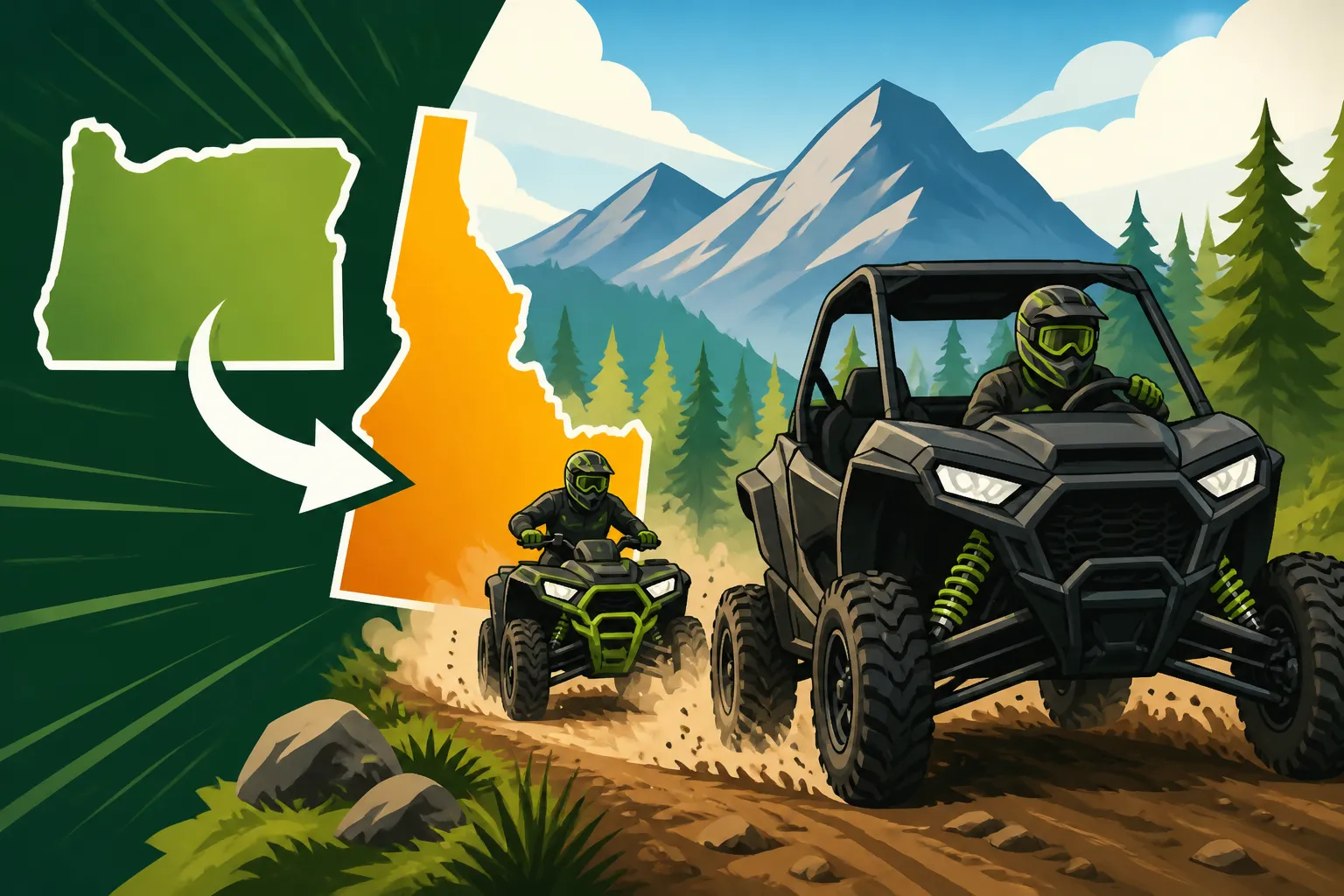
Oregon riders heading for Idaho trails can’t assume an Oregon ATV permit covers them across the state line. Idaho has its own nonresident OHV sticker rules, and a sticker alone does not make every road or trail open. Here’s how to sort out the paperwork, check where your machine can go, and avoid arriving at a trailhead unprepared.
What Oregon riders need to know about Idaho’s sticker
For an Oregon-registered ATV or UTV, an Oregon permit or registration generally does not replace Idaho’s nonresident OHV sticker when Idaho requires one. Idaho and Oregon have separate systems, and riders should plan to meet Idaho’s requirements rather than count on their home-state credentials to carry over. The background is explained in Why Idaho Ended OHV Reciprocity.
The key question is where and how you plan to ride. Idaho’s OHV sticker rules apply to many off-highway machines operated on public land and on routes open to OHVs. But a sticker is not the same thing as permission to ride anywhere, and it is not the same thing as a license plate that makes a vehicle road legal. Local rules, land-management restrictions, and the type of road can all affect access.
A useful starting point is to identify what your Oregon machine is registered as:
| Your machine or credential | What to check before riding in Idaho |
|---|---|
| Oregon ATV or off-highway registration | Do not assume it substitutes for Idaho’s nonresident OHV sticker |
| Oregon street-legal registration and plate | Check whether the machine’s road registration covers your planned use; road access still depends on Idaho and local rules |
| No current registration or sticker | Find out what Idaho requires for the machine and route before unloading |
| Rental machine | Ask the rental provider who handles Idaho permits and what routes are allowed |
| Machine used only on private property | Confirm the landowner’s permission and whether any public route is part of the trip |
For most visiting riders, the practical approach is straightforward: check Idaho’s current requirement for your machine, get the correct Idaho credential before you ride where it is required, and keep proof available. The detailed overview is in Idaho’s Non-Resident OHV Sticker.
Do not confuse a state OHV sticker with an Oregon registration document, a vehicle title, liability insurance, or a restricted vehicle plate. These serve different purposes. An OHV sticker does not establish ownership, provide insurance, or automatically authorize a trip on a public road. Likewise, having an Oregon title or registration does not necessarily satisfy Idaho’s sticker requirement.
The credential is associated with the machine, not simply with the person who bought it. If you are bringing more than one ATV or UTV, check the requirement for each machine rather than assuming one sticker covers the group. If a machine is borrowed, rented, or registered to someone else, confirm who is responsible for the Idaho sticker and whether it is already in place. Idaho’s Non-Resident OHV Sticker and Stickers for a Borrowed Machine cover those questions in more detail.
Get the right Idaho credential before the ride
Buying or arranging the sticker before setting out can save a frustrating stop at a trailhead, especially if you are traveling to a remote area. Idaho’s current purchase options and participating sellers can change, so use the state’s official information to verify where and how to obtain one. Start with Where to Buy an Idaho Non-Resident Sticker.
If you want to arrange it online, check the official process well before departure. Allow enough time to understand whether you will receive a physical sticker, what proof you should carry, and how it must be displayed. Do not assume a receipt alone is an acceptable substitute for a required sticker unless Idaho’s instructions say so. Buying an Idaho Sticker Online Before a Trip explains what to consider when purchasing ahead.
Before you buy, match the permit to the machine and your travel plans. Check the following:
- Confirm the vehicle category. Identify whether it is an ATV, UTV, dirt bike, or another type of off-highway vehicle. If it has a standard road plate, verify whether that registration changes the OHV sticker requirement for the use you have in mind.
- Check the current Idaho rule. Use Idaho’s official Parks and Recreation information or an authorized seller. Requirements, terms, and purchase procedures can change.
- Check whether every machine is covered. A family or group trip with several machines may require separate credentials. Verify each one rather than relying on the driver’s paperwork.
- Display the sticker as directed. Follow Idaho’s placement instructions for the type of machine and plate or location involved. A sticker that is loose, hidden, or placed incorrectly may be difficult to verify.
- Keep purchase proof accessible. Carry any receipt or supporting document Idaho tells you to retain. Keep it with your other trip paperwork, not buried in a trailer storage box.
- Check for additional requirements. A sticker does not replace any applicable registration, equipment, insurance, age, safety-training, or road-use rules.
A windshield-mounted phone screen or a photo of a receipt is not a good substitute for following the official display and proof instructions. Before leaving, make sure the physical sticker is on the correct machine, if a physical sticker is required, and that it is visible and intact. If a sticker is damaged or does not arrive when expected, contact the seller or Idaho program before riding rather than guessing about a temporary workaround.
For a trip that includes several vehicles, make a simple list of machine descriptions and sticker status. This is useful when machines look alike or are being transported by different people. If someone else bought a sticker, ask them to confirm which machine it belongs to and where it is displayed.
Also remember that the Idaho sticker is not permission to cross private land, enter a closed route, or ride a trail that does not fit your machine. The right paperwork solves only the permit question; route access has to be checked separately.
A sticker does not make every Idaho road or trail open
Idaho has different rules for public roads, motorized trails, and land managed by different agencies. A route that appears on a map may be closed to motorized use, limited by season, or unsuitable for a wide UTV. A county road may have a local restriction even when nearby roads are open. Before traveling, check the specific route and its current status.
Start by distinguishing between riding off-highway and using a public road. A machine’s OHV sticker does not automatically make it legal to ride on a county road. Road use may depend on the road’s designation, local ordinances, the machine’s equipment and registration, and the operator’s qualifications. See Idaho’s Restricted Vehicle Plate and Road Use for the distinction between an OHV sticker and road-use credentials.
Then check the route itself. Idaho counties can have different rules, and public-land managers may close routes for seasonal conditions, fire danger, maintenance, or resource protection. Do not rely on a trail app alone: mapping information can be incomplete or out of date. Review the relevant local ordinance or land manager’s current notice, and compare the route with an official motor vehicle use map where one applies. Which Idaho Roads Are Open to OHVs and Idaho Permit Rules on Public Land are useful starting points.
A few distinctions prevent common mistakes:
- County road access is not statewide blanket access. A road open to OHVs in one county may be restricted in another. Check each county crossed, especially on a long ride.
- A road’s surface does not determine its legal status. Gravel or dirt does not automatically mean an OHV may use it.
- A sticker does not override a closure. Follow signs, gates, posted orders, and current restrictions even if your machine is properly stickered.
- Trail width matters. A route suitable for a narrow ATV may not accommodate a wider side-by-side. Check width limits and vehicle classifications before heading out.
- Private access is separate. Permission to ride on one property does not authorize crossing another owner’s land to reach a trail.
- Road equipment and operator rules are separate. Lights, mirrors, insurance, licenses, helmets, and other requirements can depend on where and how you ride.
For a route that connects a trail to a town or fuel stop, verify every road segment. It is easy to plan the main trail correctly and overlook a short road link where different rules apply. What Idaho Requires to Ride a County Road offers a focused look at the road-use requirements.
If the route crosses onto federal land, check that land manager’s current maps and restrictions too. Public land is not one single open riding area: an authorized motorized route is different from a closed road, a nonmotorized trail, or a protected area. Stay on signed or mapped routes, and turn around if conditions or signs do not match your plan.
A practical pre-trip checklist for Oregon riders
The best time to resolve Idaho permit and access questions is before the trailer is loaded. Use this checklist for each trip:
- Confirm whether Idaho requires a nonresident OHV sticker for each machine and obtain it through an approved channel.
- Check that each sticker is displayed as Idaho directs and that you have the required proof of purchase.
- Verify the status and classification of any Oregon registration or plate. Do not assume it substitutes for an Idaho OHV sticker or makes every road legal.
- Identify the exact trailheads, roads, and connector routes you intend to use.
- Review official maps and current closure notices for the county and public-land area.
- Confirm that your machine’s width and type are allowed on the planned routes.
- Check age, supervision, helmet, training, equipment, and insurance requirements that apply to the riders and route.
- Ask the land manager or county office if a rule or road designation is unclear.
- Carry identification, registration information, proof of insurance if applicable, and any required safety certificate or permit documentation.
- Keep a backup route in mind in case a road is closed or the trail is not suitable for your machine.
If you are unsure whether your machine qualifies for a particular registration category, ask Idaho’s official program or the relevant county office before you ride. A seller may be able to process a sticker, but a purchase counter may not be able to answer every road-access question. For local route access, the county or land manager responsible for that area is the better place to confirm.
It is also worth checking requirements again shortly before departure. A sticker rule may be stable while a specific trail or road is closed because of weather, fire, construction, or land-management needs. Save the map or notice you relied on, but treat signs and current closure orders on the ground as important.
The main takeaway for Oregon visitors is simple: bring the Idaho credential required for your machine, but do not treat it as an all-access pass. Confirm the route, local road rules, and current closures separately. That small amount of advance checking helps prevent a trip from being delayed by paperwork or a mistaken turn onto a route that is not open to your machine.
Disclaimer
This article is for general informational purposes only and does not constitute professional advice. Laws, prices and regulations vary by location and change over time. Consult a qualified professional for guidance on your specific situation.