Idaho Rules During Hunting Season
Idaho’s hunting-season motorized rule can change where an ATV or UTV may travel, even when a road appears rideable on a map. The key is knowing whether the restriction applies to your game management unit, what counts as an open roadway, and which access and OHV requirements still apply. Check those details before setting out, not after reaching a closed route.
What Idaho’s motorized hunting rule restricts
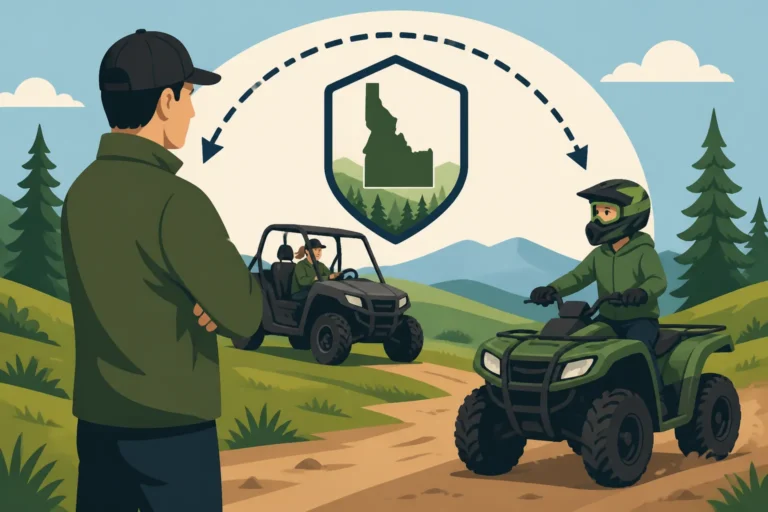
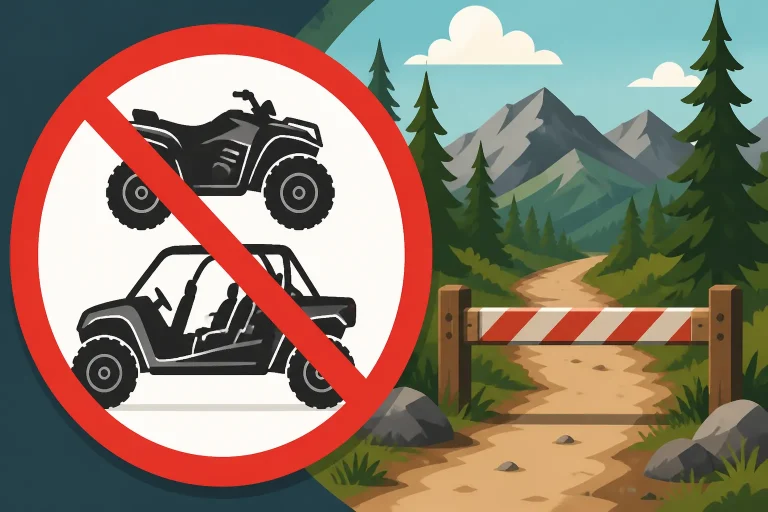
Idaho Fish and Game enforces a “Motorized Hunting Rule” in designated game management units during big-game hunting season. From August 30 through December 31, the rule restricts off-highway vehicles, including ATVs and UTVs, and e-bikes to established roadways open to motorized traffic.
That is a unit-specific hunting restriction, not a statewide ban on riding all trails during those dates. It also does not mean every road shown on a map is open to motorized use. The route must be both an established roadway and open to motorized traffic. A trail, two-track, or shortcut that connects to a road is not automatically an allowed route under the rule.
Before planning around it, check whether your hunting area is in a designated unit and review the applicable Idaho Fish and Game regulations. Then confirm that the particular route is open to motorized vehicles. If you are traveling through more than one unit, verify the rules for each one; do not assume the same restriction applies everywhere or that a route remains open across a boundary.
| Question | What to check |
|---|---|
| Does the hunting restriction apply here? | Whether your game management unit is designated for the Motorized Hunting Rule |
| Does the season restriction apply now? | The August 30 through December 31 period identified by Idaho Fish and Game |
| Can I ride this route? | Whether it is an established roadway open to motorized traffic |
| Is the road open to the public? | Land-manager restrictions, seasonal closures, and any required permission |
| Is my OHV properly permitted? | Idaho OHV registration or the nonresident permit requirement, as applicable |
The rule addresses motorized access while hunting big game. It should not be treated as a general authorization to leave a roadway for another purpose, such as reaching a campsite or exploring a side trail. If a trip includes activities beyond traveling on an open roadway, check the relevant land and hunting rules separately. For broader access questions, see Idaho Rules During Hunting Season is the article title and must not link. Instead link Idaho Permit Rules on Public Land and Idaho Trails Closed to Motorized Use in subsequent sections.
Check the route, land status, and road restrictions
A route can be affected by more than one rule. Idaho Fish and Game’s hunting restriction is one layer; the land manager may also limit motor vehicle use, and a county or other authority may close a road. Confirm each layer rather than relying on a single map or a trail that looks well used.
Use the right map, then verify closures
For National Forest roads, the Idaho Department of Parks and Recreation advises riders to obtain a Motor Vehicle Use Map for motor vehicle access information and to contact the local Forest Service Office with access questions. National Forest roads, trails, and lands can be subject to motor vehicle use restrictions. A route appearing in a general mapping app is not, by itself, confirmation that it is open to your vehicle.
The Idaho Department of Parks and Recreation publishes mapping applications and a summer trails web-based mapping app. These can help with trip planning, but compare what you see there with the applicable land-manager information and the hunting-unit restrictions. You can also review Reading an Idaho Motor Vehicle Use Map and Checking Idaho Trail Status Before You Drive before choosing a route.
A careful route check looks at the whole journey: the road you plan to use, any connecting roads, the land they cross, and the way back. A road may change status at a boundary or junction. If the map and a posted closure disagree, do not assume the map takes precedence; check with the responsible office.
Public access is not guaranteed
Some riding opportunities cross public land, private land, or a mix of both. The Idaho Department of Parks and Recreation says users must obtain permission before entering private lands. It also defines trespassing as entering enclosed or cultivated land without the owner’s expressed or implied consent. A visible track or an old route on a map is not proof that you have permission.
For Forest Service land, check the Motor Vehicle Use Map and ask the local Forest Service Office if access is unclear. For other public lands, check with the appropriate government office for restrictions. The Idaho Department of Parks and Recreation specifically advises users to check with appropriate government offices about public-land rules. See Idaho Rules on Forest Service Roads, Idaho Rules on BLM Roads, and Idaho Rules on Private Land for related access questions.
Treat a hunting-area route as closed until you can confirm it is open when the status is uncertain. That approach can prevent a wrong turn onto a prohibited road, a private driveway, or a trail that is not open to motorized use.
Keep hunting restrictions separate from OHV permits
The Motorized Hunting Rule determines where an OHV may travel while hunting big game in a designated unit. It does not replace Idaho’s OHV registration or permit rules. Conversely, having the required sticker does not give you permission to ride a closed road or enter private land.
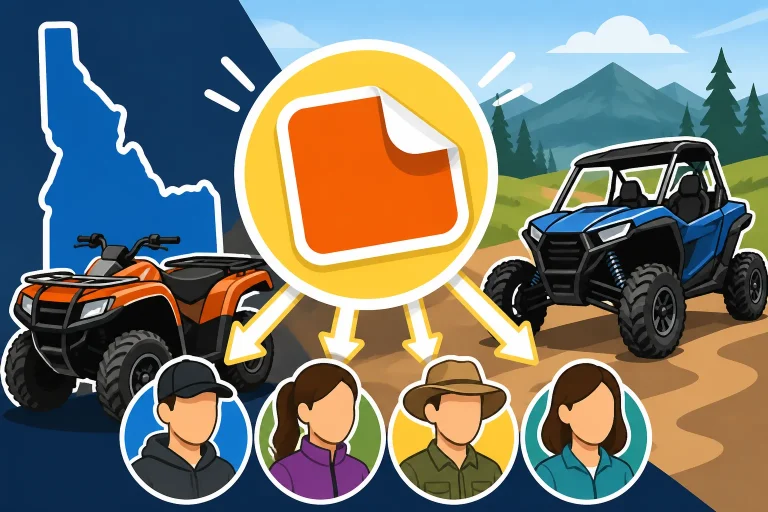
The Idaho Department of Parks and Recreation requires every motorbike, ATV, UTV, and specialty off-highway vehicle operated on public or private land to be numbered by January 1 of each year. The agency says OHV recreational permits are valid statewide, even though purchasers are asked to select a use area when registering. Choosing a use area does not restrict the permit to that area.
The Idaho Department of Parks and Recreation also requires nonresident operators of noncommercial OHVs in Idaho to obtain a nonresident OHV recreational permit. If you are visiting from outside Idaho, check the applicable permit requirements before riding; an out-of-state registration should not be assumed to satisfy Idaho’s rule. Idaho’s Non-Resident OHV Sticker explains the visitor permit topic, and Where to Buy an Idaho Non-Resident Sticker can help with the purchase question.
If you need to arrange a permit, the Idaho Department of Parks and Recreation says OHV permits can be purchased online, in person at vendors, or over the phone. Its registration system is available online around the clock, and the agency says there are more than 200 vendors across multiple states that can provide stickers. Check current availability and processing details directly with the agency or a vendor before leaving for a trip.
An OHV permit is also not the same thing as an authorization to use a particular road. For example, a current sticker does not override a road closure, a National Forest restriction, or the designated-unit hunting rule. Keep those questions separate when you plan: first confirm that your machine has the required permit, then confirm that each segment of your route is open to it.
Plan for young riders and a responsible return trip
A hunting-season ride can involve road sections, public land, and changing access rules. If a young rider is part of the group, check the rules for the specific road and the rider’s situation before the trip. Do not assume that the hunting restriction replaces or satisfies Idaho’s separate supervision and safety-course requirements.
According to the Idaho Department of Parks and Recreation, Idaho Code 49-302 requires a person under 16 operating an ATV, UTV, specialty off-highway vehicle, or motorbike on certain roads to be supervised by a licensed adult operator who is at least 18 years old. When the supervising adult is on the ground, the agency says the adult must remain within 300 feet of the unlicensed operator. The agency also says unlicensed operators under 16 on National Forest roads must have completed an IDPR-approved OHV safety course. These requirements are separate from the hunting-area route restriction; see Idaho Rules for Riders Under 16 on Roads for more detail.
Before the group leaves, agree on the approved route and where riders will stop if they become separated. Do not treat a side trail or an unmarked shortcut as an alternate route unless you have confirmed that it is open and allowed. If a sign, map, or land-manager instruction raises a question, pause and verify rather than riding ahead.
A practical pre-ride check is:
- Confirm whether the Motorized Hunting Rule applies to the game management unit and dates for your trip.
- Identify established roadways open to motorized traffic and check for closures or land-manager restrictions.
- Obtain permission for any private land you need to cross.
- Confirm that each machine has the required Idaho OHV permit or registration.
- Check supervision and course requirements if a rider is under 16.
- Make sure everyone in the group understands which roads are allowed and where the route ends.
Keep the route check current through the return trip, too. Seasonal restrictions, posted signs, or local closures may affect your return route, and a road that was open when you planned the trip may not be the route you should use later. If you cannot confirm that a road is open to motorized traffic, choose a route you can verify instead.
Sources
- Department of Parks and Recreation — ATVs, UTVs & Motorbikes | Department of Parks and Recreation (checked November 3, 2026)
- Department of Parks and Recreation — Registration & Permits | Department of Parks and Recreation (checked November 3, 2026)
- Idaho Department of Parks and Recreation — All Terrain Vehicle – (ATV) Course ID:1004 (checked November 3, 2026)
- University of Idaho Extension — FINAL-OHV-ECON-STUDY-SUMMARY-1.pdf (checked November 3, 2026)
- Idaho Department of Parks and Recreation — 2027_OHV_LE_Academy_Flyer.pdf (checked November 3, 2026)
- Idaho Department of Parks and Recreation — ID_OHV_LE_Guide.pdf (checked November 3, 2026)
- Idaho Department of Parks and Recreation — OHV_BOOKLET.pdf (checked November 3, 2026)
- Idaho Department of Fish and Game — Press Releases and Articles | Idaho Fish and Game (checked November 3, 2026)
Disclaimer
This article is for general informational purposes only and does not constitute professional advice. Laws, prices and regulations vary by location and change over time. Consult a qualified professional for guidance on your specific situation.