The Non-Resident Rule That Started in 2020
Idaho’s 2020 non-resident OHV rule can catch visiting riders off guard: a registration or permit that works at home may not satisfy Idaho’s requirements. This guide explains what changed, which machines and trips the rule may affect, and how to check your paperwork before unloading at an Idaho trailhead.
What changed in 2020
Before 2020, some out-of-state riders could rely on reciprocity: Idaho recognized certain home-state OHV registrations or permits for riding in Idaho. That arrangement changed. Riders should no longer assume that a registration or sticker from another state automatically takes the place of Idaho’s non-resident OHV sticker.
The practical point is simple: if you bring an ATV, UTV, or dirt bike from another state and plan to ride it on Idaho public land, check whether it needs an Idaho permit. Your machine’s home-state registration may still be useful proof of ownership or legal status where you live, but it may not meet Idaho’s separate permit requirement.
This is an OHV rule, not a blanket requirement for every vehicle with an out-of-state plate. A properly licensed road vehicle being used as a road vehicle is a different case from an ATV or UTV being used off highway. The machine type, how it is registered, and where you intend to ride all matter. If your machine has both off-road capability and a road registration, don’t guess based on its plate alone; confirm how Idaho treats that specific setup.
For a broader explanation of the permit itself, see Idaho’s Non-Resident OHV Sticker. For the history and policy background, Why Idaho Ended OHV Reciprocity gives the change a little more context.
The 2020 change also does not mean Idaho has banned out-of-state machines, or that an Idaho sticker gives permission to ride anywhere. It means visitors may need to satisfy Idaho’s permit rules in addition to following trail, road, land-access, and safety rules. A sticker is one piece of the trip’s paperwork, not a substitute for checking whether a route is open to your machine.
Who may need an Idaho sticker
Start with three questions: what kind of machine are you bringing, where will you ride it, and what registration or permit does it already have? Those details help separate the common cases.
| Your situation | What to check |
|---|---|
| You are visiting with an ATV, UTV, or dirt bike and will ride public land | Check Idaho’s non-resident OHV permit requirement. A home-state sticker may not be enough. |
| You plan to ride only on private land with the owner’s permission | Check whether the public-land permit rule applies to your trip. Private-property use is not the same as riding public land, but access and local rules can still matter. |
| Your machine is licensed for street use | Confirm whether the machine is treated as a registered motor vehicle for the use you have in mind, or as an OHV. A plate by itself does not settle every off-highway question. |
| You rented a machine in Idaho | Ask the rental company who handles the sticker and what the rental paperwork covers. Do not assume it is included. |
| You are riding a borrowed machine | Confirm that the machine has the required Idaho permit for your planned use. The owner’s residence does not automatically answer the question. |
| You are taking a snowmobile or another type of machine | Check the rules for that vehicle category separately. Do not assume an ATV or UTV permit rule applies in exactly the same way. |
The usual visitor question is whether a sticker from the rider’s home state counts. Since reciprocity ended for Idaho OHV stickers, the safe approach is to verify the Idaho requirement directly rather than treat an out-of-state sticker as a replacement. The state’s overview of Idaho Permit Rules on Public Land can help you work through the location part of the question.
Public land and private land are not interchangeable
A route can pass through different kinds of property during the same outing. You might stage on private ground, follow a county road for a stretch, and then enter public land. Permission to ride one section does not automatically settle the permit requirements for the next.
If your entire ride is on private land, check what rules apply to that situation and get the landowner’s permission. If any part of the ride enters public land, investigate the public-land requirements before you go. “We’re riding on a ranch” is not enough if your planned route crosses a public trail or road along the way.
Public land can include routes managed by different agencies. Their rules about route access, vehicle width, seasons, and closures can differ. A permit does not override a closure or make a non-motorized trail open to OHVs. For a ride that uses a national forest road, also review Idaho Rules on Forest Service Roads and the current route information from the land manager.
A plate does not answer every question
A plate and an OHV sticker serve different purposes. A plate may show that a vehicle is registered for certain road use, while an OHV sticker addresses a separate Idaho requirement. Neither one proves that every trail or road is open to that machine.
This distinction matters particularly for side-by-sides and other vehicles that may be configured or registered for more than one kind of use. Before you ride, work out whether you are operating the machine as a road-registered vehicle, an OHV, or both at different points of the trip. If you are unsure, describe the machine and planned route when checking with the relevant Idaho agency or permit vendor.
How to check your trip before you leave
A little preparation can prevent a wasted trip or an uncomfortable roadside conversation. Use this process before loading your machine.
- Identify the machine. Note whether it is an ATV, UTV, dirt bike, or another vehicle type. Have its registration details and vehicle identification number available if you need to ask an agency or vendor a question.
- List the places you intend to ride. Separate private land, county roads, state-managed land, and federal land where possible. A route that crosses multiple jurisdictions deserves a closer look.
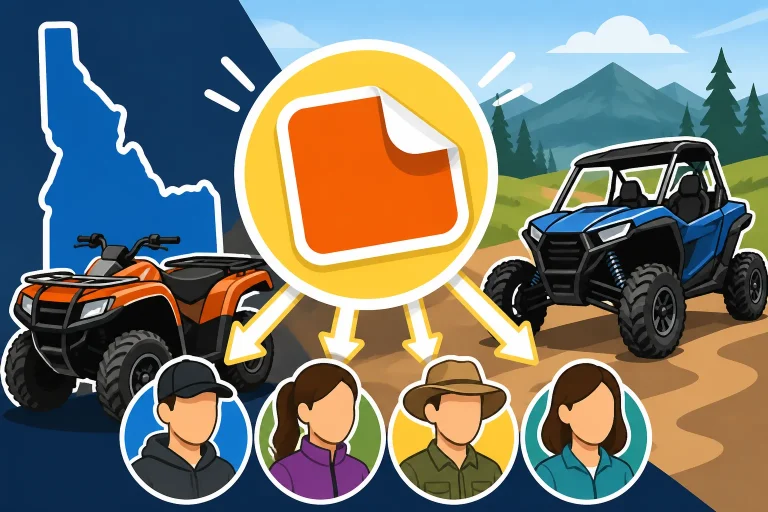
- Check whether the machine needs an Idaho non-resident permit. Do not rely solely on your home-state sticker or a friend’s past experience. The rule changed, and the answer can depend on the machine and how it will be used.
- Confirm the current purchase and display instructions. Idaho’s authorized sources can explain where to obtain a sticker and how it must be displayed. Use Where to Buy an Idaho Non-Resident Sticker and [Buying an Idaho Sticker Online] as starting points, then confirm current instructions with the official provider.
- Check route access separately. Use current maps, signs, closure notices, and land-manager information. A valid permit does not authorize travel on a closed route or a trail that excludes your machine’s width or class.
- Keep proof accessible. Carry the permit as instructed, along with your machine’s registration or ownership paperwork and any other documents required for your situation. Store a copy separately in case the original is damaged or misplaced.
The cost of a non-resident permit can depend on the permit option available and the provider’s current process. Check the official information before buying; don’t rely on an old screenshot, a discussion forum, or a price quoted from a previous season. For an explanation of how the charges work, see What Idaho Charges an Out-of-State Rider.
Buy through an authorized channel. A marketplace listing, search result, or social post is not proof that a permit has been issued. Amazon may be useful for trip gear such as a waterproof document pouch, but buying a pouch there does not satisfy a permit requirement. Likewise, don’t treat a product listing on Amazon as a source of current Idaho rules.
If you buy online, save the confirmation and read the instructions carefully. A receipt might help you show that you made a purchase, but it may not replace the required sticker or other proof. If delivery or mailing is involved, check when you need to order and what you must have with you before riding. The seller or official permit provider can clarify whether a temporary confirmation is accepted.
Common situations that cause confusion
The 2020 rule is easiest to misunderstand when a rider assumes one document covers every vehicle and every activity. These cases are worth checking before you head out.
You are visiting from a state with its own registration system
Your home-state registration still matters at home and may be relevant to Idaho’s review of your vehicle. But it is not a universal pass for riding Idaho public land. The fact that your state issues a sticker, card, or plate does not establish that Idaho recognizes it as an equivalent permit.
This applies even if you have ridden in Idaho before. A friend’s experience from a prior year may predate the change, and rules or purchase procedures can also be updated. When checking, provide the machine type, home-state registration status, and intended riding locations rather than asking only, “Does my sticker work?”
You have a street-legal machine
A road registration may change what rules apply when you are driving on roads, but it does not automatically make every off-highway route legal. Some roads are open only to certain vehicles; others may be closed by local order, agency rule, or seasonal restriction.
If your route includes a public road, check the applicable road-use requirements as well as the OHV permit question. Idaho’s road rules can involve equipment, operator qualifications, insurance, and local access restrictions. The sticker is not a substitute for those requirements, and a road plate does not automatically grant trail access.
You are renting or borrowing a machine
For rentals, ask the shop directly whether the required Idaho sticker is included and what paperwork you should carry. Rental terms and permit handling can differ between businesses. Do not infer that a machine is properly permitted just because it is parked outside a rental shop.
If you borrow a friend’s ATV or UTV, ask about the machine’s Idaho permit before setting off. The rider’s home-state residence and the owner’s residence are not the same as the machine’s permit status. For more detail, see Sticker Rules for a Rented Machine or Stickers for a Borrowed Machine.
You are riding with a young person
A permit question is separate from age, supervision, and safety requirements. A valid sticker does not make every rider eligible to operate every machine or ride without supervision. If a young person is joining the trip, check the applicable requirements before departure; Idaho Rules for Riders Under 16 is a useful place to start.
Parents should also consider practical fit and experience. A machine that is too large or powerful for a young rider can turn a permitted trip into an unsafe one. Confirm the route difficulty, the group’s pace, and the supervision plan along with the paperwork.
You are riding only a short stretch of road
A brief road connection can still raise separate questions. The road may be open or closed to OHVs, a county may have its own restrictions, or the route may cross a highway that requires a specific crossing location. A sticker does not make a closed road legal, and a map line alone is not proof that OHVs are allowed.
For county roads and other public routes, check local access rules before planning the connection. If the route is unfamiliar, review What Idaho Requires to Ride a County Road and the current signs or notices on the ground.
Before you unload at the trailhead
Make a final check at home, then keep your paperwork and route information organized during the trip. A simple folder or document pouch can keep a permit, registration, and emergency contact details together. If you pick one up through Amazon, make sure it closes securely and is easy to reach without leaving documents loose on the machine.
Keep your permit visible or stored as instructed rather than improvising a placement that could damage it or make it hard to verify. Follow the current display directions from the provider. If a sticker is damaged, missing, or peeling, resolve the problem before riding instead of assuming a receipt or a photo will be accepted as a substitute.
A paper map can also help when a phone loses service. A map case bought through Amazon may protect a folded map from dust and weather, but use the land manager’s current map information to confirm route designations and restrictions. Do not rely on a marketplace description or an outdated trail download as the final word on access.
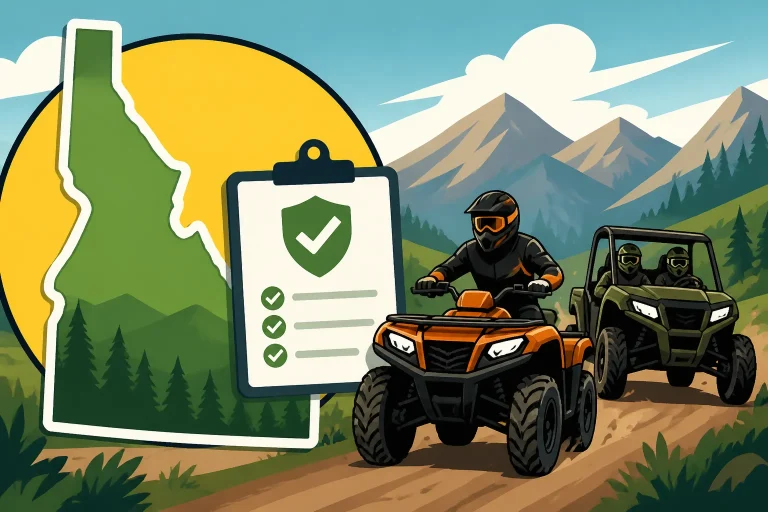
Before riding, do a quick checklist:
- The machine’s type and registration status are clear.
- You have confirmed whether an Idaho non-resident OHV sticker is required.
- You have bought it through an authorized source and followed the display instructions.
- You have checked that each planned route is open to your vehicle and intended use.
- You have checked for seasonal closures, local restrictions, and land-manager notices.
- Any passengers or young riders meet the requirements that apply to them.
- Your documents are protected and accessible.
If you are already in Idaho and discover a paperwork gap, stop and verify the requirement before entering a route where the permit is needed. A nearby vendor may be able to help, but confirm that it is authorized and that the purchase process gives you what you need before riding. For general information about permit vendors and other services, IDPR Service Centers and What They Handle can help you understand where to direct questions.
The main lesson from the 2020 change is not complicated: an out-of-state sticker is not automatically an Idaho OHV permit. Check the machine, the land, and the route; obtain the Idaho permit when required; and treat access rules as a separate part of trip planning. That approach is more dependable than relying on old reciprocity assumptions or paperwork that was valid somewhere else.
Disclaimer
This article is for general informational purposes only and does not constitute professional advice. Laws, prices and regulations vary by location and change over time. Consult a qualified professional for guidance on your specific situation.