Proving Insurance at a Traffic Stop
You’re out on a beautiful Idaho county road, maybe cutting between trailheads or heading into town for a quick bite, when you see those dreaded flashing lights in your rearview mirror. Your mind races – what did I do? And then, a more specific worry pops up: do I have my proof of insurance with me, and what exactly does the officer need to see? It’s a common moment of panic for any OHV owner. This guide is here to unravel the mystery of proving your OHV insurance during a traffic stop on Idaho roads, equipping you with the knowledge to navigate these situations calmly and confidently.
When Idaho Law Requires OHV Insurance on Public Roads
It’s easy to get confused about insurance for your ATV or side-by-side in Idaho. For many of us, our machines are primarily trail-blazers, meant for dirt, mud, and rocks far from paved roads. In those purely off-road scenarios, state-mandated liability insurance isn't a requirement. You might carry it for your own protection, and it's always a good idea, but it’s not legally compelled. However, the moment your tires touch certain public roads, the rules change entirely. This distinction is where many riders get tripped up, and it’s why understanding the nuances is so critical.
The Distinction Between Trail Use and Road Use for Insurance
When you’re deep in the [Sawtooth National Forest Trails] or exploring the [Danskin Mountains OHV Area Near Boise], liability insurance for your OHV isn't typically mandated by the state. You’re responsible for yourself and your machine, and while accidents can happen, the legal framework for liability in an off-road setting is different. Many riders still opt for comprehensive coverage, of course, to protect their investment and cover potential medical costs, but it’s a personal choice, not a legal obligation.
The game changes dramatically when you decide to use your ATV or side-by-side on certain county roads or city streets. Idaho law is clear: if you operate your OHV on any public road where it is permitted, you must carry liability insurance. This isn’t a suggestion; it’s a legal requirement designed to protect other motorists and property in case you’re involved in an accident. This applies whether you're just crossing a highway to access another trail, riding a designated county road for a few miles, or using a "restricted use" plate. If your machine is equipped for road use with mirrors, lights, and turn signals – perhaps even some robust aftermarket accessories from SuperATV to ensure durability and compliance – then you absolutely need the insurance to back it up.
Even if you only plan to ride your OHV on a road for a short distance, perhaps to get from your cabin to a nearby trailhead, that brief stint on public asphalt triggers the insurance requirement. Think of it like this: your OHV transforms from a purely recreational vehicle into a street-legal vehicle for that period, and with that transformation comes the same responsibilities as any other vehicle on the road. Understanding this distinction is the first, most crucial step to avoiding trouble during a traffic stop.
What Kind of Coverage Idaho Expects
It's not enough to simply have an insurance policy; it must meet Idaho's minimum liability coverage requirements. This is where the specifics matter. Liability insurance is designed to cover damages and injuries that you cause to other people and their property. It doesn't cover damage to your own machine or your own medical bills, although you can certainly purchase additional coverage for those scenarios.
Idaho's minimum liability requirements, like most states, are expressed in a split format: for bodily injury per person, bodily injury per accident, and property damage per accident. While I can't give you specific dollar amounts as those can change, it's essential to know these three components are what the state mandates. Your insurance policy needs to clearly reflect these minimums, or higher, to be considered compliant when you're riding your OHV on Idaho roads. These are the bedrock protections that ensure, should an unfortunate incident occur, the injured parties have a path to recovery without leaving you financially devastated.
Many riders wisely choose to carry higher limits than the state minimums. In today's world, the cost of medical care and vehicle repairs can quickly exceed basic coverage, leaving you personally responsible for any remainder. While the state-mandated coverage is the minimum to stay legal, a robust policy offers true peace of mind. For more details on what comprehensive coverage entails for your machine, you might want to look into [Insuring an ATV in Idaho]. It's about more than just staying out of trouble; it's about safeguarding your financial future.
What Counts as Valid Proof of Insurance in Idaho
The moment those lights flash, and an officer approaches, you'll need to produce proof of insurance. But what exactly qualifies? In an age of digital documents, what’s acceptable, and what might leave you in a bind? The good news is Idaho has adapted to modern technology, but there are still best practices to follow to ensure a smooth interaction.
Physical Cards vs. Digital Proof: What Law Enforcement Accepts
The old standby, a physical insurance ID card, is always accepted. It’s tangible, easy to hand over, and universally recognized. Many riders tuck a laminated copy into a waterproof pouch, perhaps with their [Keeping Paperwork on the Machine], ensuring it's protected from dust, water, and the elements often encountered on Idaho trails. This is a reliable method that won't fail due to a dead battery or lack of cell service.
Idaho law also generally accepts digital proof of insurance. This means you can display your insurance information on your smartphone, tablet, or another portable electronic device. It's incredibly convenient – most of us always have our phones with us. However, there's a crucial caveat: if your phone dies, or if you can't access the information due to poor cell service (a real possibility in much of Idaho’s beautiful backcountry), that digital proof becomes useless. Officers aren't required to wait while you search for a charger or drive to the nearest cell tower. Because of these challenges, some riders choose to carry both a physical card and a digital copy as a backup. You might even use a rugged phone mount from SuperATV to keep your device secure and visible, but remember, battery life and connectivity are still key.
Ultimately, while digital proof is convenient and legally recognized, a physical copy remains the most foolproof method for consistent presentation, especially when you're far from civilization. Make sure whatever method you choose, the information is clear, legible, and easily accessible.
Key Information Your Proof Must Clearly Display
It's not enough to just flash something that looks like an insurance card. The proof you present, whether physical or digital, must contain specific, critical information that allows an officer to verify your coverage. Think of it as the vital statistics of your policy.
First and foremost, the document needs to clearly state the name of your insurance company and your policy number. These are the identifiers that law enforcement will use to cross-reference your coverage if necessary. Equally important are the effective dates of the policy. An expired policy is, for all legal purposes, no policy at all, so ensure your dates are current. Renewing your policy promptly, or keeping an eye on your [When an Idaho OHV Sticker Expires] and insurance expiration dates together, can help prevent issues.
Crucially, the proof must include a clear description of your insured vehicle, usually its Vehicle Identification Number (VIN), or at minimum, the year, make, and model. The VIN is paramount because it uniquely identifies your machine, ensuring the policy applies specifically to the OHV you are operating. Double-check that the VIN on your insurance document matches the VIN on your machine exactly. A mismatch, even a single digit, can lead to complications and delays during a stop, as it raises questions about whether the machine you're riding is indeed the one covered. It's a minor detail that can cause major headaches, so a quick visual check of your VIN (which you can often find stamped on the frame, perhaps near the driver's side front wheel on a side-by-side or below the handlebars on a quad) against your insurance card before you ride can save a lot of stress. [Where the VIN Sits on a Side-by-Side Frame]
Navigating an Idaho OHV Traffic Stop with Confidence
Getting pulled over is rarely a pleasant experience, and the added stress of being on an OHV, perhaps away from familiar roads, can make it even more nerve-wracking. However, how you conduct yourself can significantly influence the outcome. Staying calm, being cooperative, and knowing exactly what to do can turn a potentially bad situation into a quick, uneventful interaction.
Remaining Calm and Presenting Your Documentation
When you see those flashing lights, the very first step is to pull over safely and promptly. Find a clear, level spot on the shoulder, turn off your engine, and if you’re riding a side-by-side, place it in park and set the parking brake. Keep your hands visible, perhaps resting on the handlebars or steering wheel, and wait for the officer to approach. Making sudden movements or fumbling for documents before they reach your machine can create unnecessary tension.
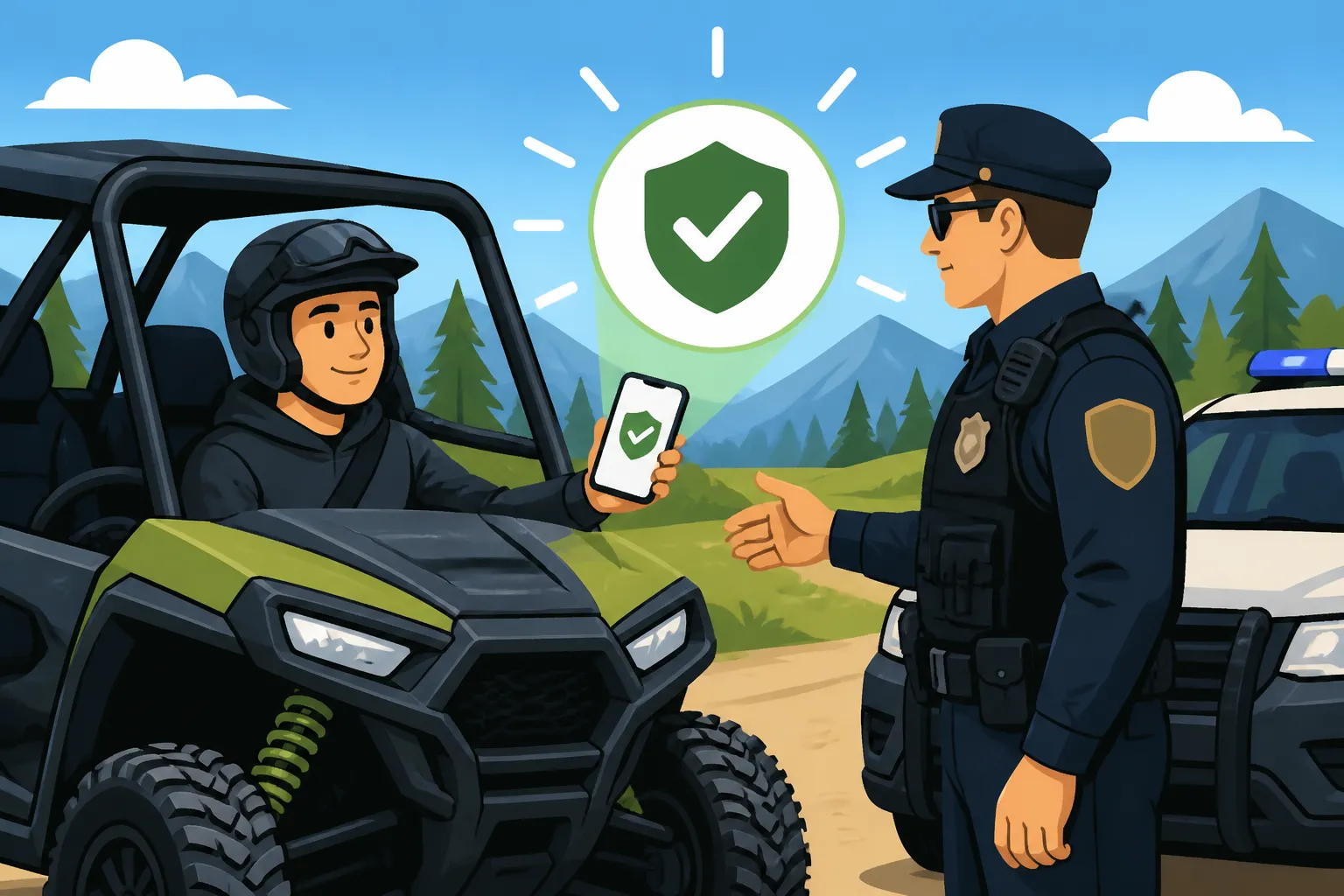
Once the officer is at your window or beside your quad, be polite and respectful. A simple, "Hello, officer," goes a long way. Inform them that you have your documents ready – your driver's license, your [What Idaho Requires Before You Ride a County Road] (which includes your OHV sticker and possibly a [Idaho Restricted Vehicle Plate Explained]), and your proof of insurance. Then, present them clearly. If you're showing digital proof on your phone, hold it steady so they can read it easily without needing to handle your device or scroll through other apps. Focus solely on presenting the requested information.
Answer any questions truthfully and concisely. Avoid being overly talkative, argumentative, or making excuses. The goal is to provide the required information efficiently and demonstrate your compliance with the law. Officers appreciate cooperation, and a smooth interaction is often a quick one. This calm demeanor, combined with a well-maintained machine that perhaps has aftermarket enhancements from SuperATV showing you're a serious rider, can contribute to a positive impression. For more on what to expect during a stop, check out [What an Idaho Deputy Asks a Rider For].
What to Do If Your Proof Isn't Immediately Accessible
Even the most organized riders can have those "oh shoot" moments. Perhaps your insurance card slipped out of your wallet, or your phone battery died right before the stop. If your proof of insurance isn't immediately accessible, the key is honesty and cooperation. Don't panic and start rummaging frantically. Calmly explain to the officer that you have insurance, but you're having trouble locating the proof at this exact moment.
If your phone battery died and you have digital proof, explain that to the officer. Ask if there’s a way to provide the information later, perhaps at the county sheriff’s office, or if they can verify it through their system. Do not argue or become defensive; this will only escalate the situation. Officers often have discretion, and a cooperative attitude can lead to a more lenient outcome, such as a warning or a "fix-it ticket" that allows you a specific timeframe to produce proof at a courthouse or law enforcement office.
The worst thing you can do is lie or pretend you don't understand the requirement. Being forthcoming, even if you’re in a tough spot, is usually the best approach. It demonstrates good faith and a willingness to comply. If you genuinely don't have insurance, that's a different situation altogether, but if you do, doing everything you can to prove it, even if delayed, is crucial. This is also why checking your documents before every major ride, especially one involving roads, is such a good habit. [Driver's License and Insurance on an Idaho Road Ride] requires these documents to be readily available.
The Repercussions of Lacking or Failing to Prove Insurance
It might seem like a minor oversight, a simple forgotten card or an expired policy. But operating an OHV on Idaho roads without the legally required liability insurance, or failing to prove you have it during a traffic stop, can lead to consequences that range from irritating to financially devastating. It's not just a slap on the wrist; there are real legal and financial ramifications that can extend far beyond the immediate moment of the traffic stop.
Fines, Citations, and Potential Vehicle Impoundment
Operating an OHV on a public road in Idaho without the mandated liability insurance is a serious traffic infraction. It’s not just a friendly reminder; it carries penalties. The most immediate consequence is a fine, which can be substantial and certainly put a dent in your riding budget. While specific amounts can vary and change over time, it's never a trivial sum. Repeat offenses will almost certainly lead to escalating fines and harsher penalties, showing the state's clear intent to enforce this requirement.
Beyond the monetary penalty, there’s the inconvenience of the citation itself. It goes on your record and can have ripple effects. In some more extreme cases, particularly if you're deemed a habitual offender, or if you're involved in an accident without insurance, law enforcement has the authority to impound your OHV. Imagine your prized side-by-side, perhaps tricked out with performance parts or accessories from SuperATV, being towed away, leaving you stranded and facing impound fees, storage costs, and the hassle of getting it back. This scenario is a significant headache and a costly one that can be entirely avoided by simply carrying the correct insurance and being able to prove it. These aren't just theoretical possibilities; they are real consequences for non-compliance. You can find more details on general penalties in [Idaho Fines for Illegal Road Riding].
Broader Ramifications Beyond the Immediate Ticket
The impact of being cited for riding without insurance extends beyond the immediate fine and potential impoundment. A conviction for driving an uninsured vehicle can negatively affect your overall driving record. This isn't limited to your OHV; it can impact your car insurance premiums as well. Insurance companies view such infractions as indicators of higher risk, which often translates into higher rates across all your insured vehicles for years to come. It’s a costly lesson that can linger long after the initial ticket is paid.
Perhaps the most significant and potentially devastating ramification comes in the event of an accident where you are at fault and uninsured. Liability insurance exists to cover the damages and injuries you inflict on others. Without it, you are personally and solely responsible for all those costs. This could mean paying for another person’s medical bills (which can quickly reach tens or even hundreds of thousands of dollars), repairing their vehicle, or compensating them for lost wages. Such financial burdens could lead to lawsuits, wage garnishments, the loss of personal assets, and even bankruptcy.
This is the true, underlying value of insurance, far beyond merely satisfying a legal requirement. It acts as a critical shield, protecting you from catastrophic personal financial loss in the event of an unforeseen incident. Therefore, ensuring your machine is properly insured and that you always have readily accessible proof is an absolutely essential component of responsible OHV ownership in Idaho. It's an investment in your peace of mind and financial security. Understanding the [Idaho Liability Insurance Minimums for Riders] is your first step to being prepared.
Types of Insurance Proof and Their Acceptance
To help clarify what works and what doesn't, here’s a quick overview of different types of insurance proof and their general acceptance by Idaho law enforcement:
| Type of Proof | Acceptance by Idaho Law Enforcement | Pros | Cons |
|---|---|---|---|
| Physical Insurance ID Card | Fully accepted and preferred | Tangible, no battery needed, widely recognized | Can get lost/damaged, may not be current if not replaced regularly |
| Digital Image on Phone | Generally accepted in Idaho | Always with you, often shows current policy info | Requires charged phone, good signal, screen visibility in bright light |
| Printed Policy Declaration | Accepted, but less common | Detailed, official record of coverage | Bulky to carry, may not reflect most current policy changes |
| Verbal Confirmation | Not accepted as standalone proof | No physical requirement | Insufficient for legal verification; must be accompanied by documentation |
Disclaimer
This article is for general informational purposes only and does not constitute professional advice. Laws, prices and regulations vary by location and change over time. Consult a qualified professional for guidance on your specific situation.