Why Montana Plates Draw Attention in Idaho
Riding your ATV or UTV with Montana plates on Idaho trails can feel like you're wearing a bright red shirt at a camouflage convention – you stand out, and not always for the right reasons. Many Idaho residents, and even some out-of-state visitors, get curious or even confused when they see a machine sporting Montana tags, especially when it's clearly being operated by someone who appears to live in Idaho. This guide will peel back the layers on why those Montana plates draw so much attention and what it truly means for you, whether you're an Idaho resident or just passing through.
Idaho's Unique Stance on Out-of-State OHV Registrations
Idaho has a very clear set of rules for off-highway vehicles (OHVs) operating within its borders, and these rules are designed to ensure that riders are contributing to the maintenance of the trails they enjoy. When an OHV sports a Montana plate, it immediately signals that the machine is registered elsewhere, which often triggers questions about whether the owner is complying with Idaho's local requirements. It's not about being unneighborly; it's about ensuring fair play and proper funding for our beloved trail systems.
Understanding Idaho's Sticker Requirements
Unlike some states that rely primarily on vehicle registration, Idaho primarily uses an OHV Sticker to signify that a machine is legally authorized for public lands and trails. This sticker is vital because the funds generated from its sale directly support the maintenance, improvement, and enforcement of Idaho's extensive OHV trail network. When a machine is registered in another state, like Montana, and doesn't also display an Idaho OHV Sticker, it can look like a rider is bypassing their responsibility to contribute to Idaho's trail system.
Think of it like this: if you're using a public park, there might be a small fee or a required permit to help maintain the grounds. If someone shows up and clearly hasn't paid, it raises eyebrows because everyone else is chipping in. The same principle applies here. [What an Idaho OHV Sticker Costs Each Year] isn't just a fee; it's an investment in the trails we all love to ride.
Why Reciprocity for Out-of-State Plates Ended
For many years, Idaho participated in reciprocity agreements with neighboring states, meaning that if your OHV was legally registered in, say, Montana or Washington, you wouldn't need an additional Idaho sticker to ride here. It was a convenient system that welcomed visitors from across state lines. However, that all changed. Idaho found that its trail system was being heavily used by out-of-state machines, but the revenue generated from stickers wasn't keeping pace with the wear and tear or the demand for maintenance.
In response to this, Idaho, like several other popular riding states, made the decision to end its OHV reciprocity agreements. This meant that, regardless of where your machine was registered, if you intended to ride on Idaho's public lands and designated OHV trails, you would need to purchase an Idaho OHV Sticker. This change was implemented to ensure that all users contribute to the upkeep of the trails, providing essential funding for the Idaho Department of Parks and Recreation (IDPR) to maintain and expand the riding opportunities we cherish. Consequently, [Why Idaho Ended OHV Reciprocity] is a question many riders ask, and it boils down to equitable funding for our trails.
The Montana LLC Route and Its Misconceptions
One of the primary reasons you might see an OHV with Montana plates being operated by someone who appears to be an Idaho resident is the popular, but often misunderstood, "Montana LLC" route. This strategy has gained traction over the years as a perceived loophole for avoiding certain taxes and fees. However, its application for Idaho residents operating OHVs within Idaho's borders is fraught with risks and complications.
The Allure of Montana Registration
The appeal of registering an OHV in Montana, particularly through a Limited Liability Company (LLC), often comes down to perceived savings on sales tax and potentially lower registration fees compared to Idaho. Montana does not have a state sales tax, which makes purchasing high-value assets like new side-by-sides or ATVs through a Montana-based LLC seem financially attractive on the surface. For someone looking to save a significant chunk of change on a brand-new, expensive machine, the idea of avoiding Idaho's sales tax can be very tempting.
Beyond the initial purchase, some might believe that Montana's annual registration fees are lower or simpler than Idaho's system of titling, licensing, and purchasing an annual sticker. This perception, however, often overlooks the legal complexities and potential penalties that can arise when attempting to use a Montana registration to bypass Idaho's specific requirements, especially for a machine primarily operated in Idaho.
The Pitfalls of a Montana LLC for Idaho Residents
While setting up an LLC can be a legitimate business strategy, using a Montana LLC solely to register an OHV that is primarily garaged and operated by an Idaho resident within Idaho can lead to legal complications. Idaho's tax laws are quite clear: if an asset is purchased and primarily used or stored in Idaho, it is generally subject to Idaho sales or use tax, regardless of where it was technically registered or through what entity. This is where the practice of using [The Montana LLC Route and What Idaho Owners Risk] becomes a real concern.
When you form an LLC, you might use legal document services like LawDepot to create operating agreements or other foundational documents. While LawDepot and similar services provide excellent templates for legitimate business structures, they don't grant immunity from the laws of the state where your vehicle is actually used. If an Idaho resident registers an OHV via a Montana LLC but keeps and rides the machine almost exclusively in Idaho, state tax authorities or law enforcement might view this as an attempt to evade Idaho taxes. This could result in a demand for back taxes, penalties, and even fines, far outweighing any initial savings. Furthermore, your personal liability, which the LLC is meant to protect, could be jeopardized if the LLC is deemed a sham or if you're not operating it as a true business.
The Consequences of Misregistered OHVs in Idaho
Seeing Montana plates on an OHV in Idaho often draws attention because it raises questions about compliance with Idaho's laws. For riders who choose the Montana LLC route or simply fail to obtain an Idaho sticker for their out-of-state machine, there are very real and often costly consequences they could face. It's not just about a friendly wave from a fellow rider; it could be a less friendly wave from a sheriff's deputy.
Enforcement and Potential Penalties
Idaho law enforcement officers, including county sheriffs and Idaho Department of Parks and Recreation (IDPR) rangers, are familiar with the various ways OHVs are registered and operated. When they see a Montana-plated OHV on an Idaho trail without the required Idaho OHV Sticker, it's a red flag. The lack of an Idaho sticker can lead to a citation for operating an unstickered OHV, which carries fines. These fines are not trivial and can quickly add up, easily negating any perceived savings from avoiding Idaho's taxes or fees. [Penalties for an Unstickered OHV in Idaho] are designed to encourage compliance and ensure everyone contributes.
Beyond the sticker, if the Montana registration is found to be part of a scheme to avoid Idaho sales or use tax, the situation can escalate. Tax authorities may initiate an audit, leading to assessments for unpaid taxes, interest, and substantial penalties. Imagine having to pay years of back taxes on your machine, plus hefty fines; that initial "deal" quickly becomes a very expensive mistake. Law enforcement can also impound machines in certain circumstances, adding towing and storage fees to an already growing bill.
Insurance Implications and Liability
Another critical aspect of the Montana plate issue lies with insurance. Most insurance policies are written based on the primary garaging location and the state of registration. If you've registered your OHV through a Montana LLC but primarily use it in Idaho, you could run into serious problems if you need to file a claim. An insurance company might deny coverage if they discover that the machine's actual primary use location contradicts the information provided during policy acquisition. This could leave you entirely exposed for damages to your own machine, medical bills, or liability for injuries to others or property damage.
Operating an OHV, especially on roads where it's permitted, often requires specific liability coverage. [Driver's License and Insurance on an Idaho Road Ride] are crucial elements of compliance. If your Montana-registered machine lacks proper Idaho-compliant insurance due to misrepresentation of its primary use, you could be facing not only fines but also significant personal financial ruin in the event of an accident. The protections afforded by the LLC structure itself can also be challenged if the entity isn't legitimately operating as a business, further exposing personal assets.
Residency and Legal Scrutiny
The question of residency often comes into play. Idaho has rules about how long a new resident has to register their vehicles after moving to the state. If you are an Idaho resident who is merely using a Montana LLC to hold title to your OHV, you could be seen as circumventing Idaho's residency laws as they apply to vehicle registration and taxation. This can lead to increased scrutiny from various state agencies, not just related to your OHV, but potentially other areas of your legal and financial life.
State tax departments are increasingly sophisticated at identifying patterns that suggest tax avoidance, and a Montana-plated OHV driven by an Idaho resident is a visible signpost. While a legal service like LawDepot can help you establish a legitimate LLC, it's crucial to understand that the legal framework of an LLC doesn't override state-specific tax and registration laws for property primarily used and located outside the LLC's home state. It's always best to consult with a local attorney or tax professional in Idaho to understand the full implications for your specific situation.
The Legitimate Path: Registering Your OHV in Idaho
The best way to avoid the unwanted attention and potential legal headaches associated with Montana plates in Idaho is to simply follow Idaho's clear and straightforward registration and titling processes. Idaho has established systems that ensure your machine is properly documented, and your contributions go directly to supporting the trails you love.
Obtaining an Idaho OHV Sticker
For any OHV operating on Idaho's public lands, trails, or open county roads, an Idaho OHV Sticker is mandatory, regardless of where the machine is titled or registered. This applies to both residents and non-residents. The process is relatively simple and the cost is an investment in your riding future. You can purchase these stickers online, at various vendors across the state, or directly through county assessor offices. [Idaho's Non-Resident OHV Sticker] is just as important for visitors as the resident sticker is for locals.
The sticker must be prominently displayed on your machine, typically on the rear fender for ATVs or on the restricted vehicle plate if your UTV is equipped with one. Renewing your sticker is also straightforward, and [Idaho OHV Registration Runs January to December], so it’s easy to remember the annual cycle. This simple act ensures you're contributing to trail maintenance and avoiding fines.
Titling an Out-of-State Machine in Idaho
If you're an Idaho resident and your OHV is currently titled in another state, or through a Montana LLC, you'll need to transfer that title to Idaho. This is a crucial step to fully comply with Idaho's laws. The process generally involves taking your existing title, along with proof of ownership and identification, to your local county assessor's office. They will assist you with the necessary paperwork to obtain an Idaho OHV title. This usually involves an inspection of the VIN (Vehicle Identification Number) to verify the machine's identity and ensure it's not stolen.
You will also be subject to Idaho sales tax if you haven't already paid a comparable sales tax in another state. If you recently purchased the machine out of state and bring it into Idaho, you'll likely owe [Use Tax When a Machine Comes Into Idaho]. The county assessor's office will handle the calculation and collection of these fees during the titling process. While it might seem like extra paperwork, properly [Titling an Out-of-State Machine in Idaho] ensures your ownership is clear and you're fully compliant. [Idaho OHV Title Application at the County Assessor] can be a surprisingly smooth process with the right documents.
Road Use and Restricted Vehicle Plates
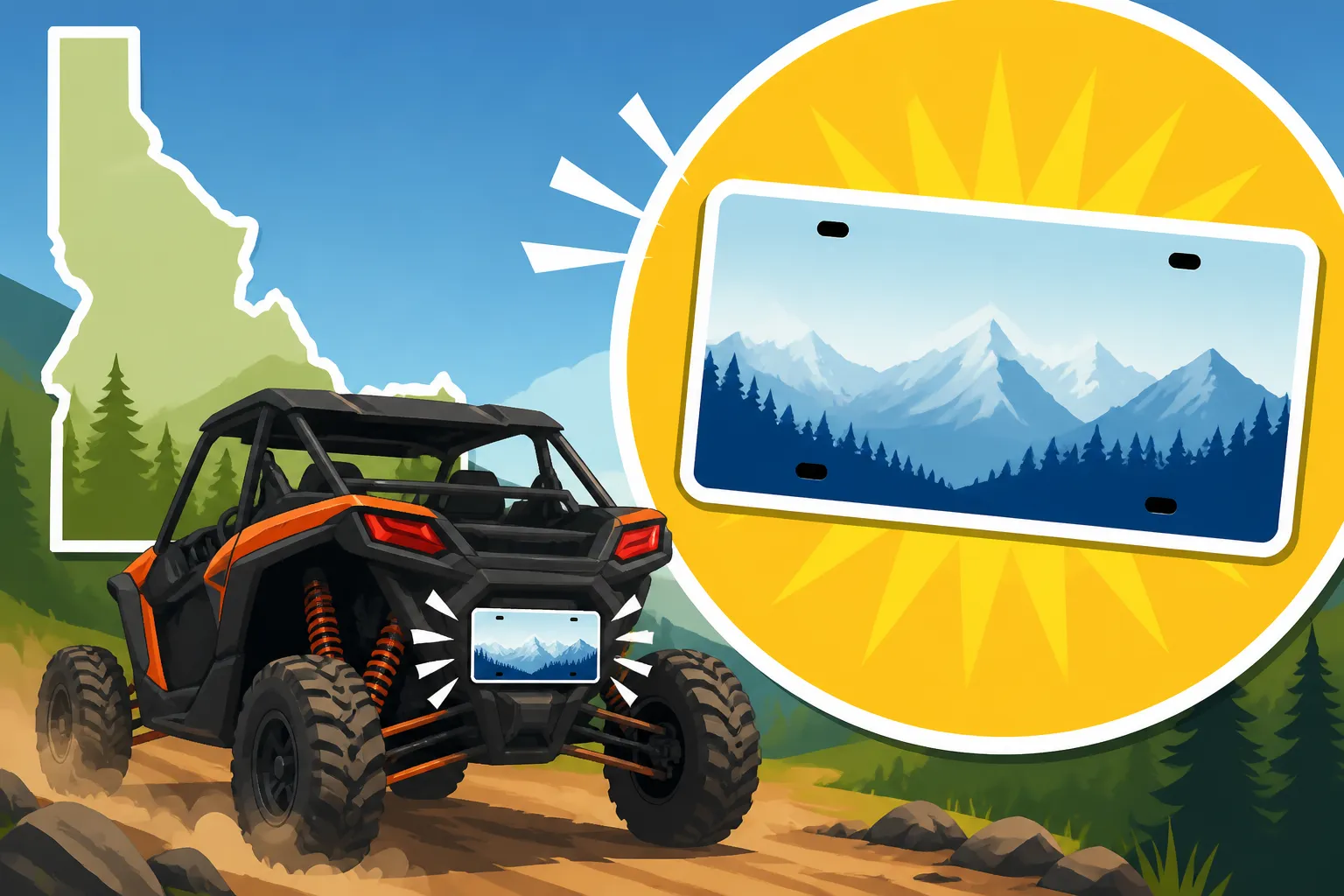
For those who want to ride their OHV on designated county roads in Idaho, there are additional requirements beyond just the OHV sticker. Idaho offers a Restricted Vehicle Plate (often referred to as an "R" plate) specifically for OHVs that meet certain equipment standards. This plate, combined with a valid Idaho OHV Sticker, allows you to legally operate on many county roads that are open to OHV traffic.
To qualify for an R-plate, your OHV must be equipped with essential safety features such as headlights, taillights, brake lights, a horn, and mirrors. You'll also need a valid driver's license and proof of liability insurance. [What Idaho Requires Before You Ride a County Road] is detailed and ensures rider safety and responsibility. Without these items, even with a sticker, you're not legal for road use. The R-plate is a distinct identifier that signals to law enforcement that your machine is equipped and registered for limited road use, reducing the chances of being pulled over and questioned.
Idaho OHV Registration at a Glance
For those navigating Idaho's OHV rules, here's a quick comparison of the key aspects that often lead to confusion when Montana plates are involved:
| Feature | Montana LLC Registration (for Idaho resident use) | Idaho OHV Sticker & Title Registration |
|---|---|---|
| Primary Purpose | Often perceived tax/fee avoidance | Legitimate registration for Idaho use |
| Sales/Use Tax | Often attempts to avoid Idaho sales/use tax | Idaho sales/use tax applies |
| OHV Sticker | Still requires Idaho OHV Sticker for Idaho trails | Mandatory Idaho OHV Sticker required |
| Trail Contribution | Funds primarily go to Montana | Funds directly support Idaho trails |
| Legal Standing in ID | High risk of legal challenge, fines, back taxes | Full compliance with Idaho laws |
| Insurance Validity | Potential for insurance claim denial | Insurance coverage generally valid |
| Road Use Plate | Montana plate not valid for Idaho road use | Idaho Restricted Vehicle Plate available |
| Residency Issues | Can raise questions about Idaho residency compliance | No residency issues |
Ultimately, the attention Montana plates draw in Idaho isn't about state rivalry; it's about the clear legal and financial implications for trail maintenance and tax compliance. Idaho riders and visitors alike are expected to contribute their fair share to the trails they enjoy.
Disclaimer
This article is for general informational purposes only and does not constitute professional advice. Laws, prices and regulations vary by location and change over time. Consult a qualified professional for guidance on your specific situation.