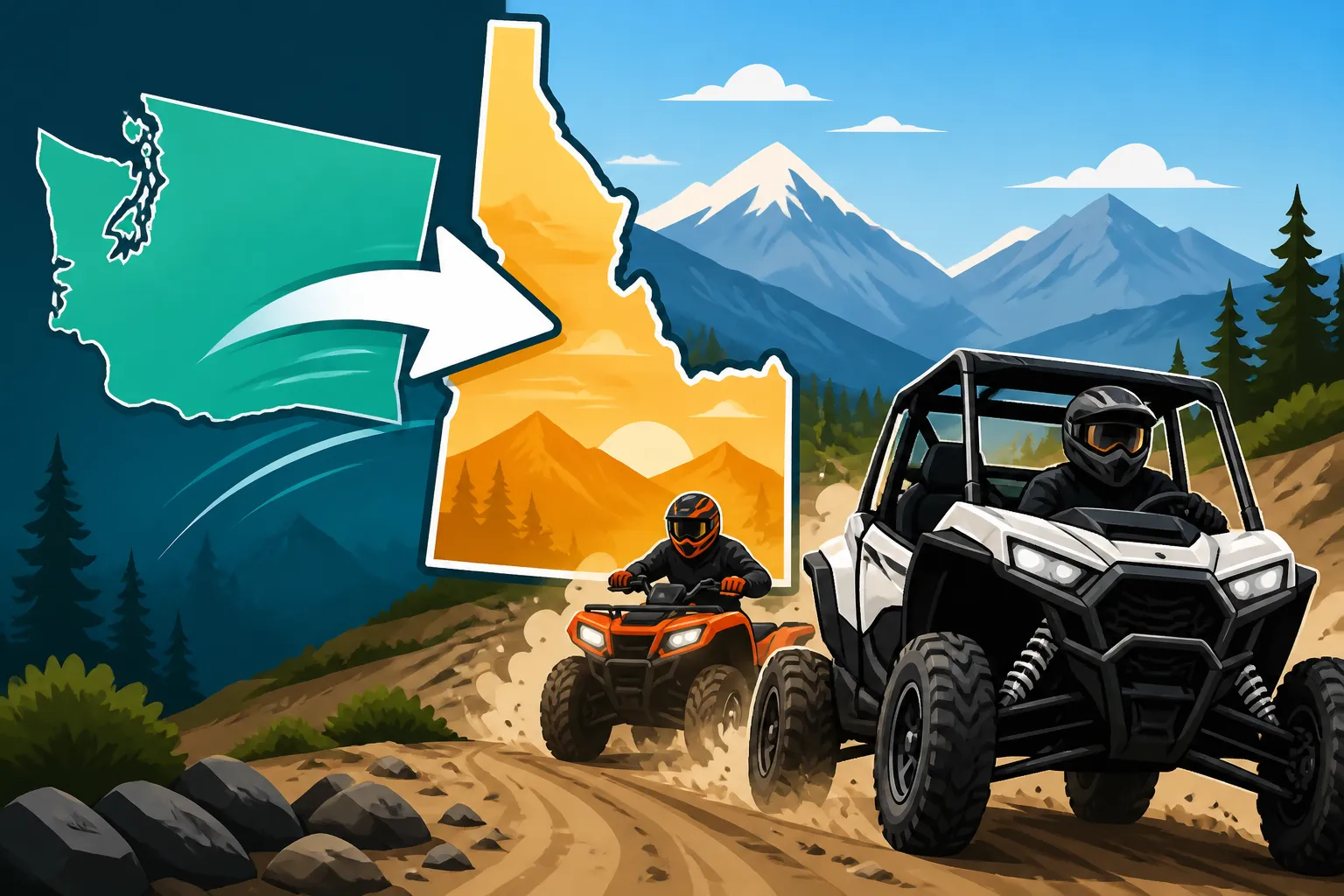
Washington Riders Coming to Idaho
Washington riders planning an Idaho trail trip often assume their Washington registration or ORV permit travels with them. It may not satisfy Idaho’s separate requirements. The key is to sort out the Idaho sticker, check where your machine can legally ride, and confirm any age, road-use, or land-manager rules before unloading.
What Washington riders need before riding in Idaho
Idaho and Washington have separate off-highway vehicle systems. A Washington registration, permit, or decal does not automatically cover the Idaho requirement for a nonresident OHV sticker. Idaho ended OHV reciprocity with neighboring states, so visitors should plan to meet Idaho’s rules rather than rely on a Washington credential. Why Idaho Ended OHV Reciprocity
For many visiting riders, the central requirement is an Idaho nonresident OHV sticker for each machine used on Idaho public land. The sticker is not a replacement for Washington registration, and Washington paperwork is not a substitute for the Idaho sticker. If your trip includes both Idaho and Washington, expect to follow the requirements that apply in each state.
A sticker also does not give you permission to ride anywhere. It is one part of the paperwork; the trail, road, and land-access rules are separate. A county road may be closed to OHVs, a trail may have a width restriction, and a forest road may be governed by a land manager’s map or seasonal order. Idaho Permit Rules on Public Land
Before leaving Washington, check these items for every machine:
- Whether it is registered or otherwise documented as required where it is based.
- Whether you need an Idaho nonresident sticker for the intended Idaho riding.
- Whether the machine’s width and type are allowed on your chosen routes.
- Whether the route crosses a county road, state highway, or other road with separate rules.
- Whether any rider under 16 needs a safety certificate or adult supervision.
- Whether the trail or road is open for your planned date.
The sticker requirement generally concerns the machine, not the person driving it. A group with several quads or side-by-sides should not assume one sticker covers the whole group. Check the current Idaho instructions for which machines qualify and how a sticker must be displayed. Idaho’s Non-Resident OHV Sticker
| Trip situation | What to check |
|---|---|
| Riding Idaho public trails or public land | Idaho nonresident sticker requirements for each machine |
| Riding a forest road | Current land-manager rules, route designation, and any applicable sticker requirement |
| Using a county road | The county’s OHV ordinance, road opening status, and required equipment |
| Crossing a state highway | Whether the crossing is permitted and what rules apply at that location |
| Riding with a person under 16 | Safety-course and direct-supervision requirements |
| Riding a trail with a wide side-by-side | Posted machine-width limits and the current route map |
Getting the Idaho sticker
Buying the sticker before the trip can save time at the trailhead, but first make sure you select the correct option for your machine and use. Sticker terms, prices, and purchase procedures can change. Confirm the current details through an official Idaho source or an authorized vendor rather than relying on an old receipt, a friend’s advice, or a Washington permit. Where to Buy an Idaho Non-Resident Sticker
When buying online, allow time for the transaction and delivery or other fulfillment steps. Do not assume that an order confirmation is the same as having a valid sticker in hand if Idaho’s instructions require the physical decal to be displayed before riding. Review the purchase directions and follow them closely. Buying an Idaho Sticker Online Before a Trip
The sticker is tied to the machine and must be displayed as directed. Keep proof of purchase and any relevant registration paperwork with your trip documents, but do not treat paperwork carried in a glove box as a substitute for a decal when the rule calls for one to be affixed to the machine. If the sticker is lost, damaged, or hard to read, check the state’s replacement instructions before riding.
Do not wait until you reach a remote riding area to figure out where a sticker is sold. Some vendors may be convenient to a town or recreation area, while others may be a substantial detour. Confirm a seller’s availability and current process before traveling there. A visitor who plans to buy on arrival should also have a backup plan in case the first location is closed or out of stock.
A Washington registration can still matter for proving that your machine is properly documented for its home state, and it may be relevant when transporting or using the machine on roads. But it does not automatically grant Idaho trail access. Likewise, an Idaho OHV sticker should not be interpreted as an Idaho road plate or a general road-use permit. Montana Registrations and Idaho Trails is about a different neighboring state, but the same practical distinction applies: a state’s registration and another state’s access rules are not interchangeable.
Choosing routes and checking road access
The safest planning approach is to choose the route first, then verify the rules for each segment. A route described online as an OHV route may include public land, a county road, a crossing, or a section subject to a seasonal closure. These segments can have different requirements. Do not rely on a single trail listing to establish that the entire trip is open and legal.
For federal forest roads, use the current motor vehicle use map for the specific forest or district. These maps identify routes open to motorized travel and may show vehicle types, seasonal dates, or other restrictions. A road that appears physically passable is not necessarily open to public motorized use. Idaho Rules on Forest Service Roads and Reading an Idaho Motor Vehicle Use Map can help explain what to look for.
County roads need a separate check. Idaho counties may set local rules for OHV use, and a road’s status can change at a county line. A sticker alone does not make a closed road open. Confirm the county’s current ordinance or route information, and look for posted signs at the road itself. What Idaho Requires to Ride a County Road
Keep these distinctions in mind:
- Public-land sticker: An Idaho requirement that may apply to operating an OHV on public land.
- Trail or road access: Permission to use a specific route, based on its designation and current status.
- Road equipment and operator rules: Requirements that may apply when riding a road section.
- Washington registration: Documentation from the machine’s home state; it does not itself establish Idaho access.
- Private-land permission: Permission from the landowner is needed where access is private, and private permission does not automatically waive other applicable rules.
A road-legal configuration or plate does not eliminate the need to understand local restrictions. Some Idaho roads are open to certain restricted vehicles only under specific conditions, while state highways and other routes may be closed to OHVs. Do not treat the presence of traffic, pavement, or a connecting trail as proof that an OHV can use the road. Idaho’s Restricted Vehicle Plate and Road Use
Plan a route that matches the machine. A side-by-side wider than the posted trail limit can be prohibited even if it has the correct sticker. A narrow trail may be suitable for a quad but not a full-size UTV. Map symbols, signs, width limits, and closure notices matter more than a route’s popularity. If a map and a sign appear to conflict, stop and confirm with the responsible land manager rather than continuing on an assumption.
Conditions can also change access. Snow, runoff, fire activity, construction, or resource-protection closures may affect a route after you planned the trip. Check status close to departure and again locally where practical. Keep an offline map or paper backup if service is limited, and make sure every driver knows the planned route and any turnarounds.
Riders under 16 and a practical trip checklist
Youth rules are easy to overlook when a family is traveling across state lines. Idaho’s requirements can depend on the rider’s age, the type of route, and whether the ride is on a forest road or another public setting. Do not assume a Washington safety card or a parent riding nearby automatically meets Idaho’s requirement. Confirm which certificates Idaho accepts and what direct supervision means for the planned ride. Idaho Rules for Riders Under 16
A youth rider should be matched to a machine that is manageable for their size and experience. Follow the applicable machine-size and supervision rules, and take extra care on roads, narrow trails, and routes with steep grades or limited visibility. A qualified adult should be able to supervise closely enough to respond, not merely be somewhere else on the same route. The 300-Foot Supervision Distance
For a family trip, make a separate check for each young rider:
- Confirm the rider’s age and whether an Idaho safety course or certificate is required for the intended route.
- Verify that the machine is suitable and allowed where the group plans to ride.
- Check Idaho’s supervision rules and keep the adult close enough to comply.
- Confirm helmet and eye-protection requirements, including any rules specific to riders under 18.
- Choose routes that match the rider’s ability and the machine’s size.
Before driving to Idaho, use this final checklist:
- Identify the exact trail system or roads you plan to use.
- Confirm the current Idaho sticker requirement for each OHV.
- Buy the correct nonresident sticker through an authorized channel and follow the display directions.
- Carry the machine’s relevant registration and ownership documents.
- Check official route maps and local rules for every county, forest, or other land unit involved.
- Verify road crossings and road sections rather than assuming they are open.
- Check youth course, supervision, helmet, and eye-protection requirements.
- Recheck closures and conditions shortly before riding.
- Keep a way to navigate when cell service is unavailable.
If you are unsure whether a particular route is open to your machine, contact the agency or county responsible for that route before riding. Asking ahead is usually simpler than discovering a restriction after reaching a gate, a sign, or a road crossing.
Disclaimer
This article is for general informational purposes only and does not constitute professional advice. Laws, prices and regulations vary by location and change over time. Consult a qualified professional for guidance on your specific situation.