Stickers for a Borrowed Machine
Borrowing an ATV or UTV can make trip planning easier, but a sticker on the machine does not automatically answer every permit question. In Idaho, check the machine’s registration, where it is registered, and where you plan to ride before setting out. This helps you spot a missing permit and avoid assuming a sticker can move from one machine to another.
Start with the machine, not the person riding it
For Idaho OHV riding, the sticker or permit is generally connected to the machine, not simply to whoever is driving. That distinction matters when you borrow a quad or side-by-side: having a valid permit for your own machine does not usually cover a different one.
First, ask the owner what the machine’s current paperwork says. Find out whether it is registered in Idaho or another state, whether its required sticker is current, and whether the sticker is actually attached to the borrowed machine. A verbal assurance that “it’s registered” is less useful than checking the documents and the sticker yourself.
The rules can depend on the machine’s registration and the land or route. Idaho’s nonresident permit requirements are separate from an Idaho resident machine’s regular registration. If the machine is registered outside Idaho, check whether it needs an Idaho nonresident OHV sticker before using it on public riding areas. Idaho’s Non-Resident OHV Sticker explains the permit category and why an out-of-state machine may need one.
| Borrowed machine situation | What to check before riding |
|---|---|
| Idaho-registered machine with a current Idaho sticker | Confirm the sticker belongs to that machine, is readable, and is current. |
| Machine registered outside Idaho | Check whether an Idaho nonresident OHV sticker is required for your intended ride. |
| Sticker is missing, expired, or hard to verify | Do not assume the machine is covered; confirm requirements and arrange the correct permit before riding. |
| Machine has a road-use plate | Check trail-sticker requirements separately; a plate does not automatically establish that public-land OHV requirements are met. |
| Ride is entirely on private property | Check the applicable private-land rules and any exceptions; do not assume the rules are identical to public-land riding. |
A sticker on the borrowed machine is not necessarily proof that every part of the planned trip is allowed. It may cover an OHV registration or permit requirement, while road use, local restrictions, and land-management rules are separate questions. Idaho Permit Rules on Public Land is a useful next step if your route includes public land.
Check the sticker itself
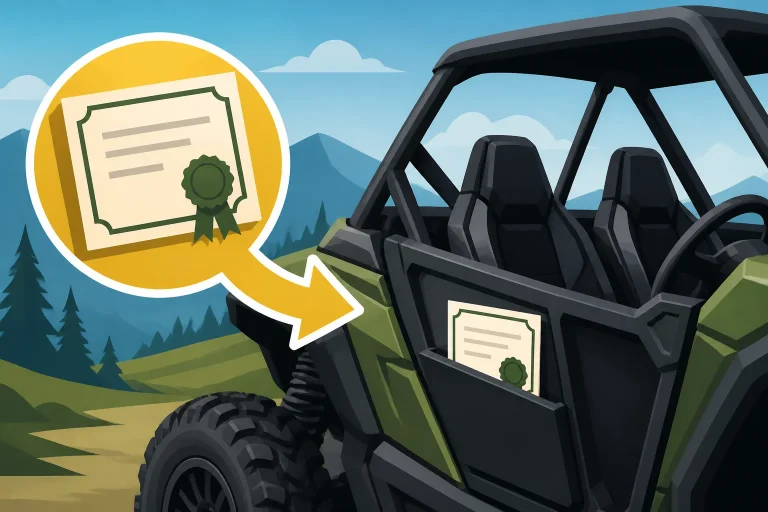
Look for a sticker attached to the machine in the required location, and check that it is legible and appears current. If the owner says a sticker is in a glove box, on another machine, or on a trailer, that does not establish that the borrowed machine is covered. The permit is not a spare pass to carry between vehicles.
Ask the owner to show you any registration or permit record they have. Keep a photo or copy available if that is practical, but do not treat a photo as a substitute for a required physical sticker. If the label is damaged, peeling, or difficult to read, resolve that before riding rather than relying on an officer or land manager to interpret it later.
Match the permit to the machine’s registration
The first useful question is whether the machine is registered in Idaho or elsewhere. Don’t base the answer only on the owner’s home address. Someone who lives in Idaho may own a machine registered in another state, and a visitor may borrow a machine that is already registered in Idaho.
Borrowing an Idaho-registered machine
If the machine has Idaho registration and a current sticker, check that the sticker is attached to the borrowed machine and corresponds to its paperwork. Idaho OHV registration follows its own renewal cycle, so a sticker that looks familiar may still need to be checked for current validity. Idaho OHV Registration Runs January to December covers the registration year.
Borrowing the machine does not mean you should take the sticker off and put it on another vehicle. If the owner has several machines, make sure you have the machine that matches the sticker and registration record. For a second quad or UTV, the relevant requirements have to be checked for that machine separately. See [Stickers for a Second Machine] if you are sorting out more than one vehicle.
Borrowing a machine registered outside Idaho
If the machine is registered outside Idaho, check the Idaho nonresident OHV permit rules before the ride. A permit or registration issued elsewhere should not be assumed to satisfy Idaho’s requirements. Idaho’s reciprocity rules have changed, and a borrowed machine does not become exempt simply because the rider is an Idaho resident or the owner has a permit from another state.
The permit question generally follows the machine and its status, rather than who happens to hold the handlebars. This is especially important if an Idaho resident borrows a visiting friend’s ATV or UTV. Check the current requirements for the machine’s registration state, the riding area, and the kind of use planned. For background on the policy, see Why Idaho Ended OHV Reciprocity.
If the machine needs an Idaho nonresident sticker, plan to get the correct one for that machine before riding. Buying an Idaho Sticker Online Before a Trip may help with advance planning, but confirm the current purchasing and display instructions through an official source. Buying a permit for your own machine does not automatically cover a borrowed one.
Don’t confuse a road plate with an OHV sticker
A plate that allows certain road use is not a universal substitute for an OHV sticker. Likewise, an OHV sticker does not give permission to ride every road. These address different requirements, and a route may call for one, both, or neither depending on the machine and the rules for that road or land.
If the borrowed side-by-side has an Idaho restricted vehicle plate, check what that plate covers and whether the specific road is open to OHVs. A plate does not override a local closure or make a state or federal highway legal for OHV travel. Idaho’s Restricted Vehicle Plate and Road Use explains the difference between the plate and road access.
Before you borrow it, confirm these details
A quick check with the owner can prevent a permit problem at the trailhead. Ask questions before loading the machine, especially if you will cross between private property, county roads, and public riding areas.
- Which machine are you borrowing? Confirm the make, model, and identifying details. If several machines are parked together, don’t rely on the owner’s general statement that “the quads are stickered.”
- Where is it registered? Ask whether it has Idaho registration or is registered in another state. If the owner is unsure, check the documents rather than guessing from the plate or the owner’s address.
- Is the sticker current and attached to this machine? Look at the actual sticker. If it is missing, expired, damaged, or attached to a different vehicle, pause and check what is needed.
- Where do you plan to ride? Identify whether the route uses public land, private property, or roads. A machine’s sticker does not establish that each road or trail is open.
- Who will be operating it, and are there age or supervision rules? A permit does not replace rider requirements. If a young person will drive, check the rules that apply to their age and the intended location.
- Does the owner have permission for you to use it? Make sure the borrowing arrangement is clear, including who is responsible for damage, recovery, and any citation.
These questions are also useful when a visitor borrows your machine. The owner should explain where the sticker is, which machine it belongs to, and what routes are allowed. Letting a Visitor Ride Your Quad covers that kind of handoff.
If a rental company supplied the vehicle, follow its instructions as well as the state and land rules. Rental paperwork may cover the company’s machine and route restrictions, but it does not automatically answer every public-land permit question. See Sticker Rules for a Rented Machine for the rental-specific version of this issue.
If the machine has no usable sticker
Don’t take a sticker off another vehicle and attach it to the borrowed one. Also avoid relying on an old sticker, an online receipt, or the owner’s recollection as proof that the current machine is covered. The appropriate fix may be to obtain the required permit, replace or correct the sticker, or choose a different machine that is already compliant.
If the owner is not available to help, or the registration information is unclear, contact an official Idaho OHV information channel or the relevant land manager before riding. Keep the machine parked until you can confirm the requirement. This is less frustrating than discovering the issue after reaching a remote trailhead.
A sticker does not settle every riding rule
Even when a borrowed machine has the right sticker, check the rest of the route. A trail may have seasonal closures, width limits, local restrictions, or rules set by the land manager. A machine that fits one trail may be too wide for another. A route that begins on a public trail may also connect to a road with separate access rules.
Private property needs a separate check. Permission from a landowner is important, but it does not automatically answer whether public-road travel or other permit rules apply along the way. Idaho has rules and exceptions tied to where and how a machine is used, so clarify the route rather than assuming all riding on private ground is treated the same. Idaho Rules on Private Land offers more detail.
For road sections, check the specific road and local requirements. A county road may be open to certain OHVs while a nearby highway remains closed. Depending on the road, the machine may need appropriate equipment, insurance, a plate, or a qualified driver. An OHV sticker alone does not make an otherwise restricted road legal.
A practical final check is to match three things before leaving: the borrowed machine’s registration and sticker, the rules for the land or road, and the rider’s age and qualifications. If any part is uncertain, confirm it before the ride. That gives you a clearer answer than treating the sticker as permission for every route in Idaho.
Disclaimer
This article is for general informational purposes only and does not constitute professional advice. Laws, prices and regulations vary by location and change over time. Consult a qualified professional for guidance on your specific situation.