Carrying the Certificate in the Machine
Carrying the Certificate in the Machine
If you ride an ATV or UTV in Idaho, a safety-course certificate can be easy to leave at home—or hard to find when someone asks for it. The safest approach is to know whether the rider needs one, keep proof accessible while riding, and treat it as separate from the machine’s sticker, title, and other paperwork.
Who needs an Idaho OHV safety certificate
Idaho’s OHV safety-course rules depend on the rider and where the machine is being operated. Youth riders are a key group to check: a course requirement may apply to a rider under 16 on public land, and supervision rules can apply as well. Those are separate requirements, so completing a course does not automatically remove the need for an adult to supervise a young rider.
Before heading out, check the current requirements for the rider’s age and the kind of land or road you plan to use. A machine may travel between a trail, forest road, county road, or private property during one outing, and the rules can differ by location. The course requirement is not the same thing as an OHV sticker or registration. Having one does not substitute for the others.
For a practical rundown of the separate obligations to check, see What Idaho Riders Need Before They Ride. If a young rider is involved, review Idaho Age Rules for Riders Under 16 and Adult Supervision Requirements in Idaho too. Course completion, age restrictions, supervision, and land access should each be checked on their own.
The certificate belongs to the rider, not to the ATV or UTV. If several people take turns operating one machine, do not assume one person’s certificate covers the rest. Each rider should know whether they personally need to complete the course and carry proof. That matters on family rides, borrowed machines, and group trips, where one vehicle may have several operators over the day.
| What you are checking | What to keep in mind |
|---|---|
| Safety course | Check whether the individual rider is required to complete it for the planned ride. |
| Certificate | Carry proof for the rider who completed the course; it is not machine registration. |
| Youth rules | Course completion does not necessarily replace age or supervision requirements. |
| OHV sticker or registration | These are separate from a safety-course certificate. |
| Road access | A certificate does not make a closed road or route open to OHVs. |
A driver’s license, if the rider has one, is not a safe substitute for checking the OHV course rule. Similarly, a parent’s certificate does not satisfy an individual rider’s course requirement. For more on how the course requirement applies to different situations, see Who Must Take the Idaho Safety Course and Idaho’s OHV Safety Course Requirements.
What to carry while riding
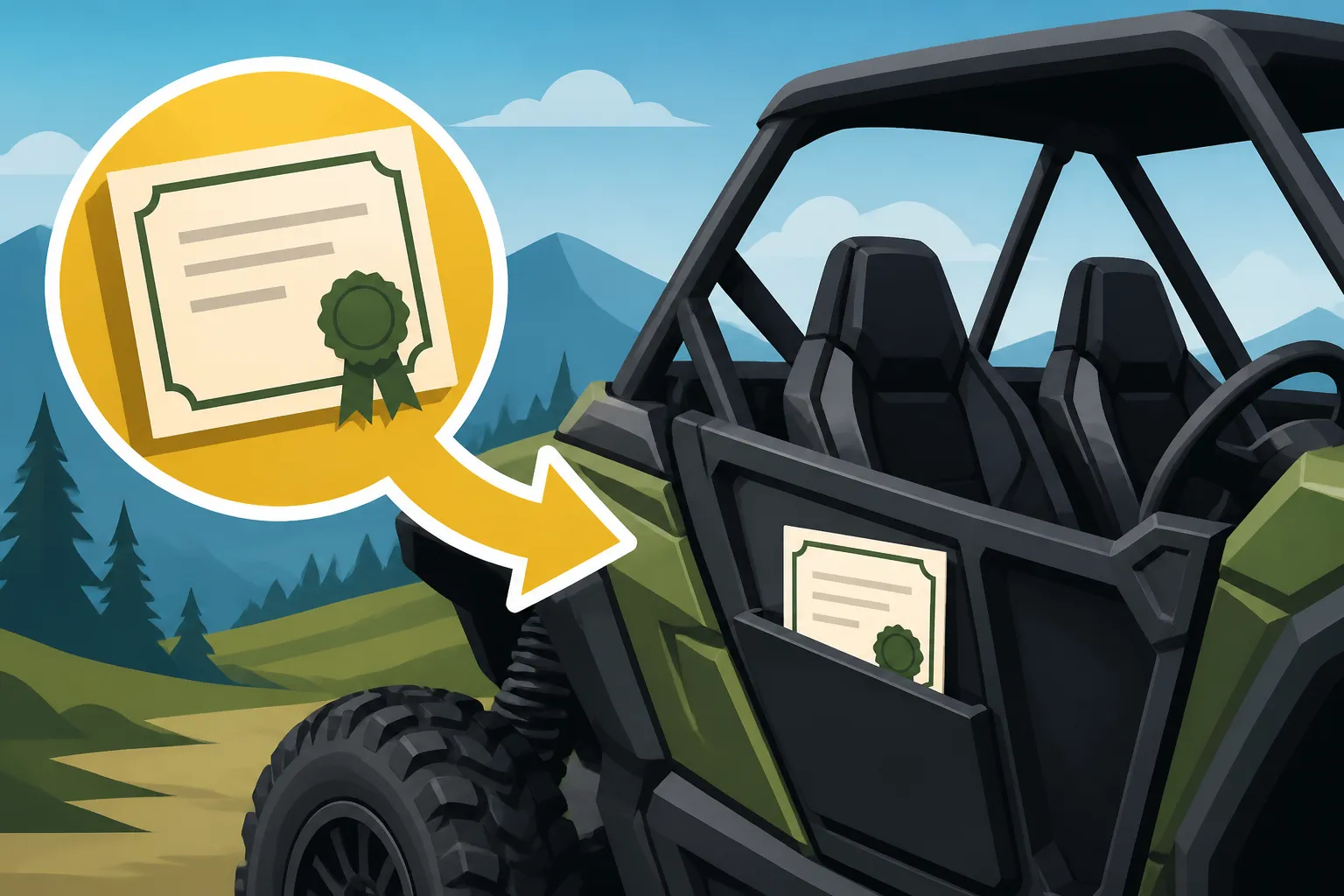
If the rider is required to complete the course, keep the certificate with them while operating. The most dependable option is a physical copy or card in a secure place on the rider or in the machine. A document kept at home, in a tow vehicle parked miles away, or on a phone that has run out of battery is not useful when proof is requested.
A simple setup can prevent most problems:
- Put the certificate in a small waterproof sleeve or document pouch.
- Store it in a secure, accessible place on the machine, such as a closed compartment.
- Tell the rider where it is and how to retrieve it safely.
- Keep a separate backup copy at home or in a phone when practical.
- Check before each trip that the certificate is still present and readable.
A pouch made for outdoor documents can help protect paper from rain, mud, dust, and wear. If you buy one from an outdoor retailer or Amazon, choose a size that fits the certificate without folding it and a closure that stays shut. The useful feature is protection and access, not a particular brand or style.
A photo or digital copy can serve as a backup, but do not assume it will always be accepted in place of the required certificate. Phone service may be unavailable, a device can lose power, and an officer or land manager may need to see a particular form of proof. Unless the current Idaho instructions clearly confirm a digital option for your situation, carry the physical certificate as the primary proof.
Keep the certificate easy to reach without putting it somewhere that can fall out, get soaked, or interfere with operating the machine. A loose paper in a glove box may be fine on a short dry ride but can become unreadable after a wet crossing or a day of dust. A pouch attached to a secure compartment is generally more reliable than a document tucked into clothing or left under loose gear.
For family rides, set up the machine so the certificate is available even if the usual operator is not riding. A parent may have packed the documents, but another eligible rider may take the controls later. Each person should know where their own proof is kept, and the group should avoid treating one machine’s paperwork as proof for every rider.
Keep the certificate separate from other ride paperwork
A certificate proves course completion. It does not prove ownership, registration, insurance, or permission to use a particular route. Keeping those documents organized together can be convenient, but it helps to understand what each one does so a rider does not present the wrong paper or assume one document covers everything.
For example, an OHV sticker or registration relates to the machine and its use under Idaho’s rules. A safety certificate relates to the rider. A title records ownership; it is not a riding permit. Insurance documentation may be relevant to road use or a particular policy, but it does not stand in for the course certificate. For a fuller overview, see Idaho Rules for Riders Under 16 on Roads and Idaho Permit Rules on Public Land.
A useful pre-ride check is to confirm the following separately:
- The rider has completed any required course and has proof available.
- The machine has the sticker or registration required for the planned use.
- The chosen route is open to that type of machine.
- Any required adult supervision is arranged.
- Other road-use requirements, such as a plate or insurance, are addressed where applicable.
This distinction matters when a ride includes public land and roads. A valid safety certificate does not authorize riding on a closed road, and an OHV sticker does not establish that the operator completed a required course. Before using county roads, confirm the route and local requirements; What Idaho Requires to Ride a County Road explains why road access needs its own check.
Do not carry the machine’s only copy of every important document in a place where one mishap could destroy them all. Keep a backup of the certificate and other records somewhere safe. If the original certificate becomes damaged or goes missing, find out how to obtain a replacement rather than relying on an old photo or an unreadable copy. Getting a Duplicate Safety Certificate covers that issue.
Before leaving: verify the rider and the route
A few minutes of preparation can avoid confusion at the trailhead or during a stop. First, identify every person who may operate the ATV or UTV. Check the course rule for each rider instead of assuming that the machine’s owner or the trip organizer has handled it for everyone. Then confirm each rider has access to their own proof.
Next, check the planned route. A ride on a public forest road may raise different questions from riding on private property, a trail, or a county road. Do not rely on a friend’s recollection of what was required on a previous trip. Rules, route access, and accepted proof can vary with the situation. For forest-road questions, see Who Needs the Course on a Forest Road; for the supervision distance and conditions, see The 300-Foot Supervision Distance.
If a course certificate is missing, unreadable, or in a format you are unsure will be accepted, resolve that before riding where proof may be required. Contact the appropriate Idaho program or agency for current instructions, including what documents it accepts and how a duplicate is issued. Avoid setting out on the assumption that an emailed receipt, course screenshot, or another person’s certificate will be enough.
A reliable routine is simple: course requirement checked, certificate packed, machine paperwork checked, route confirmed, and supervision arranged where needed. That keeps the certificate in its proper role: proof that a particular rider completed the course, not a substitute for the rest of Idaho’s riding requirements.
Disclaimer
This article is for general informational purposes only and does not constitute professional advice. Laws, prices and regulations vary by location and change over time. Consult a qualified professional for guidance on your specific situation.