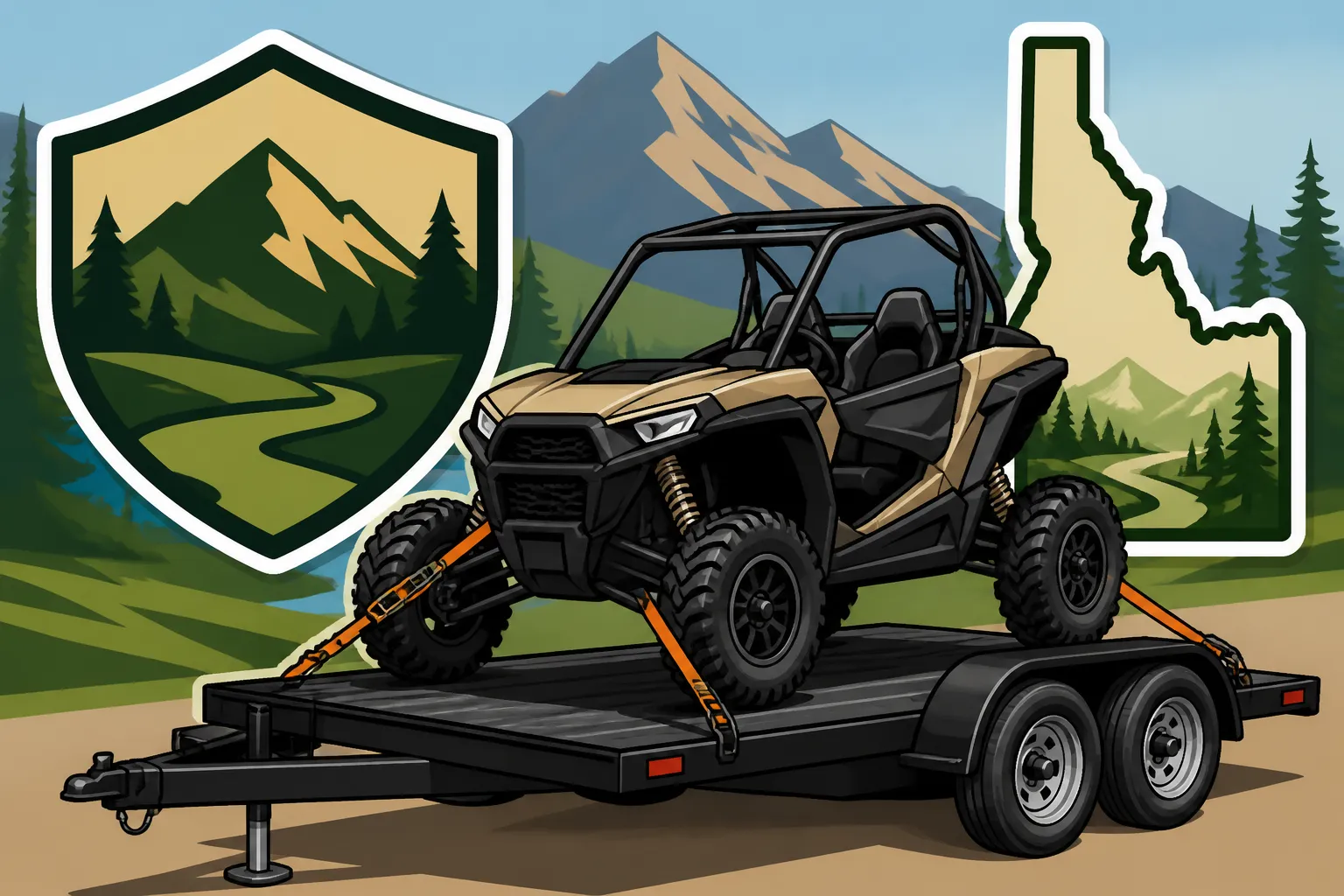
Stickers for a Machine Left on a Trailer
If your ATV or UTV is strapped to a trailer, it can be hard to tell whether Idaho’s sticker rules apply before you even unload. The key distinction is transport versus operation: hauling or storing a machine is different from riding it. Here’s how to think through the difference, what can change the answer, and what to check before heading to a trail.
Does a machine on a trailer need an Idaho OHV sticker?
Usually, a machine does not need an OHV sticker simply because it is being hauled on a trailer or parked on one. A sticker is generally tied to using the machine in places where Idaho requires OHV registration or a permit—not to transporting the machine as cargo.
That distinction matters whether you are towing your own quad across Idaho, bringing a UTV to a campground, or leaving a machine loaded while you stop for the night. A sticker does not replace the paperwork or equipment rules that apply to the tow vehicle and trailer, and the trailer may have its own requirements. For that side of the trip, see Trailer Registration for Hauling ATVs in Idaho.
The answer can change as soon as the machine comes off the trailer and is used. Riding from a parking area to a trail, moving around a staging area, or traveling on a road may count as operation even if the ride is short. The route and land type matter, as do the machine’s registration status and whether the rider is a resident or visitor.
| Situation | Is the machine being operated? | What to consider |
|---|---|---|
| Machine secured on a trailer while traveling | No | Trailer and load requirements still apply |
| Machine stored on a trailer at home | No | Storage alone generally does not trigger an OHV sticker requirement |
| Machine unloaded and ridden on public land | Yes | Check Idaho registration or permit requirements before riding |
| Machine driven on a road | Yes | Road access, equipment, license, insurance, and plate rules may apply separately |
| Machine unloaded at a private property | It depends | Check the land-use rules and any applicable exceptions |
This is a practical distinction, not a blanket exemption for every situation. A vehicle left on a trailer may be parked within a place that has its own entry, parking, or recreation requirements. A permit needed for a person, tow vehicle, trailer, or campsite is separate from an OHV sticker for the machine.
Residents and nonresidents may also have different sticker or registration obligations. If you are visiting from another state, review Idaho’s Non-Resident OHV Sticker before travel. A registration or permit from home should not be assumed to cover riding in Idaho; Why Idaho Ended OHV Reciprocity explains why visitors should check Idaho’s requirements directly.
When sticker rules start: unloading, riding, and destinations
The most useful question is not only “Is the machine on a trailer?” but “What will happen after it comes off?” A machine that stays secured for the entire trip is in a different situation from one that is unloaded and driven, even briefly.
Trailheads and staging areas
A machine may be unloaded at a trailhead or staging area before the group sets out. If riders plan to use it on an Idaho trail or other public land, check the sticker or registration requirement before unloading. Avoid assuming that a staging lot is only a parking place: riding within it, connecting to a trail, or using an access route can bring the machine into operation.
The same caution applies when a trailer is parked beside a riding area. The fact that the machine arrived on a trailer does not determine whether it can be used there. Look at the posted rules and the land manager’s current information, and confirm whether the planned route is open to your type of machine. Idaho Permit Rules on Public Land is a useful starting point for understanding how public-land use can affect permit requirements.
State parks, campgrounds, and other recreation sites
A machine left on a trailer at a state park is still being transported or stored if it remains secured. But a park may have rules about where vehicles and trailers can be parked, and it may regulate OHV use within its boundaries. If you intend to unload and ride, check the park’s rules before doing so. A sticker or registration that allows a machine to be used elsewhere does not automatically authorize riding on every park road or trail.
For a trip that includes a park, check Idaho Sticker Rules at a State Park and confirm the specific destination’s current restrictions. If you are only passing through or storing the machine, ask whether any separate park or parking requirements apply to the vehicle and trailer.
County roads and other public roads
An OHV sticker does not, by itself, make a machine legal to ride on a road. Some Idaho road use may be allowed under specific conditions, while other roads are closed to OHVs. Whether you need a plate, insurance, particular equipment, or a license depends on the road and the type of vehicle use. A machine carried on a trailer is not being ridden on that road; an unloaded machine driven along it is.
Before planning a route that uses roads, check What Idaho Requires to Ride a County Road. Also remember that a road can be subject to a local closure even when a nearby trail is open. Do not treat a trailhead access road, campground road, or short connection as automatically exempt from road-use rules.
What to check before a trip
A few checks before departure can prevent the common mistake of arriving at a trailhead with a machine that cannot legally be used on the planned route. The right preparation depends on where you intend to ride, how you plan to get there, and the machine’s registration status.
- Decide whether the machine will be ridden in Idaho. If it will stay on the trailer, focus on safe transport and trailer requirements. If you plan to unload it, find out what registration or sticker is required for the intended use.
- Identify the destination and route. A trail, public-land road, county road, private property, campground, and state park can have different rules. Check the rules for each place where the machine may be operated.
- Check whether the rider is a resident or visitor. Idaho residents and out-of-state riders may have different registration or sticker steps. Do not assume that a home-state sticker or registration automatically substitutes for Idaho’s requirements.
- Confirm that the route is open to your machine. Trail width, vehicle type, seasonal access, and local restrictions can matter. A sticker is not permission to ride a closed route or enter land where motorized use is prohibited.
- Verify display and documentation requirements. If a sticker or registration is required, follow the current instructions for where it must be displayed and what proof to carry. Do not place a sticker somewhere based only on a guess or on another machine’s setup.
- Keep transport and riding paperwork separate. The trailer’s registration and safe loading are one part of the trip; the OHV’s title, registration, permit, or road-use requirements are another.
For a visitor, the first practical step is often confirming whether the trip involves public-land riding at all. If it does, use the current Idaho information for out-of-state riders rather than relying on the rules from your home state. What Idaho Charges an Out-of-State Rider offers more context, while Where to Buy an Idaho Non-Resident Sticker can help with the next step if a sticker is required.
For a resident machine, check its Idaho registration status and the rules for the route. A machine’s ownership paperwork and its authority to be used on a particular trail or road are not the same thing. If you have recently bought the machine, moved to Idaho, or changed how it will be used, confirm that its paperwork is in order before relying on an old sticker or registration.
Common situations and mistakes
“It’s only a short ride from the trailer to the trail.” A short distance is still operation. If the route requires a sticker, registration, or other authorization, the distance does not necessarily change that requirement. Check before riding out of the staging lot or along an access road.
“The machine is on private land, so no rules can apply.” Private-land use may be treated differently from public-land use, but the details depend on the property and the activity. Permission from the landowner is important, and it does not automatically settle every registration, safety, or road-use question. If you will leave the property or use a public route, check the rules for that part of the ride too. For more on the distinction, see Do You Need a Sticker on Private Land in Idaho?.
“The trailer has a plate, so the OHV is covered.” A trailer plate is for the trailer, not a substitute for the OHV’s own registration or permit when the machine is operated. Likewise, an OHV sticker does not take the place of any requirements that apply to the trailer.
“The sticker makes the machine road legal.” A sticker or OHV registration should not be treated as a road-use plate. Road access can involve separate requirements and restrictions. Check the rules for the specific road and machine before riding there.
“The machine is just parked at a trailhead, so it must be fine.” Parking a machine on a trailer is different from unloading it. Once unloaded, even a brief ride around the lot or along a connector may be subject to rules. Follow signs and ask the land manager if the permitted area is unclear.
“A sticker on one machine covers every machine on the trailer.” Do not assume a sticker transfers between machines or covers multiple machines. Check the rules for each individual machine and buy or obtain the required authorization for each one before use.
The safest approach is straightforward: if the machine will remain secured on the trailer, an OHV sticker is generally not needed just for hauling or storage. If it will be unloaded and ridden, verify the current Idaho requirements for the machine, rider, destination, and route before you start. That keeps transport rules, trail access, and road-use rules from getting mixed together.
Disclaimer
This article is for general informational purposes only and does not constitute professional advice. Laws, prices and regulations vary by location and change over time. Consult a qualified professional for guidance on your specific situation.