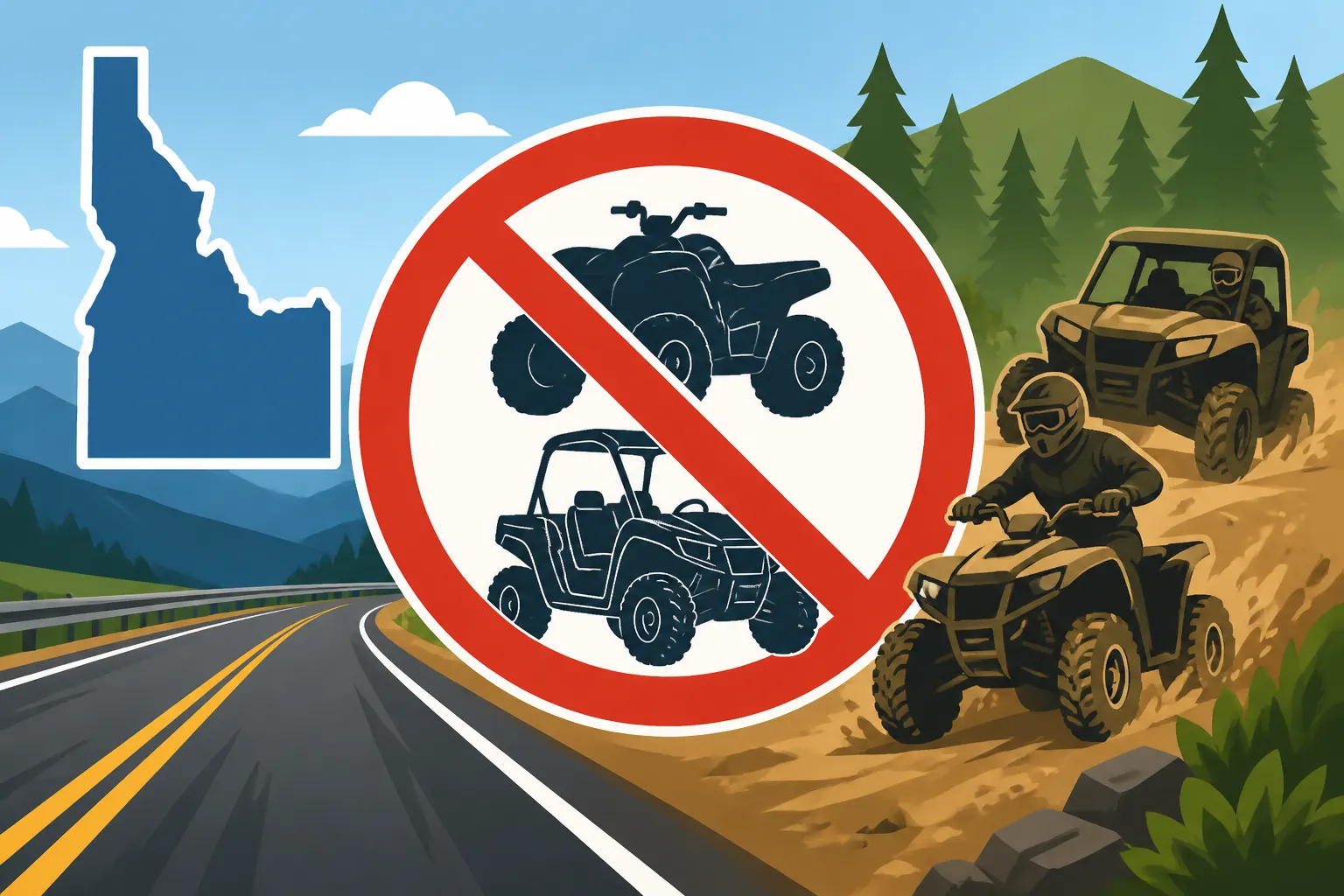
Why Idaho Bars OHVs From State Highways
Oh, the open road in Idaho! There’s nothing quite like the freedom of exploring our vast landscapes on your ATV or UTV. But as many riders discover, that freedom often comes with some pretty strict boundaries, especially when it comes to paved highways. It’s incredibly frustrating to be rolling along, enjoying a scenic route, only to hit a state highway and have to either turn around or load up, wondering why on earth these versatile machines can’t just cruise down the main thoroughfare. This guide is here to unravel that mystery, explaining precisely why Idaho's state highways are generally off-limits to your off-highway vehicles and what you can do when these major arteries get in your way.
The Core Distinction: State Highways Versus Other Roads
Before we dive into the "why not," it's crucial to understand that not all roads are created equal in the eyes of Idaho law. There's a fundamental difference in how state highways are designated, funded, and managed compared to county roads, Forest Service roads, or even certain city streets. This distinction is at the heart of the restrictions OHV riders face.
What Defines a State Highway in Idaho?
When you see a route sign marked with a shield (like US-95, SH-55, or even I-84), you're looking at a state highway or interstate. These aren't just bigger roads; they are specifically designated and maintained by the Idaho Transportation Department (ITD). Their primary purpose is to facilitate high-speed, high-volume travel for conventional motor vehicles—cars, trucks, and commercial traffic—connecting major cities and regions across the state. They are designed with specific engineering standards for speed limits, lane widths, shoulder construction, and sightlines, all geared towards the capabilities and expectations of these types of vehicles.
Think about the bustling traffic you encounter on a highway, perhaps heading to McCall or a weekend trip up US-95 through the Panhandle. Drivers on these routes expect certain speeds and vehicle types. They're typically not looking for a side-by-side traveling at a slower pace, or an ATV trying to navigate a narrow shoulder, if one even exists. The entire infrastructure, from guardrails to signage, is built around this expectation. These roads represent the main veins of Idaho's transportation network, critical for commerce, tourism, and daily commuting, and are thus subject to a different set of rules to ensure the safe and efficient flow of that specific type of traffic.
The Legal Framework: Idaho Code and OHV Access
The restrictions on OHVs riding state highways aren't just suggestions; they are explicitly written into Idaho Code. Specifically, Title 49, Chapter 4 of the Idaho Statutes, often referred to as the Off-Highway Vehicle Act, outlines where OHVs can and cannot operate. While this code allows for OHV use on most county and Forest Service roads—and even some city streets, given local approval—it generally prohibits their operation on state highways and interstates. It's a clear legislative decision aimed at maintaining the safety and integrity of the state's primary transportation network.
This legal framework also defines what constitutes an "off-highway vehicle" and distinguishes it from a "motor vehicle" that is street-legal. Your ATV or UTV, even if equipped with certain aftermarket accessories, doesn't automatically qualify as a standard motor vehicle for highway use under Idaho law. It lacks the full complement of safety and emissions equipment typically required for high-speed, public road operation. This fundamental legal separation means that unless specific, narrowly defined exceptions apply (like crossing), OHVs are simply not permitted to share these main thoroughfares. You can delve deeper into these definitions and requirements by checking out [Idaho's Restricted Vehicle Plate Explained].
Safety Concerns and Highway Design
At the core of the prohibition against OHVs on state highways are significant safety concerns. The very design of state highways and the characteristics of OHVs create a dangerous mismatch, leading to a much higher risk of accidents.
Speed Differentials and Accident Risk
One of the most obvious and critical safety issues is the vast speed differential between OHVs and highway traffic. A typical ATV or UTV might top out at 50-70 miles per hour, but many are more comfortable cruising at lower speeds, especially if they're geared for torque rather than top-end. On an Idaho state highway, speed limits commonly range from 55 to 70 mph, and traffic often flows at or above those limits. Imagine your side-by-side, even at its maximum speed, being approached from behind by vehicles traveling 10, 20, or even 30 mph faster.
This speed difference dramatically reduces the time other drivers have to react. A motorist traveling at 65 mph closing in on an OHV moving at 40 mph will cover the distance between them very quickly. This creates a dangerous scenario, particularly on stretches of highway without ample passing lanes or where visibility is limited by curves or hills. Drivers of passenger vehicles or commercial trucks may not anticipate such a slow-moving vehicle, especially one with a smaller profile, leading to sudden braking, swerving, or rear-end collisions. It's a recipe for disaster that Idaho lawmakers have wisely chosen to avoid by separating these vehicle types.
Infrastructure Limitations: Shoulders, Lanes, and Curves
Idaho's state highways, particularly in rural areas, are often not designed with OHV use in mind. Many stretches lack wide, paved shoulders suitable for slower-moving vehicles. If a shoulder exists, it might be narrow, gravelly, or drop off suddenly, creating a hazardous environment for an OHV. These machines, while rugged off-road, can become unstable on uneven or soft shoulders at higher speeds, making them difficult to control if a rider tries to "hug the edge" of the road.
Furthermore, the geometry of highway lanes and curves is optimized for passenger cars and trucks. The banking of turns, the sightlines, and the overall road surface are not ideal for the suspension, tire type, and handling characteristics of an OHV. An ATV with knobby tires, for example, handles very differently on smooth, hard asphalt at speed compared to a car with street tires. It can be prone to instability, particularly when encountering imperfections in the pavement or needing to make a quick maneuver. Adding a machine that might drift, is less responsive, or simply can't maintain pace, compromises the safety for everyone sharing the road. This also ties into [Displaying a Sticker on an Idaho R Plate] and understanding the limits of that plate.
Traffic Volume and Driver Expectations
Picture a busy weekend on US-95 through North Idaho, or a weekday commute on SH-55 near Horseshoe Bend. These roads often carry significant traffic volumes, including large commercial trucks, RVs, and impatient commuters. Drivers on these routes are typically focused on maintaining speed and flow, and their expectations are set for other traditional motor vehicles. They are simply not looking for an ATV or UTV, especially in their blind spots or appearing suddenly from an access road.
The presence of OHVs introduces an unpredictable element into this high-speed, high-stress environment. Drivers might be distracted, frustrated by slower speeds, or simply unaware of how to safely interact with an OHV on a highway. This lack of familiarity and differing expectations can lead to dangerous situations, from aggressive driving to misjudging passing distances. Idaho's approach prioritizes the safety of all road users by clearly segregating vehicle types onto the appropriate roadways, minimizing confusion and the potential for tragic accidents. It's about ensuring everyone has a clear understanding of what to expect, and what's expected of them, on specific parts of the road network.
Vehicle Requirements and Standards
Another significant reason why Idaho bars OHVs from state highways boils down to the fundamental differences in vehicle design and regulatory standards. OHVs are built for off-road performance, not for sustained high-speed highway travel.
Equipment Discrepancies: Lights, Signals, and Horns
To be truly street-legal for all public roads, a vehicle must meet stringent federal and state Department of Transportation (DOT) standards. This includes specific requirements for headlights (high and low beam, proper aiming), taillights, brake lights, turn signals, reflective devices, and a horn. While many modern UTVs come with some of these features, they often don't meet the full DOT standard for highway use in terms of brightness, visibility from various angles, or specific lamp placement. For instance, a small, recessed taillight that's perfectly adequate on a dusty trail might be virtually invisible to a truck driver approaching at 65 mph on a bright, sunny highway.
ATVs are even more deficient in this regard, often lacking integrated turn signals, proper mirrors, or a horn loud enough for highway conditions. Aftermarket kits, like those often provided by SuperATV, can add turn signals and mirrors, but the machine's overall design, wiring, and power output might still fall short of true highway compliance. Without the full suite of DOT-compliant safety equipment, an OHV becomes a hazard on a high-speed highway, making it difficult for other motorists to see, anticipate its movements, or avoid. This is a crucial distinction that separates a capable trail machine from a road-worthy vehicle.
Weight, Stability, and Road-Specific Tires
OHVs, by their very nature, are designed for rugged, uneven terrain. This means they often have high ground clearance, a relatively narrow track width (especially ATVs), and a suspension system with significant travel. While excellent for absorbing bumps and rocks, this design can make them less stable on smooth pavement at highway speeds, particularly when making sudden turns or encountering crosswinds. Their center of gravity is often higher than a typical car, increasing the risk of rollovers in evasive maneuvers.
Then there are the tires. Knobby, aggressive tread patterns are fantastic for traction on dirt, mud, and rocks. However, these same tires perform poorly on asphalt at high speeds. They wear down rapidly, generate excessive heat, reduce fuel efficiency, and most importantly, compromise handling and braking performance. They can "squirm" on pavement, reducing stability and making it harder to maintain a straight line. Conversely, street-legal vehicles are equipped with tires designed for optimal grip and longevity on pavement, ensuring predictable handling and effective braking. The fundamental mismatch in tire design alone presents a significant safety and performance issue on state highways. You can find more specific rules for machines in [Idaho Title Rules for an Older Machine].
Emissions and Noise Regulations for Highway Use
Highway vehicles are subject to strict emissions standards to control air pollution. OHVs, while increasingly cleaner, generally do not meet these same rigorous standards. Their engines are typically tuned for off-road performance and may produce higher levels of pollutants than passenger cars. While this might be less of a concern on remote trails, aggregating many such vehicles on a high-traffic highway could contribute disproportionately to urban air quality issues.
Noise is another factor. Many OHVs, especially those with aftermarket exhausts, can be quite loud. While a certain level of engine noise might be acceptable on a remote trail, constant loud exhaust noise on a state highway can be a nuisance to nearby communities and contribute to overall traffic noise pollution. Standard highway vehicles are engineered with mufflers and exhaust systems designed to meet specific decibel limits for public road operation. The less stringent noise regulations for OHVs reflect their intended use in environments where ambient noise levels and public exposure are different, reinforcing why they are kept off high-volume state highways.
Understanding the Idaho Restricted Vehicle Plate
Many OHV owners in Idaho opt for the Restricted Vehicle Plate, often referred to as an "R" plate. This plate is a fantastic tool for extending your riding opportunities, but it comes with specific limitations, particularly regarding state highways. It's easy to misunderstand what this plate actually allows.
What the "R" Plate Actually Allows
The Idaho Restricted Vehicle Plate is a game-changer for OHV access, letting you legally operate your ATV, UTV, or dirt bike on a vast network of roads that would otherwise be off-limits. Primarily, it grants access to most county roads, certain city streets (where local ordinances permit), and many Forest Service and Bureau of Land Management (BLM) roads. This is hugely beneficial for connecting trails, reaching trailheads, or simply riding from your cabin into town for supplies. With an R plate, your machine suddenly becomes much more versatile, allowing you to traverse small towns and connect different riding areas without the need to load onto a trailer. You still need to carry proof of insurance and a valid driver's license, and adhere to all traffic laws just like any other vehicle on those roads. This plate greatly expands your options for adventures, especially if you plan to explore areas like the Boise National Forest or the Caribou-Targhee National Forest, which have extensive networks of county and agency roads. Learn more about its scope in [What Idaho's $3 Restricted Use Plate Covers].
Limitations of the Restricted Plate on State Routes
Here's the crucial point that often causes confusion and frustration: the Idaho Restricted Vehicle Plate does not authorize you to ride on state highways or interstates. Period. The "restricted" in its name isn't just a suggestion; it defines the specific limitations of its use. While it broadens your access to many types of roads, it explicitly excludes the high-speed, high-volume thoroughfares managed by the Idaho Transportation Department. The plate is designed to bridge the gap between pure off-road trails and lower-speed public roads, not to transform your OHV into a full-fledged, highway-legal passenger vehicle.
The legal language is clear: the R plate permits OHVs on certain public roads, excluding those specifically designated as state or federal highways, interstates, or other roads explicitly prohibited by statute or local ordinance. So, even if your machine is equipped with all the bells and whistles—turn signals, mirrors, horn, and your R plate is prominently displayed—it still doesn't grant you permission to travel on US-95 or SH-55. The intent of the R plate is to enhance connectivity for trail riding and local access, not to integrate OHVs into the primary highway system. Understanding this limitation is vital for staying legal and safe while exploring Idaho's beautiful backcountry. This distinction is also covered in [Idaho Plates That Begin With R].
Crossing State Highways: Permissible Maneuvers
While riding on state highways is generally prohibited, Idaho law does provide specific allowances for OHVs to cross these major roads under certain conditions. This is a critical distinction that many riders need to understand to navigate the state legally and safely.
Designated Crossing Points
Idaho law permits OHVs to cross state highways only at designated intersections or at locations where the highway right-of-way has been opened for such crossings by the Idaho Transportation Department (ITD). This isn't a free-for-all; you can't just cross anywhere you please. Typically, these designated points are at established paved intersections where local roads or other permissible OHV routes meet the state highway. Think of where a county road or a Forest Service road crosses a state highway. These points are often marked, or their status can be confirmed by consulting local motor vehicle use maps (MVUMs) or contacting county and state agencies.
The logic here is purely about safety. Intersections are designed for traffic to pause, yield, and cross. There are usually stop signs, traffic lights, or at least clear sight lines that allow both the OHV rider and highway traffic to be aware of each other. Attempting to cross a highway at an undesignated point, such as between intersections or where visibility is poor, is not only illegal but extremely dangerous. It puts you in direct conflict with high-speed traffic in a location where drivers simply aren't expecting crossing vehicles. Always plan your route to utilize established, safe crossing points. You can find more specific advice for these situations in [Crossing an Idaho Highway on an OHV].
The "Straight Across" Rule and Why It Matters
When you do approach a permissible crossing point on an Idaho state highway, the rule of thumb is to cross as directly and safely as possible. This is often referred to as the "straight across" rule, though the legal text simply implies crossing with due care. You are not allowed to travel down the highway for any distance, even for a short stretch, to reach another road or to make a turn. The intent is to minimize the amount of time your OHV is actually on the highway surface.
This rule exists for all the safety reasons we've already discussed: speed differentials, vehicle stability, and driver expectations. By crossing directly, you reduce the risk of a rear-end collision or being involved in a conflict with high-speed traffic. You should yield to all highway traffic, wait for a clear and safe opening, and then proceed straight across to the other side without hesitation. Even if your next turn is just a few hundred feet down the highway, you must resist the temptation to ride that short distance. This kind of illegal maneuver is not only subject to fines but significantly increases your risk of an accident. It's a prime example of where a little patience and adherence to the rules can literally save lives.
Rules for Crossing an Interstate on an Idaho Quad
Interstates (like I-84, I-15, or I-90) represent the highest tier of restricted roads for OHVs. While crossing a state highway at a designated intersection is allowed, crossing an interstate is even more narrowly defined and often comes with additional layers of restriction. Generally, OHVs are prohibited from operating anywhere on an interstate highway, including the ramps and shoulders. The only way to "cross" an interstate is typically via an overpass or underpass that is part of a county or local road system. This means you would be riding over or under the interstate, not directly on its driving surface or right-of-way.
You will almost never find an intersection where an OHV-legal road directly crosses an interstate at grade, due to the high-speed, controlled-access nature of interstates. Therefore, if your route planning shows an interstate, assume you must use an alternative, OHV-permissible overpass or underpass structure that carries a non-highway road. Attempting to enter an interstate, even for a brief crossing, is extremely dangerous and illegal, inviting severe penalties. Always consult local maps, such as the [onX Offroad for Idaho Trails] app or published Motor Vehicle Use Maps (MVUMs), and confirm your route with local authorities if you're unsure about an interstate crossing. It’s far safer to find a legal, alternative route than to risk an encounter with interstate traffic. [Crossing an Interstate on an Idaho Quad] provides more detailed information on this topic.
Navigating Local Ordinances and Open Roads
Beyond state highways, Idaho's OHV landscape is a patchwork of rules governed by counties and cities. Understanding these local ordinances is just as crucial as knowing state law, as they can significantly impact your riding experience.
County and City Road Access: What's Permitted
This is where the Restricted Vehicle Plate truly shines. While state highways are generally off-limits, Idaho law grants counties and cities the authority to open or close their own roads to OHV traffic. Many counties across Idaho have embraced OHV tourism and local use, adopting ordinances that permit OHVs on a wide range of their paved and unpaved roads. For example, some counties will open all roads except those explicitly posted as closed, while others might only open specific routes. Towns like Stanley, Salmon, and McCall have gone further, opening many of their city streets to allow riders to access amenities, restaurants, and lodging directly from the trails.
This means that a road that's legal for OHV use in one county might be prohibited just across the county line. Riders must be diligent in understanding the local rules wherever they plan to ride. It’s not uncommon to find signs indicating "OHV Access Permitted" or "OHV Use Prohibited" at county lines or town entrances. These local permissions are what allow you to connect between trail systems, run into town for gas or groceries, and truly make a day (or week!) of exploring Idaho’s diverse terrain. This adaptability at the local level is a huge benefit for the OHV community, offering flexibility that balances recreation with safety and community needs. Learn more about the specifics in [What Idaho Requires to Ride a County Road].
Identifying Legal Riding Areas and Maps
Given the varied rules from county to county and town to town, knowing where you can legally ride is paramount. The best resource for identifying legal OHV roads and trails, especially on federal lands, is the Motor Vehicle Use Map (MVUM). These maps are published annually by the U.S. Forest Service and Bureau of Land Management (BLM) and clearly designate which roads and trails are open to various vehicle types, including OHVs. They specify seasonal closures, width restrictions, and other important rules. Many counties also publish their own maps or ordinances detailing OHV access on county roads. Online resources like the Idaho Department of Parks and Recreation (IDPR) website often provide links to these maps and local ordinances.
Additionally, apps like onX Offroad are becoming indispensable tools for riders, providing detailed topographic maps with overlays showing legal OHV routes. Many local chambers of commerce or tourism boards in OHV-friendly towns will also have updated maps and information for visitors. Before you head out, always take the time to research your route thoroughly. Don't rely solely on what looks like a good road. A little planning can prevent an accidental trespass, an unnecessary citation, or worse, putting yourself in a dangerous situation on a prohibited road. Understanding these resources is key to [Planning an Idaho Riding Trip].
The Future of OHV Access and Advocacy
The landscape of OHV access in Idaho is not static. It's a dynamic environment shaped by ongoing discussions, legislative efforts, and the dedicated work of advocacy groups. The conversation around state highway access, while largely settled, does evolve in nuanced ways regarding connectivity and specific crossings.
Ongoing Discussions and Potential Changes
While a wholesale opening of state highways to OHVs is highly unlikely due to the fundamental safety and engineering issues, there are ongoing discussions around improving connectivity for riders. These discussions often focus on designated crossing improvements, the potential for very short, highly controlled shared sections in specific circumstances (e.g., to bridge a critical gap between two major trail systems where no alternative exists), or expanded use of shoulders under strict conditions. Such changes would require extensive safety studies, legislative amendments, and buy-in from the Idaho Transportation Department, local communities, and OHV groups.
Idaho Parks and Recreation (IDPR), along with various legislative committees, periodically reviews OHV laws and considers proposals for modification. These discussions are complex, balancing the economic benefits of OHV recreation with public safety, environmental concerns, and the needs of other road users. Any significant change to state highway access would likely be incremental, highly localized, and subject to stringent safety requirements, rather than a broad, sweeping policy shift. [Idaho OHV Bills Riders Are Watching] often provides insight into these ongoing legislative considerations.
How Riders Can Advocate for More Access
If you're passionate about expanding safe and responsible OHV access in Idaho, your voice matters. The most effective way to advocate is by joining and supporting local and statewide OHV clubs. These organizations, like the Idaho Recreation Council or various local ATV/UTV clubs, play a crucial role in working with land managers, legislators, and local governments to maintain and expand riding opportunities. They organize trail maintenance days, educate riders on responsible practices, and lobby for favorable policies.
Beyond clubs, individual riders can make a difference by contacting their local county commissioners, city council members, and state legislators. Share your experiences, express your desire for expanded (but safe) access, and offer constructive solutions. Most importantly, always ride responsibly. Adhering to all rules and regulations, being respectful of other land users, and practicing ethical riding demonstrates that OHV enthusiasts are responsible stewards of public lands and roads. When riders demonstrate a commitment to safety and respect for the law, it builds trust and strengthens the argument for continued and expanded access. Your actions on the trail directly influence how the public and policymakers view the OHV community.
Common Misconceptions and Penalties
Despite the clear rules, some riders still find themselves in situations where they mistakenly, or deliberately, operate their OHVs on state highways. Understanding the potential consequences is vital.
"It's Just for a Short Bit": The Risk of Illegal Highway Use
This is one of the most common justifications heard by law enforcement: "I was only on it for a short bit," or "I just needed to get to the next turn." While the intent might not be malicious, even a short stint on a state highway is illegal and incredibly dangerous. As discussed, the risk factors — speed differential, vehicle design, and driver expectations — don't diminish just because your time on the highway is brief. A split second is all it takes for a severe accident to occur.
Imagine riding your UTV on a two-lane state highway with a 65 mph speed limit, even for just a quarter-mile to the next turn. You're trying to merge with traffic, while a semi-truck is approaching from behind, rapidly closing the distance. The truck driver might not see your smaller profile until it's too late to react safely, leading to a high-speed collision. The consequences can range from significant property damage to severe injuries or fatalities. It's simply not worth the risk, no matter how inconvenient it might seem to find an alternative route or load your machine onto a trailer. The law is designed to prevent these tragic scenarios, and ignoring it, even for a "short bit," opens you up to substantial risk.
Enforcement and What to Expect from Law Enforcement
Law enforcement agencies, including the Idaho State Police, county sheriff's deputies, and Forest Service rangers, actively enforce OHV regulations, including the prohibition on state highways. They are well-aware of the rules and the dangers involved. If you are caught operating an OHV on a state highway, you can expect to be pulled over and cited. The penalties can be significant, including fines that can quickly add up, and in some cases, your machine could be impounded. [Fines for an Unstickered OHV in Idaho] gives you an idea of the costs for other violations, and illegal highway use can be even more severe.
Law enforcement officers are trained to identify OHVs and understand the specifics of Idaho's OHV laws. They are not typically looking to make exceptions, even if you plead ignorance or claim it was "just a quick hop." Expect them to ask for your driver's license, proof of insurance, and OHV registration (your sticker). Be polite and cooperative, but understand that they are enforcing laws put in place for public safety. [Sheriff Enforcement on Idaho Back Roads] details how different agencies operate and what they might ask for. The best way to avoid an unpleasant encounter, a costly ticket, or a serious accident, is to simply know and follow the rules, and always keep your OHV off Idaho's state highways.
State Highway vs. Restricted Road Comparison
To help clarify the differences, here's a quick comparison of what's allowed and prohibited for OHVs on Idaho State Highways versus roads where a Restricted Vehicle Plate generally grants access.
| Feature / Criteria | Idaho State Highways (e.g., US, SH, I-Routes) | Restricted Roads (County Roads, Forest Service, BLM, Permitted City Streets) |
|---|---|---|
| Legal OHV Operation | Generally Prohibited | Generally Permitted with Idaho Restricted Vehicle (R) Plate & Sticker |
| Primary Purpose | High-speed, high-volume through traffic | Local access, scenic routes, trail connectors |
| Speed Limits | 55-80 mph | Typically 25-55 mph (or posted limits) |
| Vehicle Design Standard | DOT-compliant automobiles, trucks | OHVs designed for off-road, with some street-legal modifications |
| Required OHV Plate | Not applicable (not allowed to operate) | Idaho Restricted Vehicle (R) Plate |
| Required OHV Sticker | Not applicable (not allowed to operate) | Idaho OHV Sticker |
| Crossing Allowed? | Only at designated intersections/overpasses | Yes, as part of normal travel on the road |
| Riding Distance Allowed | None (except for direct, safe crossing) | Full length of the open road |
| Driver's License Needed | Not applicable | Yes, valid driver's license required |
| Insurance Needed | Not applicable | Yes, proof of liability insurance required |
| Typical Traffic | Cars, trucks, commercial vehicles | Mixed traffic: cars, trucks, OHVs, bicycles, farm equipment |
| Safety Concerns | High-risk due to speed, design, traffic | Moderate risk; requires caution, adherence to traffic laws |
| Enforcement | State Police, Sheriff | Sheriff, Forest Service, BLM, City Police |
This article is for general informational purposes only and does not constitute professional advice. Laws, prices and regulations vary by location and change over time. Consult a qualified professional for guidance on your specific situation.