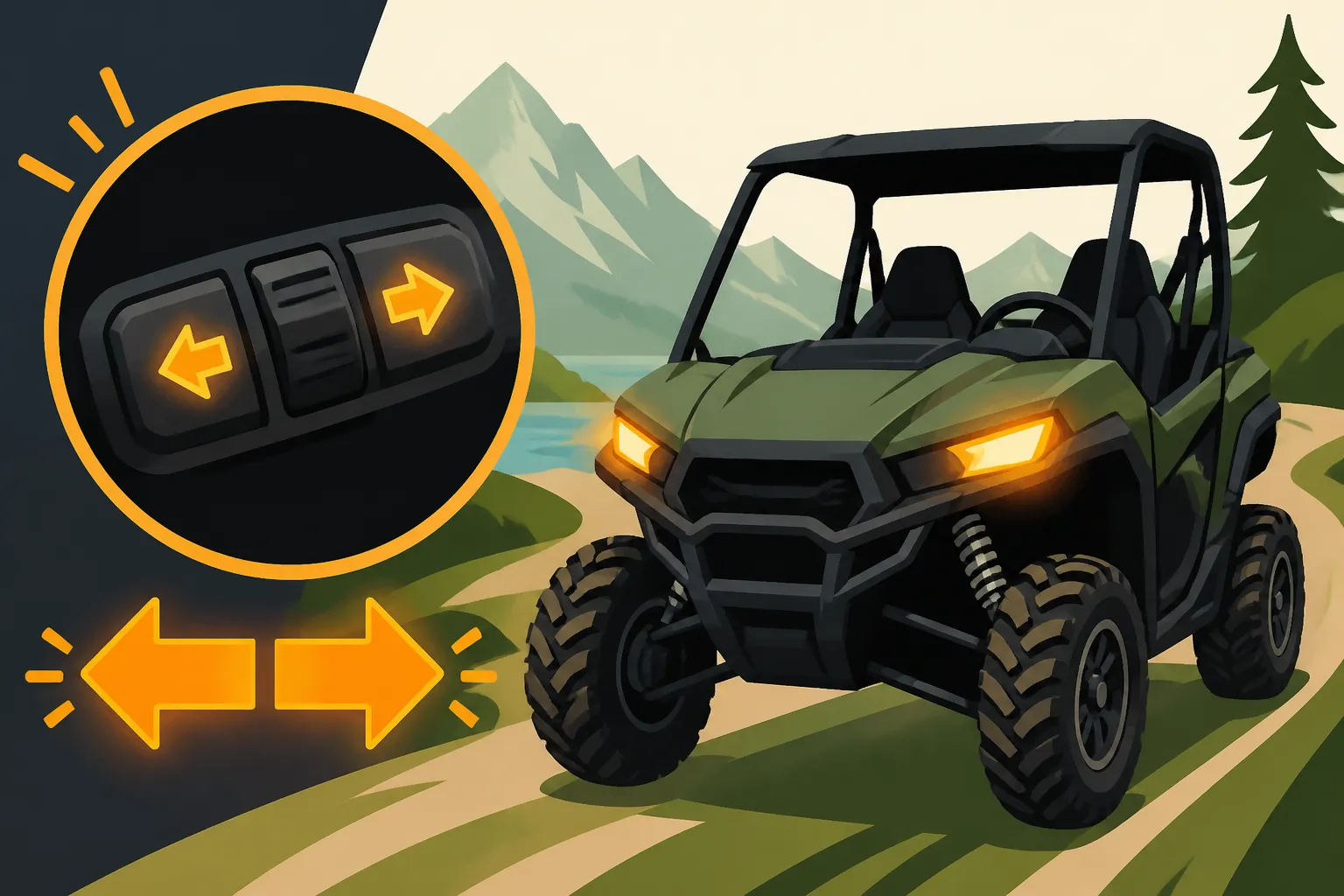
Turn Signals on an Idaho Restricted Vehicle
Riding your ATV or UTV on Idaho's scenic county roads offers an incredible way to link trails, access remote campsites, or simply explore our beautiful state. However, the convenience of a restricted vehicle plate comes with a clear set of responsibilities and equipment requirements. Many riders find themselves scratching their heads over what exactly constitutes a "street legal" setup, especially when it comes to crucial safety features like turn signals. This guide is here to untangle the confusion and walk you through everything you need to know about equipping your off-highway vehicle (OHV) with proper turn signals for legal road use in Idaho, helping you ride confidently and stay within the law.
The Essential Requirement for Idaho Road Riding
Hitting the pavement on your ATV or UTV in Idaho, even for short stretches between trail systems, means transforming your off-road machine into something that can safely and legally share the road with traditional traffic. This isn't just a suggestion; it's a critical safety and legal mandate. One of the most common oversights, and often a point of frustration for riders, involves proper signaling.
Why Turn Signals Aren't Optional on the Road
Think about it from the perspective of other drivers on the road. When you're in your pickup truck, you signal your intentions – left turn, right turn, lane change – well in advance. This allows others to react predictably and helps prevent accidents. The same principle applies when your OHV is operating on a public road. Without clear, visible turn signals, you're leaving other motorists guessing, which is a recipe for mishaps, especially on blind curves or busy intersections common in Idaho's rural areas.
While your machine might be perfectly suited for rugged trails and backcountry exploration without any signaling equipment, the moment your tires touch a paved or maintained gravel county road that's open to OHV use, the rules change. Idaho law is explicit: if you're going to operate an OHV on designated public roads, you need to meet minimum safety equipment standards. These standards are designed to ensure your visibility and your ability to communicate your actions to others. Turn signals are a non-negotiable part of this package, transforming your trail machine into a more road-aware vehicle. Without them, you're not only putting yourself and others at risk but also opening yourself up to unnecessary citations and fines.
What an Idaho Restricted Vehicle Plate Means
For many Idaho riders, the goal is to get that coveted "R" plate – the Idaho Restricted Vehicle Plate – that allows their ATV or UTV to legally traverse county roads. This plate is a game-changer for accessing trailheads, connecting segments of a ride, or simply heading into town for supplies without having to load your machine onto a trailer every time. However, it's crucial to understand that simply having the plate on your machine isn't the end of the story; it's just the beginning of your journey to road legality.
The [Idaho's Restricted Vehicle Plate Explained] outlines that this plate signifies your vehicle can be operated on public roads, but only if it meets specific equipment criteria. It's not a blanket pass to ignore standard road safety features. The "R" plate is a privilege, and with that privilege comes the responsibility of ensuring your machine is properly outfitted. This includes, but isn't limited to, working headlights, taillights, brake lights, a horn, mirrors, and, yes, fully functional turn signals. These requirements are in place to make sure that while you enjoy the freedom of road access, you do so in a manner that ensures safety for everyone sharing those roads. When you order your [Ordering an Idaho Restricted Plate], you're committing to meeting these standards. Remember, the plate itself doesn't make your machine road legal; the proper equipment does. You should also be aware of [Idaho Plates That Begin With R] and what they signify for road use.
Navigating the Specifics of Turn Signal Systems
Once you understand that turn signals are a must-have for Idaho road riding, the next step is figuring out how to get them onto your machine. Most ATVs and UTVs aren't equipped with turn signals from the factory, especially if they're primarily designed for off-road use. This means you'll almost certainly be looking at an aftermarket solution.
Aftermarket Kits and Their Components
The good news is that the aftermarket industry has recognized this need, and there are countless turn signal kits specifically designed for OHVs. These kits vary in complexity, features, and price, but they all serve the same fundamental purpose: to provide clear, visible indication of your turning intentions.
You'll find kits that range from simple toggle switches that you manually flip on and off, to more integrated, automotive-style column-mounted switches. Some advanced kits even offer self-canceling features, mimicking what you'd find in a car, which can be a real convenience when you're focusing on the road. A typical kit will include several key components: the actual lights (usually amber LEDs, which are bright and draw minimal power), a wiring harness designed to connect everything, a flasher relay to make the lights blink, and the control switch itself. Many riders turn to reputable brands like SuperATV for their comprehensive kits, which are often designed for specific makes and models of OHVs, simplifying the selection process considerably. When choosing a kit, consider your machine's electrical system, your comfort level with installation, and how discreet or integrated you want the final look to be.
Installation Considerations and Best Practices
Installing a turn signal kit can be a rewarding DIY project if you're comfortable with basic wiring, or it can be a task for your trusted powersports dealer. The process generally involves mounting the amber lights prominently on the front and rear of your machine, ensuring they're visible from various angles. This might mean drilling small holes in fenders or body panels, so careful planning is key. You'll then route the wiring harness, connecting the lights, the flasher relay, and the control switch to your machine's 12-volt power source.
Clean wire routing is essential, not just for aesthetics but also to protect the wires from snags, abrasion, and the elements inherent in OHV riding. Zip ties, loom tubing, and careful attention to pinch points are your friends here. Once everything is wired, it's critical to test the system thoroughly: left turn, right turn, emergency flashers (if included). Ensure all lights are blinking at a consistent rate and are clearly visible both day and night. If you're considering a DIY install, kits from companies like SuperATV often come with detailed instructions, but don't hesitate to seek professional help if wiring isn't your strong suit. A poorly installed system isn't just frustrating; it can be unreliable, potentially leaving you without signals when you need them most, or even causing electrical issues with your machine.
Visibility and Legal Compliance
Beyond just having turn signals, Idaho law and basic common sense demand that they are effective. This means they need to be clearly visible to other drivers, even in bright sunlight or at dusk. Most aftermarket kits provide amber-colored lights, which is the standard color for turn indicators and easily distinguishable from brake lights or headlights.
Placement is also paramount. You need lights positioned on both the front and rear of your machine, spaced appropriately to give a clear indication of width and direction. For instance, mounting front signals too close to the center might not effectively communicate your intention to someone approaching from the side. Likewise, rear signals need to be high enough and wide enough to be seen above any cargo you might be carrying or around any dust kicked up by your tires. When you’re considering [Lighting Rules for Riding After Dark in Idaho], remember that turn signals are just one piece of the puzzle, but their visibility is crucial for safety. Always do a walk-around check before you head out on the road to ensure all your lights, including your turn signals, are functioning correctly and are free from mud or obstructions that could diminish their visibility.
Beyond Just the Signals: Other Road-Legal Requirements
Turn signals are a fundamental piece of the puzzle, but they are by no means the only requirement for legally operating your OHV on Idaho's public roads. To truly be street-legal with your restricted vehicle plate, you need to ensure your machine meets a comprehensive set of equipment standards.
The Full Equipment Checklist for Idaho Roads
Think of your ATV or UTV, when on a county road, as a smaller, more specialized vehicle that still needs to conform to many of the same safety expectations as a car or truck. Here's a breakdown of what Idaho typically requires beyond just those turn signals:
- Headlights: You need at least one, but usually two, functioning headlights. They must illuminate the road ahead for a specified distance and be properly aimed. For night riding, this is absolutely essential.
- Taillights: At least one red taillight, visible from the rear, is required. This ensures your machine can be seen by vehicles approaching from behind.
- Brake Lights: These are crucial for indicating when you're slowing down or stopping. They should be red and activate automatically when you apply the brakes. Many taillights incorporate brake light functionality. You can read more about [Taillight and Brake Light Requirements].
- Mirrors: You need at least one rear-view mirror, mounted to allow you to see at least 200 feet to the rear. Many riders opt for two mirrors, one on each side, for better visibility, especially with wider side-by-sides. Check out [Mirrors on a Road-Legal Side-by-Side] for more detail.
- Horn: A working horn is mandatory for signaling warnings to other drivers or pedestrians. It needs to be audible from a reasonable distance. [Horn Requirements for Road Use] covers this specific need.
- Spark Arrester: While not directly a road safety item in the same vein as lights, a spark arrester is typically required for any OHV operating on public lands in Idaho, which includes many of the roads you might be riding. This is critical for preventing wildfires.
- Muffler: Your machine must have an adequate muffler to keep noise levels within legal limits. Excessive noise can lead to citations and is a common complaint from residents in trail towns.
- Registration/Sticker: Your OHV must be properly registered and display an Idaho OHV sticker, in addition to the Restricted Vehicle Plate.
Remember, having all these components working together ensures you're not just compliant, but also as safe as possible when sharing the road. Understanding [What Idaho Requires to Ride a County Road] is paramount for any rider.
| Equipment Type | Requirement for Idaho Restricted OHV | Notes |
|---|---|---|
| Turn Signals | Yes, front and rear, amber, visible | Crucial for communicating intentions to other road users. |
| Headlights | Yes, at least one, properly aimed | Essential for visibility to others and illuminating the road ahead. |
| Taillight(s) | Yes, red, visible from rear | Ensures you are seen from behind, especially in low light. |
| Brake Light(s) | Yes, red, activates with braking | Signals deceleration or stopping to following vehicles. |
| Rear-view Mirror | Yes, at least one, 200ft visibility | Allows rider to monitor traffic approaching from behind. |
| Horn | Yes, audible from reasonable distance | Used for warning others of your presence. |
| Spark Arrester | Yes | Prevents wildfires; typically required on public lands. |
| Muffler | Yes, adequate to meet noise limits | Reduces exhaust noise to acceptable levels. |
| Restricted Plate | Yes, properly mounted | Required for legal operation on designated public roads. [Mounting a Restricted Plate on a Side-by-Side] offers guidance. |
| OHV Sticker | Yes, current and displayed | Annual registration for OHV use on public land and designated roads. |
Why Ignoring the Rules Can Be Costly
It’s easy to think that skipping a few items on the checklist won't matter, especially on a quiet backroad. However, ignoring Idaho's road-legal requirements for your OHV can lead to a cascade of negative consequences that far outweigh the convenience or cost savings of not installing proper equipment.
First and foremost are the safety risks. Riding without turn signals, for example, means you can't clearly indicate your turns, increasing the likelihood of a collision with another vehicle. No working brake lights could mean a rear-end collision. These aren't just minor fender benders; an OHV offers far less protection than a closed-cab vehicle, making accidents potentially much more severe for the rider and passengers.
Beyond safety, there are legal and financial penalties. Law enforcement in Idaho, including local sheriffs and Fish and Game officers, are increasingly visible on popular OHV routes and connecting county roads. They are well-versed in the specific requirements for restricted vehicles. Getting pulled over for lacking required equipment like turn signals or mirrors can result in citations, which carry fines. These fines can quickly add up, easily exceeding the cost of installing the equipment in the first place. You could face [Idaho Fines for Illegal Road Riding] for various infractions, and a [Idaho Penalties for a Missing Restricted Plate] is another common issue. Repeat offenses or more serious violations could even impact your driving privileges or lead to your machine being impounded. Don't let a simple oversight turn a fun ride into a costly headache.
Common Questions and Troubleshooting
Even with the best intentions, riders often have questions or run into issues when making their OHV road-legal. Here are some of the most common scenarios and advice to navigate them.
What if My Machine Came With No Turn Signals?
This is the most common scenario for ATV and UTV owners. Unless you purchased a machine specifically designed and sold as "street legal" from the factory (which is rare for true OHVs), it almost certainly won't have turn signals. Older machines or those imported from out of state are particularly likely to lack this feature.
The solution, as we've discussed, is a quality aftermarket turn signal kit. Don't assume that because your machine is older or was previously registered in another state that it's exempt from Idaho's current requirements. When you apply for an Idaho Restricted Vehicle Plate, you are agreeing to meet Idaho's standards. For machines not originally equipped, a quality aftermarket kit, perhaps from a well-known supplier like SuperATV, is the standard solution. These kits are designed to integrate with your existing electrical system and provide all the necessary components. It's an essential upgrade, not an optional add-on, for road use.
Hand Signals vs. Mechanical Signals
A common question that arises is whether hand signals can suffice in place of mechanical turn signals. While hand signals (like extending your arm straight out for a left turn, or bent at the elbow for a right turn) are recognized in the Idaho Driver's Manual for cars and trucks in certain situations (e.g., if your mechanical signals fail), they are generally not an acceptable substitute for required mechanical turn signals on an OHV designated for road use.
Idaho's regulations for restricted vehicles are specific about having functional equipment. Hand signals, while a good backup and always a smart habit to use in addition to your mechanical signals for increased visibility, are simply not enough on their own to fulfill the legal requirement. Imagine trying to make a hand signal while navigating a bumpy gravel road, managing a clutch (if applicable), or controlling your machine with one hand on the steering wheel or handlebars. It's often impractical and can reduce your control over the vehicle. For safety and legal compliance, always ensure your mechanical turn signals are installed and working.
Ensuring Your System Works When It Matters
Installing turn signals is one thing; ensuring they work every time you need them is another. OHVs operate in harsh environments – dust, mud, water, vibrations – all of which can take a toll on electrical components. Regular maintenance and pre-ride checks are vital.
Before every road ride, make it a habit to do a quick walk-around check:
- Activate both left and right turn signals: Ensure all front and rear lights are blinking brightly and consistently.
- Check the flasher relay: Listen for the tell-tale clicking sound to confirm the relay is working.
- Inspect wiring: Look for any frayed wires, loose connections, or signs of corrosion, especially where wires connect to the lights or the main power source.
- Clean lenses: Mud or dust on the lenses can significantly reduce light output, making your signals less visible.
Common issues can include a blown fuse (always carry spares!), a failing flasher relay, or loose connections due to vibrations. Even with robust systems from brands like SuperATV, regular checks are crucial to ensure everything is in working order before you hit the pavement. Taking a few moments to verify your turn signals, along with all your other road-legal equipment, means you can ride with confidence, knowing you're safe and compliant with Idaho law.
Disclaimer
This article is for general informational purposes only and does not constitute professional advice. Laws, prices and regulations vary by location and change over time. Consult a qualified professional for guidance on your specific situation.