Montana Registrations and Idaho Trails
A Montana registration can make your ATV or UTV legal in Montana, but it does not automatically clear it for Idaho trails. Before crossing the state line, sort out what your Montana paperwork covers, whether Idaho requires a separate OHV sticker, and which roads or public lands you plan to use. That small bit of planning can prevent a turn-around—or a citation—after you unload.
What a Montana registration does and does not cover
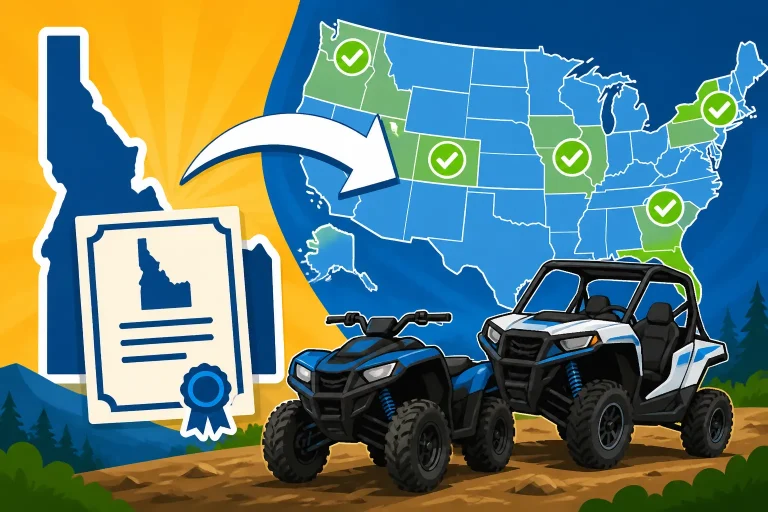
A Montana registration, plate, or decal is useful proof that your machine is registered under Montana’s rules. It is not a universal pass for riding in another state. Idaho has its own OHV permit requirements, and riders should not assume that a Montana sticker or plate substitutes for an Idaho permit.
For a Montana resident bringing an ATV, side-by-side, or dirt bike to Idaho, the practical starting point is this: plan on needing an Idaho nonresident OHV sticker when riding an OHV on Idaho public land. Idaho and Montana do not have the broad reciprocity riders sometimes expect. For background on how that situation came about, see Why Idaho Ended OHV Reciprocity.
It helps to separate three different kinds of paperwork:
- Montana registration or title: Documents connected to ownership and registration under Montana rules.
- Idaho OHV sticker or permit: Idaho’s requirement for eligible OHVs being operated in places where the state requires it.
- Road-use credentials: A license plate, equipment, insurance, driver eligibility, and local authorization that may be necessary for a particular road.
One document does not automatically replace the others. A Montana plate does not make every Idaho road open to your UTV, and an Idaho OHV sticker does not turn an off-highway vehicle into a road-legal vehicle. Likewise, a title proves ownership; it does not prove that the machine is permitted for a particular ride.
| What you have | What it may help establish | What it does not automatically establish |
|---|---|---|
| Montana title | Ownership or a record of ownership | Permission to ride Idaho trails |
| Montana registration or plate | Registration under Montana rules | Idaho OHV sticker coverage or access to every Idaho road |
| Idaho nonresident OHV sticker | Compliance with an Idaho OHV permit requirement when applicable | Road legality, trail access during a closure, or permission to cross private land |
| Landowner permission | Permission to ride on that owner’s land | Permission to ride adjacent public land or cross other property |
| A map or GPS route | A planned route | That every segment is currently open to your machine |
This distinction matters most with a plated side-by-side. Owners sometimes see the Montana plate and assume Idaho will treat the machine like a highway vehicle everywhere. Don’t rely on that assumption. The machine’s classification, the road’s status, local rules, and the required safety equipment all matter. A plate may be relevant to road use, but it is not a shortcut around Idaho’s OHV and access rules.
If your machine has a Montana registration but no Idaho sticker, the safest plan is to resolve the permit question before riding—not after arriving at a trailhead. The overview at Idaho’s Non-Resident OHV Sticker explains the permit category, while Do Montana Riders Need an Idaho Sticker? focuses on the question Montana visitors commonly ask.
Where you plan to ride changes the answer
“Idaho trails” can mean public forest roads, designated OHV routes, state-managed land, a private ranch, or a road through a town. Those places do not all follow the same access rules. Before the trip, identify the actual route and land manager rather than relying on a broad description such as “open trails near the campground.”
Public land
For an ATV, UTV, or dirt bike used on Idaho public land, treat the Idaho nonresident OHV sticker as a separate requirement from Montana registration. The sticker is tied to Idaho’s permit system; the Montana paperwork does not by itself establish that you have met the Idaho requirement.
Start with the area’s official route information. Check the relevant agency’s current map, road or trail designation, seasonal restrictions, and closure notices. A route shown on a general map may be closed to motorized use, limited to certain machine widths, or open only during a particular season. The general guidance in Idaho Permit Rules on Public Land is a useful companion, but route-specific information still matters.
Do not assume that a forest road is automatically open to your particular machine. Forest Service and BLM routes can have different designations, and a road that is open to a highway-registered vehicle may not be open to every OHV. Review Idaho Rules on Forest Service Roads or Idaho Rules on BLM Roads for the land manager involved.
Private land
Private land is different, but “private” does not mean “go anywhere.” You need permission from the landowner, and the permission only covers the property and use the owner has authorized. It does not grant access across neighboring land or onto a public trail beyond the boundary.
If your ride starts on private land and then uses a public road, trail, or forest route, check the rules for that public section. Don’t treat a ranch exemption or permission from one owner as a blanket exemption for the rest of the trip. For a more specific look at private-property situations, see [Idaho Rules on Private Land].
County roads and other roads
Road riding requires its own check. A road may allow some types of OHVs under local rules, while another road nearby may be closed. Even when a county road is open to a restricted vehicle, the rider may need the right plate or registration, required equipment, insurance, and an eligible driver.
A Montana plate alone does not answer those questions. Nor does an Idaho OHV sticker. Before planning a road connection between trail sections, check whether that exact road is open and what the county or other road authority requires. Idaho’s Restricted Vehicle Plate and Road Use explains why a restricted plate and an OHV sticker are not interchangeable.
A simple route plan should mark each segment as one of the following:
- A designated OHV trail or route.
- A public road with specific OHV access rules.
- Private property where you have permission.
- A segment that is closed, restricted, or still unverified.
If you cannot confirm a segment, don’t build your ride around it. Choose a route with verified access instead.
How to prepare your Montana machine before leaving
A smooth trip starts with the machine and paperwork, not just the trailer. Use this checklist before travel, especially if you are bringing several vehicles or riding with a group.
1. Identify each machine correctly
Make a list of every ATV, UTV, or dirt bike you plan to bring. Note the make, model, VIN or serial number, and Montana registration status. If your group has a street-registered side-by-side, an unplated ATV, and a dirt bike, do not assume the same rule applies to all three.
The machine’s category matters. A highway-registered vehicle, an OHV, and a machine used only on private land can raise different questions. When in doubt, describe the actual machine and intended use when checking with Idaho Parks and Recreation or the relevant official registration or permit office.
2. Check the Idaho permit requirement for each OHV
Confirm that your machine falls within the nonresident permit rules and whether each machine needs its own sticker. Do not assume that one sticker covers a family’s whole trailer load or that a Montana registration decal is accepted as an Idaho permit.
Use an official Idaho source or an authorized seller to confirm the current permit options, eligibility, validity period, and display instructions. The details can change, so avoid relying on an old receipt, a forum post, or a friend’s memory. Where to Buy an Idaho Non-Resident Sticker describes the usual purchase routes, and [Buying an Idaho Sticker Online] can help if you want to handle the permit before departure.
Buy through an official or authorized channel. A generic off-road decal or a marketplace listing is not proof of an Idaho permit. For example, Amazon may be useful for accessories such as a compact document pouch, but a decorative sticker purchased there is not a substitute for the state’s permit.
3. Follow the display instructions
When you receive the permit, read its instructions before applying it. Place it exactly where directed and make sure it is visible and secured. Don’t put it on a removable cover or a surface likely to be scraped off while loading, washing, or riding.
If you use a plate or mounting bracket, check that the permit remains readable and that the plate is mounted as required for the machine and intended use. A replacement bracket or small hardware kit from a retailer such as Amazon may help with a damaged mount, but installing one does not change the legal placement instructions.
Carry the supporting documents you may reasonably need, such as registration information and proof of purchase for the Idaho permit. Keep copies somewhere protected from water and mud. A small document sleeve from Amazon can be handy in a tow vehicle or gear bag; don’t assume a loose paper copy replaces a required sticker on the machine.
4. Check safety rules for every rider
A permit does not waive rider rules. If children or teens are coming, confirm the current age, supervision, helmet, and safety-course requirements that apply to the route and type of riding. Idaho’s rules may depend on the rider’s age and where the machine is operated. The overview at Idaho’s OHV Safety Course for Young Riders is a useful starting point for families.
Also check the machine itself. Make sure it is appropriate for the route, that passengers have proper seats and restraints where applicable, and that required equipment is working. A route may be legal for an OHV generally but unsuitable or closed for a wide side-by-side.
5. Verify the route shortly before departure
Trail status can change with snow, runoff, fire activity, maintenance, wildlife concerns, or local decisions. A route that was open when you booked lodging may not be open when you arrive. Check the managing agency’s current information, and carry a map or downloaded route data for areas with unreliable cell service.
A paper map can still be useful when a phone loses signal. If you pick one up through Amazon or another retailer, treat it as a planning aid—not as current proof that a route is open. Confirm closures and designations with the responsible agency.
Common assumptions that cause trouble
The most preventable problems usually come from treating one kind of paperwork as if it answers every question.
“My Montana plate means I don’t need an Idaho sticker”
This is the central mistake. A Montana registration or plate does not automatically satisfy Idaho’s nonresident OHV permit rules. Confirm the Idaho requirement for the machine and where you will ride. If you are using an ATV, UTV, or dirt bike on Idaho public land, do not leave the sticker question until you reach the trailhead.
“The Idaho sticker makes my machine street legal”
It does not. The sticker addresses an OHV permit requirement; it is not a road-use conversion. Road access can depend on the particular road, local authorization, vehicle configuration, required equipment, driver eligibility, and insurance. Read Idaho’s Restricted Vehicle Plate and Road Use before planning a ride that uses public roads.
“A road is open because it appears on my GPS”
A GPS route, downloaded track, or commercial map may show a road without telling you whether it is currently open to your machine. It may also fail to show seasonal restrictions, a local closure, or a change in land ownership. Verify the route with the managing agency and obey signs and barriers on the ground.
“The sticker covers everyone in the group”
A permit generally relates to the machine, not to a group as a whole. If several OHVs are traveling together, confirm the requirement for every machine. A passenger does not usually need to buy a separate machine sticker simply for riding as a passenger, but passengers still need to follow applicable age, helmet, and seating rules. For a borrowed machine, check Stickers for a Borrowed Machine rather than assuming the owner’s paperwork settles every question.
“I can sort it out at the trailhead”
That can leave you searching for a vendor when the group is ready to ride. Sales locations and hours vary, and remote trailheads may have no nearby service. Buy in advance when possible, or confirm a convenient authorized seller along your route. Make sure you understand whether the permit is issued immediately, how it must be displayed, and what proof to keep.
A practical pre-ride decision process
Use this short sequence for each Montana-registered OHV in your group:
- Classify the machine. Is it an ATV, UTV, dirt bike, or a highway-registered vehicle? Write down the machine’s registration status and intended use.
- Mark the planned riding areas. Separate public OHV trails, public roads, and private property. Get permission for private land and confirm the status of every public segment.
- Check Idaho’s nonresident permit rule. If the machine is an OHV being used on Idaho public land, verify whether it needs an Idaho nonresident sticker. Do not treat the Montana plate as an automatic exemption.
- Purchase through an authorized source. Confirm current availability, term, and instructions directly with the official program or seller.
- Apply and document. Display the sticker as directed and keep relevant registration and permit records protected.
- Check road and rider rules separately. Confirm road access, vehicle equipment, driver requirements, and youth rules for the actual route.
- Recheck conditions before unloading. Look for current closures, signs, weather impacts, and changes in access.
If your situation is unusual—such as a machine that is fully street-registered, used only on private land, rented, or registered to someone other than the rider—ask an Idaho authority or the relevant land manager about that exact situation. A clear description of the machine and planned route will get you a more useful answer than asking only whether “Montana plates are okay.”
For most Montana visitors, the simplest approach is to keep the paperwork in separate mental boxes: Montana registration for Montana requirements, an Idaho nonresident sticker where Idaho requires it, and separate confirmation for road access. That way, a plate does not create false confidence, and a sticker does not create false expectations about where you can ride.
Disclaimer
This article is for general informational purposes only and does not constitute professional advice. Laws, prices and regulations vary by location and change over time. Consult a qualified professional for guidance on your specific situation.