Why Idaho Followed Its Neighbors on Reciprocity
Visitors often assume an OHV sticker from home will cover them across the Idaho border. That used to be a reasonable question under reciprocity agreements, but Idaho moved to its own nonresident permit system after those arrangements stopped providing consistent coverage. Here’s why that shift happened, what “following its neighbors” means, and what out-of-state riders should check before unloading.
What reciprocity meant for OHV riders
Reciprocity is a practical arrangement between jurisdictions: one state recognizes another state’s registration or permit for a particular kind of use. For an ATV or UTV rider, it can mean that a sticker or registration purchased at home is accepted when riding on public land in another state, rather than having to buy a second permit.
That convenience depends on the states involved agreeing to recognize each other’s systems. It is not automatic just because two states share a border, and it does not necessarily mean every kind of registration is accepted for every kind of riding. A state may recognize a neighboring state’s OHV permit on certain public trails while still requiring separate registration, a road-legal plate, or other documents for different uses.
Idaho’s former reciprocity arrangements made cross-border riding simpler for some visitors. But reciprocity only works when the participating states’ rules continue to line up. When states use different permit systems, change what they require from visitors, or stop accepting each other’s credentials, the old arrangement can become uneven. An Idaho rider could find that a home-state credential did not provide the same access elsewhere that an out-of-state credential provided in Idaho.
That mismatch is the basic policy problem behind Idaho’s move to a nonresident sticker system. Rather than relying on a patchwork of agreements that might treat riders differently depending on where they were from, Idaho established a separate permit requirement for nonresident OHVs using places where Idaho requires a permit.
The change does not mean a visitor’s home-state registration is meaningless. It may still be needed to operate the machine legally at home, and it can help identify the machine and its owner. It simply may not substitute for Idaho’s permit. For background on the change itself, see Why Idaho Ended OHV Reciprocity and The Non-Resident Rule That Started in 2020.
It also helps to separate three things riders often call “registration”:
- Home-state registration or title: Documents that identify the machine or satisfy the rules where it is registered.
- An Idaho nonresident OHV sticker: Idaho’s permit for qualifying nonresident machines in areas where an Idaho sticker is required.
- A road-use plate or authorization: A separate matter that may be necessary for a specific road, and does not automatically make every road open to OHVs.
Having one of these does not automatically provide the other two. A machine with a state plate, for example, still needs to meet the rules for the particular road or trail. And an Idaho OHV sticker is not blanket permission to ride on closed land, private property without permission, or any route that is not open to the machine.
Why Idaho moved toward its neighbors’ approach
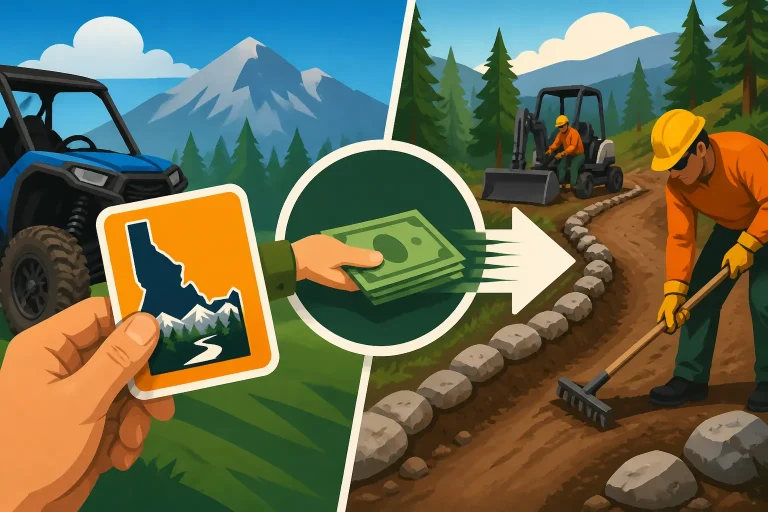
The short version is consistency and fairness between residents and visitors. Idaho has a substantial network of public riding opportunities, and maintaining access involves costs: signs, trail work, route management, enforcement and related recreation services. If Idaho residents paid into a local system while some visiting riders could use the same public riding areas under a different state’s credential, the arrangement could feel unbalanced—especially if Idaho’s own riders did not receive equivalent treatment elsewhere.
A nonresident permit gives Idaho a way to set a clear rule for visitors and collect permit revenue under its own system. It also avoids relying on the assumption that every neighboring state will continue recognizing Idaho credentials in the same way. That is a more predictable basis for planning than a reciprocal arrangement whose terms depend on multiple jurisdictions.
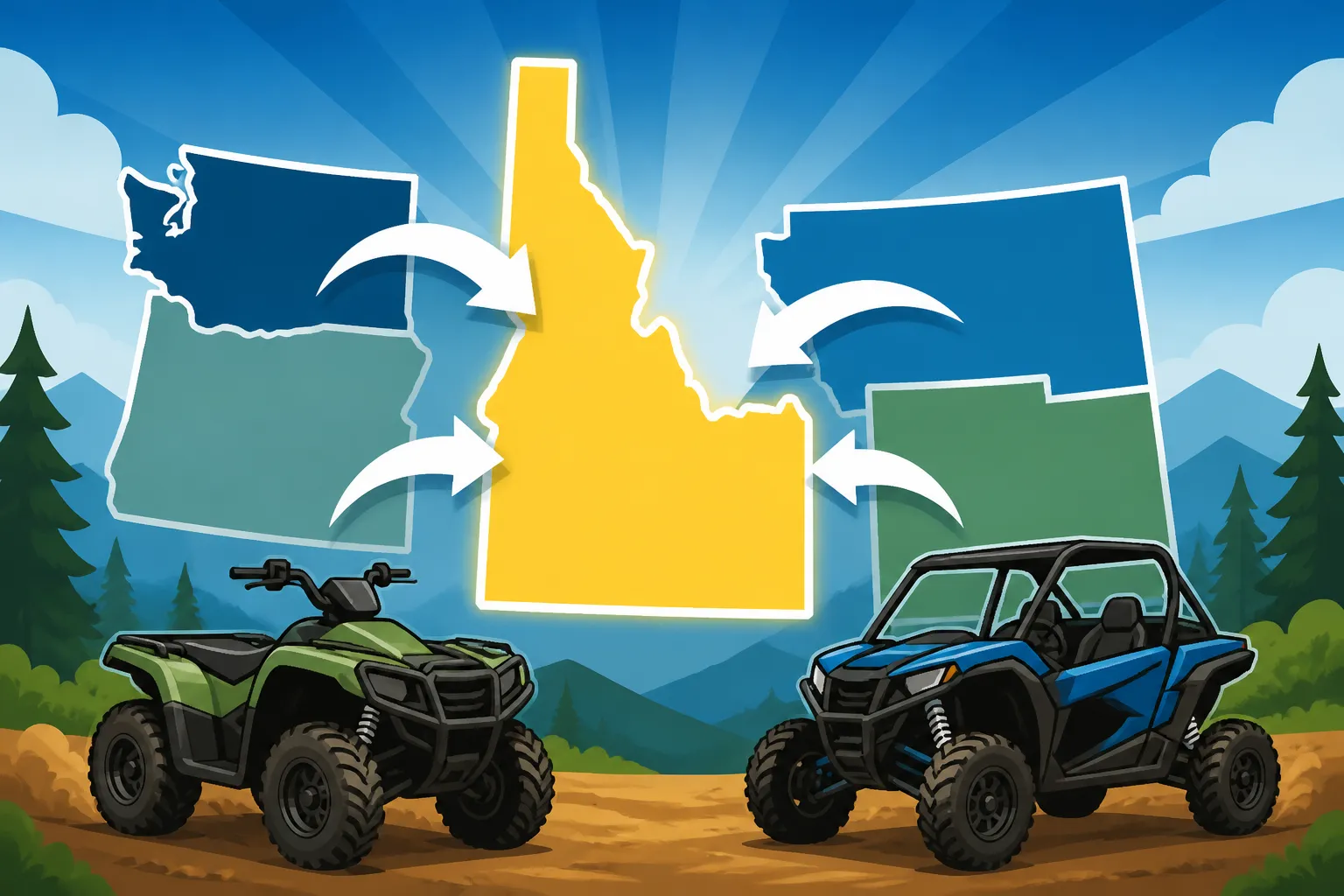
“Following its neighbors” should not be read as Idaho copying one identical policy from every surrounding state. States can use different names, fees, registration periods, eligibility rules and exemptions. A visitor may encounter a sticker system in one state, a state registration requirement in another, and a local land manager’s separate restrictions on a particular trail. The common direction is that riders should expect to meet the destination state’s permit rules instead of assuming a home-state sticker travels everywhere.
| What riders may assume | What to check instead |
|---|---|
| “My state sticker works in Idaho because we share a border.” | Whether Idaho currently requires a nonresident permit for the machine and where you plan to ride. |
| “A plate means I do not need an OHV sticker.” | Whether the plate covers the particular route and whether a separate OHV permit is required. |
| “A sticker lets me ride any public trail.” | Whether the trail is open to your vehicle type, width, season and intended use. |
| “A permit bought in one state must be accepted in the next.” | Each destination state’s current rules; reciprocity is not universal. |
| “The sticker is just paperwork.” | What the permit covers, where it must be displayed, and whether it must be carried with other documents. |
Idaho’s approach also makes the requirement easier to explain at a trailhead or during an enforcement stop. Riders can be directed to one Idaho permit rule instead of having to establish whether a particular out-of-state credential qualifies under an older agreement. That clarity is useful for visitors, vendors and land managers, even though it means some riders must buy an additional permit before riding.
There is a trade-off. Reciprocity reduces friction for people who regularly ride across state lines. A separate permit can add a step and a cost for visitors, particularly those who own machines registered in another state. But a state-specific permit is also more direct: it ties a visitor’s access to the destination’s rules and provides a clear way to support the system being used.
For more on what the permit is and who it applies to, see Idaho’s Non-Resident OHV Sticker and What Idaho Charges an Out-of-State Rider. The details can differ by machine, location and use, so treat the sticker as one piece of trip preparation rather than proof that every part of your ride is authorized.
What the change means for riders coming from nearby states
For an out-of-state rider, the most useful adjustment is to stop treating a home-state sticker as an automatic substitute. Check Idaho’s requirement before the trip, even if you have ridden in Idaho before or have a machine registered in Montana, Oregon, Washington or another nearby state. The rules that matter are Idaho’s rules for the planned trip, not the fact that your home state has its own OHV program.
The same goes in reverse. An Idaho rider heading across the border should not assume an Idaho credential will cover the ride in the next state. If you are comparing rules for a particular state, start with the relevant guide, such as Do Montana Riders Need an Idaho Sticker?, Oregon Riders Coming to Idaho Trails or Washington Riders Coming to Idaho. Those questions focus on Idaho’s permit requirement for visitors from those states; they do not replace checking the destination’s route closures and land-use rules.
Before leaving home, work through these steps:
- Identify where you will ride. A public trail system, a county road, a private trail network and a private ranch can have different rules. A general statement about Idaho is not enough to establish access at a particular location.
- Confirm the machine’s status. Note whether it is an ATV, UTV, dirt bike or another OHV, and whether it has an out-of-state plate or registration. Do not assume a road-use credential and an OHV permit are interchangeable.
- Check the Idaho permit requirement. Confirm whether your machine needs an Idaho nonresident sticker for the areas on your itinerary, how to obtain it and where it must be displayed.
- Check the route separately. Verify that each trail or road is open to your machine’s width and type, and check seasonal closures. A valid sticker does not override a closure.
- Keep required documents accessible. Carry or retain any registration, proof of ownership, permit confirmation or other documents Idaho requires for your circumstances. Do not carry the title on the trail unless an official source specifically says that is needed.
- Recheck close to departure. Permit processes and local access conditions can change. Confirm the current rule through an official Idaho source or an authorized seller rather than relying on an old forum post or a previous trip.
The distinction between a permit and route access deserves emphasis. A sticker addresses the state’s permit requirement; it does not give permission to cross private land, ride in a wilderness area closed to motorized travel, ignore a seasonal closure, or use a road that a local authority has closed to OHVs. A route may be open to one kind of OHV and not another, or may be open only during a defined season. Check land-manager maps and local notices along with the permit information.
This is especially important on a cross-border itinerary. Riders may travel through several land-management areas in one day, and the rules can change at a county line, trail junction or boundary between public agencies. Keep a map that shows the route and any relevant closures. A GPS track is useful for navigation, but it is not proof that a trail is currently open.
How to avoid permit and reciprocity mistakes
The most common mistake is deciding that a machine is “registered” and treating that as the end of the paperwork. Instead, ask what the document actually does. Does it show ownership? Does it authorize road use? Does it satisfy Idaho’s OHV sticker requirement? Those are different questions.
A second mistake is buying a permit without confirming that it is the right one for the machine and trip. Follow the official instructions for the Idaho nonresident permit, including any rules about the permit term, display and eligible vehicle types. For current purchasing options, see [Buying an Idaho Sticker Online] or Idaho Permit Rules on Public Land. Check the provider for current terms and availability before relying on a particular seller.
A third mistake is assuming the permit alone makes the ride legal. Before riding, confirm the trail’s status, vehicle limits and land access. If your route includes roads, determine whether OHVs are allowed there and what additional equipment, documents or operator qualifications apply. What Idaho Riders Need Before They Ride is a useful starting point for the broader checklist.
Use this compact check before the first ride:
- Is the machine a type covered by the permit rule?
- Is the permit current and obtained through an authorized source?
- Is it displayed as directed?
- Is the planned trail or road open to that machine?
- Are there local restrictions, seasonal closures or private-property boundaries?
- Does the operator meet any age, supervision, safety-course or protective-equipment requirements that apply?
- Are any separate road-use, insurance or equipment rules relevant to the route?
If you are riding only on private property, do not automatically apply the public-land rule without checking the details. The rules can distinguish between public and private use, and a permission-based ride on private land is not the same as riding on a public trail. Review [Idaho Rules on Private Land] and When an Idaho Rider Needs No Sticker if that is your situation. Do not assume, however, that a short private-land segment excuses a permit for the public portion of a ride.
For riders who want a small practical organization kit, a waterproof pouch can keep permit paperwork, a route note and emergency contact details together. Amazon may be one place to look for a basic pouch, but it is not a source for an official Idaho permit. Buy the permit through an authorized channel, and verify that any document or sticker is handled as Idaho directs. If you use Amazon to find a phone or GPS mount, make sure it fits securely and does not block the controls or your view; a mount is no substitute for a paper backup in areas without service. An Amazon order confirmation for riding gear does not prove permit compliance, so keep the actual permit and required records separate and easy to find.
If the rule is unclear for a particular machine or route, ask the relevant Idaho agency or land manager before the trip. A seller may be able to explain how to purchase a permit, but a store receipt cannot settle whether a specific road or trail is open. Likewise, an online map can help with planning but should be checked against current official closure information.
What reciprocity does and does not change
Idaho’s move away from broad reciprocity changes the answer to one narrow question: whether a rider can rely on a credential from home instead of obtaining the Idaho permit. It does not erase the rest of the rules that govern an OHV trip.
It does not make an out-of-state machine illegal by itself. It does not replace the machine’s title or home-state registration. It does not convert an OHV into a street-legal vehicle. It does not grant access to every public trail, and it does not remove the need to follow local road restrictions or land-manager orders.
For Idaho riders, the lesson is also useful when traveling elsewhere: carry the documents required by the destination, not just the ones familiar at home. Reciprocity can still exist in some contexts, but it should be confirmed for the exact place and activity. A neighboring state may recognize one kind of credential for trail use and still require another for road use, or it may have no reciprocal recognition at all.
For visitors, the simplest routine is to check three things independently: the Idaho permit, the route’s current access status and any operator or equipment requirements. That takes a little more preparation than relying on an old reciprocal arrangement, but it reduces the chance of reaching a trailhead with the wrong sticker or discovering that a legal permit does not authorize the route you planned.
Idaho followed the broader shift toward state-specific visitor requirements because reciprocity had become an unreliable basis for equal treatment and straightforward administration. The practical rule for riders is plain: do not count on your home-state OHV credential to cover Idaho. Confirm the current Idaho permit requirement, obtain the right authorization through an official or authorized channel, and verify that the route itself is open before you ride.
Disclaimer
This article is for general informational purposes only and does not constitute professional advice. Laws, prices and regulations vary by location and change over time. Consult a qualified professional for guidance on your specific situation.