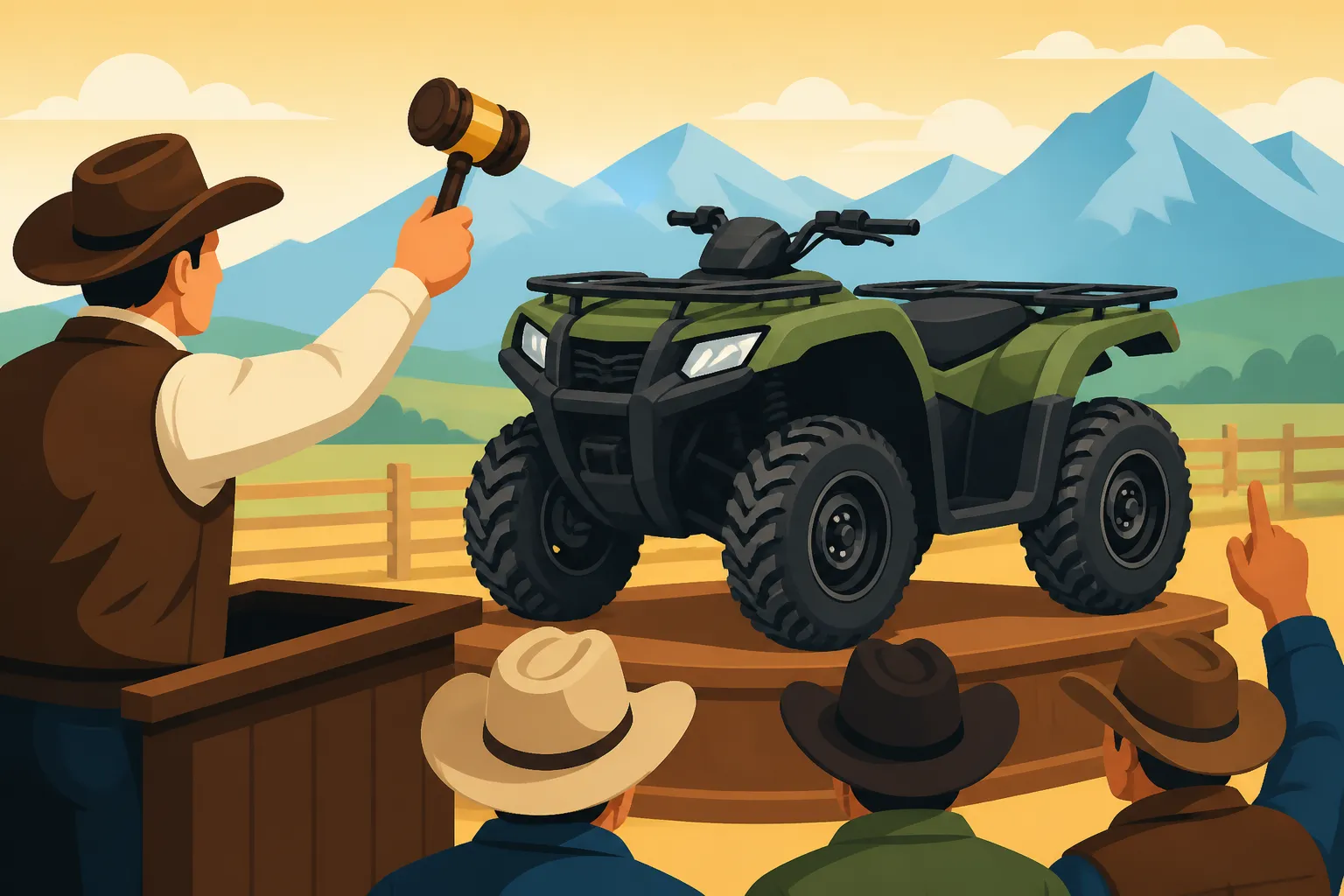
Buying a Quad at a Ranch Auction
Attending a ranch auction in Idaho for an ATV or UTV can feel like stumbling upon a hidden treasure chest. The appeal is undeniable: the chance to snag a powerful machine for work or recreation at what seems like an unbeatable price. However, the excitement can quickly turn to frustration and legal headaches if you're not prepared for the unique challenges that come with buying an off-highway vehicle (OHV) in this kind of "as-is" environment, especially regarding titles and paperwork. This guide will walk you through everything you need to know to navigate the ranch auction scene, from pre-bid inspection to post-purchase registration, ensuring you don't end up with a great deal that's a nightmare to make legal.
The Allure and Pitfalls of Ranch Auctions for OHVs in Idaho
There’s a certain romance to a ranch auction, isn't there? The auctioneer's rapid-fire patter, the anticipation, the genuine possibility of finding a sturdy side-by-side or a reliable quad that’s been used for honest work on the range. It can be incredibly tempting to see what looks like a well-kept machine go for a fraction of what a dealer might charge. But beneath that tempting surface lie unique challenges that savvy buyers need to understand before they even raise a paddle.
Why Ranch Auctions Can Be Tempting (and Risky)
On one hand, ranch auctions can be fantastic places to find robust, often well-maintained machines that have seen practical use rather than just recreational abuse. You might encounter older models that are built like tanks, or slightly used machines from a rancher who is simply upgrading their fleet. The prices can be significantly lower than retail, which is a huge draw, especially when you're looking to expand your collection or get into the OHV world without breaking the bank. Imagine finding a capable utility ATV that's perfect for hauling firewood or checking fence lines, all for a price that leaves room in your budget for accessories or maintenance.
However, the risks are just as real. Unlike buying from a reputable dealer, or even a private seller you can vet, an auction often offers very little in the way of recourse if something goes wrong. You're typically buying sight unseen, or with only a very brief opportunity for inspection. That "great deal" might hide significant mechanical issues that only surface once you get the machine home. Perhaps the engine has a slow leak you couldn't spot in the hustle of the auction yard, or the transmission slips under load – problems that can quickly eat up any savings you thought you made.
Understanding "As-Is, Where-Is" Terms
This phrase is the bedrock of almost every auction transaction, and it’s critical to understand what it truly means for an Idaho OHV buyer. "As-is, where-is" signifies that you are purchasing the item in its current condition, with all its existing faults, whether visible or not, and you are responsible for transporting it from its current location. The seller makes no warranties, expresses or implied, regarding the machine's condition, functionality, or fitness for any particular purpose.
This means if you buy a quad at an Idaho ranch auction and discover later that it needs a complete engine rebuild, the financial burden falls squarely on your shoulders. The auction house and the seller are typically absolved of responsibility once the hammer drops. This is why a thorough pre-inspection, as limited as it might be, is paramount. You are essentially taking a leap of faith, and you need to minimize that risk as much as possible by checking everything you can. This also applies to the paperwork. If a title is missing, or there’s a lien you weren't aware of, the "as-is" clause will likely mean you bought those problems right along with the machine itself.
The Realities of Title and Paperwork at Auction
Now, here’s where buying an OHV at an Idaho ranch auction gets truly complicated for many. In Idaho, any ATV or UTV with an engine size over 50cc generally requires a title. You can read more about this in [Idaho Titles Every ATV Over 50cc]. Many machines used exclusively on farms and ranches, especially older ones, may never have been titled in the first place, or their titles might be lost or simply forgotten. Ranchers might use these machines strictly on private property, never venturing onto public lands or roads, and therefore never felt the need to go through the titling process.
The auction house might not have the title in hand, and sometimes, the seller themselves might not even know where it is or understand its importance for a new owner looking to ride legally on public trails or roads. You might get a bill of sale, but a bill of sale alone is not a title, and without a title, registering for an Idaho OHV sticker becomes a massive hurdle. Imagine the frustration of buying a fantastic side-by-side, only to realize you can’t get it legally registered for the trails you planned to explore because you don't have the proper ownership document. This is a common pitfall and can lead to situations like those described in [Titling a Machine Without the Previous Owner]. It's crucial to understand that while an auction might transfer possession, it doesn't automatically transfer legal, provable ownership in the eyes of the Idaho DMV or county assessor without the correct paperwork.
Essential Pre-Auction Due Diligence for Idaho ATV Buyers
Before you even think about raising your hand at an Idaho ranch auction, you need to arm yourself with information and a critical eye. The short inspection window and the "as-is" nature demand a proactive approach to prevent buyer's remorse and costly surprises down the line.
Inspecting the Machine: What to Look For
When you get that brief window to look over the OHVs, use every second wisely. Start with a visual walk-around. Look for obvious signs of damage, such as bent frames, cracked plastics, or heavily worn tires. Are there any fresh paint jobs that might be hiding accident damage? Check the suspension components for leaks or excessive play. Jiggle the handlebars and wheels to feel for loose bearings.
Next, focus on the engine. Look for oil leaks, coolant leaks, or unusual corrosion. Pull the dipstick to check the oil level and color – dark, sludgy oil suggests poor maintenance. If possible, try to start the engine. Does it turn over easily? Does it idle smoothly? Listen for any knocking, tapping, or grinding noises that could indicate serious internal issues. Test the brakes, lights, and any other electrical components. Make sure the four-wheel drive engages if it's equipped. Don't forget to locate and verify the Vehicle Identification Number (VIN) on the frame; knowing [Where the VIN Sits on a Side-by-Side Frame] can save you time. This VIN is critical for checking the machine’s history and for titling later.
Confirming Ownership and Paperwork Availability
This is arguably the most critical step, especially at a ranch auction. Before you bid, you absolutely must attempt to confirm the availability of a clean, transferable title for the OHV. Speak directly with the auction house staff or the seller, if present. Ask them specifically if a title will be provided upon sale. If they say no, or seem unsure, consider that a major red flag. If they offer only a bill of sale, understand that you will face significant challenges when you attempt to title and register the machine in Idaho.
A private party bill of sale is helpful for establishing a paper trail, but it won't replace a title when you go to the county assessor. In Idaho, you generally need the signed-over title to prove ownership for a new title application. If the title is truly lost, the previous owner would ideally apply for a duplicate title before the sale. If you buy a machine without a title, you might find yourself in a complex situation, possibly needing to pursue a bonded title, which is an involved process with its own costs and requirements. Always try to run the VIN through a theft database or a reputable vehicle history service if you can, to ensure the machine isn't stolen and doesn't have any hidden liens. This simple check can save you immense heartache.
Budgeting for More Than Just the Bid Price
It’s easy to get caught up in the excitement of bidding and focus solely on the final hammer price. However, that’s rarely the total cost of acquiring an OHV at an auction. First, factor in the buyer's premium, which is a percentage added to the winning bid by the auction house – this can range from 10% to 18% or even more. Next, consider sales tax. In Idaho, you'll generally owe [Idaho Sales Tax on an ATV Purchase] on the purchase price, unless you have a valid exemption. If you bring a machine into Idaho from out of state, be aware of [Use Tax When a Machine Comes Into Idaho].
Beyond the purchase and taxes, you'll need to account for transportation costs to get the machine from the auction site to your home. If the machine isn't running, this might involve hiring a tow service or renting a trailer. Then, there's the inevitable maintenance and potential repairs. Even a machine that looks good on the surface might need new tires, fluids, filters, or brake pads. Always set aside a contingency fund, perhaps 10-20% of your maximum bid, specifically for these unexpected expenses. Don't forget the cost of getting an [What an Idaho OHV Sticker Costs Each Year] once you have a title. Overlooking these additional costs can quickly turn a "bargain" into an over budget purchase.
Navigating the Auction and Post-Purchase Steps in Idaho
You've done your homework, inspected the machines, and prepared your budget. Now it's time for the actual auction. This phase requires discipline and a clear understanding of the steps you need to take immediately after the sale to secure your new OHV properly in Idaho.
Bidding Smartly and Knowing Your Limit
The auction environment is designed to encourage competitive bidding, and it’s easy to get swept up in the moment. Before the auction even begins, decide on your absolute maximum bid for each machine you're interested in, and stick to it. This limit should incorporate all the additional costs we just discussed – buyer's premium, sales tax, potential repairs, and transportation. Don't let the thrill of the chase push you past your pre-determined ceiling. It's often better to walk away from a machine you truly want if the bidding goes too high than to overpay and regret it later.
Listen carefully to the auctioneer for any last-minute disclosures about the machine's condition or paperwork. Sometimes, a seller might reveal a known issue just before bidding starts, which should influence your maximum bid. Bid clearly and confidently, but always with your budget firmly in mind. Remember, the goal is a good deal, not just winning the bid.
Getting Your Proof of Purchase and Next Steps
Congratulations, the hammer dropped, and you're the proud new owner of an OHV! Your immediate priority is to get proper proof of purchase. Insist on a detailed bill of sale from the auction house or seller. This document should clearly state:
- The date of sale.
- The full names and addresses of both buyer and seller.
- A complete description of the OHV, including make, model, year, and most importantly, the VIN.
- The purchase price.
- A clear statement that the item is sold "as-is, where-is" (if that's the case).
- Signatures from both parties.
Even if you receive a title, a solid bill of sale is invaluable. If the title is missing, this bill of sale becomes your primary document to prove ownership and initiate the process of obtaining a new Idaho title. You can find templates for robust bills of sale through services like LawDepot, which can help ensure all necessary legal details are included for your protection. For more guidance on this, check out [ATV Bill of Sale Wording Buyers Should Insist On].
Once you have your bill of sale and, ideally, a signed-over title, your next step is to head to your local county assessor's office in Idaho to apply for a new title. This process is detailed in [Idaho OHV Title Application at the County Assessor]. You’ll need the bill of sale, the previous owner's signed title (if available), and possibly a VIN inspection. If you purchased without a title, this is where the real work begins, and you might need to consult with the assessor’s office about specific procedures for [Bonded Title for an ATV in Idaho].
Registering and Riding Your Auction Find in Idaho
After successfully obtaining an Idaho title in your name, you can finally proceed with registering your OHV. This involves purchasing an Idaho OHV sticker, which is required for riding on public lands and designated trails. You can learn more about this process and the costs involved in [What an Idaho OHV Sticker Costs Each Year]. Once you have your title and sticker, you're almost ready to hit the trails!
However, if you cannot obtain a title, your options for riding legally in Idaho become extremely limited. Without a title, you cannot get an OHV sticker, which means you cannot legally ride on public trails, forest roads, or any other public land where an OHV sticker is required. Your riding will be restricted to private property with permission from the landowner. Attempting to ride an unstickered machine on public land can lead to [Penalties for an Unstickered OHV in Idaho], including fines and potential impoundment. This is why the due diligence on title availability before the auction is so critically important. Don't let the excitement of an auction deal turn into the frustration of an OHV you can't legally ride where you want.
Auction vs. Other Purchase Methods: A Comparison
To help you weigh your options, here's a quick comparison of buying an OHV at a ranch auction versus other common methods in Idaho.
| Feature | Ranch Auction | Private Sale | Licensed Dealer |
|---|---|---|---|
| Price Potential | Often lowest prices, potential bargains. | Competitive, can find good deals. | Generally highest prices, less room for negotiation. |
| Inspection | Limited time, "as-is" basis, no test rides. | More thorough inspection possible, test rides often allowed. | Most thorough, pre-delivery inspection, warranties. |
| Paperwork/Title | Most uncertain, titles often missing/lost. | Varies, usually clear if seller is prepared. | Most reliable, dealer handles titling/registration. |
| Recourse | Minimal to none after sale. | Limited, "as-is" common, but direct contact with seller. | Strongest, warranties, consumer protection laws. |
| Selection | Unpredictable, whatever is consigned. | Varies widely by local listings. | Largest selection of new and often certified used machines. |
| Financing | Usually cash or pre-approved personal loan. | Cash or personal loan. | Dealer financing options available. |
| Sales Tax | Buyer pays directly to state/county. | Buyer pays directly to state/county (on purchase price). | Dealer collects and remits. |
| Convenience | Requires active participation, transport. | Arranging meetings, haggling. | "One-stop shop" convenience, can be quick. |
| Brand Mentions | Possible older, mixed brands. | Various brands. | LawDepot for documents, specific manufacturer brands. |
This table highlights why, while auctions can offer enticing prices, they come with the highest risk, particularly concerning the critical step of securing a proper title for your OHV in Idaho. Always consider your comfort level with potential administrative hurdles before committing to a bid.
Disclaimer
This article is for general informational purposes only and does not constitute professional advice. Laws, prices and regulations vary by location and change over time. Consult a qualified professional for guidance on your specific situation.