Do You Need a Sticker on Deeded Idaho Ground?
A deeded parcel can feel like a private exception to Idaho’s riding rules, but owning the ground does not automatically settle the sticker question. The key is how the ATV or UTV is used: recreational riding on private land generally still requires registration, while narrow exemptions apply to machines used exclusively for certain work. Here’s how to tell which situation fits.
Does an ATV or UTV need a sticker on deeded Idaho ground?
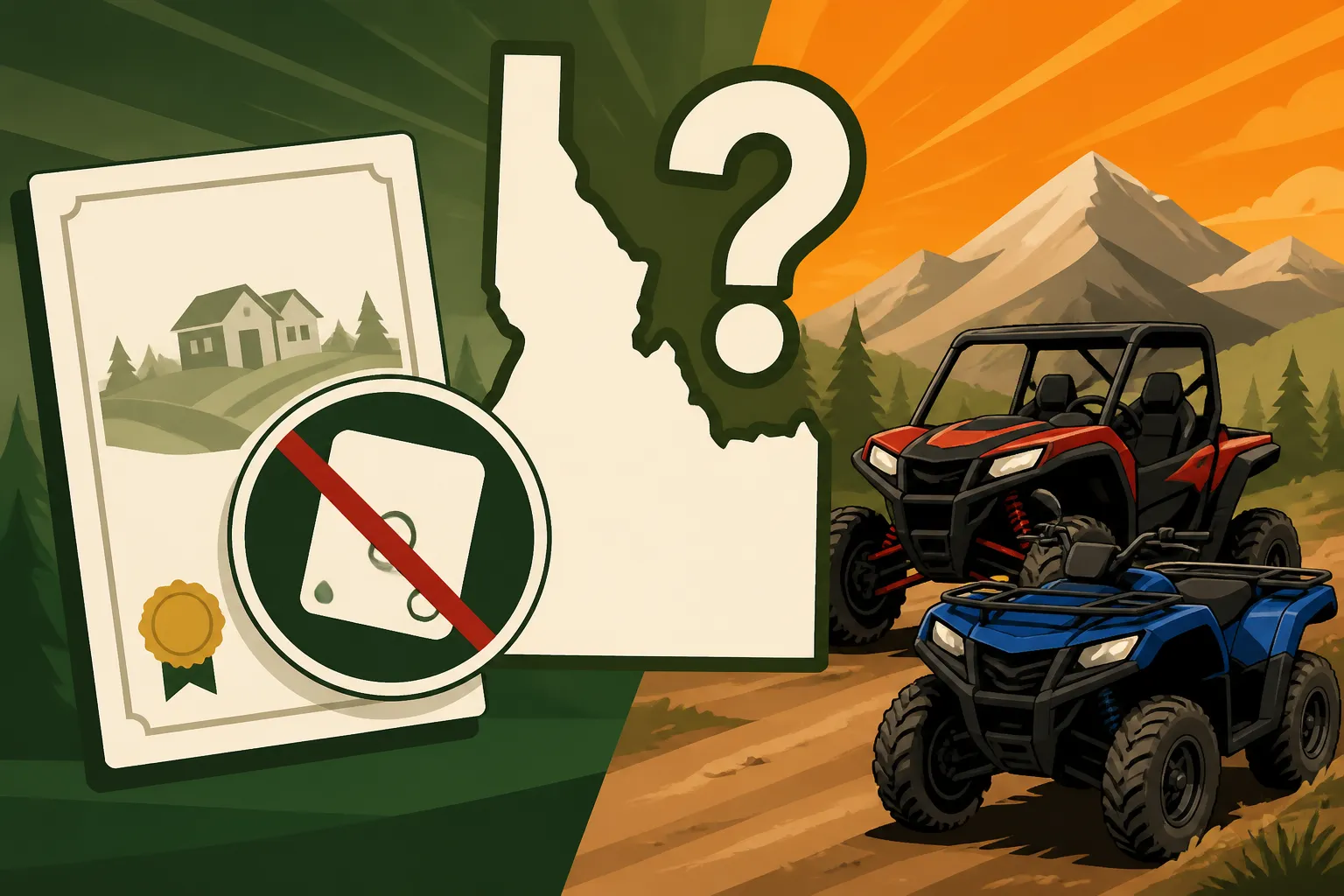
Usually, yes, if the machine is used for recreation. Idaho’s numbering requirement is not limited to public trails. According to the Department of Parks and Recreation, every motorbike, ATV, UTV, or specialty off-highway vehicle operated on public or private land must be numbered by January 1 each year, unless it qualifies for a specific exemption.
That means a recreational ride on your own deeded property is not automatically sticker-free. The same general rule applies if you ride on a friend’s property with permission: the landowner’s consent addresses access, but it does not by itself exempt a recreational machine from the numbering requirement. For the access question, see Riding a Friend’s Property by Permission and Idaho Rules on Private Land.
“Deeded” describes ownership of the land, not a special category of OHV use. A machine kept on private ground may still need its IDPR recreational permit sticker if it is used there for general riding, recreation, or other non-exempt purposes. Idaho State Legislature materials specify that general recreational OHVs operated on private land are otherwise subject to annual certificate-of-number requirements, unless they meet an agricultural-use or snow-removal exemption.
| How the machine is used | Sticker or numbering requirement |
|---|---|
| Recreational riding on your own private land | Generally required |
| Recreational riding on private land with the owner’s permission | Generally required |
| Used exclusively on private land for agricultural purposes | Exempt from the OHV recreational permit and restricted vehicle license plate |
| Used exclusively for snow removal | Exempt from Idaho’s OHV registration and numbering requirements |
| Used for both exempt work and recreation | The exclusive-use exemption may not apply; confirm the machine’s status with the Department of Parks and Recreation |
The practical distinction is exclusive use, not where the machine is parked or who owns the parcel. An ATV used only for qualifying agricultural work is different from one that is also taken out for recreational laps, hunting-season rides, or weekend trail riding. The exemption is not a blanket rule for every machine kept on a farm or ranch.
If you are weighing a farm-use claim, compare the details with Farm Exemptions From Idaho OHV Rules and Idaho Rules for Ranch Work Machines. Those topics are useful because “used on a farm” and “used exclusively for agricultural purposes” are not necessarily the same thing.
Which private-land uses qualify for an exemption?
The stated exemptions are limited. According to the Idaho State Legislature, OHVs used exclusively on private land for agricultural use or exclusively for snow removal purposes are exempt from Idaho’s registration and numbering requirements. The Department of Parks and Recreation also describes machines used exclusively on private land for agricultural use as not requiring an OHV recreation permit or restricted vehicle license plate.
The word exclusively matters. A machine that performs farm work but is also used for general recreation may not fit the agricultural exemption. Likewise, a machine used for snow removal but also taken out for recreational rides is not clearly within an exemption that applies to use exclusively for snow removal. When use is mixed, do not assume that one qualifying task makes every use exempt.
Agricultural use should be understood as a narrow use-based exception, not simply a description of the property or owner. A recreational ride does not become agricultural just because it happens on a ranch. If the machine’s role is mixed or hard to classify, ask the Department of Parks and Recreation what documentation or registration status applies before relying on an exemption.
There are also distinct rules for road use. A machine exempt from a recreational sticker because it is used exclusively for qualifying work should not be assumed to be cleared for every public road or trail. Road access, restricted vehicle plates, local rules, land-manager restrictions, and recreational permitting are separate questions. If you plan to leave private property, review What Idaho Requires Before You Ride a County Road and Idaho’s Restricted Vehicle Plate and Road Use.
Use this checklist before treating a machine as exempt:
- Identify its actual uses. Include recreation, property maintenance, agricultural tasks, and snow removal.
- Check whether the claimed use is exclusive. An exemption tied to exclusive use may not fit a machine also used recreationally.
- Separate private-land use from travel elsewhere. A private-property exemption does not automatically answer what is required on public land or a road.
- Ask the state agency if the facts are mixed. Explain how the machine is used rather than asking only whether the land is deeded.
For more on the distinction between private land and the permit requirement, see Unstickered Machines on Deeded Ground and When an Idaho Rider Needs No Sticker.
What the sticker rule means for ordinary private-property riding
If you use an ATV or UTV for recreation on private property, plan on having the required registration sticker even if you never ride a public trail. According to the Department of Parks and Recreation, the annual numbering requirement covers operation on both public and private land, and the certificate of number follows a calendar-year cycle: vehicles must be numbered by January 1 each year.
The recreational permit sticker is not proof that you have permission to ride on someone else’s land. The Department of Parks and Recreation says users must obtain permission before entering private lands. That permission and the sticker address different issues: one is about access to the property, and the other is about numbering the machine.
The sticker also does not make a trail, road, or neighboring parcel open to OHV use. Public-land routes can have separate restrictions, and areas within National Forest boundaries may be subject to motor vehicle use rules. The Department of Parks and Recreation recommends checking with appropriate government offices and using a Motor Vehicle Use Map for motor vehicle access information. For trip planning, see Reading an Idaho Motor Vehicle Use Map.
If you need to obtain a permit, the Department of Parks and Recreation says off-highway vehicle permits can be purchased online, in person at vendors, or over the phone. The agency also says registrations can be purchased online at any time, and that more than 200 vendors across multiple states can provide stickers. Check the Department’s current instructions for the process that suits you and for any current cost or delivery details.
When permitting a vehicle, purchasers are asked to select a use area. According to the Department of Parks and Recreation, choosing a use area does not limit the permit to that area: registrations and permits are valid statewide. That statewide validity still does not override private-land permission or local and land-manager access restrictions.
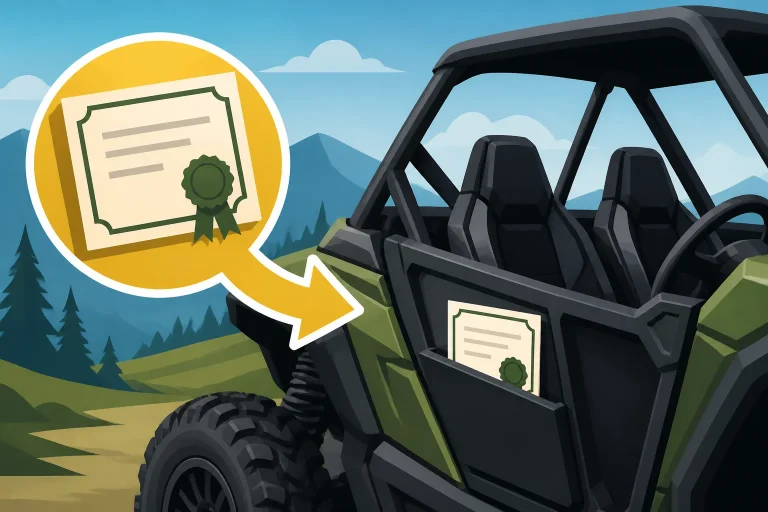
For an ATV, UTV, or specialty off-highway vehicle, placement matters too. The Department of Parks and Recreation says the recreational permit sticker must be placed on the rear fender. Keep the sticker visible and in good condition, and check Where the Idaho Sticker Goes on the Plate if you need help with placement for a particular machine.
How to decide what to do before riding
The safest way to handle the question is to classify the machine by its use, then check where you intend to ride. Avoid relying on a rule of thumb such as “it’s my land” or “it’s a farm machine.” Those statements do not establish that the vehicle meets an exclusive-use exemption.
Use this process:
- Write down every type of use. Note whether the machine is used for recreation, farm work, snow removal, or more than one of these.
- Apply the exclusive-use test. If you want to rely on an agricultural or snow-removal exemption, confirm that the machine’s use meets the exemption as described by the Idaho State Legislature and the Department of Parks and Recreation.
- Check whether you will leave the parcel. Public roads, public lands, and trail systems can have additional rules. Verify access separately before riding beyond the property.
- Get an answer for an unclear or mixed-use situation. Contact the Department of Parks and Recreation and describe the machine’s actual uses. Do this before assuming a sticker is unnecessary.
- Keep access permission separate from registration. If the land is not yours, get the owner’s permission even if the machine is properly numbered.
If you are uncertain, getting the machine properly registered before recreational riding is a more reliable course than assuming the private-property setting creates an exemption. If you believe your machine is used only for qualifying agricultural work or snow removal, confirm that status with the appropriate agency. A parcel’s deed, the machine’s location, and an owner’s permission do not, by themselves, replace the use-based exemption test.
Sources
- Department of Parks and Recreation — Registration & Permits | Department of Parks and Recreation (checked November 3, 2026)
- Idaho Department of Parks and Recreation — OHV_BOOKLET.pdf (checked November 3, 2026)
Disclaimer
This article is for general informational purposes only and does not constitute professional advice. Laws, prices and regulations vary by location and change over time. Consult a qualified professional for guidance on your specific situation.