Driver’s License Requirements on Idaho Roads
One of the most confusing and frustrating aspects of enjoying your ATV or UTV in Idaho is figuring out when you actually need a driver's license to ride on public roads. It's easy to assume that because it's an off-highway vehicle, the same rules as driving your truck don't apply. But Idaho has specific laws that can quickly turn a fun ride into a legal headache if you're not properly licensed. This guide will meticulously break down those requirements, ensuring you understand exactly what's expected to keep your adventures legal and safe.
The Basics: When an Idaho Driver's License Is Required for OHVs on Roads
Idaho offers incredible opportunities for ATV and UTV enthusiasts, from vast trail networks to scenic backcountry roads. However, the minute your wheels touch a paved or gravel public road, a different set of rules kicks in, and the question of your driver's license status becomes critically important. It's not just about having a machine capable of road use; it's about whether the operator is legally qualified.
Understanding "Street Legal" in Idaho
Before we even get to the driver's license, it's crucial to clarify what "street legal" means for an OHV in Idaho. Many riders mistakenly believe that if they have an OHV sticker, they're good to go on any road. That's simply not true. An OHV sticker allows you to ride on designated OHV trails and forest roads where OHVs are permitted. It does not automatically grant you permission to ride on county roads or cross highways without further compliance.
To be truly "street legal" for road use beyond just crossing, your machine needs specific equipment and a special plate. This includes things like headlights, taillights, brake lights, mirrors, a horn, and often turn signals. Many riders turn to aftermarket companies like SuperATV to acquire these necessary components to bring their machine into compliance. Without these features and the proper plate, your machine isn't considered suitable for road operation, regardless of your license status. You'd be in violation before you even start the engine. You can learn more about what your machine needs in [What Idaho Requires Before You Ride a County Road].
The Driver's License Rule for Public Roads
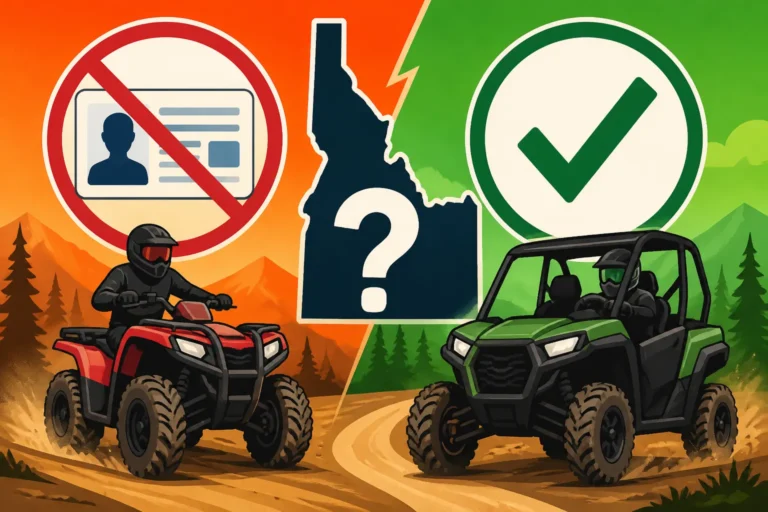
Here's the direct answer that often surprises people: if you are operating an ATV, UTV, or any other Off-Highway Vehicle on any public road in Idaho, you generally need to possess a valid, unexpired driver's license. This isn't just for primary highways, but also includes county roads, city streets, and even many gravel forest service roads that are open to other motor vehicle traffic. The distinction Idaho law makes is between off-highway trails and public roads. On an actual off-highway trail, the driver's license requirement is often different, especially for younger riders.
However, once you leave that dedicated trail system and venture onto a road that's shared with cars, trucks, and motorcycles, the state considers you a driver of a motor vehicle on a public roadway. Therefore, the same foundational licensing requirements apply as if you were driving your car. This is a critical point that many new residents or first-time OHV owners in Idaho overlook. It's not enough to simply own the machine; you must be a licensed operator to take it on many public thoroughfares.
Age, Supervision, and Learner's Permits: What About Younger Riders?
The rules around young riders and driver's licenses can be particularly complex and are often a source of confusion for families eager to enjoy Idaho's vast riding opportunities together. It’s natural to want to share the experience with your kids, but safety and legal compliance always come first. Idaho has specific provisions, especially concerning public roads, that dictate what young riders can and cannot do, and under what conditions.
The Under-16 Landscape and Direct Supervision
For riders under the age of 16, the rules are much stricter, especially when it comes to public roads. Generally, a person under 16 years of age is NOT allowed to operate an OHV on a public road, even if supervised. This is a fundamental difference from riding on designated trails or private land. On trails, younger riders can often operate appropriately sized machines if they meet certain safety course requirements and are under the direct supervision of an adult. However, those specific trail rules do not translate to public road access.
The state's intent is to keep less experienced, unlicensed operators off the same roads shared with heavier, faster-moving traffic. While a 12-year-old might be an incredibly capable rider on a dirt track or a forest trail, the risks associated with navigating a public road, even a quiet gravel one, are significantly higher. Parents need to be acutely aware of this distinction and plan their routes accordingly, ensuring that younger family members stick strictly to approved off-highway trails or private property. For more detailed information on age-specific rules, refer to [Idaho Road Rules for Young Riders] and [Supervising a Young Rider Within 300 Feet].
Operating an OHV with a Learner's Permit
What about teenagers who are learning to drive and possess an Idaho learner's permit? This is a common question, and the answer is typically no, a learner's permit is not sufficient for operating an OHV on a public road in Idaho. A learner's permit comes with specific restrictions, such as requiring a licensed adult to be in the passenger seat (which isn't always possible or practical in an OHV) and only allowing operation of specific types of vehicles.
An OHV, even when equipped with the necessary components like mirrors or turn signals from brands like SuperATV to be street-legal, is still generally categorized differently than a standard passenger vehicle by the Department of Motor Vehicles for licensing purposes. To operate a motor vehicle on a public road without the specific restrictions of a learner's permit, you need a full, unencumbered driver's license. Therefore, if you're a teenager with just a permit, you should stick to riding your ATV or UTV on designated trails or private property, keeping off any roads where a full license would be required. This helps ensure compliance and, more importantly, enhances safety for everyone on the road.
Beyond the License: Other Requirements for Road-Legal Riding
Getting your driver's license ducks in a row is a massive step, but it’s only one part of the equation when it comes to riding your OHV legally on Idaho’s public roads. The state has put together a comprehensive set of requirements, all designed to ensure safety and accountability when these machines share space with traditional road vehicles. Skipping any of these can lead to fines, citations, or even more serious consequences if an incident occurs.
The Idaho Restricted Vehicle Plate
Perhaps the most visible and often misunderstood requirement for road use is the Idaho Restricted Vehicle Plate, often referred to as an "R-plate." This is not just a fancy sticker; it's a specific license plate issued by the county assessor's office that signifies your OHV has met the state's equipment requirements to be operated on certain public roads. Without this plate, displaying an OHV sticker alone doesn't grant you road access. The R-plate signifies that your machine is equipped with things like a headlight, taillight, brake lights, turn signals (if required by the specific road), a horn, and mirrors. Many riders outfit their machines with kits from companies like SuperATV to ensure they meet these specifications.
The R-plate must be properly displayed on the rear of your machine, just like a car's license plate. It's essentially the state's way of saying, "Okay, this machine is equipped to handle road conditions, and we know who owns it." It's also critical to remember that even with an R-plate, you're not allowed on ALL public roads. Interstate highways and some state highways are almost universally off-limits to OHVs. The R-plate specifically indicates that your vehicle is compliant for roads where OHV use is allowed. For a deep dive into this, check out [Idaho's Restricted Vehicle Plate Explained] and [Idaho Plates That Begin With R].
Insurance and Other Safety Gear
Just like driving your car, if you're operating an OHV on public roads in Idaho, you absolutely need to carry liability insurance. This isn't optional; it's a legal mandate. The minimum coverage requirements are similar to those for passenger vehicles, designed to protect you financially if you're at fault in an accident causing injury or property damage to others. Failing to have valid insurance can result in significant fines and penalties. Always carry proof of insurance with you when riding. [Liability Insurance Idaho Road Riding Requires] offers more specifics on this vital aspect.
Beyond insurance, certain safety gear and machine components are non-negotiable for road travel:
- Helmets: While adults over 18 with a valid driver's license are not always legally required to wear a helmet on certain roads, it's always the safest choice. For anyone under 18, helmets are mandatory. Be sure to understand [Idaho Helmet Rules for Riders Under 18].
- Eye Protection: Goggles or a face shield are crucial for protecting your eyes from dust, debris, and insects, making them a common-sense necessity.
- Functional Equipment: Beyond the R-plate requirements, your machine needs to be in good working order. Tires must be highway-rated if you plan significant road travel, brakes must be fully functional, and your suspension should be properly maintained.
Understanding Road Designations
Even with a driver's license, an R-plate, and all the right equipment, you can't just ride your OHV on every single public road in Idaho. The state has specific rules about which roads are open to OHV traffic and which are not. Generally, you'll find OHVs allowed on many county and forest service roads, particularly in rural areas that connect trails or provide access to trailheads. However, major state highways, interstates, and some city streets will remain off-limits.
Local jurisdictions, such as counties and cities, also have the authority to regulate OHV use on roads within their boundaries. What might be legal in one county could be prohibited just across the line in another. Always check local ordinances and look for signage. Motor Vehicle Use Maps (MVUMs) from the Forest Service are also invaluable tools for understanding which federal roads and trails are open. It’s a lot to keep track of, but doing your homework prevents unwelcome surprises from law enforcement. For general guidance, refer to [Which Idaho Roads Are Open to OHVs] and [Riding an ATV on the Road in Idaho].
Common Scenarios and Misconceptions About Licenses
Idaho's OHV laws, particularly those surrounding road use, can feel like a labyrinth. Many riders encounter specific situations or hold onto common beliefs that, while seemingly logical, don't quite align with the letter of the law. It's essential to address these scenarios head-on to prevent riders from inadvertently breaking the rules.
Riding Farm/Ranch Machines on Roads
One of the most frequent areas of confusion involves ATVs and UTVs used for agricultural purposes. It's common to see farmers or ranchers using their side-by-sides to move between fields, check fences, or haul feed along rural county roads. Many assume that because the machine is being used for work, the driver's license requirement is waived. In Idaho, there are limited exemptions for farm and ranch machines, but they come with very specific conditions, and they don't always fully waive the driver's license requirement for all public road use.
Typically, these exemptions apply to machines being operated by a farmer or rancher, or their employees, solely for agricultural purposes, directly relating to the operation of their farm or ranch, and often only for short distances on specific types of roads (like secondary county roads that directly connect parts of their property). Even in these cases, the machine often still needs to be equipped for road safety (lights, etc.), and the operator must usually still hold a valid driver's license. The key is "agricultural purposes only." If that same UTV is used for a joyride into town, even by the farmer, the exemption likely vanishes, and the standard driver's license rule applies. It's a narrow exemption designed for very specific work-related travel, not general transportation. If you're relying on this exemption, it's absolutely crucial to understand its exact boundaries to avoid a citation.
Quick Crossings and Short Stretches
Another common scenario involves riders needing to make a "quick crossing" of a paved road to get from one trail section to another, or riding a very "short stretch" of road to bypass an obstacle or connect to another trail. Riders often ask if the driver's license requirement still applies for such brief encounters with public roadways. The short answer is: yes, generally, it does.
Idaho law typically doesn't make exceptions for the duration or distance of travel on a public road when it comes to needing a driver's license. The moment your OHV wheels touch a public road surface where other motor vehicles operate, the expectation is that the operator is properly licensed. While law enforcement officers may exercise discretion in some circumstances, relying on that discretion is a gamble. A few hundred feet on a public road is still "on the road," and therefore, you're expected to meet all the requirements, including having a valid driver's license and an R-plate on your machine. Trying to quickly sneak across a paved highway, even with a properly equipped machine, without a license, is still a violation. It's far better to plan your route to avoid public road sections if you or anyone in your riding group doesn't hold a valid license.
Here's a quick summary table for common driver's license requirements:
| Scenario | Driver's License Required? | Additional Requirements (General) |
|---|---|---|
| Adult (16+) on Public Road | Yes | R-Plate, Insurance, Lights, Horn, Mirrors, etc. |
| Under 16 on Public Road | Generally No | Not permitted to operate on public roads |
| Teenager with Learner's Permit on Public Road | Generally No | Not sufficient for independent OHV road operation |
| Farm/Ranch Use on Public Road (Exemptions) | Yes, in most cases | Must be for direct agricultural purpose; specific road/distance limits |
| Quick Crossing/Short Stretch of Public Road | Yes | All standard road requirements apply, regardless of distance |
| On Designated OHV Trail | No (but safety course/age rules apply) | OHV Sticker; age/supervision for minors; helmet for under 18 |
| On Private Property (with permission) | No | None by state law, but owner's rules/insurance should be followed |
Penalties for Non-Compliance and Staying Legal
Ignoring Idaho's driver's license requirements for OHV road use can lead to more than just a stern talking-to. The state takes these regulations seriously, primarily for public safety reasons. The potential consequences range from financial penalties to more severe legal repercussions, making it crucial for every rider to understand the risks of non-compliance.
What Happens if You're Caught Without a License
If a law enforcement officer pulls you over while you're operating an OHV on an Idaho public road without a valid driver's license, you could be facing a significant citation. This isn't just a minor infraction; operating a motor vehicle without a valid license is a serious offense. The specific penalties can vary based on the officer's discretion, the local jurisdiction, and whether you have any prior offenses.
Expect at least a fine, which can be substantial. Beyond the immediate financial hit, there could be additional consequences. Your OHV might be impounded, leaving you stranded and incurring towing and storage fees. If you're involved in an accident while unlicensed, your insurance company could deny coverage, leaving you personally liable for all damages and injuries. This could amount to tens of thousands of dollars, completely derailing your financial future. Furthermore, repeated offenses could lead to more serious charges, impacting your ability to get a driver's license in the future, or even facing jail time in extreme cases. It's simply not worth the risk. [Idaho Fines for Illegal Road Riding] details some of the financial consequences you could face.
Best Practices for Ensuring You're Road-Ready
The good news is that staying legal and avoiding these penalties is entirely within your control. It requires a bit of planning and adherence to the rules, but the peace of mind knowing you're riding safely and legally is invaluable. Here are some best practices:
- Get Licensed: First and foremost, if you plan to ride your ATV or UTV on any public road in Idaho, ensure you have a valid, unexpired driver's license. If you're a new resident, transfer your out-of-state license promptly.
- Plate Your Machine: Obtain and properly display an Idaho Restricted Vehicle (R) Plate for your OHV. Ensure your machine is equipped with all the necessary components—headlights, taillights, brake lights, mirrors, horn, and often turn signals. Companies like SuperATV offer excellent kits for these upgrades.
- Insure Your Ride: Carry the required liability insurance for your OHV. Always keep proof of insurance on your person or in your machine when riding.
- Know Your Routes: Before you head out, study maps and familiarize yourself with the area. Understand which roads are open to OHVs and which are off-limits. Pay attention to signage. Apps and online resources can be very helpful here.
- Review Local Ordinances: If you're riding near or through a town or specific county, quickly check their local ordinances regarding OHV use on roads. Rules can vary, and what's allowed in one place might be prohibited just a few miles down the road.
- Carry Your Paperwork: Always have your driver's license, proof of insurance, and OHV registration/plate documentation with you when you ride. A small waterproof bag is perfect for this.
- Supervise Young Riders Appropriately: Understand the distinct rules for minors on trails versus roads. Never allow an unlicensed minor to operate an OHV on a public road, even for a short distance.
- Stay Sober: Remember that driving an OHV on a public road is subject to the same DUI laws as operating a car. Don't drink and ride. You can find more information on this in [Idaho Alcohol Limits for OHV Operators].
By following these guidelines, you'll not only avoid costly citations but also contribute to a safer riding environment for everyone. Idaho's trails and roads offer incredible experiences, and being fully prepared means you can enjoy them without worry.
Disclaimer
This article is for general informational purposes only and does not constitute professional advice. Laws, prices and regulations vary by location and change over time. Consult a qualified professional for guidance on your specific situation.