Idaho Road Rules Riders Get Wrong
It’s a common scenario across Idaho: you’ve got your side-by-side or ATV loaded up, ready to hit some incredible trails, and you think you’ve got a good handle on where you can and can’t ride. But the truth is, many riders unintentionally bend or outright break the rules when it comes to operating their off-highway vehicles (OHVs) on Idaho roads. This guide aims to clear up some of the most common misconceptions and ensure your next adventure doesn't end with an unexpected citation.
The Myth of "Any Dirt Road is Fair Game"
One of the biggest misunderstandings among OHV enthusiasts in Idaho is the assumption that any unpaved, gravel, or "dirt" road is automatically open for their ATV or UTV. The reality is far more nuanced, and simply seeing others ride on a particular road doesn't make it legal. Idaho's laws allow for counties to designate roads as open or closed to OHVs, and this can vary wildly even between neighboring jurisdictions or within different areas of the same county. You can't just assume a road is open; you need to verify it.
Understanding County Ordinances vs. State Law
While state law provides a framework for OHV operation, local county ordinances often dictate the fine print of where you can ride on their roads. A state highway, for example, is generally off-limits to OHVs unless specifically designated, but a county road might be open. The key word here is might. Some counties embrace OHV tourism and have a network of open roads, while others, perhaps due to population density, safety concerns, or local preference, keep many of their roads closed to OHVs. It can be incredibly frustrating to discover this after you've already committed to a route, especially when county lines blur and the rules suddenly change. You might be riding legally on a gravel road in Boise County, cross into Valley County, and suddenly be in violation because their ordinance differs. [Idaho City and County Ordinances That Close Roads] explains this in more detail.
It's crucial to do your homework before you head out. Check the county's website for their OHV ordinance or call the county sheriff's department or county clerk's office. Don't rely solely on what you hear at the local gas station or from another rider, as information can be outdated or misinterpreted. Always seek official sources. This proactive approach can save you a significant headache, not to mention a potential fine, and ensures you're a responsible ambassador for the sport.
Federal Lands and MVUMs
Moving from county roads to federal lands, like those managed by the U.S. Forest Service or the Bureau of Land Management (BLM), introduces another layer of rules that riders often overlook. Many assume that because it’s "public land," they can ride anywhere. This is absolutely not the case. Federal agencies use Motor Vehicle Use Maps (MVUMs) to designate specific roads and trails where motorized travel is permitted. These maps are the law on federal land, and they show which routes are open to what type of vehicle (e.g., ATV, UTV, motorcycle, full-size vehicle) and during what season.
The MVUMs are updated regularly, and it's your responsibility to have the most current version for the area you plan to ride. While an MVUM might show a particular forest road is open, it might also indicate a seasonal closure, or specify that only street-legal vehicles are allowed, even if it looks like a typical trail. Riding off-route, even for a short distance, or on a closed route is illegal and can lead to significant fines and environmental damage. [Reading an Idaho Motor Vehicle Use Map] can help you navigate these maps effectively. Tools like onX Offroad or other GPS apps can be invaluable for cross-referencing your location with the MVUMs, but always have a paper map as a backup, especially in areas with no cell service.
Driver's License, Insurance, and Age Requirements – Not Just for Cars
Another area of confusion stems from the perception that an OHV is strictly an "off-road" machine, and therefore, the same rules that apply to cars on the road don't apply to them. This couldn't be further from the truth when you're operating your ATV or UTV on a road, even one designated as open to OHVs. Once you put tires on asphalt or gravel that's part of the public road system, you enter a different legal landscape.
The Driver's License Dilemma
Many riders mistakenly believe that if they’re just "crossing a road" or "riding on a short section" of a county road, they don't need a driver's license. Idaho law is clear: if you are operating an OHV on a public road, whether paved or unpaved, you must possess a valid driver's license. This isn't just a suggestion; it's a requirement. This rule applies to everyone, regardless of age, who is operating a restricted-use OHV on a designated public road. It’s not like riding exclusively on private land or within a dedicated off-road park where a license typically isn't needed.
This also means that if you're supervising a younger rider who doesn't have a license, they cannot operate an OHV on a public road, even if you're following them closely. The only exception to the driver's license requirement on roads might be for specific agricultural exemptions on very limited roadways, but for recreational use, assume a license is always needed. [Driver's License Requirements on Idaho Roads] provides a more in-depth look at this.
Insurance: More Than Just a Good Idea
Just like with a driver's license, the necessity of liability insurance for OHVs on public roads is often overlooked. While you might not need specific OHV insurance for riding on private property or within designated trail systems, the moment your machine touches a road open to the public, you are generally required to carry liability insurance. This is not just about protecting your own investment; it's about protecting others in case of an accident. Imagine a collision with a passenger vehicle or another OHV on a shared road – without insurance, you could be facing devastating financial consequences.
Idaho's requirements for liability insurance on public roads are similar to those for passenger vehicles. Don't gamble on this. Check with your insurance provider to ensure your policy covers road use for your ATV or UTV. If your current policy doesn't, many providers offer specific OHV insurance or an endorsement to your existing policy. This small investment can save you immense stress and expense down the line. [Idaho ATV Insurance Cost] and [Liability Insurance Idaho Road Riding Requires] are good resources.
Youth Riders on Roads
Idaho has specific rules for youth riders, particularly concerning engine size and supervision, but these rules become even more stringent when an OHV is operated on a public road. A common mistake is believing that if a younger rider is allowed to ride a certain machine on a trail, they can also ride it on an open road, especially if an adult is supervising. However, as noted above, a valid driver's license is required for anyone operating an OHV on a public road. This means that generally, riders under the age of 16 (or whatever the minimum licensing age is) cannot operate an OHV on an Idaho road, even with adult supervision.
This isn't to say youth riders can't enjoy Idaho's OHV opportunities; it simply means their riding must be confined to private property or designated trails and areas where road use is not involved. Understanding these nuances is vital for parents and guardians to ensure their children are riding safely and legally. [Idaho Road Rules for Young Riders] elaborates on this complex topic.
The Restricted Vehicle Plate – It's Not a "Free Pass"
The Idaho Restricted Vehicle Plate, often referred to as the "R" plate or restricted-use plate, is a fantastic option for riders who want to connect trails or access amenities by riding on designated county roads. However, many riders misinterpret what this plate truly allows. It does not magically make your OHV street-legal in the same way a car is, nor does it grant you carte blanche to ride anywhere. It’s a tool for specific, limited road access.
Where the "R" Plate Does (and Doesn't) Take You
The primary purpose of the "R" plate is to allow your OHV to legally operate on county roads specifically designated as open to OHV use by local ordinance, and to cross state and federal highways where permitted. Crucially, the "R" plate does not allow you to ride on interstate highways, state highways (unless explicitly signed), or any road that a county has decided to close to OHVs. The misconception often arises when riders see the plate as a universal "street legal" stamp. It’s not. It’s a permit for restricted use on approved routes. [Idaho's Restricted Vehicle Plate Explained] goes into depth on this.
Think of it this way: the "R" plate is like a key that unlocks some doors, not all of them. You still need to know which doors are open. This requires checking county ordinances, Forest Service MVUMs, and BLM travel management plans for the specific areas you plan to ride. Simply having the plate without knowing the local rules is a recipe for a ticket.
Equipment Requirements for Road Use
Obtaining an Idaho Restricted Vehicle Plate also comes with specific equipment requirements that many riders might overlook or misunderstand. It's not enough to just have the plate; your machine must be outfitted to meet certain safety standards for road operation. These requirements are in place for the safety of the OHV operator and other motorists.
Here’s a table summarizing key equipment often required for road-legal OHV operation in Idaho with an "R" plate:
| Requirement | Description |
|---|---|
| Headlights & Taillights | Must be operational during daylight and nighttime, clearly visible from specified distances. |
| Brake Lights | Must illuminate when the brake is applied, visible from the rear. |
| Turn Signals | Must have front and rear turn signals that are operational and clearly visible. Many stock ATVs lack these, requiring aftermarket installation. (SuperATV offers various turn signal kits.) |
| Horn | An audible warning device capable of being heard from a distance. |
| Mirrors | At least one rearview mirror is typically required, positioned to provide a clear view of the road behind. |
| Muffler & Spark Arrester | Must be equipped with an adequate muffler to prevent excessive noise and a spark arrester in good working order for fire prevention. |
| Windshield (UTV) | While not universally required for all OHVs, some interpretations for UTVs on roads may lean towards having a windshield, or at least eye protection. |
| Seat Belts (UTV) | For side-by-sides, all occupants must be properly restrained in factory-installed or equivalent seatbelts. |
Many ATVs and UTVs come from the factory ready for the trail, but not for the road. Adding items like turn signals, rearview mirrors, and a horn is often necessary to meet these requirements. Companies like SuperATV specialize in aftermarket accessories and kits that can help you get your machine compliant, from their "plug-and-play" turn signal kits to mirrors and windshields designed for specific models. Don’t wait for a sheriff's deputy to point out your missing equipment; make sure your machine is ready before you hit the road. [Mounting a Restricted Plate on a Side-by-Side] and [Turn Signals on an Idaho Restricted Vehicle] provide useful insights.
Speed, Passengers, and Crossing Highways – Specific Rules Often Overlooked
Beyond the primary issues of road access and equipment, there are other critical operational rules that many OHV riders either misunderstand or simply forget about when transitioning from trail to road. These seemingly minor details can lead to significant safety hazards and legal trouble.
Speed Limits and Safe Operation
On a trail, your speed is often dictated by terrain, visibility, and your own comfort level. On a public road, however, posted speed limits apply, and these are often much higher than an OHV is safely designed to travel. Even on a gravel county road where the speed limit might be 45 mph, operating a side-by-side or ATV at that speed can be inherently unstable and dangerous. OHVs have a higher center of gravity and different suspension characteristics than passenger vehicles, making high-speed road operation risky.
The common mistake is to ride at the posted limit because it's "legal." However, riders should always operate their OHV at a speed that is reasonable and prudent for the conditions, and always well within the machine's capabilities and their own skill level. This means often traveling significantly below the posted speed limit, especially on turns, washboard gravel, or when encountering other traffic. [Idaho Speed Limits for Restricted Vehicles] is a helpful resource. Don't push your machine or yourself beyond safe limits just because a sign says you can go faster.
Carrying Passengers and Machine Capacity
On the trail, some riders might informally carry an extra passenger or allow multiple children on a machine designed for fewer. While this is unsafe anywhere, it becomes explicitly illegal and far more dangerous on a public road. When operating an OHV on an Idaho road, you must adhere strictly to the manufacturer's stated seating capacity. A single-rider ATV means one rider. A two-seat side-by-side means two occupants.
This rule is in place for passenger safety, as machines are designed with specific weight distribution and safety features (like seatbelts and roll cages for UTVs) for a certain number of occupants. Overloading an OHV or carrying passengers in an undesignated area (like the cargo bed of a UTV) can severely impact handling, braking, and stability, greatly increasing the risk of an accident. Always ensure all passengers are seated properly, using available seatbelts, and that you are not exceeding the machine’s design capacity. [Carrying a Passenger on a One-Seat Quad] covers these important rules.
Crossing State and Federal Highways
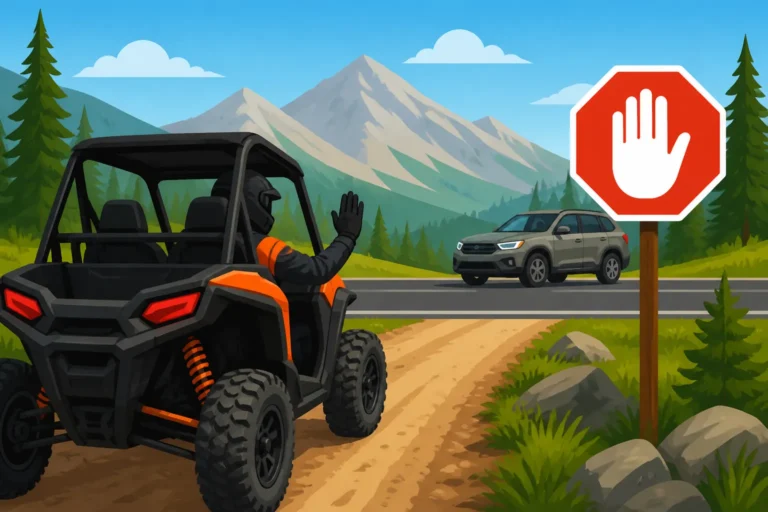
Idaho law does allow for OHVs to cross certain state and federal highways, even if they are not permitted to ride on them. This is a critical distinction that many riders get wrong, sometimes mistakenly riding along a highway shoulder instead of making a direct, perpendicular crossing. The rule is generally that an OHV can cross a state or federal highway at an intersection or at a location where it is safe to do so, going directly from one legal OHV route to another. You cannot travel down the highway or use the shoulder as a connection.
When making such a crossing, the OHV operator must yield to all traffic on the highway, ensuring the crossing can be completed safely and quickly. This means looking both ways, waiting for a clear gap in traffic, and executing the crossing efficiently. Never assume right-of-way. This rule is often misunderstood, leading riders to travel illegally on highway shoulders, which is extremely dangerous due to the speed and volume of highway traffic. [Crossing an Idaho Highway on an OHV] provides more context on how to perform these crossings legally and safely.
Disclaimer
This article is for general informational purposes only and does not constitute professional advice. Laws, prices and regulations vary by location and change over time. Consult a qualified professional for guidance on your specific situation.