Inheriting an ATV in Idaho
Losing someone close is incredibly tough, and amidst the grief, you often find yourself navigating a maze of practical matters – including what to do with their beloved ATV or side-by-side. It can feel overwhelming, especially when you're trying to figure out the legalities of transferring ownership of a recreational vehicle. This guide is here to walk you through the process of inheriting an ATV or UTV in Idaho, making sense of the paperwork and steps required to get that machine into your name so you can honor their memory on the trails.
Navigating the Immediate Aftermath: Initial Steps After Inheriting an ATV in Idaho
When an ATV or UTV owner passes away, one of the first things you'll contend with is the immediate situation surrounding the machine itself. This isn't just about legal ownership; it's also about practical considerations during what's undoubtedly a difficult time. Taking these initial steps thoughtfully can save you headaches down the road.
Locating Key Documents and Information
The very first thing you need to do, after attending to personal matters, is to start gathering information about the deceased's ATV or UTV. Think of it like a treasure hunt, but for very important papers. You're looking for the original title document – this is the cornerstone of ownership. In Idaho, [Idaho Titles Every ATV Over 50cc], so it's highly likely a title exists for any substantial machine. Check secure places where important documents are usually kept, like a safe, a file cabinet, or a lockbox. Many people also keep vehicle titles with other financial or estate planning documents.
Beyond the title, look for any registration papers, past OHV stickers, or even insurance policies related to the machine. These might not be critical for the transfer of ownership itself, but they provide a comprehensive picture of the machine's history and current status. Knowing if the machine was actively registered and ridden can offer clues about its condition and any current obligations, such as an expiring sticker. You should also try to locate the machine's Vehicle Identification Number (VIN) and note it down. This number is unique to the ATV and will be essential for all future paperwork. Without the VIN, you won't be able to process anything.
Securing the Machine and Its Accessories
Once you've identified the ATV or UTV, it’s prudent to secure it, especially if it's a valuable asset. This might mean moving it to a locked garage, ensuring it's covered, or at least making sure it's not easily accessible to unauthorized individuals. Unfortunately, theft can be a concern, and you don't want to add that stress to an already trying time. If the machine was stored outdoors or in an unsecured location, consider temporary measures to protect it.
Don't forget about associated accessories like helmets, riding gear, ramps, or even a trailer. While these items aren't part of the ATV's legal title, they are often considered part of the estate. If there are other beneficiaries or heirs, maintaining an inventory of all assets, including these recreational items, is a good practice. This transparency can help prevent misunderstandings later on. Treat the ATV and its related gear with the same care you would any other significant piece of property, ensuring its safety and documenting its presence.
Understanding the Deceased Owner's Intent
This step delves into the emotional and legal aspect of inheritance. Did the deceased express any wishes regarding the ATV? Was there a will? A trust? Or perhaps verbal instructions given to family members? While verbal wishes can be difficult to enforce legally, they can provide clarity and reduce conflict among family members. If there is a will, it should explicitly state who inherits personal property, including specific vehicles. If the ATV is mentioned by name or VIN, it makes the transfer much smoother.
If the will states, for example, "all recreational vehicles to my son, John," then John is the clear beneficiary. However, if the will simply says "all remaining assets to my spouse," the ATV would fall under that general clause. If you're dealing with a will, the named executor or personal representative will be instrumental in carrying out these wishes. They are legally responsible for distributing assets according to the will's instructions. If you're unsure where to find the will, it's usually with the deceased's attorney, in a safe deposit box, or among their most important papers. This initial understanding of intent sets the stage for how the estate will be handled, which directly impacts the ATV's future ownership.
Understanding Idaho's Estate Process and Your ATV
The path to inheriting an ATV in Idaho largely depends on the overall estate of the deceased. Idaho, like other states, has specific procedures for handling property after someone passes, and understanding these is crucial for a smooth transfer of the ATV title.
Small Estate vs. Formal Probate: Which Applies?
Idaho law provides different pathways for estates depending on their size and complexity. This is perhaps the most critical distinction you'll encounter. If the total value of the deceased's estate is below a certain threshold (which can change, so always check the current figures with the Idaho courts or an attorney), you might be able to use a "small estate affidavit" process. This is a simplified procedure that avoids the longer, more expensive formal probate court process. For many individuals who primarily owned an ATV, a vehicle, and some personal effects, their estate might qualify as a small estate. [Small Estate Paperwork for a Machine] details this process.
If the estate qualifies for a small estate affidavit, you, as the heir or personal representative, can often fill out a simple form, swear under oath that you are entitled to the property, and present it to the Idaho County Assessor's office to transfer the ATV title. This is a massive time-saver. However, if the estate is larger and includes real estate, significant financial assets, or complex debts, it will likely require formal probate. In a formal probate, a court oversees the distribution of assets, and an executor (if there's a will) or an administrator (if there isn't) is officially appointed to manage the estate. The ATV would then be transferred under court order, which can take several months, or even a year or more, depending on the complexity of the estate.
The Role of a Will or Trust
The presence of a valid will or trust dramatically simplifies the inheritance process. A will is a legal document that dictates how the deceased's assets should be distributed. If the will specifically names you as the beneficiary of the ATV, or if it falls under a general clause for personal property, the executor named in the will has the authority to transfer the title to you. They will typically sign the back of the title as the "seller" in their capacity as executor, and then provide you with a copy of the death certificate and letters testamentary (the court document officially appointing them as executor). This proves their legal authority to transfer the asset.
Similarly, if the ATV was placed into a trust, the trust document would dictate who inherits it. The trustee of the trust would then be responsible for the transfer. Trusts are often used to avoid probate altogether, meaning the transfer could be even quicker than with a will. In either case, having these clear instructions from the deceased makes the legal process far less ambiguous, providing a straightforward path to transfer [Transferring an Idaho OHV Title After a Sale]. A service like LawDepot can provide template documents if you need to understand the typical structure of wills or affidavits, though always consult a legal professional for specific advice related to an estate.
Dealing with Intestacy: No Will, No Clear Path
This is where things can get a bit more complicated. "Intestacy" means the deceased passed away without a valid will. In such cases, Idaho state law dictates how their assets are divided among their closest relatives. This isn't a free-for-all; there's a specific order of priority. Typically, a surviving spouse inherits first, followed by children, then parents, siblings, and so on.
If there's no will, the estate will almost certainly go through probate, even if it's a relatively small estate, to officially determine the legal heirs. The court will appoint an administrator to manage the estate and distribute assets according to Idaho's intestacy laws. This means you might need to petition the court to be appointed as the administrator, or another family member might take on that role. The process involves identifying all heirs, notifying creditors, and eventually obtaining a court order allowing the transfer of the ATV. This route generally takes longer and requires more legal involvement than if a will had been in place. It's often at this point that family members might consider using resources like LawDepot to understand the necessary legal forms or to prepare initial affidavits for court, but legal guidance is strongly recommended.
The Official Transfer: Getting the ATV Title and Registration in Your Name
Once you've navigated the estate process, whether through a simple affidavit or full probate, the actual transfer of the ATV's title into your name is the next crucial step. This is where you'll interact directly with Idaho's state agencies.
Preparing the Necessary Paperwork for Transfer
To initiate the title transfer, you'll need a collection of documents. This isn't a situation where you can just show up hoping for the best. Be prepared to present:
- The Original Idaho Title: This is paramount. The back of the title usually has sections for seller and buyer information. In an inheritance situation, the executor or administrator of the estate, or the person legally authorized by a small estate affidavit, will sign as the "seller."
- Death Certificate: A certified copy of the deceased's death certificate is always required to prove the original owner is no longer living.
- Proof of Your Entitlement:
- If there's a Will/Probate: You'll need "Letters Testamentary" (if there was an executor) or "Letters of Administration" (if there was an administrator appointed by the court). These court documents confirm that the person signing the title has the legal authority to do so.
- If using a Small Estate Affidavit: You'll present the completed and notarized small estate affidavit.
- Application for Certificate of Title: You'll need to fill out a new title application form (often provided at the county assessor's office) with your information as the new owner.
- Bill of Sale (Optional but Recommended): While not always strictly required for an inheritance, a bill of sale, even one for "zero" consideration, signed by the executor/administrator and yourself, can serve as an additional record of the transfer. LawDepot offers customizable bill of sale templates that can be useful in formalizing this step, even within a family.
- Proof of Identification: Your own valid government-issued ID (like an Idaho driver's license) will be needed.
It can feel like a lot, but having everything organized before you go to the county assessor's office will make the process much smoother. [Documents to Bring to an Idaho Assessor's Office] can provide a more general checklist for titling any OHV.
The County Assessor's Office: Your Next Stop
In Idaho, ATV and UTV titles are processed through your local County Assessor's office, not the DMV that handles regular vehicle registrations. This is an important distinction that sometimes catches people off guard. You'll take all your meticulously prepared documents to the Assessor's office in the county where you reside, or where the deceased resided if it's still part of the estate process.
When you arrive, a clerk will review your paperwork. They'll verify the VIN on the title application against the existing title and the other supporting documents. They'll also collect any applicable fees. While there typically isn't a sales tax on inherited property in Idaho, there will be a title transfer fee. Be prepared to pay this fee, often with a debit card or check, as cash policies can vary by office. If everything is in order, they will process the transfer, and you'll typically receive a new title in the mail within a few weeks, sometimes longer depending on the county's processing times. Be sure to ask about the expected turnaround time and if they provide any temporary proof of ownership. [Idaho OHV Title Application at the County Assessor] goes into more detail about this specific step.
What About the OHV Sticker and Plates?
Once you have the title in your name, you'll need to ensure the ATV is properly stickered and, if applicable, has an Idaho Restricted Vehicle Plate.
OHV Sticker: An Idaho OHV sticker is required for nearly all off-highway vehicle use on public land in Idaho, regardless of whether you just inherited it or bought it new. Even if the machine already has a current sticker from the previous owner, that sticker is tied to the machine and remains valid until its expiration date. You don't usually need to get a new sticker immediately if a valid one is present. However, once that sticker expires, you, as the new owner, will be responsible for renewing it. You can purchase these stickers online, at vendor locations, or through IDPR service centers. [Idaho OHV Sticker Price This Year] gives you an idea of the costs involved.
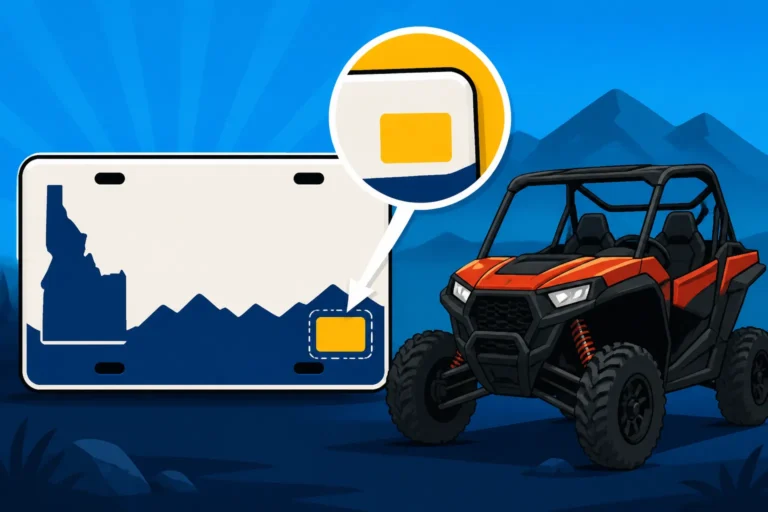
Restricted Vehicle Plate: If the deceased used the ATV or UTV for riding on specific public roads that allow OHV use in Idaho, it might have had an Idaho Restricted Vehicle Plate (often referred to as an "R" plate). This plate allows limited road use. Unlike the OHV sticker, which stays with the machine, the restricted plate is typically tied to the owner. If the machine had one, you will need to apply for a new Restricted Vehicle Plate in your name if you intend to ride on roads. This process is also handled through the County Assessor's office. You cannot simply use the deceased's old plate. You will need to bring your newly issued title and the application for the restricted plate.
Here's a quick overview of what you'll typically need:
| Document/Requirement | Purpose | Where to Obtain/Provide |
|---|---|---|
| Original Title | Proof of previous ownership, signed by executor/administrator | Deceased's records |
| Certified Death Certificate | Proof of previous owner's passing | Funeral Home/County Recorder |
| Letters Testamentary/Admin. | Proof of executor/administrator's authority (for probate) | Probate Court |
| Small Estate Affidavit | Proof of heir's entitlement (for small estates) | Heir/Estate Attorney (LawDepot templates helpful) |
| Application for Title | To apply for new title in your name | County Assessor's Office |
| Your Photo ID | Identification of new owner | Your person |
| Title Transfer Fee | Required state fee for transfer | County Assessor's Office |
| OHV Sticker (if expired) | Required for public land use | IDPR/Vendors |
| Restricted Plate (if desired) | Required for road-legal use | County Assessor's Office |
Common Challenges and Solutions When Inheriting an Idaho ATV
Even with a clear process, inheriting an ATV can present unique challenges. It’s important to be aware of these potential roadblocks and know how to navigate them.
When the Title is Lost or Never Existed
This is a fairly common headache: you've inherited an ATV, but the original title is nowhere to be found. Perhaps it was misplaced, destroyed, or maybe the deceased never actually obtained a title after purchasing it from a private party (which, unfortunately, happens). This doesn't mean you're out of luck, but it does add an extra layer to the process.
Your first step is to check if Idaho has any record of the title. If you have the VIN, the County Assessor's office can sometimes look up the last titled owner. If the deceased was indeed the last titled owner, you, as the executor or heir, can apply for a duplicate title in their name. Once that duplicate title is issued, you can then proceed with the standard transfer process into your name. This essentially becomes a two-step process: replace the lost title, then transfer it. [Replacing a Lost Idaho OHV Title] provides specific instructions on this.
What if the deceased never titled it in their name to begin with? This is trickier. You'll need proof of ownership that satisfied the previous owner's acquisition. This might involve a bill of sale from when they bought it, or a chain of bills of sale from previous owners. You might also need to pursue a "bonded title" if proper documentation of ownership history is entirely missing. This is a more complex legal process where you essentially obtain a surety bond to protect against a rightful owner appearing later. In these situations, legal counsel is highly advisable. Always bring any available documentation, no matter how sparse, to the County Assessor's office and explain your situation. They can often guide you through the specific requirements. [Proof of Ownership for an Idaho OHV Title] might offer some ideas.
Handling Multiple Beneficiaries or Disputes
What happens if the will names multiple people as beneficiaries, or if intestacy laws mean several heirs are entitled to the ATV? This can lead to shared ownership or, unfortunately, disputes. If the will names specific individuals, those individuals become co-owners. When transferring the title, all named beneficiaries would typically need to be listed on the new title, meaning [An Idaho OHV Title in Two Names] or more. This also means that for any future sale or major decision regarding the ATV, all owners would need to agree and sign off.
If disputes arise, such as one heir wanting the ATV and another wanting its monetary value, communication is key. Often, the best solution is for one beneficiary to "buy out" the others, or for the ATV to be sold and the proceeds divided. If an executor or administrator is involved, they are responsible for mediating these situations or following the will's instructions for asset distribution. If the will or estate plan is vague, it may be up to the heirs to come to a mutual agreement. If an agreement cannot be reached, the matter may need to be resolved through the probate court, which can add significant time and legal costs to the process. It's often helpful to involve a neutral third party, like an estate attorney, to help facilitate these discussions.
Out-of-State Machines or Out-of-State Heirs
Idaho's rules primarily govern machines that were titled in Idaho and heirs who reside in Idaho. But what if the ATV was titled in another state, or if you, the heir, live outside of Idaho?
Out-of-State Machine: If the deceased owned an ATV titled in, say, Oregon, and you inherit it, the initial steps of processing the inheritance would generally fall under Oregon's estate laws. Once you have successfully transferred the title into your name according to Oregon's procedures, you would then follow Idaho's process for [Registering an Out-of-State Machine in Idaho] if you intend to bring and use it here. This would involve applying for an Idaho title and OHV sticker. You would present your out-of-state title (now in your name), proof of your identity, and the necessary fees to the Idaho County Assessor's office. Idaho will likely require an inspection of the VIN to ensure it matches the title. Be aware of potential [Idaho Use Tax After an Out-of-State Purchase] if the machine hasn't had sales tax paid on it within a certain timeframe, though inherited items often have specific exemptions from sales/use tax.
Out-of-State Heir: If you live outside of Idaho but inherited an ATV titled in Idaho, the process is slightly different. The Idaho estate laws still govern the inheritance of the machine. Once the Idaho estate process is complete, and you have the necessary documentation (such as a signed Idaho title, letters testamentary, or a small estate affidavit), you would then typically register the ATV in your home state. You would present the Idaho transfer documents to your state's equivalent of the DMV or vehicle titling agency. If you plan to ride the ATV in Idaho, you will still need to purchase an Idaho non-resident OHV sticker. This ensures you comply with Idaho's public land access rules, even if the machine is titled in another state.
No matter the specific scenario, the key is to approach each step methodically, gather all available documentation, and don't hesitate to contact the appropriate Idaho County Assessor's office or seek legal guidance when you encounter complex issues.
Disclaimer
This article is for general informational purposes only and does not constitute professional advice. Laws, prices and regulations vary by location and change over time. Consult a qualified professional for guidance on your specific situation.