Paying Idaho Tax on a Machine Bought in Utah
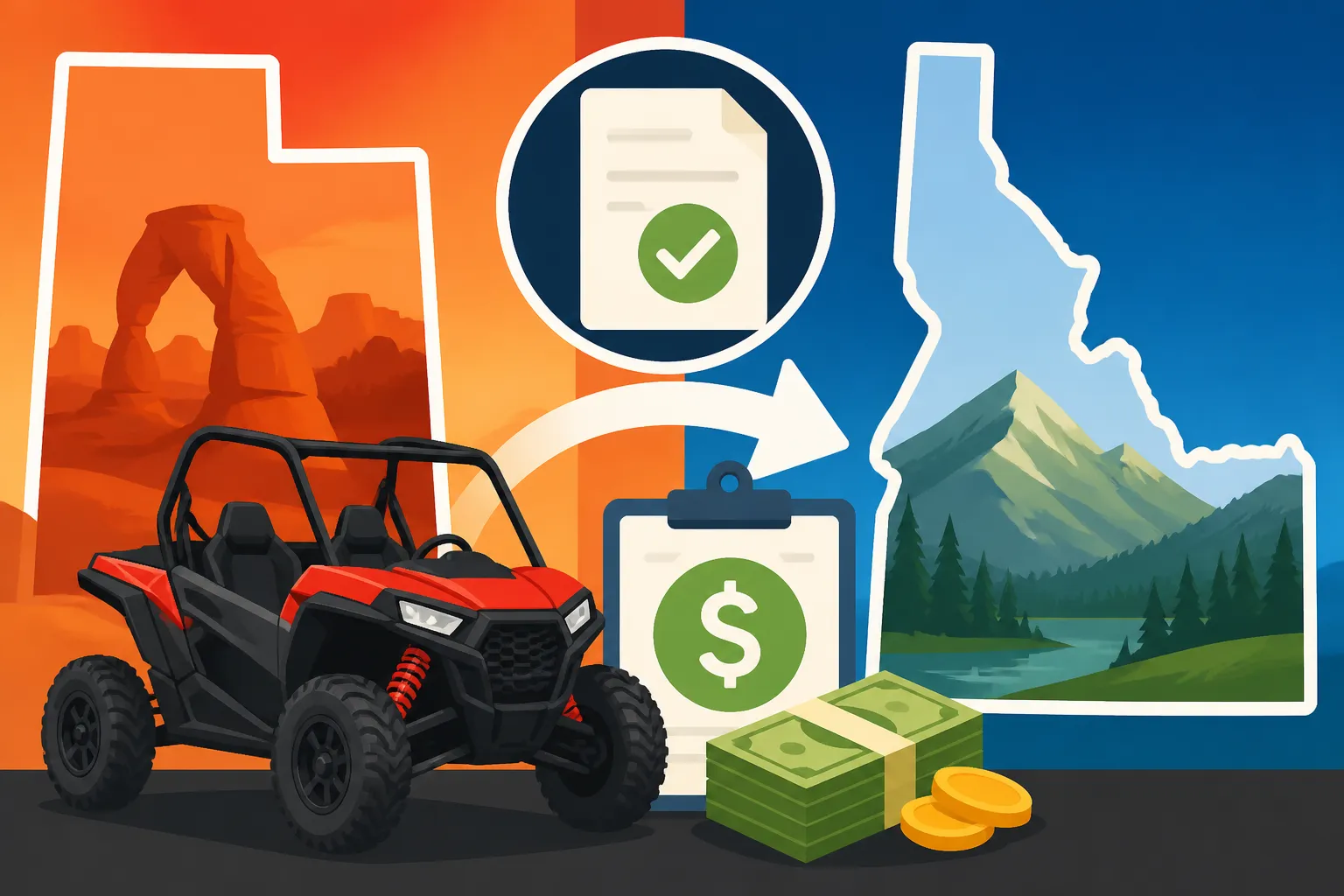
Bringing a new-to-you ATV or UTV home to Idaho, especially from a neighboring state like Utah, can feel like navigating a maze of paperwork and fees. One of the biggest head-scratchers for folks is often the sales tax situation: "I already paid tax in Utah, do I have to pay it again in Idaho?" It’s a common and completely valid concern that leaves many riders feeling confused and frustrated. This guide is here to clear up that confusion, explaining Idaho's use tax, how it applies to your out-of-state machine, and what you need to do to get your rig legally titled and ready for Idaho's incredible trails.
Understanding Idaho's Use Tax for Out-of-State Purchases
Let's cut right to it: when you buy an ATV or UTV in Utah and bring it into Idaho, you'll likely encounter what Idaho calls "use tax." This isn't just Idaho trying to get a second bite at the apple, I promise. It's a way for the state to ensure a fair playing field and that everyone contributes their share to state services, regardless of where they made their purchase. Think of sales tax as what you pay at the point of sale in a specific state, and use tax as what you owe when you use or consume a taxable item in Idaho that you purchased without paying Idaho sales tax.
For example, if you snagged that sweet side-by-side from a dealer in Salt Lake City, you almost certainly paid Utah sales tax. When you bring that machine into Idaho, the state wants to make sure that residents who bought their machines from Idaho dealers (and thus paid Idaho sales tax) aren't at a disadvantage. This also means that if you happened to buy a machine privately in Utah and didn't pay any sales tax there, Idaho's use tax will definitely apply. It’s all about consistency, and avoiding the situation where everyone just drives to a state with no sales tax to buy their toys.
Why Idaho Charges Use Tax on Out-of-State Machines
The fundamental reason Idaho charges use tax on vehicles brought in from out of state is to maintain what's called "tax parity." Imagine if you could just pop over the border to a state with a lower sales tax rate, or no sales tax at all, buy your ATV, and never owe Idaho anything. That would be a huge disadvantage to all the fantastic Idaho powersports dealers and would mean less revenue for critical state services that everyone benefits from.
Sales tax is levied by the seller at the point of sale. Use tax, on the other hand, is a direct obligation of the purchaser. It's designed to capture the tax revenue that would have been collected as sales tax if the transaction had occurred within Idaho's borders. The state wants to ensure that the use of goods within Idaho is taxed equitably, irrespective of the purchase location. So, when you bring your new-to-you UTV from Utah across the state line, Idaho views that as "using" the vehicle within its jurisdiction, and thus, use tax applies if Idaho's sales tax wasn't collected initially. This concept is key to understanding [Use Tax When a Machine Comes Into Idaho].
How Utah Sales Tax Credits Idaho Use Tax
Now, this is where it gets less painful for many buyers. Idaho isn't trying to double-tax you. The state understands you likely paid sales tax in Utah, and it provides a credit for that. Essentially, Idaho will credit you the amount of sales tax you paid in Utah, up to Idaho's current sales tax rate.
Let's walk through a conceptual example (remember, I can't give you current rates, you'll need to check those!). Say Idaho's sales tax rate is 6%, and you bought your ATV in Utah, where the sales tax rate was 5%. You paid 5% sales tax in Utah. When you bring the machine to Idaho, you would owe Idaho the difference – in this case, 1% – as use tax. Idaho gives you credit for the 5% you already paid. Now, what if Utah's sales tax rate was, say, 7%? In that scenario, since you paid more than Idaho's 6% rate, you likely wouldn't owe Idaho any additional use tax. You paid your fair share, and then some, according to Idaho's standard.
The crucial part here is having crystal-clear documentation. You absolutely must have proof of the sales tax you paid in Utah. This usually comes in the form of a detailed bill of sale or an invoice from the Utah dealership. Without that proof, Idaho's County Assessor will assume you paid no sales tax in Utah and will charge you the full Idaho use tax amount. This is why when you're buying a used machine, particularly from a private party, even if it's out of state, a well-drafted bill of sale is critical. Resources like LawDepot can provide customizable bill of sale templates that ensure all necessary details, including any sales tax collected, are properly documented.
The Process: Declaring and Paying Idaho Use Tax
The good news is that for most ATV and UTV owners, the process of paying Idaho use tax is integrated into the titling process. You don't usually send a separate check to the Idaho State Tax Commission directly. Instead, when you go to your local County Assessor's office to title your machine, they will handle the use tax calculation and collection. This makes it a one-stop shop for getting your machine legally recognized in Idaho. This process is covered in more detail in articles like [Idaho OHV Title Application at the County Assessor].
Documents You'll Need at the Assessor's Office
Getting all your ducks in a row before you head to the Assessor's office will save you a lot of time and potential headaches. Here’s a rundown of the essential documents you’ll need, especially if you bought your machine out of state:
- Proof of Ownership: This is paramount. If it's a brand-new machine, you'll need the Manufacturer's Certificate of Origin (MCO). If it's a used machine, you'll need the original title, properly signed and released by the previous owner. Make sure all names and signatures match exactly. For insights on what to look for, check out [ATV Bill of Sale Wording Buyers Should Insist On].
- Bill of Sale: This document is incredibly important, especially for determining the purchase price and documenting any sales tax paid. It should clearly list the buyer and seller, the machine's make, model, year, and most importantly, the Vehicle Identification Number (VIN). It also needs to state the purchase price and, if applicable, the amount of sales tax paid and to which state. If you bought from a private seller, you might have generated your own bill of sale, and this is where tools from LawDepot can be incredibly helpful to ensure it's legally sound and comprehensive.
- Proof of Utah Sales Tax Paid: This will usually be part of your bill of sale or an itemized dealer invoice. Make sure it explicitly states the sales tax amount and that it was paid to the State of Utah. Without this, the Assessor has no way to credit you.
- Identification: Your valid driver's license or state-issued ID.
- Payment for Fees and Taxes: Be prepared to pay the Idaho title fee and any calculated use tax. Most Assessor offices accept various forms of payment, but it’s always wise to call ahead and confirm. The typical [Idaho Title Fee at the County Assessor] is quite modest, but the use tax can be significant depending on the machine's value.
Having these documents complete and organized will ensure a smooth process. Missing even one piece of information can send you home to track it down, delaying your ability to hit those trails.
Calculating What You Owe (or Don't)
When you sit down with the clerk at the County Assessor's office, they will take your documents and work through the use tax calculation for you. They'll primarily look at your bill of sale to determine the purchase price and any sales tax already paid.
Here's how the general calculation works from their perspective:
- Determine the Machine's Value: They'll use the purchase price listed on your bill of sale. If the purchase price seems unusually low for the machine's type and condition (especially in a private sale), they might consult valuation guides like the NADA Guide to determine a fair market value. This ensures that people aren't artificially lowering their purchase price to avoid taxes.
- Calculate Idaho's Use Tax: They'll apply Idaho's current sales tax rate to that determined value. For example, if the machine's value is $10,000 and Idaho's rate is 6%, the calculated Idaho tax would be $600.
- Apply Credit for Out-of-State Sales Tax: They'll look at your proof of sales tax paid in Utah. Let's say you paid 5% in Utah on that $10,000 machine, which is $500.
- Determine Net Amount Due: They subtract the Utah tax paid ($500) from the calculated Idaho use tax ($600). In this example, you would owe Idaho $100 in use tax.
What happens if you didn't pay any sales tax in Utah, perhaps because you bought it from a private seller? In that case, the credit for out-of-state tax paid would be zero. You would then owe the full Idaho use tax amount, which, using our example, would be $600. This is a common scenario for many private party sales. That's why understanding [Idaho Sales Tax on an ATV Purchase] is important, even for private transactions.
Common Scenarios and Avoiding Headaches
While the process of paying use tax might seem straightforward on paper, real-life situations often throw curveballs. Anticipating these can help you prepare and avoid unnecessary delays or unexpected costs.
Private Party Purchases and Use Tax
This is a big one. When you buy an ATV or UTV from a private seller in Utah (or any state), it's highly likely that no sales tax was collected at the time of sale. Unlike dealerships, private individuals aren't usually registered to collect sales tax. This means that when you bring that privately purchased machine into Idaho, you will almost certainly owe the full Idaho use tax on its purchase price.
The absence of sales tax from a private transaction in Utah doesn't exempt you from Idaho's use tax. It simply means there's no credit to apply. Therefore, make sure you factor this into your budget when negotiating the purchase price. A clear, comprehensive bill of sale is still essential, even for private transactions, as it documents the agreed-upon purchase price that the Assessor will use for their calculations. If you're arranging a private sale and need a reliable document, LawDepot offers easy-to-use templates for bills of sale that can be customized to include all necessary details, protecting both buyer and seller.
When the Assessor Questions the Value
Sometimes, especially with older machines, a private sale with a very low stated purchase price can raise a red flag at the Assessor's office. While most transactions are accepted at face value, if the purchase price on your bill of sale seems significantly lower than the machine's reasonable market value, the Assessor might question it. Their goal isn't to overcharge you but to ensure that taxes are levied fairly based on the actual value of the property.
In such cases, the Assessor may refer to industry valuation guides (like the NADA Guide or Kelley Blue Book for powersports) to determine a fair market value. If their valuation is higher than your stated purchase price, they might assess the use tax based on their valuation, not yours. If you genuinely bought the machine at a lower price due to its condition or necessary repairs, be prepared to provide documentation. This could include:
- Photos: Pictures of the machine showing its current condition.
- Repair Estimates: Written estimates from a powersports mechanic detailing needed repairs.
- Market Research: Printouts of similar machines listed for sale at comparable prices.
Having this kind of evidence can help you justify the lower purchase price and ensure you're taxed fairly. It's all about transparency and having the right paperwork to back up your claims.
What Happens After Paying Use Tax and Titling
Once you've navigated the use tax labyrinth and successfully titled your ATV or UTV in Idaho, you're not quite done, but you're definitely over the biggest hurdle! Titling establishes legal ownership, but to legally ride on Idaho's public lands and designated trails, you need one more thing: an OHV sticker.
Getting Your Idaho OHV Sticker
The Idaho OHV sticker is your ticket to accessing the vast network of trails and public lands across the state. It's essentially your annual registration for off-highway use. Once you have your Idaho title in hand, you can purchase an OHV sticker. This is a separate fee from the title and use tax.
You can buy these stickers from various vendors, including many County Assessor offices, specific IDPR Service Centers, and even some powersports dealerships. [Where Idaho Sells OHV Stickers] provides more details on vendor locations. The cost of the sticker is a yearly fee, and it directly contributes to the maintenance and development of Idaho's OHV trails. So, while it's another expense, you know that money is going right back into the riding experience we all love. For details on the current cost, you can look up [What an Idaho OHV Sticker Costs Each Year].
Restricted Use Plates and Road Riding
For those who plan to ride their ATV or UTV on eligible county roads in Idaho, you'll need to take an additional step beyond just the OHV sticker: obtaining a Restricted Use Plate, often simply called an "R-plate." This plate signals to law enforcement that your machine meets specific requirements for limited road use.
The R-plate also comes with its own set of rules and a separate fee. It's crucial to understand that not all Idaho roads are open to OHVs, and there are specific equipment requirements (like mirrors, horn, headlights, and taillights) to legally operate on those that are. This plate doesn't make your OHV street-legal in the same way a car is, but it allows for specific, restricted use. For more information on what this entails, you can refer to [Idaho's Restricted Vehicle Plate Explained]. This step is optional and depends entirely on your riding intentions.
Here's a quick comparison of the three main fees you might encounter when bringing an out-of-state OHV into Idaho:
| Fee Type | Purpose | When/Where Paid | Credit for Out-of-State Payment? |
|---|---|---|---|
| Idaho Use Tax | Replaces Idaho Sales Tax for out-of-state purchases, ensures tax parity. | At the County Assessor's office (during titling) | Yes, for sales tax paid in another state (up to Idaho's rate) |
| Idaho Title Fee | Establishes legal ownership of the machine in Idaho. | At the County Assessor's office | No |
| Idaho OHV Sticker | Annual registration for public land/trail access, supports trail systems. | Various vendors (Assessor, IDPR, dealers) | No |
| Restricted Plate | Allows limited legal use on eligible county roads. | County Assessor's office | No |
Bringing an ATV or UTV from Utah into Idaho might involve a few extra steps, particularly when it comes to use tax, but with the right documentation and a clear understanding of the process, it’s entirely manageable. Don't let the paperwork deter you from experiencing the incredible off-road opportunities Idaho has to offer. Just be prepared, get your documents in order, and you'll be hitting the trails in no time.
Disclaimer
This article is for general informational purposes only and does not constitute professional advice. Laws, prices and regulations vary by location and change over time. Consult a qualified professional for guidance on your specific situation.