Sawtooth Switchbacks and Machine Width
A trail that looks wide enough on a map can feel surprisingly tight when it bends sharply across a Sawtooth hillside. For ATV and UTV riders, machine width is only part of the challenge: turning radius, wheelbase, loose ground, and room to reposition all matter on a switchback. This guide explains how to assess those factors and choose routes more confidently.
Why machine width matters on Sawtooth switchbacks
Width is more than the number on the spec sheet
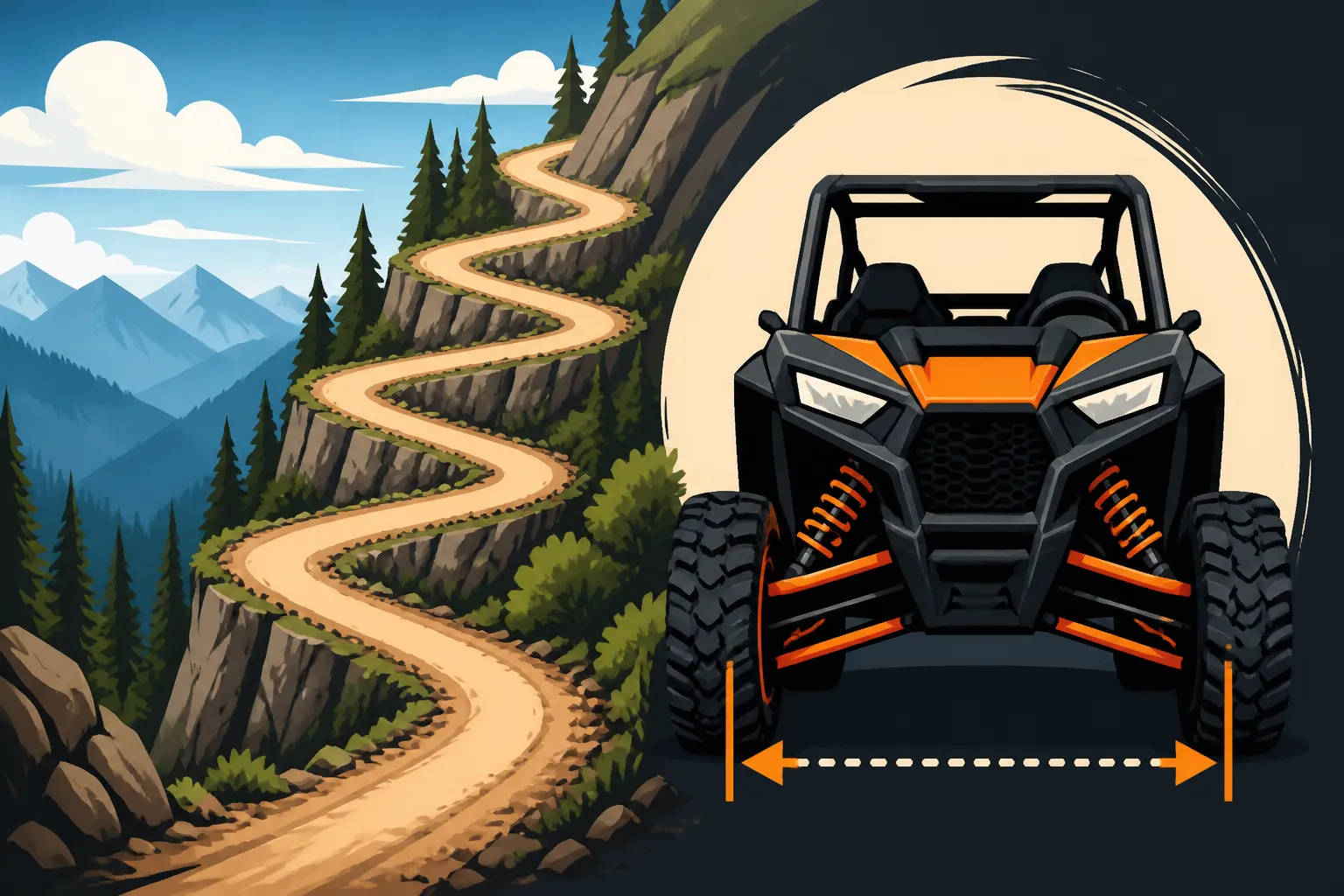
A machine’s published width gives you a useful starting point, but it doesn’t tell the whole story. A side-by-side may fit between the edges of a trail and still be difficult to steer around a tight bend. Long wheelbases, wide tires, accessories, and a rear end that swings outward can all make a turn feel narrower than expected.
It helps to think about the space your machine needs while it moves, not just while it sits still. On a switchback, the front wheels may need to track close to the inside edge while the rear tires follow a wider arc. If the trail narrows at the apex, or the outside edge drops away, there may be little room to correct a poor line.
The margin matters, too. A route that technically accommodates your machine may still be uncomfortable if brush, rocks, ruts, or a steep slope leave almost no room on either side. A narrow trail can feel manageable on a short quad but demanding in a wider UTV, even when both are allowed on the route.
Width ratings do not replace route-specific checks
A trail’s width category is not a promise that every turn will be easy. A route marked for machines of a certain width may include steep grades, sharp corners, uneven surfaces, or exposed sections. Conditions can also change after rain, snowmelt, erosion, or trail maintenance.
Before heading out, check the designated route information and restrictions for the area you plan to ride. The [Reading an Idaho Motor Vehicle Use Map] guide can help you understand how to use the map that applies to your route. For Sawtooth area rides, also review [Sawtooth National Forest Trails] and confirm that the route is open to the type and width of machine you intend to bring.
A map is a planning tool, not a live view of every obstacle. If a trail description is vague about machine width, difficulty, or surface, don’t assume that a full-size side-by-side will fit comfortably just because the route is visible. When the details are unclear, look for current local information before unloading.
Match the whole machine to the route
Compare more than the vehicle’s advertised width. Consider the turning radius, wheelbase, ground clearance, tire setup, and whether you have added mirrors, a roof, a spare tire, or other gear that changes the machine’s overall footprint. A loaded machine may also handle differently from the same vehicle without passengers and equipment.
For example, two UTVs might have similar widths, but a longer machine may need more space to pivot through a tight uphill turn. A quad can often make a compact turn, but its rider still needs room to shift position and avoid putting a tire near an unstable edge. The right question is not simply, “Can it fit?” It’s, “Can I turn it safely with the space and traction available?”
How to evaluate a route before you ride
Start with official route information
Use the applicable Motor Vehicle Use Map to identify designated routes and restrictions, then check for current closures or other notices before you leave. The map helps establish where motorized travel is allowed; it does not guarantee that a route is easy, wide, or suitable for every machine. A line on a map can also be difficult to interpret without checking the surrounding route details.
The [Checking Idaho Trail Status Before You Drive] guide is a useful next step when you’re planning around changing conditions. If you use onX Offroad, treat it as an additional navigation and planning aid rather than a substitute for official route designations or closure notices. Comparing the app’s route view with official information can help you catch planning questions before you’re on the trail.
Pay attention to the route’s full length, not just the first section near the trailhead. A trail may begin on a broad road and become narrower or steeper farther along. If your group includes machines with different widths, plan around the least capable vehicle and the tightest section you expect to encounter.
Look for clues about turns and terrain
Maps and trail descriptions may not spell out every switchback, but clues about elevation, terrain, and route character can still help. A route with frequent elevation changes, narrow trail descriptions, or technical difficulty is worth examining carefully if you’re bringing a wide machine. Ask whether the route includes steep side slopes, loose rock, deep ruts, or limited space to turn around.
The [Idaho Trail Difficulty Ratings] guide can help you think beyond width alone. A route may be suitable for a certain machine category but still require confident low-speed control. Riders new to mountain trails may prefer to start with routes described as less technical rather than learning on a steep, exposed switchback.
Planning tools such as onX Offroad can help you follow the route and understand how it connects to nearby roads and trails. Check the map before departure, download or prepare the information you’ll need for areas with weak service, and carry a backup navigation option. In remote terrain, a phone display should not be your only plan.
Use a practical fit check
Before you commit to a long ride, compare your machine’s dimensions with the route restrictions and consider the tightest likely turn. If you can, ask people familiar with the specific route whether it suits your vehicle. A general statement that a trail is “open to UTVs” may not answer whether a long, wide side-by-side will be comfortable on its switchbacks.
| What to check | Why it matters | Planning question |
|---|---|---|
| Machine width | Helps determine whether the route’s restrictions allow your vehicle | Is my machine within the route’s stated width limit? |
| Wheelbase and turning radius | Affects how much room a sharp bend requires | Can I turn without repeatedly backing up? |
| Trail surface | Loose rock, ruts, and mud can reduce control | Will the surface make it harder to hold a line? |
| Slope and exposure | A small steering error can have bigger consequences on a steep edge | Is there room to stop or reposition safely? |
| Route status | Closures and conditions can change | Have I checked current notices before leaving? |
| Group capability | One poorly matched machine can hold up or endanger the whole group | Can every vehicle handle the narrowest section? |
If the answers are uncertain, choose a wider or less technical route, or leave the larger machine at home. That may feel disappointing when you’ve planned a trip around a particular trail, but it’s better than reaching a tight corner and realizing there’s no comfortable way through.
Riding a switchback in a wide ATV or UTV
Approach slowly and choose your line early
Reduce speed well before the bend. A switchback is a poor place to discover that you’re moving too fast, especially on loose gravel or a steep grade. Approach with enough time to read the surface, identify the inside and outside edges, and decide where you want the front tires to go.
Keep the turn controlled and avoid making a sudden correction near the edge. In a UTV, remember that the rear wheels follow a different path from the front wheels; the machine may need more room than it appears to from the driver’s seat. On a quad, stay balanced and use smooth inputs rather than forcing the handlebars through the turn.
If another rider is close behind, don’t let their pace rush you. Make space before the bend when it is safe and appropriate, then take the corner at a speed that lets you stay in control. A patient approach is usually faster than stopping halfway through a turn to recover from a poor line.
Stop only where you can do so safely
If you reach a corner that looks too tight, stop before entering it if there’s a stable place to do so. Assess the turn from a safe position and talk through the next move with your group. Don’t assume that backing up will be straightforward: a narrow trail, steep cross-slope, or loose surface can make reversing just as challenging as turning forward.
Avoid using fragile trail edges, vegetation, or loose ground as extra turning space. Going around an obstacle or widening a corner can damage the trail and create hazards for other riders. Stay on the designated route, and don’t try to solve a fit problem by pushing through brush or riding off the trail.
When a turn doesn’t appear safe for your machine, turning back may be the sensible choice. Make that decision before the group becomes committed to a steep or exposed section. Leave enough distance between vehicles that each rider can assess a corner without pressure from the machine behind them.
Adjust the route to the group
A route that works well for an experienced rider on a compact quad may not suit a first-time UTV driver or a group with several wide machines. Set expectations before leaving the staging area. Agree that riders can call for a pause, that the group will regroup at safe pullouts, and that nobody has to attempt a corner just because someone else has already ridden through it.
For mixed groups, plan around the widest and least maneuverable machine. Check that everyone understands the route, knows how to communicate if conditions feel unsafe, and has enough space to follow without crowding. The [Wide Side-by-Sides on Narrow Idaho Trails] guide offers more to consider when assessing a route for a larger vehicle, while [Idaho Trails That Suit a 50-Inch Machine] can help clarify why width restrictions matter when choosing a trail.
If a route is a poor fit for one vehicle, split the group only if you can do so safely and have a clear plan for where to meet. Otherwise, choose a route everyone can ride together. The best day on the trail is not necessarily the one with the most difficult turns; it’s the one where everyone gets back without feeling pressured to take a risk.
Planning a Sawtooth ride with the right machine
Choose the vehicle after choosing the route
It’s tempting to bring the biggest machine because it carries more people, gear, or supplies. But a roomy UTV can be less convenient on narrow, twisting routes than a smaller quad. Start with the trail you want to ride, confirm the applicable restrictions, and then decide which vehicle makes sense.
The [Riding Near Stanley on an OHV] guide can help you explore the area as you plan. If your trip includes single-track routes, review [Sawtooth Single Track for Dirt Bikes] as well; single-track is designed for a different kind of machine and is not an appropriate route for an ATV or UTV simply because it appears on a map.
Think about the whole outing, too. Where will you park and unload? Can your trailer reach the staging area? Will you have room to turn around? The [Idaho Trailhead Parking and Staging] guide covers practical details that can affect the start of your ride. A machine that fits the trail but creates a problem at the trailhead can make the day harder before the ride begins.
Build flexibility into the day
Mountain weather and trail conditions can affect how a route feels, even when the designated route remains open. A wet or rutted surface may offer less traction, while snow or runoff can change which sections are practical. Leave room in your plan for a slower pace, a turnaround, or an alternate route.
Share your route plan with someone who is not riding with you, and be realistic about how long the trip may take. Carry navigation information you can access without relying on cell service, along with basic supplies appropriate for a remote ride. onX Offroad may help you keep track of your planned route, but it’s still wise to know where you are without assuming your phone will always have a signal.
Above all, keep the machine on designated routes and follow posted restrictions. If the trail becomes too narrow or challenging, don’t push ahead just to stay on schedule. A route choice that respects your vehicle’s size, the group’s skill, and the conditions is what makes a Sawtooth ride enjoyable rather than stressful.
Disclaimer
This article is for general informational purposes only and does not constitute professional advice. Laws, prices and regulations vary by location and change over time. Consult a qualified professional for guidance on your specific situation.