Towing Off a Remote Mountain Trail
A disabled ATV or UTV on a remote Idaho trail can turn a good ride into a stressful recovery, especially when the machine is stuck on a slope, around a blind bend, or miles from cell service. The safest way to get it out depends on the terrain, the damage, and the equipment you brought. This guide walks through how to assess the situation and choose a sensible recovery plan.
Assess the Machine and the Trail Before You Tow
Stop, secure the scene, and check for injuries
Before anyone reaches for a winch or tow strap, stop the group and make the area safer. Get riders out of the travel path, switch off the disabled machine if it is safe to do so, and keep people away from steep edges and unstable ground. On a narrow Idaho shelf road, another rider or vehicle may come around a blind corner with little warning. Use a spotter to watch for approaching traffic, and make the group visible without standing where a machine could slide or swing.
Check for injuries first. If someone may have a serious injury, prioritize getting help rather than moving the machine. If the machine is leaking fuel, smoking, or has damaged electrical components, avoid creating sparks or continuing to operate it. A machine that simply will not start calls for a different response than one with a broken steering component, damaged suspension, or a wheel that will not turn.
Once people are safe, look over the machine without putting yourself beneath it or between it and a slope. Note whether it can roll freely, steer, and hold its brakes. A machine with a locked wheel or broken steering may be unsafe to tow with its tires on the ground. If the problem is a puncture rather than a breakdown, the advice in Flat Tires Far From a Tire Shop may help you decide whether a trail-side repair is realistic.
Read the ground, not just the distance
A short tow across firm, level ground can be safer than a much longer pull over loose rock. Distance alone is a poor measure of difficulty. Look at the slope, footing, width of the trail, available turning space, and what lies below the machine. Loose gravel, wet clay, snowmelt, roots, and embedded rocks can all change how a machine behaves under tension.
Ask whether the disabled machine can be moved to a wider, flatter spot before attempting a recovery. Even a few feet may create room for a straight pull and keep the towing machine from being dragged sideways. Do not try to reposition it by hand on a steep slope, and do not stand downhill of a machine that could roll.
If the trail is too narrow to safely stage a second machine, or the disabled vehicle is close to an edge, stop and reassess. A rushed recovery can cause a second machine to become stuck or damaged. For more on choosing equipment and managing exposure on a tight route, see Recovery Gear for a Narrow Shelf Road.
Decide whether the machine is towable
A machine should only be towed with its wheels on the ground if it can roll and steer predictably and the operator can control it. If the steering is damaged, the brakes do not work, a wheel is locked, or the frame or suspension is compromised, dragging it may worsen the damage or make it impossible to control.
Check the owner’s manual for the manufacturer’s towing instructions. Some drivetrains can be damaged by being pulled with the engine off or with the wheels turning. If you do not know whether the machine can safely roll, do not assume that a tow strap makes it safe. A recovery may need a winch, a trailer, a different machine, or professional help.
Choose a Recovery Method That Matches the Situation
Use a controlled tow only on suitable ground
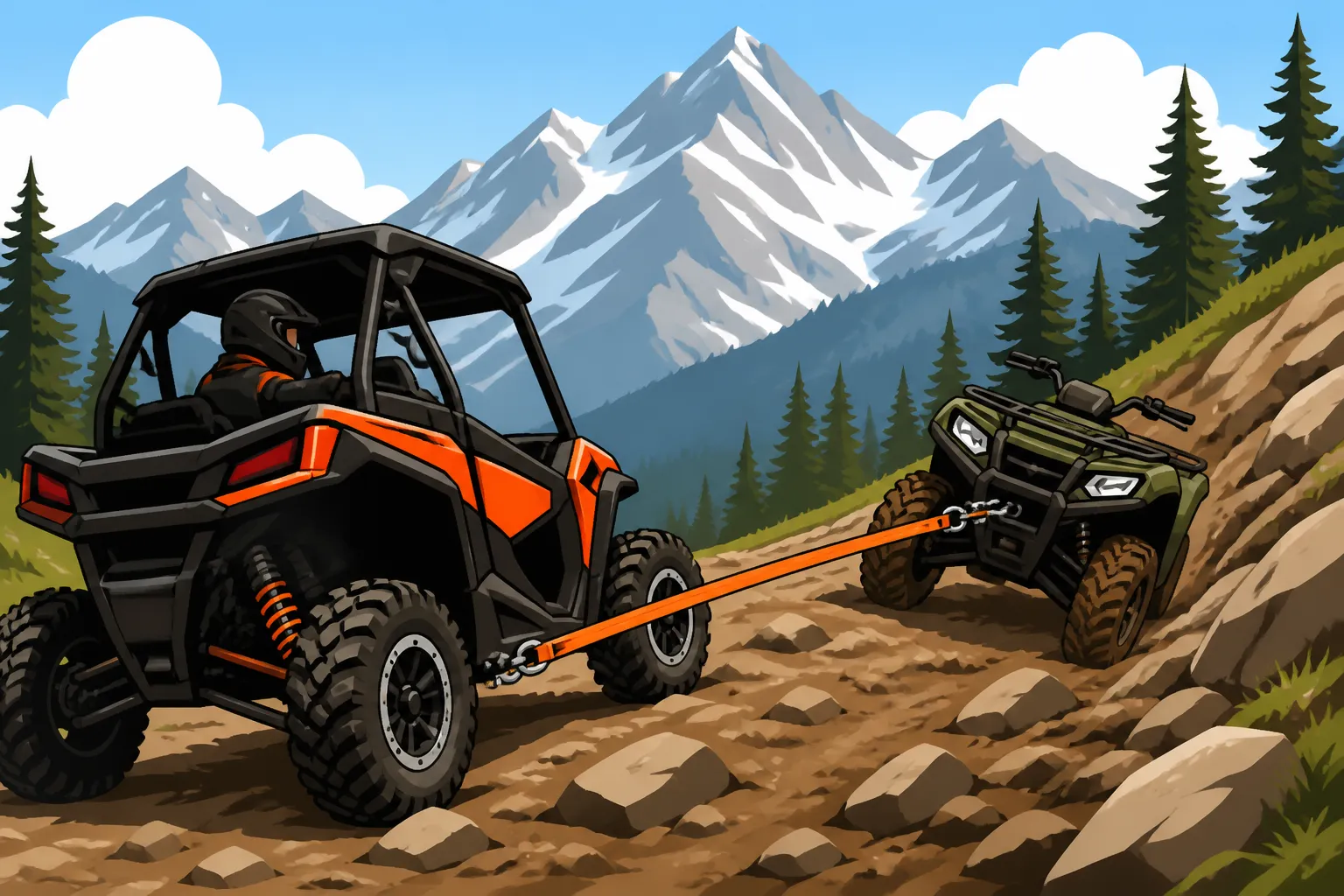
A tow behind another ATV or UTV may be reasonable when the disabled machine rolls and steers, the route is relatively level and wide, and both operators can communicate clearly. Use the recovery points intended for towing or recovery, not a bumper, rack, axle, or suspension component unless the manufacturer specifically identifies it for that purpose. Attach the line before starting, keep slack to a minimum, and move slowly enough that both operators can stop without a sudden jerk.
The disabled machine needs a capable rider who can steer and use its brakes. If it cannot be controlled, a second person should not be asked to ride it simply to make the tow easier. Keep bystanders well away from the line and the machines. Never straddle a tow line, stand inside a loop, or place yourself between the vehicles. A line under tension can move violently if a connection fails.
Avoid improvised towing arrangements, including tying a strap around a rack or attaching to a passenger’s machine in a way that could pull it sideways. Do not use a tow method that creates more force than the recovery points, line, or operators can safely manage. If the machine needs a sharp uphill pull or is likely to lurch, a controlled winch recovery may be more appropriate.
Use a winch for a measured pull, not a dramatic yank
A winch can help move a machine a short distance to safer ground or assist with a careful recovery. The anchor must be stable, the connection must be appropriate for recovery, and the pull should be as straight as the terrain allows. Use an appropriate tree-protection strap when anchoring to a tree, and avoid damaging vegetation or using an anchor that could shift or fail.
Before winching, clear people from the line of pull and from the area where the machine could roll. Keep hands away from the winch line and fairlead while it is under tension. Operate the winch in short, controlled pulls, checking the anchor, line, and machine position as you go. Stop if the anchor moves, the line becomes damaged, the machine twists unexpectedly, or the terrain changes.
Do not use a winch as a substitute for a safe anchor or a clear plan. A tree on loose soil, a small sapling, or a vehicle positioned on a side slope may not be a sound anchor. For a step-by-step look at planning a careful pull, read Winching on a Narrow Mountain Trail.
Know when not to recover it yourself
There are situations where the safest recovery is to wait for qualified help or arrange a recovery from a more accessible location. Examples include a machine hanging near a drop-off, a rollover with someone trapped, a fuel leak, a damaged frame, a failed anchor, or a route where a recovery vehicle cannot be positioned without risking another accident.
If you need emergency assistance, share the clearest location details you can: trail or road name, nearby junctions, landmarks, coordinates if available, the number of people in the group, and the nature of the problem. Cell service can be unreliable in Idaho’s backcountry, so do not count on being able to call once you are stuck. Review Cell Service in the Idaho Backcountry before a trip and build a communication plan around the coverage you actually expect.
| Situation | Safer first option | Avoid |
|---|---|---|
| Machine rolls and steers on firm, level ground | Slow, controlled tow with a capable rider at the controls | Sudden pulls or towing from an improvised attachment |
| Machine is stuck but has a stable, suitable anchor nearby | Carefully planned winch pull to safer ground | People standing near the line or downhill of the machine |
| Steering, brakes, wheel, or frame may be damaged | Stop and assess; seek an appropriate recovery method | Dragging it with its wheels on the ground without confirming it is safe |
| Machine is near a steep edge or unstable slope | Keep people clear and get experienced help | Rushed recovery or positioning another machine on the same hazard |
| Someone is injured or the machine is leaking fuel | Address the emergency and request help | Continuing recovery as if it were an ordinary breakdown |
Prepare for a Remote Idaho Recovery Before You Ride
Pack equipment you know how to use
A recovery kit only helps if it is in good condition and someone in the group knows how to use it. Depending on your machine and route, useful items may include rated recovery straps, suitable soft shackles, a winch and compatible accessories, gloves, a tire repair kit, basic tools, and a first-aid kit. Follow equipment and vehicle manufacturer guidance, and do not mix components whose capacity or intended use you cannot confirm.
Keep recovery equipment accessible rather than buried under camping gear. Before leaving, inspect straps for cuts, fraying, damaged stitching, or contamination, and check that hooks and connection points are secure. Make sure the group understands who will direct the recovery and what signal means stop. A simple plan matters when wind, engine noise, or a helmet makes conversation difficult.
Pack for a recovery taking longer than expected. Water, warm layers, a light source, food, and a way to communicate can make a long delay far more manageable. The checklist in What to Carry on a Remote Ride is a useful starting point for planning beyond the mechanical gear.
Share the route and carry more than one navigation option
Before heading out, tell someone where you plan to ride, when you expect to return, and what they should do if you are overdue. Within the group, agree on a route and meeting points before riders spread out. This is especially helpful when a disabled machine cannot move and another rider has to seek help or return to a trailhead.
Offline navigation can be valuable where mobile coverage is weak. Apps such as onX Offroad can help riders review routes and save maps for offline use, but a phone is not a complete emergency plan: battery life, device damage, and map coverage still matter. Carry a backup power source, protect devices from weather and impacts, and consider a paper map for the area. Check route access and closures before setting out; a route that appears on a map is not automatically open to motorized use.
onX Offroad can also help a group communicate a location more clearly when a phone can obtain a position, but do not assume a location can be sent without a connection. For a longer backcountry route, consider a satellite communication device and make sure someone knows how to use it.
Make the decision to turn around early
Changing plans is not a failure. If weather, snowmelt, mud, smoke, trail damage, or a mechanical problem makes the route riskier than expected, turn back while the group still has daylight and energy. A machine that is struggling on a steep climb may become much harder to recover on the descent. Reassess before committing to a narrow section or a long stretch without an easy exit.
Use a current map and check land-management information before riding. onX Offroad may help with route planning, but riders should still confirm access and closures with the relevant land manager. For trip planning and conditions, Checking Idaho Trail Status Before You Drive and Reading an Idaho Motor Vehicle Use Map can help you avoid arriving at a route that is closed or unsuitable for your machine.
Manage the Tow and Get the Group Back Safely
Assign clear roles and communicate before moving
Keep the recovery team small. One person should direct the operation, while the operators focus on controlling their machines. Other riders should stay in a safe waiting area, away from the line, the vehicles, and any slope where a machine might slide. Agree on clear hand signals or another communication method before tension goes on the line.
Move only when everyone is ready. The person directing the recovery should be able to see the machines and the line without standing in its path. If anyone loses sight of the operation or sees a problem, stop. Restart only after the line, anchor, machine position, and people have been checked.
Do not let a group’s schedule pressure the recovery. It is better to pause, reposition, or call for help than to continue because the trailhead is “only a little farther.” Fatigue and frustration make it easier to miss a damaged connection or a changing slope.
Recheck the machine after it reaches safer ground
Once the machine is out of immediate danger, inspect it again before continuing. Look for bent steering parts, damaged tires, loose connections, fluid leaks, and anything that changed during the pull. If the machine does not steer, brake, or run normally, do not assume it will make it back safely just because it moved a short distance.
A tow to a staging area is not the same as a return trip over the full route. The machine may need to be transported on a trailer, and the other riders may need to split up to get help. Keep the group together when possible, and avoid leaving a rider alone with a disabled machine in a remote location unless there is no safer option.
After the incident, note what failed, what equipment was useful, and what you wish you had packed. Update your route plan and maintenance routine before the next ride. If a recovery exposed a gap in your gear or communication plan, address it before returning to remote terrain.
Disclaimer
This article is for general informational purposes only and does not constitute professional advice. Laws, prices and regulations vary by location and change over time. Consult a qualified professional for guidance on your specific situation.