Do Utah Riders Need an Idaho Sticker?
Utah riders planning to bring an ATV or UTV into Idaho often assume their Utah registration covers both states. It generally does not: Idaho has its own nonresident OHV sticker requirement for many public-land rides. Here’s how to tell whether you need one, what it covers, and what to check before leaving home.
The short answer for Utah riders
In most cases, yes. If you bring an ATV or UTV registered in Utah and plan to ride it on Idaho public land, expect to need an Idaho nonresident OHV sticker. A Utah registration or OHV decal does not, by itself, replace Idaho’s requirement.
The rule is based chiefly on the machine and where it will be operated, not simply on whether the person riding it lives in Utah. A Utah resident riding an Idaho-registered machine may be in a different position from a Utah resident riding a Utah-registered machine. If you borrow a machine or travel with one registered to someone else, check the status of that specific vehicle rather than relying on the rider’s home address.
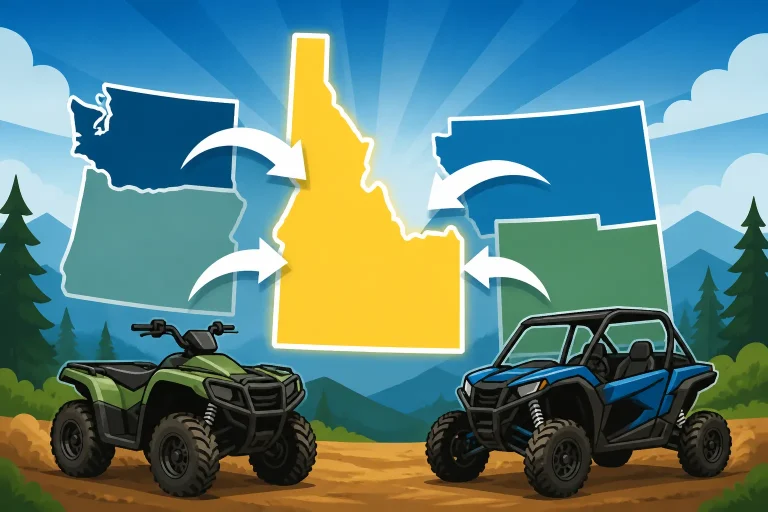
Idaho ended OHV reciprocity with neighboring states, so Utah’s permit should not be treated as an Idaho permit. For background on that change, see Why Idaho Ended OHV Reciprocity. Utah riders are among the visitors affected; Utah and Nevada Riders in Idaho covers the issue from that regional perspective.
| Your situation | What to expect | What to check |
|---|---|---|
| Utah-registered ATV or UTV on Idaho public land | An Idaho nonresident OHV sticker is generally required | Current Idaho Parks and Recreation requirements and any site-specific rules |
| Utah-registered machine kept on private land with permission | The public-land sticker requirement may not apply just because the machine is in Idaho | Property boundaries, landowner permission, and any local requirements |
| Machine with a highway plate | A plate does not automatically answer every OHV-permit question | Whether the vehicle is legally registered for the intended use and whether an OHV sticker is also required |
| Idaho-registered machine ridden by a Utah visitor | The machine’s Idaho status may matter more than the rider’s Utah residence | Registration, plate, and the rules for the specific road or trail |
| Rental or borrowed machine | The owner or rental company may have handled some paperwork, but do not assume it | Whether the machine has the required Idaho sticker and where it may be ridden |
The sticker is a permit for the machine; it is not a general pass for every rider, trail, road, or recreation area. It does not make an otherwise closed route legal, turn an OHV into a highway-legal vehicle, or replace a county road-use rule. Separate requirements can apply to the vehicle, its operator, and the route.
If the trip includes county roads, check those rules separately. Idaho road access varies by road and local ordinance, and a sticker alone does not authorize a road ride. What Idaho Requires to Ride a County Road explains why checking the specific route matters.
Which rides and machines the rule can affect
The practical question is not only “Is the machine in Idaho?” It is also “Where will it be operated, and what kind of vehicle is it under the applicable rules?”
Public land and trail riding
For a Utah-registered ATV or UTV used on Idaho public land, plan on getting the Idaho nonresident sticker before riding. Public-land trips can include more than a marked trail: riders may use staging areas, connecting routes, or forest roads, each of which can have its own access restrictions. Having a sticker does not mean every road or trail is open to OHVs.
Check the land manager’s current information and the route map for the area. Forest Service and BLM land can have route-specific motorized access rules, seasonal closures, and other restrictions. Idaho’s permit requirement and a land manager’s access rules are separate questions: you may need the sticker and still be prohibited from riding a particular route. See Idaho Permit Rules on Public Land and Idaho Rules on Forest Service Roads when planning a trip.
Private property
A ride confined to private property may be treated differently from a ride on public land. If the ATV or UTV will stay on private property and you have the owner’s permission, Idaho’s public-land sticker requirement may not be triggered just because the machine crossed the state line.
That is not a blanket exemption for every situation. A route that leaves private property and enters a public trail, road, or staging area can bring the public-land rules into play. Permission to cross one parcel also does not give permission to use adjoining land. If your route crosses between private and public areas, confirm where the boundaries are and what rules apply at each point.
Highway plates and restricted plates
A Utah highway plate, if the machine has one, does not automatically settle whether an Idaho OHV sticker is needed for every kind of riding. A plate and an OHV sticker serve different purposes. A machine may need to meet road requirements for a particular public road and also face separate requirements when used off-highway.
Likewise, an Idaho restricted vehicle plate is not the same thing as an OHV sticker. Idaho’s restricted plate relates to limited road use under applicable conditions; the sticker relates to OHV requirements. Neither one automatically gives unrestricted access to public roads. For the distinction, read Idaho’s Restricted Vehicle Plate and Road Use and Why an Idaho Plate Is Not a Registration on Its Own.
Before a road segment, confirm whether the road is open to OHVs, what equipment and operator rules apply, and whether local approval is required. For a machine with a highway plate, ask Idaho Parks and Recreation or the relevant local authority how the rules apply to the exact vehicle and planned use rather than assuming the plate replaces every other permit.
One sticker per machine
Treat the sticker requirement as machine-specific. If a group brings several ATVs or UTVs, do not assume one sticker covers the trailer, the group, or every machine. Each vehicle should be checked separately, including a borrowed machine or one with different registration paperwork.
Passengers do not normally purchase a separate sticker for themselves; the permit question concerns the machine being operated. That does not remove other rider responsibilities, such as following age, supervision, helmet, or passenger rules where they apply.
Getting the right Idaho sticker before the trip
For a Utah rider, the simplest approach is to identify the machine’s registration status and intended riding area before departure. Then buy the Idaho nonresident sticker through an authorized channel and confirm how it must be displayed.
Check the machine’s paperwork
Start with the registration document and identification details for each ATV or UTV. Make sure you know who the registered owner is, what state issued the registration, and whether the machine has a highway plate or another type of registration. If the paperwork is incomplete or does not match the machine, resolve that before relying on it to establish an exemption.
A vehicle’s title and registration are different documents, and neither should be confused with an OHV sticker. A title generally establishes ownership; a registration or plate relates to authorization to use the vehicle in particular ways. An Idaho nonresident sticker is a separate permit. If you are uncertain about an out-of-state registration, Idaho’s Non-Resident OHV Sticker and Idaho Permit Rules on Public Land are useful starting points.
Buy through an authorized seller
Idaho nonresident stickers are available through designated sellers and official channels. Options and purchase procedures can change, so verify current instructions with Idaho Parks and Recreation before you leave. Where to Buy an Idaho Non-Resident Sticker outlines the kinds of places to check, while Buying an Idaho Sticker Online Before a Trip can help you assess whether an online purchase fits your timing.
Do not wait until the group is unloaded at a trailhead to discover that the sticker must be purchased or displayed differently than expected. If ordering online, check whether the sticker is mailed, issued electronically, or requires another step before the machine can be used. Allow enough time for the delivery or processing method described by the seller. If buying in person, confirm the seller’s hours and that it handles the specific nonresident permit you need.
The cost and available purchase options can change. Check the current official provider information rather than relying on an old receipt, a prior trip, or a price quoted in an outdated discussion. If you have several machines, ask how the seller handles multiple permits and make sure the information is entered for the correct vehicles.
Display it as instructed
After purchase, follow the Idaho instructions for placing the sticker on the machine. Do not leave it in a glove box or assume that a receipt is a substitute for displaying the permit where required. Check that it is legible, secure, and attached to the correct vehicle.
If a sticker is damaged, missing, or difficult to read before the trip, contact the issuing seller or Idaho Parks and Recreation for replacement guidance. Avoid improvising a new placement or moving a sticker between machines unless the official instructions allow it. The display requirement is distinct from simply having proof of purchase.
Keep the purchase confirmation and relevant vehicle registration information accessible while traveling. You may not need to carry every ownership document on the trail, but having a way to verify the permit and vehicle details can make it easier to resolve a question during a stop or at a recreation site. What Idaho Riders Need Before They Ride gives a broader checklist of ride preparations.
Avoiding common Utah-to-Idaho mistakes
Most permit problems come from treating a sticker, registration, plate, or route map as if it answers all the other questions. Before setting off, work through the basics for each machine and each planned riding area.
-
Do not count on Utah reciprocity. Utah registration or an OHV decal does not generally substitute for Idaho’s nonresident sticker on a public-land ride. Check Idaho’s current rule even if the machine is properly registered at home.
-
Match the permit to the machine. Confirm that each ATV or UTV in the group is covered. A sticker on one vehicle does not cover a second machine, and a rider’s permit is not a substitute for the vehicle’s sticker.
-
Confirm where the route goes. A route can move from private property to a public road or trail. Check the land status, route designation, local closures, and any county road ordinance. A sticker does not make a closed road or restricted trail available.
-
Separate road legality from OHV permission. A Utah plate, Idaho restricted plate, and Idaho OHV sticker are not interchangeable. Verify whether your machine may use each road segment and whether separate vehicle, equipment, or operator requirements apply.
-
Check age and supervision rules. A youth rider may have requirements that do not apply to an adult, including supervision or safety-course rules in some circumstances. Do not assume an adult’s permit or presence automatically satisfies every requirement. Check Idaho Age Rules for Riders Under 16 before bringing young riders.
-
Verify rental and borrowed machines. If you rent or borrow an ATV or UTV, ask who is responsible for the sticker and whether the permitted routes match your plan. Get a clear answer before riding, and do not assume that the owner’s paperwork authorizes every kind of use.
-
Recheck close to travel. Rules, authorized sellers, closures, and purchase procedures can change. Review official Idaho Parks and Recreation guidance and the land manager’s current route information before leaving. Keep a copy of the route map and permit confirmation available, particularly when riding in areas with limited cell service.
A few minutes of preparation can prevent a frustrating arrival-day delay. For a Utah-registered ATV or UTV headed onto Idaho public land, the safe planning assumption is that an Idaho nonresident sticker is needed. Then verify any exception based on the machine’s exact registration and use, and confirm that every road or trail on the itinerary is open to that vehicle.
Disclaimer
This article is for general informational purposes only and does not constitute professional advice. Laws, prices and regulations vary by location and change over time. Consult a qualified professional for guidance on your specific situation.