Riders With a Driver’s License and the Course
A driver’s license and an Idaho OHV safety certificate answer different questions. One concerns permission to drive; the other concerns safety training and, for younger riders, supervision on public land. Here’s how to tell whether you need the course, what your license does and does not change, and what to check before riding.
A driver’s license does not replace the safety course
Having a driver’s license does not automatically satisfy an OHV safety-course requirement in Idaho. The license is not proof that you completed an approved course, and the course certificate is not a driver’s license. They serve separate purposes.
For many adult riders, Idaho’s youth-focused safety-course rules will not apply. The key question is generally the rider’s age and where the machine will be operated, not whether the rider holds a driver’s license. Riders under 16 using an OHV on public land may be subject to safety-course and supervision rules. A license held by a parent or other adult does not become the young rider’s course certificate.
A driver’s license can still matter for other parts of a ride. For example, it may be relevant to whether someone can operate a vehicle on a road that is legally open to OHVs. Road access also depends on the road’s rules, the machine’s equipment and registration, and any local restrictions. A license does not make every road open to OHVs or waive those separate requirements.
| What you have | What it may help establish | What it does not establish |
|---|---|---|
| Driver’s license | That you are licensed to drive, where a license is required for the type of operation | Completion of an OHV safety course or permission to ride on a closed road |
| OHV safety certificate | Completion of an approved safety course, where the course rule applies | A driver’s license, road access, registration or an OHV sticker |
| OHV registration or sticker | Compliance with applicable registration or permit rules | Road legality or completion of a safety course |
| Restricted vehicle plate | A machine’s eligibility for certain road use, subject to restrictions | Permission to use every road or exemption from rider requirements |
The distinction is worth keeping in mind even if you are an experienced driver. A road-driving test does not necessarily cover trail etiquette, OHV-specific controls, riding on public land or the judgment needed to avoid damaging trails. The safety-course rules are about the rider and the setting; road-use rules are a separate layer. For a broader checklist, see What Idaho Requires Before You Ride.
When the course matters for riders under 16
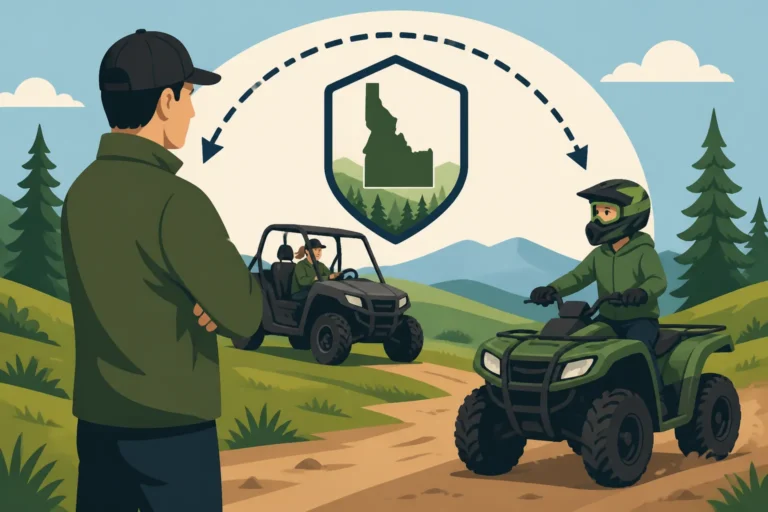
Idaho’s OHV safety education rules are especially important for riders under 16. A young rider’s age can affect whether they need an approved safety course, whether they must ride under adult supervision and what rules apply on a road. A parent’s or supervisor’s driver’s license does not remove those questions.
In general, check the course and supervision requirements before a rider under 16 operates an OHV on public land. The rules can depend on the specific riding situation, including whether the rider has completed the approved course and whether an adult is supervising. Do not assume that a young rider is exempt just because they are riding with a licensed driver, or that passing the course automatically makes every kind of riding lawful.
For the current age-specific details, start with Who Must Take the Idaho Safety Course and Idaho Supervision Rules and the 300-Foot Rule. Those topics matter because “supervision” is more specific than simply having an adult somewhere on the ride. Confirm the required age and supervision conditions for your situation rather than relying on a general rule of thumb.
A practical way to check a young rider’s situation
Before taking a youth rider out, work through these questions:
- How old is the rider? Do not rely on whether they look mature or can control a machine. Age is a key part of the rule.
- Where will they ride? Public trails, public land, private property and public roads can involve different requirements.
- Has the rider completed an approved course? If the rule applies, confirm that the course is recognized and that the rider has the certificate or other proof available.
- Will an adult supervise? Check who qualifies and what “direct supervision” means for the riding situation. Being in the same group may not be enough.
- Will any part of the route use a road? Road rules are separate from trail rules. Check them before planning a route that connects a trail to a town, staging area or trailhead.
This is also why a driver’s license is not a shortcut through the analysis. It may be relevant to the adult’s ability to drive or supervise under a particular rule, but it does not answer whether the young rider needs their own course certificate.
If the route includes a road, review Idaho Rules for Riders Under 16 on Roads as well as the course rules. A young rider can meet one requirement and still be ineligible to operate on a particular road or machine.
What the course certificate does and does not do
An approved course certificate is evidence of safety-course completion. Where Idaho’s youth rules make the course relevant, the certificate may affect whether a young rider needs adult supervision. It does not serve as a general permit to ride, and it does not replace other paperwork or equipment requirements.
Think of compliance as several separate checks:
- Rider eligibility: Is the rider old enough and otherwise allowed to operate the machine in this setting?
- Course and supervision: Does the rider need a course certificate or an adult supervisor?
- Machine requirements: Does the OHV need a title, registration or sticker for the planned use?
- Road requirements: Is the road open to OHVs, and does the machine meet the rules for that road?
- Safety equipment: Are helmets or other protective equipment required for this rider and ride?
A course certificate does not change the machine’s registration status. It also does not provide road-use authorization. For example, a sticker or plate cannot be substituted for a course certificate, just as a certificate cannot replace a required sticker. If you are sorting out permits and paperwork, Idaho OHV Safety Course Requirements and Idaho’s Restricted Vehicle Plate and Road Use address different parts of the process.
Keep the certificate accessible when it may be needed to show compliance. That does not necessarily mean carrying the original paper in every circumstance; check what form of proof is accepted and what the rider should have available. See Carrying a Safety Certificate for practical details. If the certificate is misplaced, check the relevant course provider or state program for the process to obtain a duplicate.
Do not assume that a course taken for another state automatically meets Idaho’s requirements. Recognition can depend on the course and the rule involved. Riders coming from outside Idaho should verify whether their certificate is accepted before relying on it. An out-of-state driver’s license alone does not prove course completion.
Separate the riding area from road use
The most common point of confusion is treating “public land” and “public road” as the same thing. They are not interchangeable. A trail on public land may have one set of OHV rules, while a county road or other public road may have additional requirements. A route can also move between different jurisdictions, so rules may change during the ride.
On public land, check the applicable course, supervision, sticker and land-use rules. Forest roads can have their own access and operating conditions, so review Idaho Rules on Forest Service Roads before assuming a route is open. A map or trail app can help with route planning, but it is not a substitute for checking current closures and local restrictions.
For a road section, confirm that OHV use is allowed there and that the machine meets the requirements for that road. A restricted plate may be one part of the road-use picture, but it does not make a closed road open. Local ordinances and restrictions can also affect access. For more on the plate, see Idaho’s Restricted Vehicle Plate and Road Use.
A driver’s license should therefore be treated as one item in the checklist, not a universal pass. It may be required for some road operation, but it does not:
- Replace a young rider’s safety-course certificate.
- Automatically qualify an adult to supervise under every circumstance.
- Register or sticker an OHV.
- Make an otherwise restricted road legal for OHV use.
- Override age, equipment, land-management or local requirements.
If you are planning a mixed route that includes both trails and roads, verify each section separately. This is particularly important when a youth rider is involved. Confirm the rider’s course and supervision status before the trip, then check the machine’s paperwork and the route’s access rules.
A useful pre-ride checklist
Before leaving, make sure you can answer these questions:
- Does the rider’s age trigger a course or supervision rule?
- Is the course approved for the Idaho requirement, and can the rider show proof if needed?
- Does the adult supervisor meet the applicable rule?
- Is the OHV properly documented for the planned use?
- Are any roads on the route open to OHVs?
- Does the machine have the required equipment and plate or sticker for that use?
- Have you checked for seasonal closures or local restrictions?
If any answer is uncertain, confirm it with the relevant Idaho agency or land manager before riding. Rules can differ by location and can change, so an old certificate, map or recollection may not resolve the question.
Disclaimer
This article is for general informational purposes only and does not constitute professional advice. Laws, prices and regulations vary by location and change over time. Consult a qualified professional for guidance on your specific situation.