Group Size Limits on Forest Land
A large ATV or UTV ride on Idaho forest land takes more planning than choosing a trail and setting a meeting time. Group-size limits can depend on the land manager, route, activity and whether the ride is organized or commercial. There is no single number that safely applies everywhere. Here’s how to check the rules and avoid arriving with a group that needs a permit or a different plan.
There Is No Single Group Limit for All Idaho Forest Land
“Forest land” can mean land managed by different agencies or owners, and each may have its own rules. Even on National Forest land, requirements can vary by forest, ranger district, route and activity. A limit that applies to one trail, campground or event area may not apply to a different place nearby.
The practical takeaway is to check the rules for the exact route and meeting area, rather than relying on a number from another ride or a general online discussion. A land manager may set a limit for a particular location or activity, or require advance authorization for a gathering. Permit conditions can also set a maximum group size or require the organizer to divide a group into smaller parties.
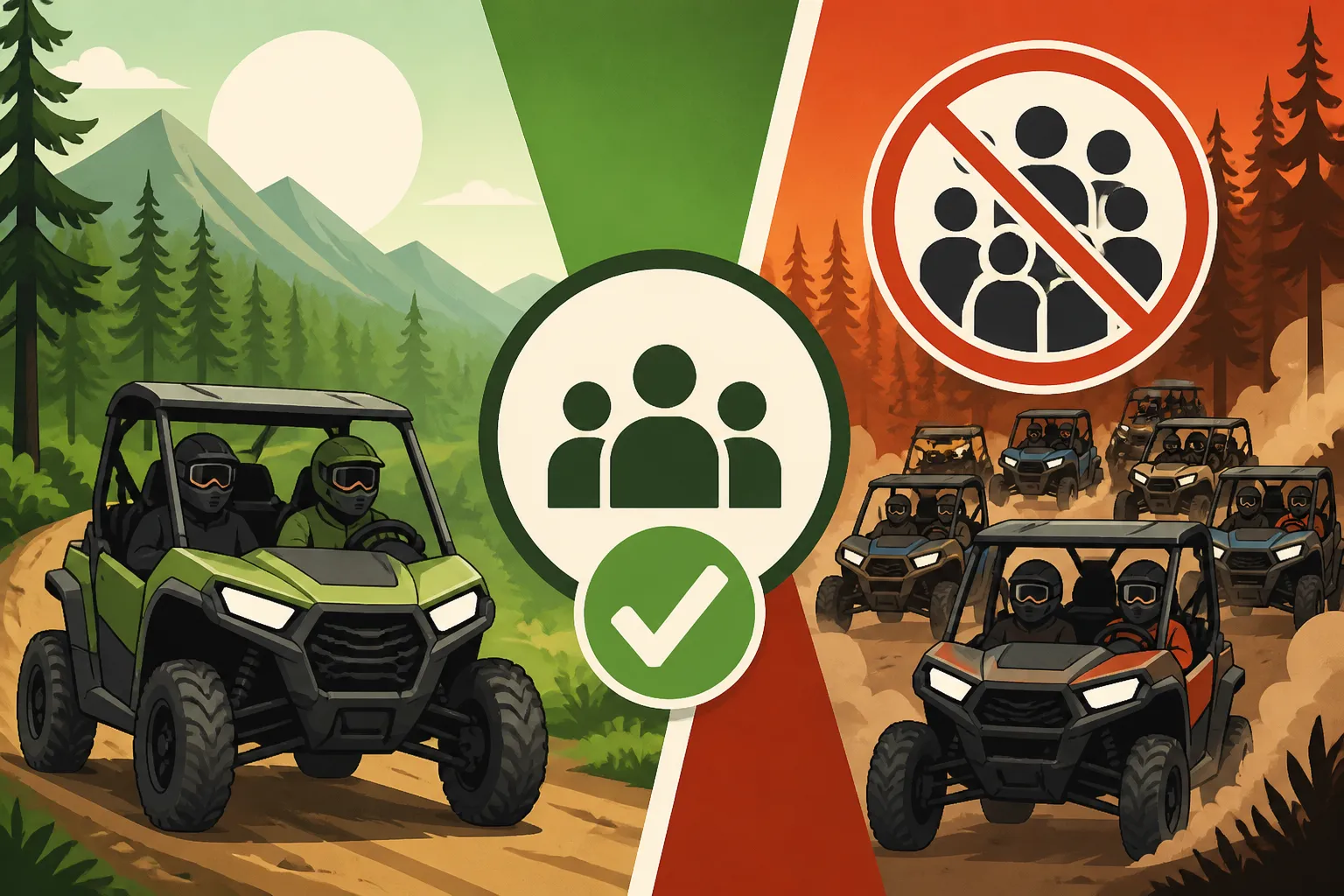
A typical family ride with a few machines is different from an advertised group event that brings many riders to the same trailhead. The difference is not necessarily the number of vehicles alone. Factors can include whether the ride is organized, whether people are being charged, whether the group uses a staging area, and whether the activity affects other visitors or natural resources.
It also matters who manages the land. National Forest, Bureau of Land Management, state, county and private lands may have different rules. A route can pass through more than one jurisdiction, so checking only with the agency responsible for the starting point may not be enough. For public-land access, Idaho Rules on Forest Service Roads and Idaho Rules on BLM Roads provide useful context, but they do not replace checking local restrictions for your specific ride.
Before treating any group-size number as final, confirm:
- Which agency or landowner manages the trail and staging area.
- Whether a local order, closure or special restriction is in effect.
- Whether the limit applies to the entire gathering or to each riding party.
- Whether a permit is required for your type of event.
- Whether the permit or site reservation sets a separate limit.
If the rules are unclear, contact the responsible office and describe the actual plan: number of machines and people, route, date, staging location, whether the ride is open to the public, and whether money will change hands. Those details help staff tell you which requirements apply.
What Can Change the Limit or Require Authorization
A group may be subject to more than one rule. A route could have a local restriction, a staging area could have its own capacity, and an organized event could require authorization even if the same number of people riding informally would not. Do not assume that a large ride is allowed just because the trail is open to individual riders.
Informal rides and organized events
A casual outing among friends is generally simpler to plan than a club ride, charity event or advertised gathering. An organized activity may involve a set meeting point, a planned route, public invitations, registration, fees, support vehicles or repeated use of a site. These details can affect whether the land manager considers the ride an event or a use that needs a permit.
There is no reliable universal cutoff to use for deciding when a ride becomes an event. Ask the land manager about the complete arrangement instead of trying to interpret a number from a different district or permit. If the ride is being promoted publicly, involves a club or business, or is expected to bring a sizable group to a sensitive area, ask early. Permit review can take time, and the agency may need to assess impacts or set conditions.
For an activity on National Forest land, Forest Service Permits Idaho Riders Need is a helpful starting point. For a club gathering or similar event, also review Idaho Permits for an Organized Ride. A permit may specify the route, timing, parking, group size, safety measures or other conditions. Treat those conditions as part of the plan, not as optional guidance.
Location, crowding and resource impacts
A trail may be open but still be a poor fit for a large group. Narrow routes, limited passing space, small parking areas, fragile ground, wildlife concerns and nearby campsites can all make a gathering more disruptive. Managers may respond with local limits, permit conditions, route changes or closures.
A group that is too large to ride safely as one unit can also create problems without violating a stated numerical cap. Riders may bunch up at intersections, block access for other users, spread out and lose contact, or leave the route to pass. A planned ride should account for the trail’s width and difficulty, not just the number of people.
Keep to designated routes and check map information before leaving. Reading an Idaho Motor Vehicle Use Map can help riders understand where motorized travel is allowed, while Idaho Trail Closures in Fire Season is relevant when seasonal restrictions or fire conditions could affect a planned route. An open route on a map does not guarantee that an event or large gathering is permitted at a particular site.
Wilderness and other restricted areas
Some protected places have stricter access rules than nearby forest roads. Wilderness is not open to motorized OHV travel, and a group-size question does not change that. Avoid routes that enter a closed area, including informal tracks that appear to continue beyond a permitted route. See Idaho Wilderness Areas Closed to Motors and confirm boundaries on current land-manager maps.
Local orders can also close routes or staging areas for reasons such as safety, maintenance, fire danger or resource protection. A trail that was open on a previous visit may not be open for your planned date. Check current notices close to departure, particularly for a large ride that would be difficult to relocate at the last minute.
| Ride or setting | What to check | Practical approach |
|---|---|---|
| Small, informal ride | Route access, closures and staging | Confirm the route is open and the meeting area can accommodate the group |
| Club or public ride | Event authorization, route and group conditions | Contact the land manager before advertising or taking registrations |
| Guided or paid trip | Commercial-use and outfitter requirements | Ask which permits apply to the operator and the specific route |
| Large gathering at a trailhead | Parking capacity, site use and any event conditions | Do not assume a trail’s openness means the trailhead can host an event |
| Route crossing agency boundaries | Rules for each land manager and segment | Identify every jurisdiction and check each one separately |
How to Check the Rules Before You Invite Riders
The safest approach is to make the inquiry specific and keep a record of the answer. A general question such as “How many ATVs can ride in Idaho?” is too broad to resolve a local limit. Give the land manager enough information to assess the plan.
- Pin down the route and gathering place. Identify the trailhead, roads or trail segments, and any planned stops. If the route is not fixed, provide the likely options and ask whether any are unsuitable for a group.
- Identify the land manager for each segment. A route may cross between National Forest, BLM, state or private land. Find out who is responsible for the access point as well as the riding route.
- Describe the group honestly. Include the expected number of machines and riders, whether children are coming, and whether the group will ride together or in smaller parties.
- Explain how the ride is organized. Say whether it is private or open to the public, whether riders will register, whether there is a fee, and whether a club, business or guide is involved.
- Ask direct questions. Confirm whether there is a group-size limit, event permit, reservation or special-use authorization. Ask if there are conditions for parking, timing, route choice or splitting into smaller parties.
- Get the answer in a form you can use. If authorization is needed, ask how to apply and whether written approval or permit conditions will govern the ride. Keep the relevant communication and any approval with the organizer.
- Recheck before departure. Confirm that no closure or restriction has changed the plan. A permit does not necessarily override a later closure or route restriction.
When contacting an office, avoid asking staff to approve a vague idea. A concise itinerary is more useful: where the group meets, the route it intends to ride, the expected size, the date, and any commercial or public-event elements. If you expect participants to arrive in separate vehicles, mention the parking demand too. A ride with a manageable number of machines can still overwhelm a small staging area if everyone arrives in a truck and trailer.
If the office says the plan needs a permit, ask about the application process, lead time and conditions. Do not assume approval is automatic or that a permit for a different event, route or year applies to your ride. If the agency cannot give a firm answer at first, ask which office or ranger district handles the location.
Plan a Group That Fits the Route and the Rules
Even when no fixed cap applies, breaking a large ride into smaller parties can make the day safer and easier to manage. It can reduce congestion at trail junctions, help riders maintain spacing and make it easier to keep everyone together. But splitting up does not automatically remove an event-permit requirement: a large organized gathering can remain an organized gathering even if participants ride in smaller groups. Confirm that arrangement with the land manager.
Set a realistic pace and select routes for the least experienced rider and the least capable machine in the group. Check width limits, difficulty and current conditions before choosing a route. A route suitable for a handful of experienced riders may be a poor choice for a mixed group with children, passengers or full-size side-by-sides. Idaho Trail Difficulty Ratings and Wide Side-by-Sides on Narrow Idaho Trails can help with route planning.
Agree on basic group practices before starting:
- Choose a lead rider and a sweep rider, and make sure both know the route.
- Set stopping points where the group can pull off without blocking the trail.
- Keep a safe following distance and avoid crowding other trail users.
- Give riders a way to communicate and a plan for someone who falls behind.
- Make sure each rider knows the route boundaries and where the group will regroup.
- Use legal staging and parking areas, leaving access open for other visitors and emergency vehicles.
For a bigger gathering, have a clear arrival and departure plan. Ask participants not to park on vegetation or block gates, roads or trail access. Keep the meeting area as small and orderly as practical, and do not extend the event beyond the location or times approved by the land manager. These steps are useful even when a permit is not required because they reduce conflict with other visitors and the risk of damage.
A group leader should also be ready to change plans. Weather, fire activity, mud, traffic or a closure can make the planned route unsuitable. Decide in advance who will check for current updates and how the group will communicate a change. Checking Idaho Trail Status Before You Drive and Where Idaho Closure Orders Are Posted can support that last-minute check.
The main rule is simple: do not rely on a statewide group-size figure. Verify the requirements for the precise route, land manager, gathering and activity. If your ride is organized, public or commercial, ask about permits before you promote it or collect money. When the rules and the trail’s capacity both fit the group, the ride is more likely to work for participants and for everyone else using the forest.
Disclaimer
This article is for general informational purposes only and does not constitute professional advice. Laws, prices and regulations vary by location and change over time. Consult a qualified professional for guidance on your specific situation.