Where Idaho Sticker Revenue Is Spent
Where Idaho Sticker Revenue Is Spent
If you buy an Idaho OHV sticker, it is reasonable to ask what the money actually supports. The short answer is that sticker revenue helps fund Idaho’s off-highway vehicle program and riding opportunities, but it does not necessarily go straight to the trail you use. Here’s how to understand the funding, what it can support, and where to look for project-level details.
How Idaho OHV sticker money is handled
Sticker revenue is part of a broader funding system for off-highway vehicle recreation. The Idaho Department of Parks and Recreation (IDPR) administers OHV programs, and funding can support eligible work carried out by state and local agencies, organizations, and other partners. The details depend on the funding source, program rules, and approved budget.
That distinction matters. Buying a sticker does not usually create a direct payment to a particular trail, club, county, or land manager. Revenue is collected and managed through the state’s processes, then used for eligible program purposes. Projects may receive support through grants or other approved arrangements, while agencies and organizations may also contribute staff time, equipment, or other funds.
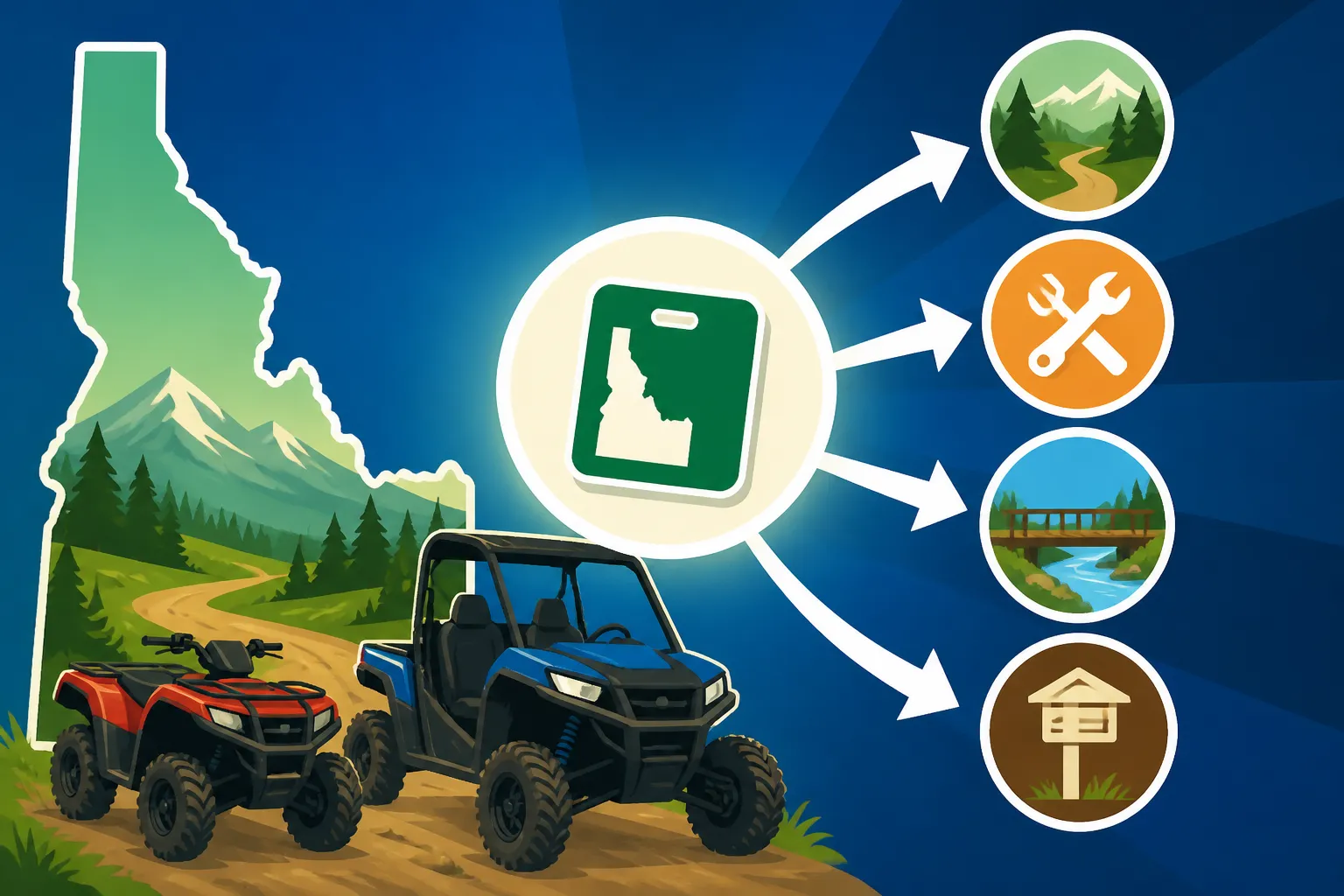
The money also supports more than trail building. A useful way to think about the system is that it can help pay for the infrastructure and work that make riding possible: maintaining routes, managing access, improving trailheads, providing signs, and supporting related safety or program needs. The exact activities funded can vary. A project may combine sticker-supported funds with other public or private contributions.
Some riders use “sticker revenue” as shorthand for all the money associated with OHV registration and permits. In practice, the charge you pay may include more than one component, and different sources of revenue may have different handling or requirements. For a breakdown of the purchase itself, see Idaho OHV Sticker Fee and the Vendor Charge. To understand where the sticker is obtained, see Where Idaho Sells OHV Stickers.
| Funding question | Practical answer |
|---|---|
| Does my sticker payment go directly to the trail I ride? | Usually, no. Revenue is managed through program and budget processes, and eligible projects may receive support later. |
| Can the money help with trail maintenance? | Trail maintenance is one of the kinds of work OHV funding may support, depending on program eligibility and approvals. |
| Does it only pay for trails? | No. Related work can include signs, trailhead improvements, access management, safety, and other program needs. |
| Does every project get the same amount? | No. Funding depends on eligibility, applications, available funds, review, and approval. |
| Can I see exactly where a particular payment went? | A single payment may not be traceable to one project. Look for program and grant information to see how funding is used more broadly. |
The main takeaway is that a sticker contributes to a statewide system, not a personal trail pass with a project-by-project spending guarantee. That system can benefit the places you ride, but funding decisions depend on the program’s approved uses and the projects that qualify.
What the funding can support
The clearest way to understand OHV spending is to look at the kinds of work involved in keeping riding areas usable and responsible. A trail is not just a line on a map. It can require maintenance, signs, safe access, coordination with land managers, and repairs after weather or heavy use. Some funding supports visible improvements; other work is less noticeable but important to keeping routes open and manageable.
Trail maintenance and repair
Maintenance can include repairing erosion, improving drainage, clearing downed trees, addressing washouts, and fixing damage caused by heavy use or weather. The specific work depends on the terrain and the land manager’s priorities. A route in a dry, rocky area may need different attention from one affected by spring runoff or repeated mud.
Repair work is not always a permanent fix. A trail may need follow-up after another season of use, and a severe storm can create needs that exceed a routine maintenance budget. Funding can help pay for labor, equipment, materials, or contracted work, subject to the applicable rules.
Riders who notice a damaged or blocked route can report the issue to the responsible land manager. Do not assume that a route is open just because it appears on an older map. Before heading out, check Checking Idaho Trail Status Before You Drive and Idaho Trail Closures in Fire Season.
Signs and route information
Signs help riders find routes, recognize closures, understand permitted uses, and avoid entering sensitive or restricted areas by mistake. They may also show route numbers, difficulty information, or connections to staging areas. Signs need to be installed, replaced, and maintained; a missing or damaged marker can make a route harder to follow and increase the chance of off-route travel.
Maps and signs work best together. A map can show a larger network, while a sign confirms what is on the ground. Neither should be treated as a promise that every route is open under all conditions. Seasonal restrictions, fire closures, maintenance, and local rules can affect access.
For map planning, Reading an Idaho Motor Vehicle Use Map explains why the current land-manager map matters. For help interpreting route markings in the field, see Trail Signs and Route Numbers.
Trailheads and staging areas
Riding areas need places where users can park, unload, and start a trip without blocking roads or damaging surrounding land. Depending on the project, funding may help improve a staging area, parking layout, access road, information board, or other facility connected to riding.
The work can be modest but useful: a better entrance, clearer signs, a safer place to unload, or improvements that reduce conflicts between trailers and other visitors. A trailhead project may also need coordination with the agency or owner responsible for the land. Sticker funding does not automatically authorize construction wherever a group wants to build; the project still has to meet land-management and funding requirements.
Planning where to stage is part of a responsible trip. Idaho Trailhead Parking and Staging covers what to consider before towing a trailer to a riding area.
Access management and resource protection
Good management is not only about creating more riding opportunities. It can also involve keeping vehicles on designated routes, closing damaged sections, protecting sensitive resources, and helping riders understand where motorized use is allowed. In some places, managing access may mean directing traffic toward a durable route or putting up signs to keep machines away from a closed area.
This can feel frustrating if the visible result is a closure rather than a new trail. But a temporary or permanent restriction may be necessary to protect the route, respond to a hazard, or comply with land-management requirements. Funding and staffing for signs, information, and related work can help make restrictions clearer and reduce accidental violations.
Riders can help protect access by staying on designated routes and respecting posted closures. Penalties for Riding Off the Trail explains why leaving a route can have consequences beyond a citation, including damage that may affect future access.
Safety and rider education
OHV programs may support safety-related work, rider education, or information for users. The exact activities and funding rules vary, but education can help riders understand equipment, supervision, route use, and the responsibilities that come with riding on public land.
For younger riders, Idaho’s course and supervision requirements are separate from the question of how sticker funds are spent. If you are planning a ride with a child or teenager, check Idaho OHV Safety Course Requirements and Idaho Supervision Rules and the 300-Foot Rule. A sticker does not replace a required safety certificate, supervision, or other applicable rules.
Work that is not guaranteed
It is important not to overstate what a sticker payment promises. A sticker does not guarantee that:
- A specific trail will be built or maintained.
- Every trail will be open throughout the year.
- A nearby county or land manager will receive a particular amount.
- A project will be completed as soon as riders request it.
- All repair, law enforcement, education, or facility costs will be covered by sticker revenue alone.
Available money, project eligibility, land ownership, environmental review, agency priorities, and other resources all affect what can happen. A proposal that sounds worthwhile may still need permissions, matching contributions, planning, or a responsible project sponsor.
How projects receive support
Many riders imagine sticker revenue being divided evenly among trail areas. That is not a safe assumption. Funding commonly reaches projects through an application, review, and approval process, or through agency budgets and planned work. The process allows program administrators to consider whether a project is eligible, whether it is ready to proceed, and whether it serves a defined need.
An OHV club may identify a maintenance problem, but it may not be the entity that can legally perform the work. The route could cross land managed by a government agency, require permission from a private landowner, or need coordination with several partners. A project therefore needs more than a good idea: it needs a suitable applicant or sponsor, approvals, a work plan, and a way to account for the funds.
Common steps in a funded project
The precise process depends on the funding route, but a project often follows a pattern like this:
- A need is identified. Riders, land managers, clubs, or local officials report a problem or propose an improvement.
- A responsible partner is found. The project needs an applicant or sponsor with authority and capacity to manage the work.
- The scope is defined. The proposal explains what will be done, where, why, and who will carry it out.
- Eligibility and approvals are checked. The work must fit funding rules and receive any necessary land-manager or property approvals.
- The application or budget request is reviewed. Decision-makers consider available funds, project readiness, program priorities, and other applicable criteria.
- Approved work is completed and documented. The recipient or responsible agency follows the terms of the award and reports on the work.
Not every project follows these steps in exactly the same order. Some work may be part of an agency’s routine program rather than a standalone grant. But the general point holds: money is allocated through structured decisions, not automatically assigned based on which trail a rider used that day.
For clubs that want to take part, Idaho Trail Grants to Local Clubs explains the grant connection, while How Idaho Clubs Apply for Trail Money focuses on the application side. Some projects also rely on crews and seasonal labor; Trail Crews Paid From Sticker Fees offers a related look at that work.
Why projects compete for limited funds
A program may receive more proposed work than it can fund in a given cycle. Projects can differ greatly in size and urgency. One request might involve replacing signs; another could involve repairing a long section of route or improving a heavily used trailhead. Program staff and reviewers have to consider which work is eligible and how it fits current priorities.
A project may also be delayed because it is not ready. For example, the route’s land manager may need to approve the work, the project plan may need revision, or the applicant may need additional partners. That does not necessarily mean the proposal was rejected permanently. It may need more preparation or another funding opportunity.
The work can also depend on matching resources. A grant or program may require the applicant to contribute money, labor, equipment, or another form of support. Requirements differ, so an organization should review current program instructions rather than assume that a particular match applies to every project.
What local clubs and riders can do
Riders who want sticker revenue to support local riding can help by identifying needs and working with the people who have authority to address them. A club may be able to organize volunteers, document trail conditions, communicate with a land manager, or apply for eligible support. Individual riders can report damage and share useful information without attempting unauthorized repairs.
A practical approach is:
- Record the location clearly, including a route name or nearby landmark.
- Describe the problem rather than proposing work that could require permits or specialized equipment.
- Include a photo only if it can be taken safely and without leaving the route.
- Contact the agency or land manager responsible for the area.
- Ask whether a club, public agency, or other eligible partner can submit a project request.
- Follow up through the appropriate program channel instead of assuming that a report creates an approved project.
For funding and application questions, the relevant IDPR OHV program or the agency responsible for the land is the right starting point. A riding club can often help connect users with the appropriate contact, especially where local volunteer work is already organized.
How to follow the money and understand its limits
The most useful question is not simply “Where did my sticker payment go?” It is also “What program or project records can show how OHV funding is being used?” Since payments are generally pooled and handled through administrative processes, an individual sticker purchase is unlikely to be traceable to a single trail project. Program reports, grant information, budgets, and project summaries are more useful for understanding spending.
Look for program-level information
For a broad view, look for IDPR information about OHV funding, grants, approved projects, and program activity. Those materials can help explain what kinds of work are eligible and which projects have received support. If you cannot find a detail online, contact the program and ask a focused question, such as:
- Which funding program supports this type of work?
- Is there a public list of approved projects or awards?
- Which agency manages the route?
- Can an OHV club apply, or must a government partner submit the request?
- Are there reporting documents for completed projects?
- What information is available about how program funds are administered?
A precise question is more likely to lead to a useful answer than asking for a full accounting of a single sticker sale. If you are asking about a specific trail, include the route name, county or general area, and the type of work you are asking about.
Separate sticker costs from the sticker’s purpose
What a rider pays at checkout may include a charge associated with the permit or registration and, depending on the sales channel, a vendor or transaction component. Those are not necessarily the same thing. A retailer or online service may charge for handling the sale, while the underlying program revenue is managed separately.
That is why a receipt is useful for confirming what you purchased, but it does not necessarily tell you how program revenue is distributed after collection. For background on the retail side, see Where Idaho Sells OHV Stickers and Idaho OHV Sticker Fee and the Vendor Charge.
Residents and visitors should also distinguish between an Idaho OHV registration and a nonresident sticker. Their requirements and purchase routes can differ. Idaho’s Non-Resident OHV Sticker explains the visitor permit, while Why Idaho Ended OHV Reciprocity gives context for why riders from some neighboring states need to meet Idaho’s requirements rather than rely on another state’s registration.
Do not assume that a local project gets local revenue
A rider may buy a sticker near one trail system and expect that area to receive the proceeds. That is an understandable assumption, but it is not a dependable way to read the funding system. The sale location does not necessarily determine the destination of the money. Likewise, a trail’s popularity does not guarantee that it receives a proportional share.
Funding may be directed through statewide priorities, specific grant programs, agency plans, or approved projects. A local area can still benefit, but that usually requires an eligible project and a responsible partner. If you want to know whether a particular trail has received support, ask about the trail or project directly rather than trying to infer it from the place where a sticker was bought.
Stickers are only one part of trail funding
OHV work may draw on multiple sources: state program resources, agency budgets, grants, local contributions, volunteer hours, and other funding. A project can combine those sources, and the funding mix may change from one project to another. That is another reason an exact “my sticker paid for this sign” answer may not be available.
This broader funding picture does not make sticker revenue unimportant. It means that sticker money is one contribution within a system that has to plan, approve, and deliver work across many riding areas. A successful project may depend on coordinating that contribution with land managers, local partners, and other resources.
Riders can support the system by buying the permit that applies to them, following route rules, reporting damage, and getting involved through an established club or partner group. Those actions do not guarantee a specific project, but they help maintain the conditions that make responsible riding possible.
What riders should take away
Idaho OHV sticker revenue helps support recreation and related program work, but it is not a direct donation to the trail where a rider bought or used a sticker. Funding is administered through program and budget processes, and eligible projects may receive support for maintenance, signs, trailheads, access management, safety, and other needs.
The most reliable way to learn about a specific project is to identify who manages the land, then ask that agency or IDPR about project funding and records. Clubs can also help riders understand local needs and apply for eligible support. Keep expectations realistic: funding depends on rules, approvals, available resources, and project readiness.
If you are preparing for a ride, treat the sticker as one part of compliance, not as a guarantee of access or trail conditions. Confirm the correct permit, check current closures, and follow posted routes. The wider funding system works best when riders help protect the places and routes the program is intended to support.
Frequently Asked Questions
Does Idaho send my sticker money to the trail I ride?
Not necessarily. Sticker revenue is managed through program and budget processes. Eligible projects may receive support, but an individual payment is not usually assigned to a specific trail.
Does Idaho sticker revenue pay for trail maintenance?
Trail maintenance is among the types of work OHV funding may support. The exact projects and funding sources vary, and work may also depend on land-manager approval and other resources.
Can an OHV club receive funding?
Clubs may be able to participate in eligible grant or project processes, depending on current program rules and the applicant requirements. Check the current instructions or ask the relevant program before preparing a proposal.
Where can I find out whether a trail received funding?
Start with the agency that manages the land and ask about the trail or project by name. IDPR program or grant information may also provide details about approved projects and funding.
Disclaimer
This article is for general informational purposes only and does not constitute professional advice. Laws, prices and regulations vary by location and change over time. Consult a qualified professional for guidance on your specific situation.