Does a Safety Certificate Expire?
Does a Safety Certificate Expire?
If you completed Idaho’s OHV safety course, you may be wondering whether your certificate is still valid—or whether a new machine, a birthday, or a move from another state means starting over. In general, the certificate is proof that you completed a course, not a permit with a routine renewal date. The important catch is that course completion does not settle every riding or supervision rule.
Does an Idaho OHV safety certificate expire?
An Idaho OHV safety certificate generally does not have a routine expiration date. Completing the approved course provides a record of your training; it is not the same as a vehicle registration or sticker that must be renewed periodically. If you passed the course and still have valid proof of completion, you usually do not need to retake it simply because time has passed.
That answer is only about the certificate itself. It does not mean that every rule connected with operating an ATV or UTV stays the same, or that a certificate automatically grants permission to ride anywhere. Age, the kind of machine, the land you are on, and any applicable supervision requirement can affect what you must do.
It also helps to distinguish among three different things:
| Item | What it shows or does | Does it have a separate time limit? |
|---|---|---|
| OHV safety certificate | Evidence that the rider completed an approved safety course | Generally, the certificate itself does not routinely expire |
| Idaho OHV sticker or registration | Addresses registration or sticker requirements for a machine | May need renewal; check the current rules for the machine |
| Supervision requirement | Sets conditions for a young rider in situations where supervision applies | Depends on the rider and riding situation, not the certificate’s age |
If you are unsure whether you took the approved course, start with Idaho OHV Safety Course Requirements. That can help you identify the training requirement that applies, rather than relying on assumptions based on a different state’s rules or a course with a similar name.
Why the certificate and riding rules are easy to confuse
A safety certificate is about training. A sticker or registration relates to the machine. A supervision rule concerns how and with whom a young rider may operate. These requirements can apply to the same ride, but one document does not automatically replace the others.
For example, a rider might have completed a safety course but still need to meet a separate age-related supervision rule. A properly registered machine might still need a sticker for the planned ride. And a valid certificate does not make a closed road or trail open to OHVs.
This is why it is useful to ask two separate questions: “Is my certificate still accepted?” and “What else does this rider and machine need for this particular ride?” If you are trying to determine which riders need the course in the first place, Who Must Take the Idaho Safety Course covers that related question.
When might you need to check the certificate again?
A certificate that does not routinely expire can still be difficult to use if you cannot show it, if you are unsure what course it records, or if someone asks you to confirm it meets a particular requirement. Rechecking your records is especially sensible before a trip if the certificate is old, the rider took the course outside Idaho, or the ride involves public land.
The rider is approaching a different age bracket
A birthday can change which age-related rules apply, even if it does not cancel a course certificate. Do not assume that a certificate earned as a younger rider automatically changes supervision requirements, or that turning 16 removes every other requirement. Check the rule for the rider’s current age and the planned location.
For a rider nearing that age transition, Idaho Rules for a Rider Turning 16 is a useful companion topic. Keep the certificate question separate from the age question: one is about whether training was completed, and the other is about the conditions that apply to the rider now.
The course was taken in another state
An out-of-state certificate may be accepted in some situations, but do not assume every state’s course, card, or online record qualifies. Course approval and proof requirements can differ. If you completed the training elsewhere, confirm that Idaho accepts that specific course or certificate before relying on it for an Idaho ride.
The relevant detail is not merely that the rider “took an ATV class.” It may matter which provider offered it, whether the course was approved for the requirement, and whether you can document completion. See Out-of-State Certificates Idaho Accepts for the acceptance question. If a course provider or agency needs to verify the record, gather the course name, completion date, and any identification number shown on the certificate.
You are planning a different kind of ride
The rules that apply on public land may not be identical to the rules on private property or to conditions for using a road. A course certificate does not establish that the rider meets every requirement for every setting. Before you ride, identify whether the route uses a public trail, a forest road, a county road, or private land, and check the rules for that place.
For example, [Idaho Rules on Private Land] addresses a different setting from public-land riding. If a route includes roads, do not treat a safety certificate as permission to use them; road access and equipment requirements are separate questions. A rider may need to check What Idaho Requires Before You Ride a County Road if the planned route includes a county road section.
What a safety certificate does—and does not—prove
A certificate is useful evidence that its holder completed training. It can help answer a question about course completion, but it is not a general riding license and does not certify that the holder has current skills on every machine or terrain type.
What it can help establish
A valid certificate or course record can help show that a rider completed the required safety education, where that education is relevant. It may also be a practical reminder of topics covered in training, such as protective equipment, safe machine operation, and trail awareness.
Keep a clear copy with your important riding documents. A phone image can be convenient, but a dead battery, damaged phone, or poor signal can make it less useful in the field. A paper copy stored in a waterproof document pouch—whether from an outdoor retailer or Amazon—can serve as a backup. Do not leave original records exposed to rain, fuel, or mud.
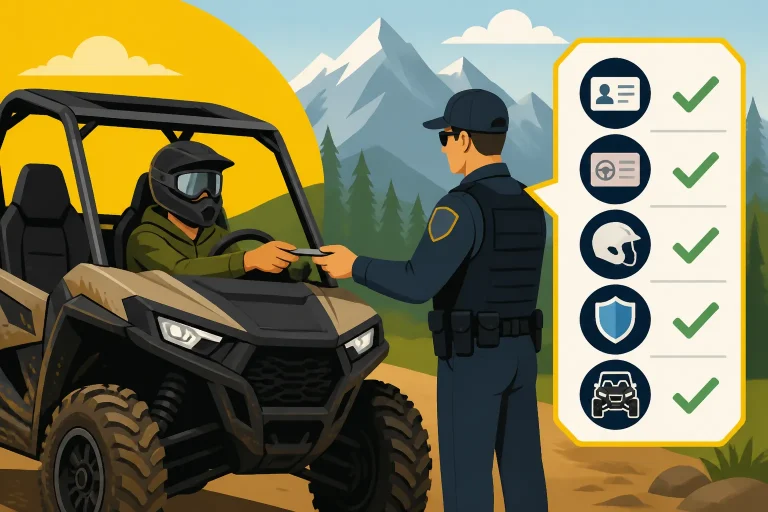
If a parent or guardian manages the paperwork for a young rider, keep the certificate where the supervising adult can find it. The rider should know what the document is and how to produce it if asked. For more on carrying proof, see Carrying a Safety Certificate.
What it does not establish
A safety certificate does not, by itself:
- Register or title an ATV or UTV.
- Provide an OHV sticker for the machine.
- Show that the machine is insured.
- Make a route open to motorized use.
- Replace a driver’s license or road-use requirement where one applies.
- Automatically satisfy a supervision rule.
- Prove the rider is currently skilled on a larger, faster, or unfamiliar machine.
Those distinctions matter when preparing for a ride. A certificate belongs to the rider; registration and stickers relate to the machine; road access and trail access depend on the route and local rules. One piece of paperwork should not be treated as a substitute for the others.
A young rider may also need a responsible adult nearby, depending on the applicable rule and setting. The course and supervision requirements are related to youth safety, but they are not interchangeable. Check Adult Supervision Requirements in Idaho and, when distance is part of the question, The 300-Foot Supervision Distance.
How to confirm and protect your course record
If you cannot find your certificate, do not assume you have to repeat the course—or assume that someone else can verify it without enough information. First, look for the original card, email, course completion page, or account used when the class was taken. Then contact the course provider or the appropriate Idaho program contact to ask about replacement proof.
Use this process:
- Find any record you still have. Search for the certificate, an email confirmation, a course receipt, or a saved completion page. Note the rider’s name as it appeared when the course was taken.
- Identify the course provider. A provider name helps distinguish an approved course from general training or a class taken under another state’s program.
- Gather identifying details. Have the rider’s name, approximate completion date, and any certificate or course number available. Do not send sensitive personal information through an unverified channel.
- Ask what proof is accepted. If the record is missing or from another state, ask whether a replacement certificate, digital record, or other documentation can be used.
- Keep a backup. Save a digital copy and a paper copy in separate places, and make sure the adult responsible for the ride knows where they are.
If you completed a course long ago and the provider is no longer easy to reach, contact the relevant Idaho program office for direction rather than paying for a new course immediately. The state’s course and record procedures are the right place to confirm an individual case.
It is also worth checking the certificate before a trip that includes young riders. That gives you time to sort out a missing record, an out-of-state course, or a question about supervision before you arrive at a trailhead. If the route crosses roads, verify road access separately; Idaho’s Restricted Vehicle Plate and Road Use explains why road-use authorization is not the same thing as course completion.
Planning a ride without relying on the certificate alone
Treat the certificate as one part of a pre-ride check. A little preparation can prevent a last-minute problem, especially when a family is taking several machines or travelling across jurisdictions.
Start with the rider. Confirm that the right people completed the required course, that any young rider meets the applicable supervision conditions, and that passengers meet the rules for that machine. Then check the machine. Look at the sticker or registration status and make sure the vehicle is appropriate for the terrain and route.
Next, confirm where you plan to ride. Public land, private property, county roads, and trails can have different rules. A certificate does not override a closure or replace permission to enter private property. If you are travelling from out of state, check whether the machine needs an Idaho sticker and whether the rider’s course record is accepted. Idaho Non-Resident OHV Sticker can help with the sticker side of that planning.
Finally, carry usable proof. Keep the certificate accessible but protected, and do not rely on a single phone screenshot if you will be out of service. Save contact details for the course provider or program office in case a record needs to be confirmed later.
The practical takeaway is simple: an Idaho OHV safety certificate generally does not expire on a routine schedule, but the certificate is only proof of training. Check current age, supervision, course-acceptance, machine, and route requirements separately.
Frequently Asked Questions
Do I need to retake the Idaho course because my certificate is old?
Usually, no. The certificate itself generally does not have a routine expiration date. Confirm with the relevant program if you cannot verify that the original course qualified or if a specific situation requires additional proof.
Does turning 16 make a safety certificate invalid?
No. A birthday does not ordinarily erase proof that the course was completed. However, age can affect other riding rules, so check the requirements that apply to the rider’s current age and location.
Will Idaho accept a safety course certificate from another state?
It may, but acceptance depends on the course and proof. Confirm that Idaho accepts the specific out-of-state course before relying on it.
Is a safety certificate enough to let a young rider ride alone?
Not necessarily. Course completion and supervision are separate issues. Check the current supervision rule for the rider’s age and the place where they will operate.
What if I lost my certificate?
Look for the course provider’s record or contact the appropriate program to ask about replacement proof. Gather the rider’s name, approximate completion date, and any course identification number before making the inquiry.
Disclaimer
This article is for general informational purposes only and does not constitute professional advice. Laws, prices and regulations vary by location and change over time. Consult a qualified professional for guidance on your specific situation.