Permit Questions Rangers Hear Most
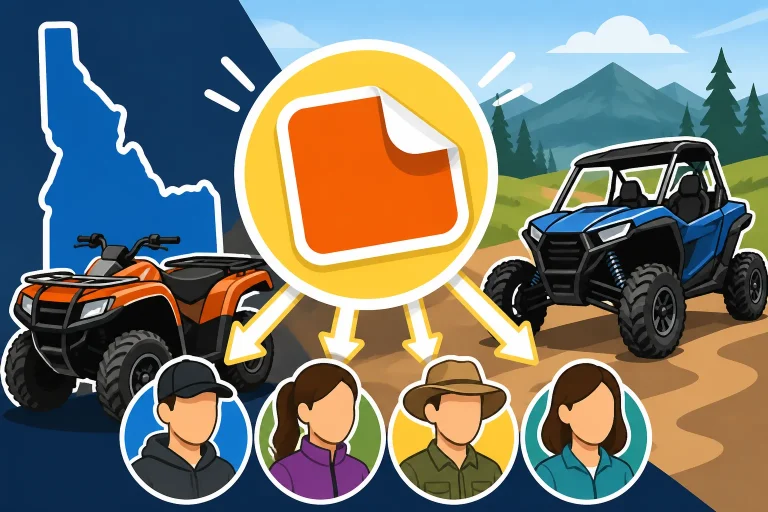
Idaho ATV and UTV riders often ask whether a sticker is a permit, whether an out-of-state registration counts, and what changes on roads or agency-managed land. The answer depends on the machine, the rider, and where the route goes. Here are the questions to sort out before unloading, so a valid sticker does not get mistaken for permission to ride anywhere.
Does an Idaho OHV sticker count as every permit I need?
No. An OHV sticker is one part of the paperwork for many rides, not a universal pass for every road, trail, or kind of use. Riders can use “permit” to mean a registration sticker, an authorization for a particular land area, or approval for a commercial trip or organized event. Those are different things.
For an ordinary recreational ride, first check whether the machine needs the applicable Idaho OHV sticker. Requirements can depend on whether the machine is registered in Idaho or comes from another state. Then check the rules for the exact route and land manager. A sticker does not by itself open a closed road, authorize off-trail travel, or replace a special permit when one is required.
| What you may mean by “permit” | What it generally covers | What to verify |
|---|---|---|
| Idaho OHV sticker or registration | The machine’s Idaho OHV registration requirement | Whether the machine and rider’s situation require a sticker, and where to buy it |
| Road-use permission | Whether a specific road is open to the machine and whether road equipment or documents are required | The road’s jurisdiction, local ordinance, and vehicle requirements |
| Land-manager authorization | Use subject to an agency’s land or route rules | The current map, closure notices, and any area-specific conditions |
| Event or commercial-use permit | An organized ride, guided trip, or other special activity when authorization is required | Which agency manages the location and what application or approval applies |
A rider may need to think about more than one row. For example, a machine might have its sticker and still be prohibited from a particular road. A guided operator may need authorization for the activity, while each customer must still follow the rules that apply to the machine and route.
Do not treat an Idaho plate as proof that every registration step is complete. The plate, sticker, title, and permission to use a road each serve different purposes. Why an Idaho Plate Is Not a Registration on Its Own explains why those documents are easy to confuse. For sticker basics, start with What Idaho Requires Before You Ride.
It also helps to check the machine itself before buying a sticker. A dirt bike, quad, side-by-side, and street-legal vehicle may not follow identical rules. If you are unsure what category your machine falls into, confirm it with the relevant Idaho office rather than relying on the seller’s description or a friend’s setup.
Do out-of-state registrations or stickers count in Idaho?
This is one of the most common questions from visitors. Do not assume that a registration or OHV sticker from another state automatically satisfies Idaho’s requirements. Reciprocity rules can differ between states and may change. Check the current Idaho rule for a machine registered outside Idaho and for the specific kind of land or route you plan to use.
The state’s non-resident sticker information is a useful place to start. Idaho’s Non-Resident OHV Sticker covers the basic distinction, while Why Idaho Ended OHV Reciprocity explains why riders should not rely on an old understanding of reciprocity. If you ride from Montana, Oregon, Washington, Utah, or another nearby state, look up the rule for your own situation before travelling.
Before the trip, answer these questions:
- Where is the machine registered? Have the registration information available, and check whether Idaho requires a separate OHV sticker for that machine.
- Where will you ride? Public land, county roads, state park roads, and private property can have different requirements.
- Is the machine rented or borrowed? Ask who is responsible for the sticker and what paperwork comes with the machine. A rental company’s coverage or paperwork should not be assumed to apply to every route.
- Will the ride cross a road or county boundary? Local rules may change along the route. A route that is legal in one place may enter a closed road or an area with different conditions.
A sticker can be easy to obtain and still be the wrong answer to a route question. Check the map and any local restrictions as well as the sticker requirement. For purchasing options, Where Idaho Sells OHV Stickers and Where to Buy an Idaho Non-Resident Sticker can help you identify the next step.
If you are arriving close to your ride date, verify how the sticker is issued and when it becomes valid. Do not assume an online order, receipt, or out-of-state document will substitute for the required display. When a requirement is unclear, ask the appropriate Idaho office or land manager and describe the machine and planned route specifically.
Do young riders need a separate permit or safety certificate?
A youth rider may have requirements beyond the machine’s sticker. Age-related rules can involve safety education, supervision, helmets, and the type of route. These requirements are not interchangeable: a safety certificate does not make a closed road legal, and an adult’s presence does not automatically satisfy every age rule.
Start by checking the rider’s age and the kind of riding planned. A rule for an agency-managed forest road may not be identical to a rule for a trail or a private ranch. Pay particular attention when a young rider will be away from an adult, operating a different machine, or travelling on a road open to vehicles.
Questions worth checking before a youth ride include:
- Does the rider need to complete an Idaho-approved safety course for this type of riding?
- Must the rider carry proof of course completion?
- Does the rider need direct adult supervision, and how close must the adult remain?
- Are there age-based helmet requirements?
- Is the machine an appropriate size and type for that rider?
- Does the route include a county road, public road, or land with additional restrictions?
The course and supervision rules can be especially confusing when a trip moves between trails and forest roads. See Who Must Take the Idaho Safety Course for course questions and Idaho Supervision Rules and the 300-Foot Rule for supervision. For parents choosing a machine, Youth Machine Size Rules Idaho Parents Ask About is a helpful companion.
Before leaving, make sure the adult supervising understands the route, not just the general riding area. A map may show a connected network, but a connecting segment could have different rules or be closed. If a young rider will operate on a public road, check road-use requirements separately; trail permission is not road permission.
Carry required documents in a secure, accessible place, and keep them protected from water and damage. Ask the relevant office what proof is acceptable if you are unsure whether a digital record, printed certificate, or other document will work. Avoid relying on a photo of paperwork unless the authority confirms that it is accepted.
What if the ride is on a road, private land, or part of a guided event?
A sticker does not settle whether a particular road or property is open to OHVs. Road access depends on the road’s jurisdiction, local decisions, and any vehicle requirements that apply there. Private land is different again: permission from the landowner matters, and public-land permits do not grant access to someone else’s property.
For county roads, look up the county’s current ordinance and the road segment itself. Do not assume that a road is open because it is gravel, has OHV traffic, or connects two legal trails. A route may cross county lines or change from a trail to a public road without an obvious sign. Which Idaho Roads Are Open to OHVs and Finding an Idaho County’s OHV Ordinance can help you work through those checks. If you plan to ride a road, also review What Idaho Requires to Ride a County Road.
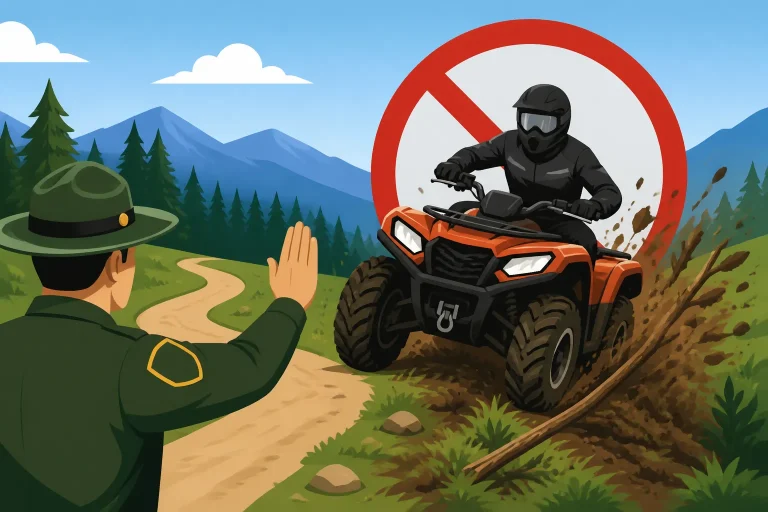
On public land, identify who manages the route. The Forest Service and Bureau of Land Management each have rules, maps, closures, and conditions for their own areas. A permit for one place is not automatically valid on land managed by another agency. Stay on designated routes, check current notices before departure, and do not cross a signed closure on the assumption that a sticker grants access. The pages on Idaho Rules on Forest Service Roads and Idaho Rules on BLM Roads explain why the land manager matters.
Private land requires a separate check. Get permission from the owner or authorized manager, clarify where you may ride, and respect any limits on timing, routes, guests, or machine type. A sticker does not authorize entry, even if the property borders a public trail. If the property is leased or used for hunting, confirm who can grant permission and whether additional conditions apply.
Guided rides and organized events raise another question: who obtains the permit? The answer depends on the activity and the land manager. A commercial guide or event organizer may need an agency authorization, but participants should not assume that this covers every individual requirement. Ask the operator which agency manages the route, what approvals are in place, and what you must bring or display yourself.
If you are organizing an event or guiding trips for pay, contact the relevant land manager well before advertising a route. Group size, route, commercial use, staging, and resource impacts can affect what approval is needed. Starting with Idaho Permits for an Organized Ride or Idaho Permits for Guided Trips can help identify the questions to ask. An informal group ride and a commercial tour are not necessarily treated the same way.
A quick way to settle permit questions before riding
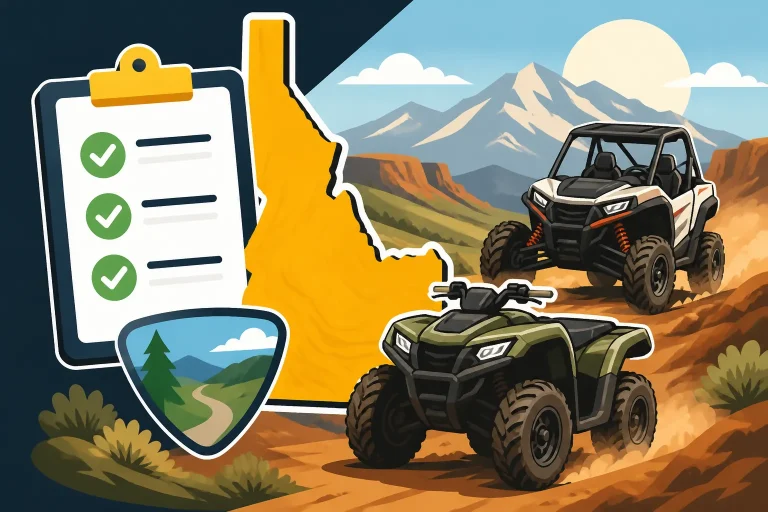
When someone asks, “Do I need a permit?” the practical answer is to clarify what they mean. Work through the machine, rider, route, and activity in that order. This prevents the common mistake of checking only for a sticker and overlooking a road restriction, youth rule, or land-manager condition.
- Identify the machine. Note its type, registration state, and whether it is rented, borrowed, or privately owned.
- Identify the rider. Check age-related safety, supervision, and equipment requirements for everyone who will operate or ride as a passenger.
- Map the whole route. Include trailheads, road connections, county boundaries, staging areas, and any public-land sections.
- Check the sticker requirement. Confirm whether the machine needs an Idaho OHV sticker and how it must be displayed.
- Check the route rules. Ask the county or land manager whether the specific roads and trails are open to your machine and intended use.
- Check special activities. For a guided trip, commercial use, or organized event, ask whether the operator or organizer needs separate authorization.
- Carry what is required. Keep registration details, course proof, and other required documents available in the form accepted by the relevant authority.
If two sources seem to conflict, ask the agency responsible for the exact road or land area. Give the office useful details: the machine type, registration state, rider age if relevant, planned route, and whether the ride is personal or commercial. A general question such as “Is my ATV legal in Idaho?” may not get a dependable answer because legality can change from one route segment to the next.
A little preparation is more useful than trying to resolve a permit question at a trailhead. Confirm the sticker, verify the route, and check current closures shortly before leaving. That gives you a clearer answer than relying on a sticker alone or assuming that another rider’s paperwork applies to your machine.
Disclaimer
This article is for general informational purposes only and does not constitute professional advice. Laws, prices and regulations vary by location and change over time. Consult a qualified professional for guidance on your specific situation.