Penalties for Riding Off the Trail
Riding an ATV or UTV a short distance beyond a trail can seem harmless, but in Idaho it may violate a route closure, land-use rule, or property boundary. The consequence can be more than a warning: depending on where you ride and what damage occurs, you may face a citation, a trespass complaint, or costs to repair the site. Here’s what affects the outcome and how to avoid making a mistake worse.
What counts as riding off the trail in Idaho
“Off the trail” does not always mean driving far into the woods. It can mean leaving a designated route to go around a puddle, cutting a corner, riding beside a road, or following tracks onto a closed spur. Whether that conduct is prohibited depends on the land, the route designation, and any posted or seasonal restrictions.
On many public lands, motorized use is limited to routes shown as open to motor vehicles. A visible track or the fact that another rider went that way does not establish that it is legal. A route may be closed, non-motorized, or open only to certain vehicle types. Some roads and trails also have seasonal closures or width limits. Check Idaho Trails Closed to Motorized Use and Reading an Idaho Motor Vehicle Use Map before setting out.
A sticker, registration, or restricted plate does not grant permission to ride anywhere. Those documents address requirements for the machine or its use; they do not override a land manager’s route restrictions, a local closure, or a private landowner’s rights. For a related overview of land-use requirements, see Idaho Permit Rules on Public Land.
Common situations that can create problems include:
- Taking a machine around a gate, berm, or clearly posted closure.
- Riding through vegetation to avoid a muddy or damaged section of trail.
- Cutting switchbacks or widening a route to pass another machine.
- Leaving a marked route to reach a viewpoint, campsite, or hunting spot.
- Riding on land beyond the route boundary, even if the boundary is not obvious from the trail.
- Continuing along a route after a seasonal closure takes effect.
Not every unplanned departure has the same legal significance. A rider may need to move briefly to avoid an immediate hazard, or may become disoriented and stray from a route without intending to violate a rule. That context can matter, but it is not a guarantee that no citation will be issued. If you have to leave the trail for safety, keep the deviation as short as possible, return to the authorized route when safe, and avoid making a new path.
The key question is usually not whether the ground looks like a trail. It is whether the route is open to your type of machine and whether your ride stays within the allowed area. If signs, maps, or a gate conflict with what other riders say, treat the restriction as real until you confirm otherwise.
Penalties and costs depend on the place and the damage
There is no single penalty that applies to every off-trail incident in Idaho. A land manager, county, or law enforcement agency may handle the conduct differently depending on where it happened and which rule was violated. The result may be a warning or citation, but more serious circumstances can lead to additional consequences.
| What happened | Possible consequence | What can affect the outcome |
|---|---|---|
| Briefly left an open route with little or no impact | Warning or citation | Signs, route rules, intent, and the officer’s assessment |
| Rode through a closed area or ignored a barrier | Citation or other enforcement action | The closure, land jurisdiction, and whether the restriction was clearly marked |
| Entered private land without permission | Trespass complaint or citation | Property boundaries, permission, signs, and local rules |
| Damaged soil, plants, water, or trail structures | Citation and possible repair or restoration costs | The extent of damage and the responsible land manager’s process |
| Repeated or deliberate violations | More serious enforcement response | Prior conduct, refusal to comply, and any related violations |
Treat this table as a practical overview, not a schedule of guaranteed penalties. Exact fines, legal classifications, and procedures can change and depend on the specific rule and jurisdiction. For current details about damage-related enforcement, see Resource Damage Citations and What They Cost. For a separate issue that can arise when riding beyond public routes, review Idaho Trespass Law for Riders.
Environmental impact matters. A tire rut can channel runoff, erode a slope, damage vegetation, or widen a trail as other riders follow it. Riding through a stream or wet ground can also create impacts beyond the visible tire track. When a land manager documents damage, the response may involve a request or requirement to address restoration costs in addition to any citation. The amount and process depend on the circumstances; do not assume that paying a ticket automatically covers repair work.
Where you ride matters too. Public land may be managed under rules different from those on a county road or private property. A trail that is open on one side of a boundary may be closed on the other. A route can also be subject to a local ordinance or a temporary closure that does not appear on an older map. How an Idaho County Closes a Road to OHVs explains why county road access should be checked separately from trail access.
A wilderness boundary deserves particular care: motorized travel is prohibited in designated wilderness areas. Riding into one may be treated more seriously than mistakenly taking an unauthorized turn on an open trail, especially if the route is clearly marked or the conduct causes damage. Review Idaho Wilderness Areas Closed to Motors and check the map for the actual boundary before riding near it.
What happens if an officer or land manager contacts you
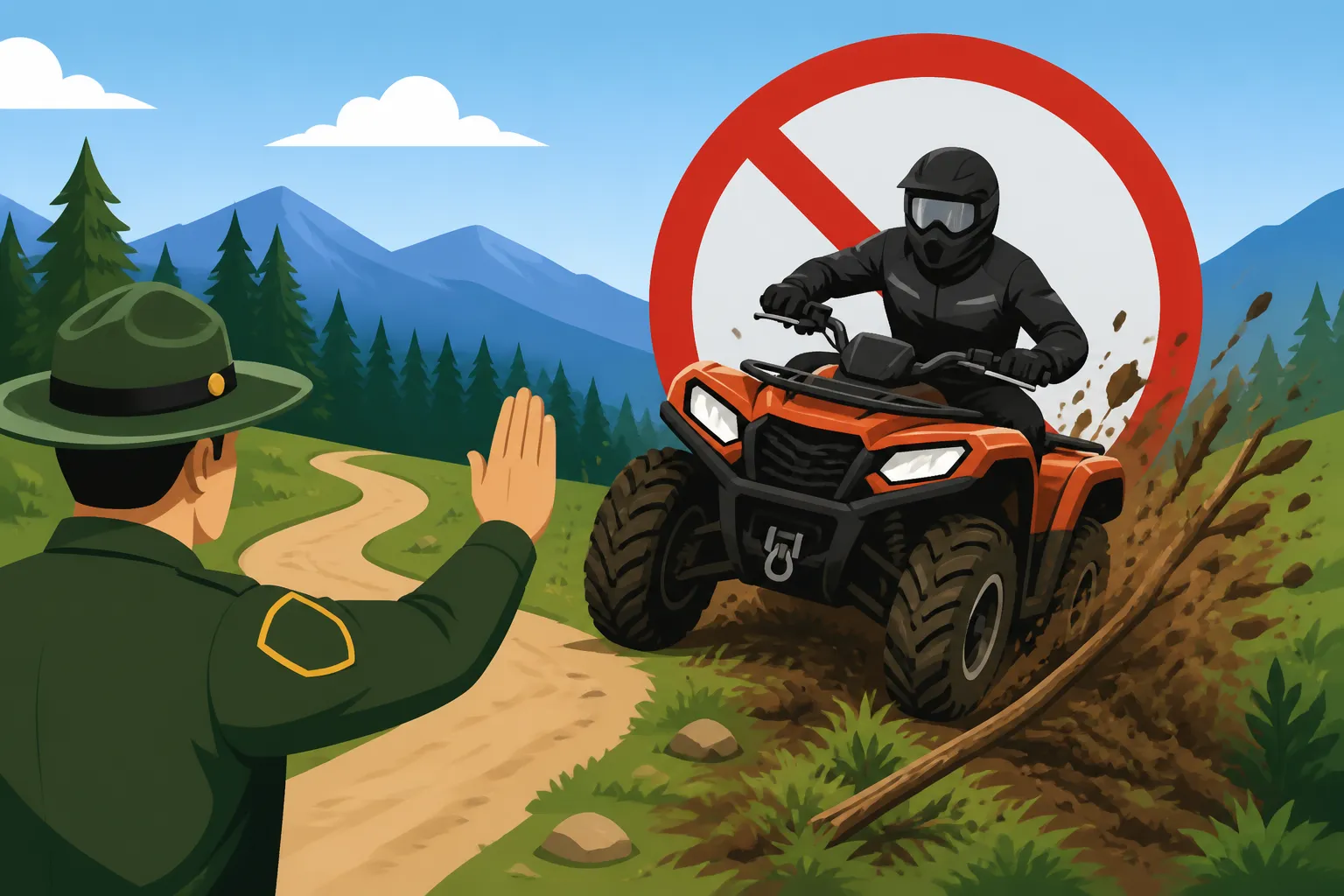
If an officer, ranger, or land manager tells you to stop, do so safely and promptly. Do not ride away, argue while moving, or continue farther into a closed area. A calm response can prevent a route violation from becoming a more difficult encounter, though it does not erase an alleged offense.
You may be asked for identification, machine paperwork, or information about where you entered the area. What is required can vary by jurisdiction and situation. Keep your answers clear and factual. If you are unsure whether a route was open, say so rather than guessing or claiming that a map showed something you have not checked. What an Officer Asks For at a Stop covers the kinds of questions riders may encounter.
If you receive a citation, read it carefully. Note the issuing agency, the alleged violation, the response or payment instructions, and any deadline stated on the document. Do not assume that an informal conversation with an officer changes a deadline or resolves the matter. If the citation involves significant damage, a trespass allegation, or other serious consequences, consider getting advice from a qualified professional familiar with the relevant jurisdiction.
It may help to preserve information while details are fresh:
- Write down the route, approximate location, date, and conditions.
- Keep any citation, photographs, maps, and relevant messages together.
- Record what signs, gates, or barriers you saw and where they were located.
- If a map or closure notice informed your decision, save the version you used.
- Follow the instructions on the citation or contact the issuing agency to clarify procedure.
Do not remove signs, alter a trail, or post identifying details about another rider online as a way of resolving a dispute. If you believe a sign was missing, a closure was unclear, or a map was inaccurate, raise that issue through the agency’s process and provide the location and supporting information. A claim that the route was confusing is more useful when it is specific and documented.
For a closure that affects a planned trip, confirm the current status before driving to the trailhead. Maps may not reflect a new fire restriction, emergency closure, or seasonal change immediately. Where Idaho Closure Orders Are Posted and Checking Idaho Trail Status Before You Drive can help you build a pre-ride check into your plan.
How to avoid an off-trail violation
The most reliable approach is to decide your route before you ride and have a way to check it while you are out. Use the map that applies to the land you plan to visit, then confirm that the route is currently open and suitable for your machine. If you are riding near a county road, a trail boundary, or a wilderness area, verify those details separately rather than assuming one map answers every question.
Before departure, check:
- Whether the trail or road is open on the day of your ride.
- Whether your machine’s width or type is allowed on the route.
- Whether a seasonal, fire-related, or temporary closure applies.
- Where the route crosses private land, county boundaries, or restricted areas.
- Whether posted signs or barriers differ from the map you planned to use.
If a route is blocked, do not create a bypass. Turn around and use a route you have confirmed is open. A detour may seem like the quickest choice, but it can turn a simple inconvenience into a citation or damage claim. If the trail is muddy or rutted, ride through the designated route only where conditions allow; avoid widening it to find firmer ground. When the route is unsafe, backtrack rather than forcing a new line.
Pay attention to signs as you approach them, not just after you have passed. A gate or closure notice can apply even when the route beyond it looks passable. If the sign is unclear, stop in a safe place and check with the responsible land manager before proceeding. Do not treat another rider’s tracks as evidence of permission.
Finally, remember that staying on a legal route protects more than your own riding access. Repeated shortcuts and trail widening can damage land and prompt new closures for everyone. If you see a damaged sign, blocked trail, or fresh off-route damage, report the location through the appropriate channel rather than driving farther off-route to investigate. Reporting Trail Damage in Idaho offers a starting point for that kind of report.
Disclaimer
This article is for general informational purposes only and does not constitute professional advice. Laws, prices and regulations vary by location and change over time. Consult a qualified professional for guidance on your specific situation.