Reading Idaho’s OHV Law Enforcement Guide
An Idaho OHV law enforcement guide can look like a list of offenses and citations, but it is most useful as a map of the rules an officer may apply. The hard part is knowing which rule fits your machine, your age, the land you’re on, and the road you’re using. Here’s how to read the guide without mistaking a summary for permission to ride.
Start With What the Guide Is—and Is Not
A law enforcement guide is generally written to help officers identify applicable requirements and respond to possible violations. It can be a handy reference for riders, but it is not necessarily a complete statement of every rule. It may summarize statutes, agency rules, or local requirements, and it may use short labels that make sense to an officer but need more context for a rider.
Treat the guide as a starting point. When a line could affect your trip, confirm the rule with the agency that has authority over that part of the ride. Depending on where you’ll go, that may mean checking Idaho Parks and Recreation information, a county ordinance, or land-management rules for the route. A public-land trail and a county road can have different requirements even when they connect.
A useful way to read each entry is to ask four questions:
- What conduct does the entry address? Look for the actual action or omission, such as riding where access is restricted, failing to meet an equipment requirement, or lacking a required permit.
- Who or what does it apply to? The rule might depend on the machine, the operator’s age, the land, or the type of road.
- Where does it apply? “Public land,” “county road,” and “private property” are not interchangeable categories.
- What is the legal source? Look for a statute, administrative rule, ordinance, or land-manager regulation that you can check in its full context.
Do not assume a short heading gives you all four answers. A line that mentions a sticker, plate, safety certificate, or road use may refer to a requirement with conditions or exceptions. If the guide provides a citation to a law or rule, read that provision and check whether another part of the same law limits or defines it.
It also helps to separate three questions that riders often combine: whether a machine needs a particular credential, whether it can be used on a particular route, and whether the operator meets the requirements for that ride. A sticker or plate does not automatically establish that every road or trail is open to the machine. Likewise, a route being open to OHVs does not automatically answer whether the operator has the required documents or equipment.
For a broader overview before digging into individual entries, see Idaho OHV Rules for First-Time Visitors. If you are visiting from another state, read Idaho’s Non-Resident OHV Sticker alongside the guide rather than assuming your home-state documents settle Idaho requirements.
Sort Requirements by Machine, Rider, and Place
The fastest way to misread an enforcement guide is to treat “OHV” as if it meant one uniform set of rules. In practice, the relevant requirement can change with the machine, the person operating it, and the route. Make a short fact sheet for your planned ride before you interpret an entry.
| What to identify | Questions to ask | Why it matters |
|---|---|---|
| Machine | Is it an ATV, UTV, dirt bike, or another off-highway vehicle? Is it registered or titled? | Different machine types and uses may be treated differently. |
| Operator | How old is the rider? Is supervision or a safety credential relevant? | Some requirements are tied to the operator, not just the machine. |
| Route | Is it a trail, a forest road, a county road, or a road within a town? | Access rules and road-use requirements may come from different authorities. |
| Land | Is the route on state, federal, county, or private land? | The land manager may set access conditions in addition to state requirements. |
| Trip purpose | Is the machine being used for recreation, work, or a permitted activity? | A special use or exemption may be narrow and should not be assumed. |
Check the machine requirement separately
An entry about registration, a sticker, or a plate does not necessarily describe every credential a machine may need. A machine’s status can depend on how it is classified and where it will be operated. Also, a machine’s title is a different matter from permission to ride it on a given route. For help separating those issues, see Why an Idaho Plate Is Not a Registration on Its Own and Idaho Plates That Begin With R.
For a nonresident machine, do not assume that registration or a permit from another state substitutes for an Idaho requirement. Check the Idaho rule that applies to the machine and the land you plan to use. This is particularly important when a trip includes roads, trails, and staging areas governed by different authorities.
Check the rider requirement separately
A requirement can attach to the operator rather than the vehicle. Age, supervision, safety education, protective equipment, and passenger rules may each have their own conditions. If the guide points to a youth or training requirement, verify who must meet it and in what settings. A credential that is relevant for one type of route may not answer every question about a ride.
The guide Idaho OHV Safety Course Requirements can help you identify the course-related questions to check. For youth riders, also consult the specific age and supervision guidance that fits the situation; do not rely on a general entry to answer a question about a particular child’s route or supervision arrangement.
Check the route and land separately
An OHV may be allowed on one part of a trip and prohibited on another. A county road may be open or closed under local rules, while a nearby trail is controlled by a land manager. A route appearing on a map is not, by itself, proof that it is open to your machine or available during your trip.
Before riding a county road, check What Idaho Requires to Ride a County Road and confirm the relevant county’s current ordinance or road information. For public land, use the rules and maps provided by the agency managing that land. A trip that crosses onto federal land may encounter restrictions that are not explained by a state enforcement summary. Riders should also pay particular attention to designated motorized routes and boundaries near protected areas; Idaho Wilderness Areas Closed to Motors explains why a route’s location can matter.
If an entry seems to conflict with a map or sign, do not choose whichever answer is more convenient. Pause and confirm the route’s status with the responsible agency before riding it.
Trace Each Entry Back to Its Authority
A law enforcement guide is easiest to use when you can follow its shorthand back to the rule behind it. Find the citation or agency reference associated with an entry, then check the underlying text. The exact wording may define terms, identify exceptions, or make clear which machines and locations are covered.
When you cannot find a citation, or the reference is unclear, look for the guide’s issuing agency and ask where the entry comes from. Avoid relying on a search snippet, an old screenshot, or a forum comment as the final answer. Those can help you locate an issue, but they may omit a condition or reflect an earlier version of a rule.
Use the right source for the question
Different sources answer different parts of an OHV question. A state agency can explain state program requirements, but it may not decide whether a county has closed a road. A county ordinance may address road access but not settle a federal land manager’s trail restrictions. The guide itself can point you toward the issue, but it may not replace either source.
A practical source check looks like this:
- Identify the authority named in the entry. Note whether it refers to state law, an agency rule, a county ordinance, or a land manager.
- Read the rule in context. Check surrounding definitions, exceptions, and cross-references instead of relying only on the heading.
- Confirm the route’s current status. Look for current maps, closure notices, signs, or official information from the agency responsible for the route.
- Check whether the rule fits your facts. Compare the machine, rider, location, and activity described in the rule with your planned ride.
- Keep a record of what you checked. Save the relevant official page or map for trip planning, but remember that access can change.
For county access, Finding an Idaho County’s OHV Ordinance is a useful next step. For land beyond county control, identify the land manager and use that agency’s route information. Do not treat a general statewide summary as evidence that a specific road is open.
Watch for terms that sound similar
Enforcement guides often compress distinctions that matter on the ground. “Registration,” “sticker,” “plate,” “permit,” and “title” are not interchangeable. Some relate to identifying or documenting a machine; others may relate to where or how it can be operated. Similarly, “road legal” can be too broad to answer whether a machine is allowed on a particular road.
When you see a term you recognize, resist the urge to fill in the meaning from a different state’s system. Check how Idaho uses it in the relevant rule. If the entry describes a requirement for public-land riding, do not assume it also answers road-use questions. If it describes road use, do not assume it grants access to every trail.
The same caution applies to exemptions. An exemption may apply only to a particular land type, activity, vehicle, or operator. Do not extend an exemption for one circumstance to a recreational ride that merely looks similar. If your situation involves ranch work, a leased property, a rental, or a guided trip, verify the exact conditions rather than inferring an exemption from the guide’s brief wording.
Use the Guide to Prepare for a Stop or a Trip
The goal is not to memorize every citation. It is to understand which requirements could apply to your ride and know where to verify them. A little preparation can also make a roadside conversation clearer: you can describe your machine and route accurately, show relevant documents when asked, and avoid confusing a local restriction with a statewide rule.
Before you leave, write down the basic details of your ride:
- The machine type and the credential or identification it carries.
- The operator’s age and any relevant supervision or safety-course status.
- The route, including each road or trail connection.
- The land manager or local authority responsible for each section.
- Any required documents, equipment, or route-specific conditions you have confirmed.
Use that list to check the guide. If an entry is about a road requirement, make sure it applies to the road you intend to use—not simply to OHV riding in general. If it concerns a young rider, verify the age and supervision conditions. If it concerns a sticker or permit, check which machine and location the requirement covers.
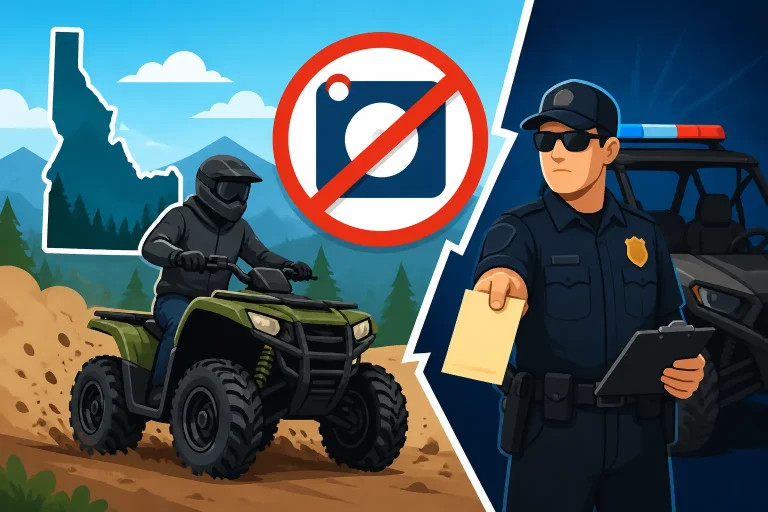
A guide can also help you prepare for questions an officer may ask, but it is not a script or a guarantee that a particular document will be sufficient. Keep documents accessible without carrying original paperwork that could be lost or damaged. For more on the practical side of a roadside encounter, see What an Officer Asks For at a Stop and Four Things Idaho Riders Must Carry on a Road.
If you receive a citation, read the document carefully and note the specific rule or ordinance cited, the location, and any instructions or deadlines listed. A guide’s summary can help you understand the category of issue, but it cannot determine whether the citation is valid in your circumstances. If you need to challenge a citation or interpret a legal requirement, contact the court or agency named on the paperwork, or consult a qualified professional.
| Before the ride | What to verify |
|---|---|
| Machine | Classification and any applicable title, registration, sticker, plate, or permit requirement |
| Rider | Age-related rules, supervision, safety-course requirements, and required protective equipment |
| Route | Whether each road or trail section is open to the machine |
| Land | Which agency or local authority manages each section |
| Conditions | Closures, seasonal restrictions, signs, and route-specific instructions |
| Documents | What the rider should have available during the trip |
Rules and route access can change, so revisit official information when planning a later ride. Idaho OHV Rules That Changed Recently can help flag the need to check for updates, but use the responsible agency’s current information to confirm a particular requirement. When an answer is uncertain, the safer choice is to stop and verify before riding onto a questionable road or trail.
Disclaimer
This article is for general informational purposes only and does not constitute professional advice. Laws, prices and regulations vary by location and change over time. Consult a qualified professional for guidance on your specific situation.