Driver’s License and Insurance on an Idaho Road Ride
It’s a common frustration for Idaho ATV and UTV owners: you’re out on a fantastic trail ride, and you just want to connect to another trail, grab a bite in town, or even head home, but you’re unsure about the rules for riding your machine on public roads. This guide aims to clear up the confusion surrounding driver’s license and insurance requirements, helping you navigate Idaho’s unique regulations so you can enjoy your ride responsibly and legally.
The Idaho Dream: Riding from Trailhead to Town
There’s nothing quite like the freedom of exploring Idaho’s vast backcountry on an ATV or UTV. The stunning scenery, the winding trails, the sheer exhilaration of it all – it’s what draws so many of us to these incredible machines. But sometimes, that freedom feels a bit limited when a public road stands between you and your next adventure, or when you just need to run into town for gas or a burger.
The Lure of the Open Road for OHVs
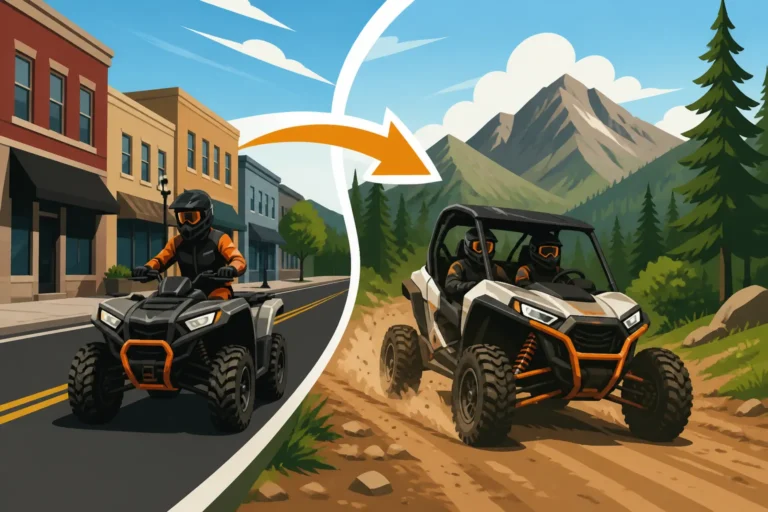
Imagine a perfect riding day: you start at a remote trailhead, wind your way through dense forests and across sun-drenched meadows, maybe even crest a mountain pass with breathtaking views. As the day winds down, instead of loading your dusty machine back onto a trailer, you could simply transition onto a designated county road, cruise into a nearby trail town, grab dinner, and then perhaps even ride back to your cabin. This seamless connection from trail to town, and back again, is the ultimate dream for many OHV enthusiasts. It makes your side-by-side or quad not just a recreational vehicle, but a truly versatile mode of transportation, opening up new possibilities for exploration and convenience. It expands your riding area, reduces the hassle of constant loading and unloading, and allows for more spontaneous adventures.
The desire to use our machines more flexibly is perfectly understandable. We invest a lot in our ATVs and UTVs, and unlocking their full potential, including limited road use, makes them even more valuable. Whether it's to link up two fantastic trail systems that are separated by a short stretch of pavement or simply to ride from your property to a nearby trail without trailering, the appeal of legal road riding is immense. It allows us to integrate our OHV lifestyle more fully into our daily lives and trips.
Navigating Idaho's Unique Road Rules
While the dream of connecting trails and towns by OHV is alluring, Idaho has a very specific set of rules governing when and where you can ride your ATV or UTV on public roads. It's not a free-for-all, and simply jumping on a county road without understanding the regulations can lead to fines, citations, and even impoundment of your beloved machine. Many riders are surprised by the nuances of these laws, often assuming that if a road is unpaved, it's fair game. This isn't always the case.
Idaho's rules are designed to balance the recreational desires of OHV riders with public safety and the need to protect road infrastructure. They vary significantly from those governing traditional cars and trucks, and also differ from state to state. What might be perfectly legal in a neighboring state could land you in hot water in Idaho. This complexity can be incredibly frustrating for riders who just want to do the right thing. But understanding these nuances, from what kind of plate you need to [What Idaho Requires Before You Ride a County Road], is crucial for a smooth and legal ride. We're going to dive deep into these rules to demystify them and help you stay on the right side of the law.
Do You Need a Driver's License for an OHV on Idaho Roads?
This is perhaps one of the most frequently asked questions, and understandably so, given the varied nature of OHV use. Many assume that because it’s an off-highway vehicle, standard driver’s license rules might not apply. However, when it comes to riding on public roads in Idaho, the answer is clear.
The Core Requirement: A Valid Driver's License
Let’s get straight to it: if you plan to operate your ATV or UTV on any public road, highway, or right-of-way that is open to other motor vehicle traffic in Idaho, you absolutely must possess a valid, unexpired driver’s license. There's no getting around this fundamental requirement. The moment your wheels touch a paved or even a designated gravel county road, your OHV is treated like any other motor vehicle regarding operator licensing. This means you need a standard Class D driver's license, the same one you use to drive your car or pickup truck.
This requirement isn't just arbitrary; it's rooted in public safety. When you're sharing the road with cars, trucks, and other vehicles, the state wants to ensure that you have demonstrated a basic level of driving competency and knowledge of traffic laws. Operating an OHV on a road carries the same responsibilities and risks as operating any other vehicle. A valid license indicates that you've passed the necessary tests and are deemed capable of navigating public roadways safely. For those who are new to Idaho or haven't driven a car in a while, it’s worth reviewing the state’s driver licensing requirements to ensure your license is current and appropriate. You can find more specific details on [Driver's License Requirements on Idaho Roads].
Age and Licensing for Young Riders on Roads
This is where a lot of confusion, and potential frustration, arises for families who love to ride together. Idaho has specific rules for young riders on trails and private land, often allowing those as young as 8 or 10 years old to operate smaller machines under supervision. However, these rules vanish the moment an OHV enters a public road. On Idaho roads, the standard minimum age for obtaining a driver's license applies directly to OHV operators.
What this means in practice is that if your child, regardless of their proficiency on the trails, does not possess a valid Idaho driver's license, they cannot legally operate an ATV or UTV on a public road. This includes learner's permits. While a learner's permit allows a supervised teenager to drive a car on the road, an OHV is often not explicitly covered in the same way, and the supervision requirements for a learner's permit typically involve being accompanied by a licensed adult in the same vehicle, which isn't always feasible or legal on an OHV. So, for the vast majority of scenarios, a full, unrestricted driver’s license is required for anyone operating an OHV on an Idaho public road, regardless of age. Always check the very latest [Idaho Road Rules for Young Riders] if you're planning a family trip that includes road sections.
Exceptions and Special Circumstances (Very Limited)
It's tempting to look for loopholes or special circumstances, but when it comes to the driver's license requirement for OHVs on Idaho public roads, genuine exceptions are exceedingly rare and typically do not apply to recreational riding. One might consider agricultural exemptions for farm and ranch use, where a farmer or rancher might operate an OHV on a public road for short distances to access their fields or move livestock. These uses are usually tied to specific farm operations and are often limited in scope and distance, and even then, there are often specific criteria that must be met.
Another potential area of misunderstanding involves crossing a road. Some riders believe that merely crossing a road to get from one trail segment to another might be exempt. However, the law generally doesn't distinguish between "riding on" and "crossing" a road when it comes to operator licensing. The moment you enter the flow of traffic on a public thoroughfare, even for a few yards, you're expected to be a licensed driver. It's best to assume that if you're on a public road, a valid driver's license is required. Don't rely on assumptions for these critical rules; always ensure you're compliant to avoid any issues during your ride.
Insurance: Your Safety Net on Idaho Roads
Just like carrying a valid driver's license, having proper insurance is non-negotiable when taking your ATV or UTV onto Idaho's public roads. This isn't just about protecting your investment; it's about protecting yourself and others in the event of an unforeseen accident. The consequences of riding uninsured can be severe, far outweighing the cost of a policy.
The Mandatory Minimum: Liability Coverage
Let's be absolutely clear: if your ATV or UTV is being operated on any public road, street, or highway in Idaho, liability insurance is mandatory. This is not an option; it's a legal requirement, just as it is for cars and trucks. Liability insurance is designed to cover damages and injuries you might cause to other people and their property if you are found at fault in an accident. It covers things like medical bills for an injured pedestrian or the cost of repairing another vehicle you collide with.
Idaho law specifies minimum liability coverage amounts that you must carry. These minimums are there to ensure that victims of an accident caused by you have at least some recourse for their expenses. While it's tempting to opt for just the minimum to save money, many experienced riders and insurance professionals recommend carrying more coverage than the state-mandated minimums. An accident, especially one involving personal injury, can easily exceed those basic limits, leaving you personally responsible for the difference. Understanding [Liability Insurance Idaho Road Riding Requires] is your first step to being a responsible road rider.
Beyond the Basics: Understanding Different Coverage Types
While liability insurance is the legal baseline, it’s worth exploring other coverage options to fully protect yourself and your machine. Just like with car insurance, a comprehensive OHV policy can offer peace of mind far beyond what the minimums provide.
- Collision Coverage: This pays for damages to your ATV or UTV if it collides with another vehicle, an object (like a tree or guardrail), or if it rolls over. Given the dynamic nature of off-road riding and the potential for incidents, collision coverage is often highly recommended, as OHV repairs can be expensive.
- Comprehensive Coverage: This protects your machine from non-collision events, such as theft, vandalism, fire, natural disasters (like floods or hail), or striking an animal. If your prized side-by-side is stolen from your garage or damaged in a severe windstorm, comprehensive coverage would kick in.
- Uninsured/Underinsured Motorist (UM/UIM): This coverage is crucial if you're involved in an accident with another driver who either has no insurance or insufficient insurance to cover your damages and injuries. It essentially protects you when the other party can't or won't pay.
- Medical Payments (MedPay) or Personal Injury Protection (PIP): These cover medical expenses for you and your passengers, regardless of who is at fault in an accident. Given that OHV riding carries inherent risks of injury, having this additional medical coverage can be a lifesaver.
When considering the cost of repairs for a modern UTV or ATV, which can easily run into the thousands, investing in these additional coverage types can prevent a massive financial hit down the line. You can find more detail on typical costs and coverage options in our article on [Idaho ATV Insurance Cost].
How OHV Insurance Differs from Auto or Homeowners
This is another area ripe for misunderstanding. Many riders mistakenly believe that their existing car insurance policy or homeowners insurance will automatically extend coverage to their ATV or UTV. This is almost universally false, especially when it comes to road use.
Your standard auto insurance policy is specifically designed for street-legal vehicles and typically has exclusions for off-highway vehicles. Trying to make a claim for your wrecked UTV under your auto policy will likely be denied outright. Similarly, while your homeowners insurance might offer some extremely limited coverage for an OHV, this coverage is almost always restricted to incidents that occur on your private property and often comes with very low coverage limits. It is absolutely insufficient for any kind of public road use or even extensive trail riding.
The bottom line is that if you intend to ride your ATV or UTV on public roads in Idaho, you need a dedicated, standalone OHV insurance policy. These policies are specifically tailored to the unique risks associated with ATVs and UTVs, covering both off-road and on-road riding (if you've opted for the necessary endorsements). Don't take chances; confirm with your insurance provider that you have a policy that explicitly covers your machine for the type of riding you plan to do, especially road riding. Our article [Does Homeowners Insurance Cover an Idaho ATV?] delves deeper into why homeowners insurance usually isn't enough.
Getting Your OHV Road-Ready: Beyond Driver's License and Insurance
Having your driver's license and insurance sorted out are critical first steps, but they are just two pieces of the puzzle for legal road riding in Idaho. Your machine itself needs to meet specific requirements to be deemed "road-ready." Ignoring these can lead to the same fines and headaches as riding without proper documentation.
The Restricted Vehicle Plate: Idaho's Key to Road Access
In Idaho, the primary way your ATV or UTV gains access to designated public roads is through the Restricted Vehicle Plate, often referred to as an "R Plate." This special license plate signifies that your OHV is equipped to meet specific street-legal requirements and is permitted on certain county and Forest Service roads, where allowed by local ordinance. It’s distinct from a standard vehicle registration and clearly identifies your machine as an OHV operating under specific conditions.
Obtaining an R Plate involves more than just filling out a form. It’s an acknowledgment that your machine must adhere to a set of safety and equipment standards designed for road use. Without this plate, even if your machine has all the right lights and mirrors, it's not legally equipped for road access. This plate essentially acts as your OHV's passport to the approved road network. It allows law enforcement to quickly identify that your machine is operating legally within Idaho's unique OHV road access framework. Understanding [Idaho's Restricted Vehicle Plate Explained] is vital for any rider looking to connect trails via public roads.
Essential Equipment for Road Legality
Beyond the R Plate, your ATV or UTV must be outfitted with specific safety equipment to be street-legal in Idaho. This isn’t a suggestion; it’s a legal mandate. Each item serves a crucial safety function when you’re sharing the road with other traffic.
- Headlights: Your machine must have at least one, but usually two, functional headlights that emit a white light visible from a certain distance. These are critical for visibility, especially during dawn, dusk, or in adverse weather.
- Taillights and Brake Lights: A red taillight visible from the rear, and brake lights that activate when you apply the brakes, are essential for communicating your presence and intentions to drivers behind you.
- Horn: A working horn is necessary for signaling warnings or attracting attention in traffic situations.
- Mirrors: You’ll need at least one rear-view mirror, mounted to provide a clear view of the road behind you. Many riders opt for two (one on each side) for enhanced safety, especially on UTVs. Companies like SuperATV offer a range of robust and adjustable mirrors specifically designed for the rugged demands of OHVs, ensuring you have excellent rear visibility.
- Turn Signals: While not always explicitly required for all OHVs (especially older ATVs), modern UTVs and newer ATVs often need functional turn signals to clearly indicate your turns when on public roads. It's always best practice to have them if you can.
- Spark Arrestor: While primarily an off-road requirement to prevent wildfires, a properly functioning spark arrestor is also critical for road-legal machines that might traverse areas prone to fire danger, or simply for general environmental responsibility.
Every single one of these components must be in good working order. It's not enough to have them installed; they must be fully functional. A broken headlight or a non-working brake light can result in a citation. For detailed rules on lighting, check out [Lighting Rules for Riding After Dark in Idaho], and for mirrors, refer to [Mirrors on a Road-Legal Side-by-Side].
Mufflers, Helmets, and Passenger Rules
Beyond the core equipment, there are other important considerations for making your OHV road-legal and safe for public roads. These regulations aim to reduce noise pollution, protect riders, and ensure passenger safety.
- Mufflers and Noise: Your OHV must be equipped with a muffler that is in good working order and prevents excessive or unusual noise. Idaho has regulations concerning noise levels, particularly in residential areas or near towns. Aftermarket exhausts that make your machine excessively loud might be perfectly fine on a remote trail but could draw unwanted attention and citations on a public road. A functioning spark arrestor, typically integrated into the muffler, is also a must for fire prevention. For more on this, see [Mufflers and Spark Arresters].
- Helmets: Idaho law requires all OHV operators and passengers under the age of 18 to wear a helmet that is approved by the Department of Transportation (DOT) when riding on public roads or public lands. While adults 18 and over are not legally mandated to wear a helmet, it is strongly recommended for all riders due to the inherent risks of OHV operation, especially when sharing roads with larger vehicles. Safety should always be paramount. You can review the specifics on [Idaho Helmet Rules for Riders Under 18].
- Passenger Rules: If you plan to carry passengers, your OHV must be designed for more than one person, with appropriate seating and handholds. Passengers must be able to reach the footrests. Side-by-sides are generally designed for multiple occupants, but single-seat ATVs are, as the name implies, for a single rider only. Always ensure that any passengers are secured properly and that the machine's weight limits are not exceeded. Seatbelts (in UTVs) must be worn.
Practical Steps to Ensure Compliance
Navigating the rules can seem overwhelming, but breaking it down into actionable steps makes the process much more manageable. Here’s a clear path to ensure you're fully compliant before you hit Idaho's public roads.
Verifying Road Legality and Getting Licensed
Before you even think about riding on a road, the first step is to confirm that your specific ATV or UTV can be legally equipped for road use in Idaho. Most modern machines can, but older or highly modified vehicles might pose challenges. Once you've confirmed your machine's potential, ensure all the required equipment (lights, mirrors, horn, etc.) is installed and functioning perfectly. If you need to upgrade components, sources like SuperATV can provide many of the necessary road-legal accessories, from turn signal kits to mirrors and windshields.
Next, focus on your driver’s license. If you already have a valid Idaho driver’s license, you’re good to go on that front. If your license is expired, suspended, or if you're a new resident, you'll need to address this before attempting any road riding. New Idaho residents must transfer their out-of-state driver's license within a certain timeframe to be legally compliant. Don't procrastinate on this; a simple traffic stop can quickly escalate if your license isn't valid in Idaho.
Shopping for the Right Insurance Policy
Once you understand the mandatory liability requirements and have considered additional coverage types, it's time to shop for an OHV insurance policy. Don't just go with the first quote you receive.
- Get multiple quotes: Contact several insurance providers. Many major carriers offer OHV policies, and some specialty insurers focus solely on recreational vehicles.
- Be specific about your use: When speaking with agents, clearly state that you intend to use your ATV or UTV on designated public roads in Idaho. This is a critical detail, as some basic OHV policies might not include this coverage by default.
- Compare coverage and deductibles: Look beyond just the premium. A cheaper policy might have significantly higher deductibles or lower coverage limits, leaving you more exposed in an accident.
- Ask about discounts: Inquire about multi-policy discounts (if you bundle with your home or auto insurance), safety course discounts, or anti-theft device discounts.
- Understand your policy: Read through the policy documents carefully. Ensure you understand what's covered, what's excluded, and what your responsibilities are. If anything is unclear, ask your agent for clarification.
Choosing the right policy isn't just about meeting a legal requirement; it's about protecting your financial future in case of an unfortunate incident.
Documenting and Carrying Proof
This seems obvious, but it’s often overlooked until it’s too late. When you’re riding your OHV on an Idaho public road, you must carry physical proof of all required documentation. This includes:
- Your valid driver’s license.
- Proof of OHV liability insurance: This could be an insurance card or declaration page from your insurer.
- Your OHV registration (the sticker) and Restricted Vehicle Plate (R Plate): The plate must be properly displayed on your machine, and you should know where your registration sticker is.
If a law enforcement officer stops you, they will ask for these documents. Failure to produce them on demand can lead to citations, fines, and delays. It's smart to keep these documents in a waterproof, secure pouch on your machine, or a wallet that's easily accessible but won't fall out during a bumpy ride. Never assume that an officer can "look it up" in their system; you are legally responsible for carrying proof. Our article [What an Idaho Deputy Asks a Rider For] offers insights into typical interactions with law enforcement on Idaho roads.
Common Misconceptions and Avoiding Costly Mistakes
Despite clear regulations, several myths and misunderstandings persist regarding OHV road use in Idaho. Falling prey to these can lead to significant legal and financial headaches. Let's debunk some of the most common ones.
"Just Kidding": The Myth of Casual Road Use
One of the most dangerous misconceptions is the idea that "just a quick hop" across a road, or a short ride down a paved street to get to a gas station, doesn't count as full-fledged road use and therefore doesn't require all the proper licensing, insurance, and equipment. This couldn't be further from the truth. In Idaho, the moment your wheels hit a public road, highway, or right-of-way, you are operating a motor vehicle on a public thoroughfare.
There are no informal exemptions for short distances or seemingly harmless crossings. Law enforcement treats any operation on a public road under the full weight of the law. This means if you are caught without a driver's license, insurance, or the proper equipment for even a 50-foot dash across a highway, you are subject to the same penalties as if you had been riding for miles. This "just kidding" mentality is a recipe for costly mistakes and can lead to fines, citations, and even impoundment of your OHV. Always assume that if you are on a public road, you need to be 100% compliant.
Out-of-State Confusion and Reciprocity
Visitors to Idaho, especially those from neighboring states, often assume that if their ATV or UTV is street-legal in their home state, it will automatically be legal on Idaho roads. This is a common and potentially expensive mistake. While Idaho has an OHV sticker system that provides some reciprocity for out-of-state trail use, this generally does not extend to road riding.
When it comes to operating an OHV on Idaho's public roads, you are expected to comply with Idaho's specific requirements, regardless of your home state's laws. This means you will need an Idaho Restricted Vehicle Plate, even if your machine has a "street legal" plate from Oregon, Washington, or Utah. Furthermore, you will still need a valid driver's license (which generally reciprocates across states) and proof of liability insurance that meets Idaho's minimums. Never assume your out-of-state plate or registration grants you automatic road access in Idaho; always check Idaho's specific laws. If you're planning to move here, our article [Registering an Out-of-State Machine in Idaho] offers valuable insights.
The High Cost of Non-Compliance
The penalties for riding an OHV on Idaho roads without a proper driver's license, insurance, or the required equipment can be steep and far-reaching. It's not just a slap on the wrist; these are serious violations that can impact your finances and your ability to ride in the future.
- Fines: Expect significant monetary fines for each violation. These can quickly add up if you're missing multiple items (e.g., no license, no insurance, no R-plate, no working lights).
- Impoundment: Law enforcement has the authority to impound your OHV if it's being operated illegally. This means your machine is towed and stored, and you'll be responsible for hefty towing and storage fees to get it back, in addition to any fines.
- Driving Record Impact: Operating without a license or insurance can lead to points on your driving record, potential suspension of your driver's license, and an increase in your insurance premiums for your other vehicles.
- Legal Consequences: In some cases, repeated violations or serious incidents could lead to more severe legal charges. If you're involved in an accident while uninsured, you could face immense personal financial liability for damages and injuries.
- Loss of Riding Privileges: Persistent non-compliance can even lead to restrictions on your ability to ride OHVs on public lands or roads in Idaho.
The small cost of getting properly licensed, insured, and equipped pales in comparison to the financial and legal ramifications of being caught in non-compliance. You can learn more about general penalties in [Fines for an Unstickered OHV in Idaho].
Enhancing Your Road-Legal OHV Experience
Once you've ensured your ATV or UTV meets all the legal requirements for road use in Idaho, you can turn your attention to making your road riding experience even safer, more comfortable, and more enjoyable. These enhancements go beyond the minimums but significantly contribute to peace of mind.
Accessorizing for Safety and Visibility
While the basic equipment list is crucial for legal compliance, adding certain accessories can dramatically improve your visibility and safety when sharing the road with other vehicles. Remember, your OHV is often smaller and less visible than a typical car or truck, so anything you can do to stand out is beneficial.
- Whip Flags: While often associated with dune riding, a brightly colored whip flag on a tall pole can significantly increase your vertical profile, making you much more visible over hills or around corners to oncoming traffic.
- Brighter LED Lights: Upgrade your stock headlights and taillights to brighter LED versions. Not only do they draw less power, but their intensity can greatly improve your ability to see and be seen, especially at dusk or dawn. Many aftermarket companies, including SuperATV, offer plug-and-play LED light bars and replacement headlights/taillights that boost visibility without draining your battery.
- Upgraded Mirrors: Beyond the single required mirror, consider adding a second mirror for a more comprehensive view of traffic approaching from behind. Wider, more stable mirrors provide a better field of vision than flimsy stock options.
- Full Doors or Enclosures: On a UTV, full doors or even cab enclosures can offer additional protection from road debris, wind, and weather, making road sections more comfortable and safer.
- Windshields: A full or half windshield helps protect you from wind, insects, and small road debris, allowing for a more comfortable and focused ride on longer paved sections. Many are quick-release, so you can remove them for dusty trail sections.
These aren't mandatory, but they are smart investments for anyone who plans to regularly ride their OHV on public roads, especially if you're going to be sharing busy routes.
Pre-Ride Checks for Road Safety
Before every ride that includes public road sections, performing a quick pre-ride inspection is a non-negotiable habit. This ensures all your safety equipment is functioning and your machine is in optimal condition for the demands of road use.
- Tires: Check tire pressure (refer to your owner's manual for recommended road pressure, which might differ from trail pressure) and inspect the tread for wear, cuts, or embedded objects. A flat tire on a busy road is far more dangerous than on a trail.
- Lights: Verify that all headlights, taillights, brake lights, and turn signals (if equipped) are working. Have someone stand behind you while you activate your brakes and turn signals.
- Brakes: Test both front and rear brakes to ensure they engage smoothly and effectively. Check fluid levels if applicable.
- Horn: Give a quick toot to confirm your horn is functional.
- Mirrors: Ensure mirrors are clean, properly adjusted, and securely fastened, providing a clear view behind you.
- Fluids: Check engine oil, coolant, and brake fluid levels.
- Cargo: Make sure any cargo is securely fastened and won’t shift or fall out during the ride, especially at higher road speeds.
- Seatbelts/Nets: For UTVs, ensure all seatbelts are functional and fastened before starting, and that any safety nets are properly secured.
A few minutes spent on these checks can prevent a breakdown or, worse, an accident on the road, where hazards are often different and consequences more severe than on a trail.
Riding Etiquette and Sharing the Road
Riding an OHV on a public road isn't just about legality; it's also about responsibility and courtesy. We want to ensure OHV road access remains open, and that means being good ambassadors for the sport.
- Stay to the Right and Ride Single File: Always keep as far to the right side of the road as safely possible. When riding in a group, always ride single file, never two abreast, especially on narrower county roads. This is a common rule for [Riding Single File on a Narrow Road] and helps other vehicles pass safely.
- Respect Speed Limits: OHVs often have lower top speeds than cars, but even when your machine can go faster, always adhere to posted speed limits. Some county roads might have specific lower limits for OHVs.
- Yield to Other Vehicles: Be courteous and yield to faster-moving traffic. Pull over safely to allow cars and trucks to pass you when appropriate.
- Minimize Dust: On unpaved county roads, be mindful of dust. Slow down when passing homes, other vehicles, or pedestrians to minimize the dust cloud you create. Excessive dust can be a nuisance and a safety hazard.
- Be Predictable: Use your turn signals well in advance, maintain a steady speed, and avoid erratic movements. Other drivers might not be accustomed to sharing the road with OHVs, so clear communication of your intentions is key.
- No Reckless Behavior: Public roads are not a place for stunts, excessive noise, or aggressive driving. This type of behavior gives all OHV riders a bad name and can lead to calls to law enforcement and potential road closures for OHVs.
By being a responsible and courteous road user, you contribute to a positive perception of OHV riding and help ensure continued access to Idaho's roads and trails for everyone.
Disclaimer
This article is for general informational purposes only and does not constitute professional advice. Laws, prices and regulations vary by location and change over time. Consult a qualified professional for guidance on your specific situation.