Plated Jeeps on OHV Trails
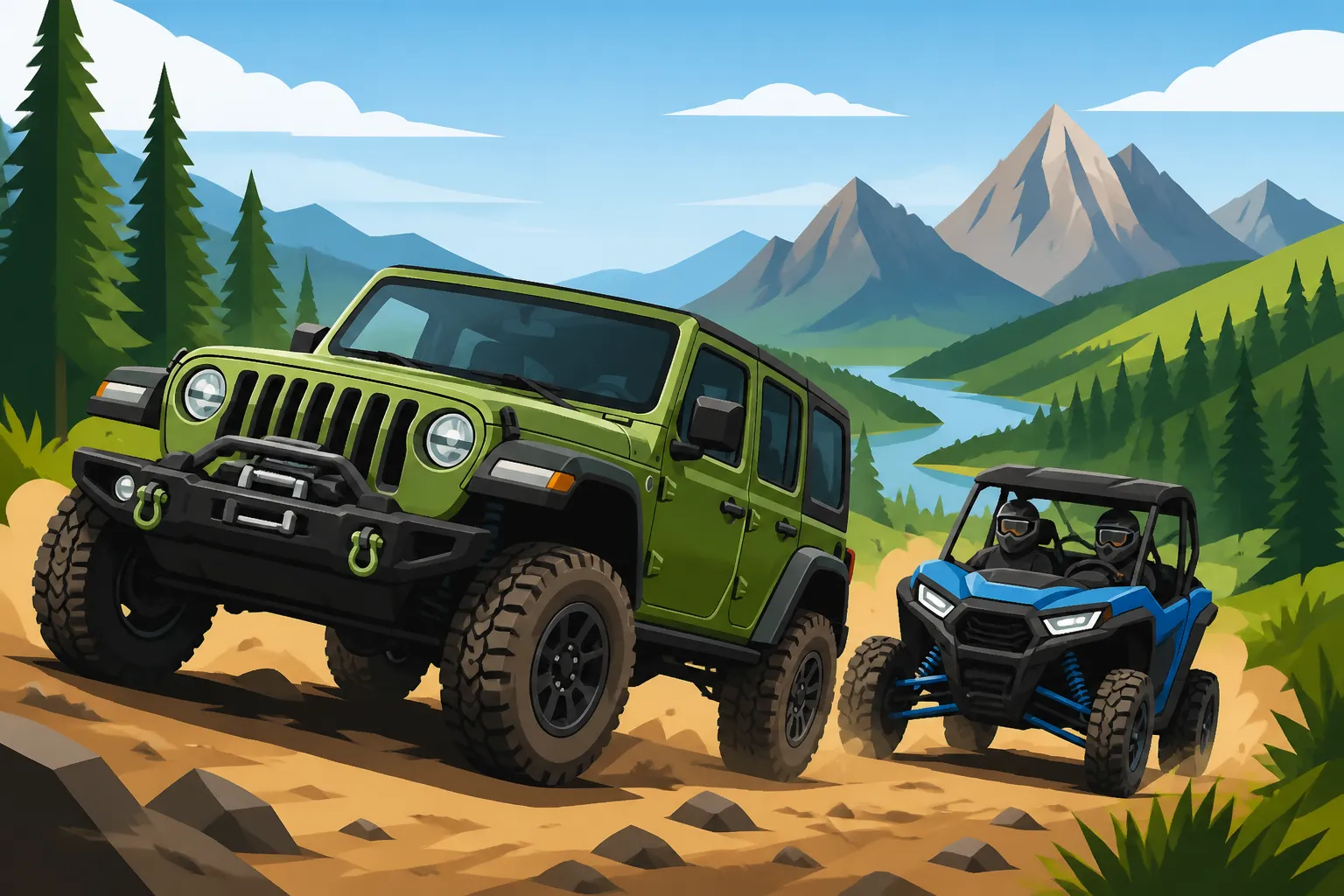
It’s easy to look at a lifted Jeep, gleaming in the Idaho sunshine with its knobby tires, and assume it can go anywhere an ATV or UTV can. After all, it’s "plated," right? This common misconception often leads to frustration, confusion, and sometimes even fines for owners of street-legal 4x4s who are just trying to enjoy Idaho’s incredible backcountry. This guide will meticulously break down the crucial differences between what a standard highway plate allows, what Idaho’s unique OHV rules cover, and how you can responsibly explore our state’s diverse trail systems with your full-size, plated vehicle.
The Basics: What "Plated Jeep" Means for Idaho Off-Roading
When we talk about a "plated Jeep" in the context of hitting the trails, we're typically referring to a vehicle that is fully street-legal, meaning it has a standard Idaho license plate that allows it to operate on public roads and highways. This is a critical distinction, as Idaho has very specific regulations for different types of vehicles in its vast network of off-road trails and forest roads. Understanding what your vehicle's registration actually signifies is the first step toward a safe and legal adventure.
Defining a Highway-Legal Vehicle in Idaho
In Idaho, a highway-legal vehicle—like your Jeep Wrangler, Toyota 4Runner, or any other full-size 4×4—is subject to all the same rules as any car or truck on the pavement. This means it needs to be properly registered, insured, and operated by a licensed driver. When you take that vehicle off the main road and onto a dirt or gravel path, its status as a highway-legal vehicle carries certain implications for access. It’s not just about having a plate; it’s about what kind of plate and what rules govern the specific piece of ground you're on. Many riders coming from other states, or even new residents, assume that because their Jeep has a regular license plate, it's inherently allowed on all dirt roads and trails. However, Idaho's system for managing its public lands and motorized recreation is more nuanced than that.
Your standard Idaho plate signifies compliance with highway vehicle laws. It doesn't automatically grant you carte blanche to motor down every two-track or narrow trail you encounter in a national forest or on BLM land. In fact, relying solely on your highway plate can land you in areas specifically designated for smaller, narrower off-highway vehicles, leading to potential fines or resource damage. This is a point of frequent misunderstanding, especially when you see maps showing a mix of vehicle types. It’s easy to assume that if any vehicle can use a trail, all vehicles can. But the devil, as they say, is in the details of the specific trail designations.
What are "OHV Trails" in the Idaho Context?
When Idaho refers to "OHV trails," it's usually talking about routes specifically designated for Off-Highway Vehicles (OHVs). These are machines like ATVs, UTVs (side-by-sides), and dirt bikes. These trails are often designed with specific widths, grades, and surface conditions that are suitable for these smaller, lighter, and more agile machines. The state's OHV program, managed by Idaho Parks and Recreation (IDPR), works with federal land management agencies like the Forest Service and Bureau of Land Management (BLM) to maintain and designate these routes. Funding for these trails often comes from the sale of [What an Idaho OHV Sticker Costs Each Year] and other user fees, which full-size highway vehicles typically do not contribute to directly unless they have an [Idaho's Restricted Vehicle Plate Explained].
It's crucial to understand that not all "dirt roads" are "OHV trails." Many forest roads are indeed open to highway-legal vehicles, but an OHV trail implies a more specific designation. These trails are part of a carefully planned network designed to manage motorized access, protect natural resources, and provide diverse recreational experiences. Some OHV trails are incredibly narrow, often single-track routes meant only for dirt bikes, while others might be wider two-tracks suitable for ATVs and side-by-sides up to a certain width. The critical point is that these designations often exclude full-size vehicles due to their width, weight, and potential impact on the trail surface. This is where the confusion often arises: a road that looks like any other dirt path might actually be a designated OHV trail with restrictions on full-size vehicle access.
Where Your Plated Jeep Can Go in Idaho's Backcountry
While the restrictions might seem daunting at first, owning a plated Jeep or full-size 4×4 still opens up an incredible amount of Idaho's backcountry for exploration. The key is knowing which types of routes are open to your vehicle and how to identify them properly. Idaho is blessed with millions of acres of public land, and much of it is accessible to highway-legal vehicles, allowing for scenic drives, camping, fishing, and access to trailheads.
Accessing Forest Service and BLM Roads
The vast majority of forest roads and Bureau of Land Management (BLM) roads in Idaho are open to highway-legal vehicles. These are typically gravel or dirt roads, ranging from well-maintained, wide thoroughfares to rough, rutted two-tracks that require high clearance and 4×4 capability. These roads are your primary playground when piloting a full-size, plated rig. They weave through national forests and BLM land, offering stunning vistas, access to remote campsites, and connections to various recreational opportunities. Many of these roads are actually part of the county road system, even if they're unpaved, and as such, are fully legal for your street-plated vehicle. [Idaho Rules on Forest Service Roads] and [Idaho Rules on BLM Roads] generally confirm that forest roads and BLM roads are open to licensed vehicles unless specifically signed otherwise.
However, even on these roads, it's essential to stay on designated routes. "Road" does not mean "anywhere you can drive." Off-roading off the designated road is strictly prohibited and carries significant penalties, not to mention environmental damage. Look for road numbers and signs. If a path veers off into the trees with no sign or clear designation, assume it's not a legal route for your vehicle. Land management agencies work hard to sign their routes, but signs can get knocked down or stolen. This is where maps become invaluable, which we'll discuss later. These roads often serve multiple purposes – for logging, ranching, and access to private inholdings – so always be aware of other traffic, including large commercial vehicles, and respect private property boundaries.
Designated Full-Size 4×4 Routes and Trail Systems
Beyond just forest service roads, some areas within Idaho's public lands actually have designated trail systems or routes specifically designed and maintained for full-size 4×4 vehicles. These are often more challenging than a typical gravel road, featuring rocks, mud, and steep climbs, providing an exhilarating experience for those with capable rigs. These routes are usually wider and built to withstand the weight and dimensions of Jeeps, trucks, and other overland vehicles. They are distinct from the narrow OHV trails intended for ATVs and dirt bikes. Finding these specific routes requires careful planning and the use of the right maps.
Examples of such routes might include certain challenging sections of the Magruder Corridor, specific loops in areas like the Danskin Mountains where wider trails exist, or designated routes within particular national forests that explicitly welcome full-size vehicles. These routes are typically identified on official Motor Vehicle Use Maps (MVUMs) from the Forest Service or BLM. When planning your trip, always consult these maps to confirm that a particular trail or route is indeed open to full-size vehicles. Don't rely on word-of-mouth or outdated information. These designated 4×4 routes often connect to county roads or forest service roads, allowing you to create extended loops and adventures. They offer a fantastic way to push your vehicle's capabilities within a legal and managed environment.
The Strict Limits: Where Plated Jeeps Cannot Venture
While Idaho offers a wealth of opportunities for plated Jeeps, it's equally important to understand and respect the boundaries. Failing to do so can lead to citations, damage to sensitive ecosystems, and conflicts with other recreational users. The biggest mistakes full-size vehicle owners make often stem from not understanding the specific width restrictions or confusing their standard license plate with Idaho's specialized OHV plate.
The No-Go Zones: Single-Track and Width-Restricted Trails
This is where the rubber meets the road, or rather, where the wide tires don't meet the narrow trail. Most "OHV trails" in Idaho, especially those marked for ATVs, UTVs, or dirt bikes, have width restrictions that explicitly exclude full-size vehicles like Jeeps. You'll often see signs indicating "50-inch width limit," "motorcycles only," or "ATVs only." These restrictions are not arbitrary; they are put in place for a variety of reasons. Narrow trails are often less stable, more prone to erosion, and not designed to handle the weight and width of a Jeep. Driving a full-size vehicle on a restricted trail can tear up the trail surface, damage sensitive vegetation, and create ruts that make it difficult for the intended smaller OHVs to pass.
Beyond the physical damage, it's also a matter of safety and respecting other users. Imagine a dirt bike rider coming around a blind corner on a trail designed for motorcycles, only to find a full-size Jeep occupying the entire width. This creates dangerous situations. Furthermore, some trails are specifically designated as "single-track," meaning they are only wide enough for one dirt bike. Trying to force a Jeep down such a trail is not only illegal but also incredibly irresponsible and damaging. Always pay close attention to signage at trailheads and along routes. If you see a width restriction sign, even if the trail looks wide enough in places, assume it applies to the entire length and turn back. Ignorance of the rule is not a valid defense if you're cited by a forest ranger or sheriff's deputy.
Confusion with Idaho's Restricted Use Plates (R-Plates)
One of the most significant sources of confusion for full-size vehicle owners comes from Idaho's "Restricted Use Plate," often referred to as an "R-plate." This is a special license plate issued by the state of Idaho specifically for ATVs, UTVs, and dirt bikes that allows them to operate on certain designated county roads and, in some cases, cross state highways. The key here is that an R-plate does not turn an OHV into a highway-legal vehicle. It merely grants specific road-riding privileges to otherwise off-highway machines in designated areas. You can learn more about [What Idaho's $3 Restricted Use Plate Covers].
A standard, highway-legal Jeep with its regular license plate is already allowed on all legal public roads and highways. It does not need an R-plate. The R-plate is for OHVs like side-by-sides that would otherwise be restricted to trails. The mistake often happens when a Jeep owner sees a side-by-side with an R-plate on a county road and mistakenly believes their highway-plated Jeep somehow needs special OHV designation to be on dirt roads. This is incorrect. Your highway plate is your authority to be on those roads. The R-plate issue is largely irrelevant to a vehicle already fully plated for the highway. The rules for [Idaho Plates That Begin With R] are distinct from standard vehicle registration, and understanding this difference is key to knowing where your vehicle belongs. A standard Jeep can ride roads where an R-plated side-by-side can, but the Jeep typically cannot ride trails where only an R-plated side-by-side can go if those trails are width-restricted.
Equipping Your Plated Jeep for Idaho's Diverse Terrain
Taking a plated Jeep or 4×4 onto Idaho's backcountry roads and designated 4×4 trails requires more than just a license plate. These routes can be rugged, remote, and challenging, demanding specific modifications and a solid understanding of trail etiquette to ensure both safety and enjoyment for everyone. Thinking ahead about your vehicle's setup and your approach to the trail can make all the difference.
Essential Modifications for Trail Safety and Capability
While a stock Jeep can handle many forest service roads, tackling the more adventurous, designated 4×4 trails often necessitates some thoughtful modifications. Clearance is king when dealing with Idaho's rocky and uneven terrain. A quality lift kit and larger, more aggressive tires (like those available from brands such as SuperATV, known for robust off-road components) can significantly improve your vehicle's ability to clear obstacles without scraping its underside. Skid plates for the engine, transmission, and fuel tank are crucial investments, protecting vital components from rocks and debris. Think of them as cheap insurance against expensive repairs.
Beyond clearance and protection, consider your recovery gear. A winch, securely mounted to a heavy-duty bumper, is almost indispensable for self-recovery or assisting others. Carrying a full complement of recovery straps, shackles, a shovel, and a hi-lift jack can get you out of sticky situations. Good lighting, especially for night drives or inclement weather, is also vital, and aftermarket LED light bars or auxiliary lights can greatly enhance visibility. Finally, don't forget a reliable communication device. Cell service is spotty at best in many Idaho backcountry areas, so a satellite messenger, two-way radio, or even a CB radio can be a lifeline in an emergency. Preparing your vehicle isn't about making it invincible, but about equipping it to safely navigate the challenges you're likely to encounter far from pavement.
Trail Etiquette and Responsible Riding for Full-Size Rigs
Just as important as your vehicle's setup is your approach to riding on the trails. Trail etiquette is paramount for minimizing impact and ensuring a positive experience for all users. Always yield to uphill traffic and remember that smaller, more agile vehicles like dirt bikes and ATVs may be sharing wider routes with you. Pull over safely to let faster traffic pass, and signal your intentions clearly. When encountering horses or hikers, slow down, give them a wide berth, and be prepared to stop and shut off your engine if they appear startled. A friendly wave and a smile go a long way.
Dust control is another major concern, especially during Idaho's dry summers. Slow down when approaching other vehicles, campsites, or structures to minimize dust clouds. Excessive dust not only obscures visibility but also irritates other users and can be a nuisance for residents along gravel roads. "Tread Lightly!" is more than just a slogan; it's a philosophy for responsible recreation. Stay on designated trails, pack out everything you pack in (and maybe a little extra trash you find), and never drive through streams or wet areas if there's a clear bypass, as this contributes to erosion and harms aquatic habitats. Your responsible behavior reflects on the entire off-road community and helps preserve access for everyone.
Avoiding Pitfalls: Laws, Maps, and Respecting the Land
Even with a perfectly equipped Jeep and the best intentions, navigating Idaho's backcountry requires a commitment to understanding and following the rules. The intricate patchwork of land ownership and management designations means that what's legal on one stretch of road might be prohibited just a few miles down the line. The key to avoiding pitfalls lies in diligent preparation, accurate navigation, and a deep respect for the environment.
Understanding Motor Vehicle Use Maps (MVUMs)
If you're going to explore Idaho's public lands in a plated Jeep, Motor Vehicle Use Maps (MVUMs) from the U.S. Forest Service and Bureau of Land Management are your absolute best friends. These maps are the official, legal documents that designate which roads and trails are open to which types of motorized vehicles, and during what seasons. They are not just suggestions; they are regulatory documents. You can often download these maps for free from the Forest Service or BLM websites, or pick up paper copies at ranger stations. [Reading an Idaho Motor Vehicle Use Map] is a skill every backcountry explorer should master.
MVUMs use a system of lines and symbols to indicate vehicle types (highway-legal vehicles, OHVs, motorcycles only), open seasons, and width restrictions. A road shown as open to "highway-legal vehicles" is fair game for your Jeep. Trails marked for "vehicles 50 inches or less in width" are off-limits to full-size rigs. Roads that are seasonally closed will have specific dates listed. Never assume a road is open just because it looks like a road. Always check the MVUM for the specific forest or BLM district you plan to visit. While GPS apps like Gaia GPS or onX Offroad can display MVUM data, it's always wise to have a downloaded or paper copy as a backup, especially in areas with no cell service. Relying on an outdated or incorrect map can quickly lead you into restricted areas, with consequences ranging from a stern warning to a hefty fine.
Here's a simplified look at how vehicle access might be portrayed on an MVUM:
| Map Symbol/Line Type | Vehicle Type Allowed | Notes |
|---|---|---|
| Solid black line | Highway-Legal Vehicles | Standard roads, open unless otherwise marked. |
| Dotted black line | OHV (50 inches or less) | ATVs/UTVs up to 50" wide. Jeeps are generally prohibited. |
| Double dashed line | Motorcycle Only | Single-track for dirt bikes. Jeeps are prohibited. |
| Shaded Area | Wilderness | No motorized vehicles allowed, including Jeeps. |
| Line with specific dates | Seasonal Road | Open to specified vehicles only during those dates. |
Potential Penalties and Environmental Impact
Ignoring trail signs, width restrictions, or MVUM designations can lead to significant penalties. Forest rangers, BLM law enforcement officers, and county sheriffs regularly patrol public lands, and they are well-versed in OHV and motorized vehicle regulations. Driving a full-size vehicle on a trail designated for narrower OHVs, or on a closed route, can result in fines that quickly add up, and in some cases, your vehicle could even be impounded. [Penalties for an Unstickered OHV in Idaho] gives a sense of how seriously Idaho takes its OHV rules, and while a plated Jeep doesn't need an OHV sticker, similar enforcement applies to illegal access. Beyond the financial cost, you could also face charges for resource damage, especially if your vehicle creates deep ruts, damages vegetation, or impacts water quality.
The environmental impact of off-trail driving or driving on inappropriate trails cannot be overstated. Full-size vehicles compact soil, destroy fragile plant life, and can disrupt wildlife habitats. Driving through wet meadows or stream beds when there's an alternative route creates erosion and introduces pollutants into water sources. These actions contribute to trail closures and restrict access for all users in the long run. Our public lands are a shared resource, and it's incumbent upon every user, especially those with powerful vehicles, to practice responsible recreation. Taking the time to understand the rules, plan your routes, and equip your vehicle properly not only protects you from legal trouble but also ensures that Idaho's incredible natural beauty remains pristine for future generations to enjoy. It's about respecting the land, the wildlife, and your fellow recreationists, ensuring that everyone can continue to explore and enjoy Idaho's unparalleled outdoor experiences.
Disclaimer
This article is for general informational purposes only and does not constitute professional advice. Laws, prices and regulations vary by location and change over time. Consult a qualified professional for guidance on your specific situation.