Roll Cages and Nets on a Road Ride
Riding your ATV or UTV in Idaho, especially when you want to take it beyond the dirt trails and onto a county road, can bring up a lot of questions about safety and legality. It’s not always clear what modifications or equipment are necessary when you transition from a dedicated off-road machine to something you’re using on public byways. This guide will dive deep into the world of roll cages and safety nets, clarifying what Idaho law expects, what makes good sense, and how to keep you and your passengers safe on your street-legal journeys.
Understanding Idaho's General OHV Safety Requirements
Before we talk specifically about taking your machine on Idaho's roads, it's helpful to understand the baseline for OHV safety here in the Gem State. Idaho is a fantastic place to ride, known for its vast trail systems and welcoming attitude toward off-road vehicles. However, that doesn't mean it's a free-for-all when it comes to safety equipment. There are specific rules in place, and these rules often become more stringent when you move from private land or designated trails to public roads shared with other traffic.
Trail vs. Road: Different Expectations
When you're out on a backcountry trail, perhaps navigating through the challenging terrain of the Danskin Mountains or exploring a remote logging road in North Idaho, the focus is often on the thrill of the ride and the capabilities of your machine. Riders understand the inherent risks of off-road conditions—uneven ground, steep inclines, unexpected obstacles. In these environments, while common sense and personal protective gear are always advised, the legal requirements for the machine itself often revolve around things like a spark arrester to prevent wildfires and maintaining reasonable noise levels. Your primary goal is often self-preservation and protecting your investment.
However, the moment you decide to turn off that dirt track and onto a paved or graveled county road, the rules of the game change significantly. Now, you’re not just responsible for yourself and your passengers; you're also sharing the road with cars, trucks, cyclists, and pedestrians. The speeds can be higher, the surfaces less forgiving in a slide, and the potential for severe collisions increases dramatically. Because of this, Idaho law, much like other states, imposes additional requirements on OHVs used on public roads. These requirements shift the emphasis from just "off-road capability" to "on-road safety and visibility," ensuring your machine can interact safely within a conventional traffic environment. It’s a crucial distinction, and understanding it is the first step toward responsible riding.
What Idaho Law Says About Cages and Nets Generally
Idaho state law, when it comes to general OHV use, is primarily concerned with fundamental operational safety and environmental responsibility. For instance, there are regulations regarding youth rider ages and associated [Idaho Helmet Rules for Riders Under 18], as well as requirements for a valid [Idaho OHV Sticker Price This Year] for public land use. Machines need proper mufflers and spark arresters. When it comes to the structural components of an ATV or UTV—things like roll cages and safety nets—Idaho generally defers to the manufacturer's design for off-road use. There isn't a specific state statute that mandates a particular type of aftermarket roll cage or requires the installation of safety nets purely for trail riding.
The roll cages that come standard on side-by-sides (UTVs) are considered Roll-Over Protective Structures (ROPS) and are designed by the manufacturer to provide a measure of protection in the event of a rollover. These are built to industry standards, not typically to specific Idaho legislation for trail use. For ATVs, the rider's active participation and proper riding technique are usually the primary safety factors in a rollover. So, while manufacturers certainly include safety features, Idaho law for general OHV operation focuses more on the rider's equipment and the machine's basic functional integrity rather than prescribing specific structural enhancements or enclosures for non-road use. This distinction becomes critical when you consider what happens when you aim for that street-legal restricted plate.
Roll Cages and Nets on Idaho Roads
Now, let's get to the heart of the matter: what happens with your roll cage and nets when you want to take your side-by-side or ATV onto an Idaho county road? The reality is that Idaho's approach to "street legal" OHVs focuses more on ensuring they behave like other vehicles on the road rather than dictating extreme structural modifications.
Factory Cages and Their Role on Public Roads
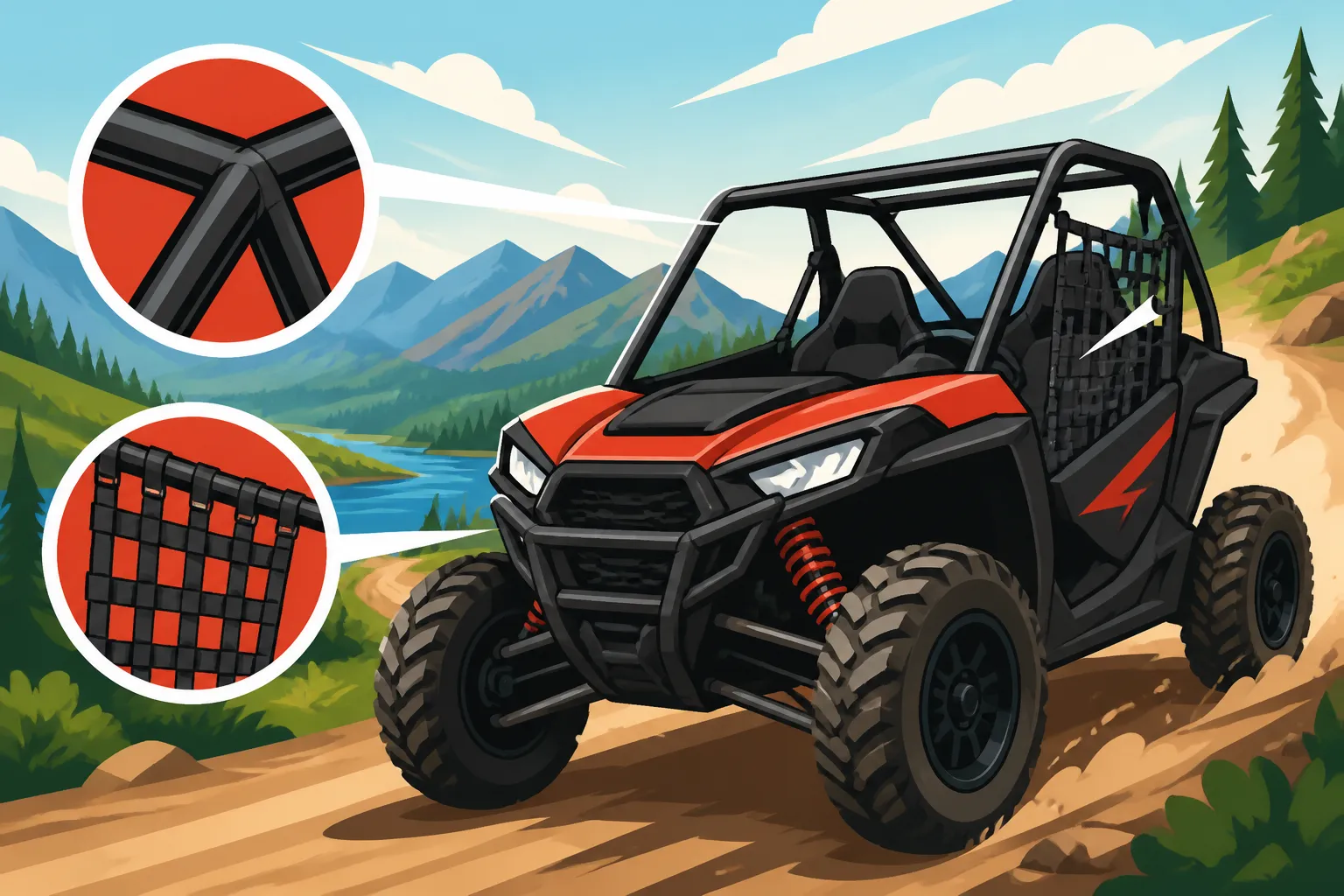
Every side-by-side, whether it's a sport model like a Polaris RZR or a utility machine like a Can-Am Defender, comes equipped with a factory-installed roll cage, also known as a ROPS (Roll-Over Protective Structure). These cages are integral to the machine's design and are engineered to provide a zone of protection for occupants in the event of a rollover or impact. When Idaho considers an OHV for a [Idaho Restricted Vehicle Plate Explained], the presence and integrity of this factory ROPS are implicitly understood to be part of the vehicle's inherent safety design.
Idaho law doesn't explicitly state, "Your roll cage must be X thickness or Y material." Instead, by allowing a side-by-side to obtain a restricted plate, the state acknowledges that the manufacturer's design, including its ROPS, meets a baseline level of structural safety for the vehicle type. You won't be required to present engineering drawings of your cage at the DMV. The assumption is that if the vehicle was sold new with that cage, it's considered part of its safe operational design. However, any damage to the factory cage or significant modifications could potentially raise questions about the machine's safety, though this is usually more of a concern for insurance or in the unfortunate event of an accident, rather than a prerequisite for plating. When you're [Mounting a Restricted Plate on a Side-by-Side], the focus is on visibility and operational signals, not the cage itself, as long as it's intact.
Aftermarket Roll Cages: Enhancing Safety or Inviting Scrutiny?
Many side-by-side enthusiasts, especially those involved in competitive riding, extreme rock crawling, or custom builds, choose to upgrade their factory roll cages with aftermarket units. These can range from simple cage extensions for more head clearance to full, custom-fabricated cages designed for ultimate protection. Brands like SuperATV offer a variety of heavy-duty aftermarket roll cages and components, including full replacement cages, intrusion bars that provide an extra layer of protection across the front of the cab, and rear cage extensions for additional cargo or passenger space with added rollover protection.
The big question for road use is: are these aftermarket cages legally required or specifically addressed by Idaho law? The answer, typically, is no. Idaho doesn't mandate specific aftermarket cage standards for road-legal OHVs. If anything, enhancing your roll cage beyond factory specifications generally increases safety, which is always a positive. It's rare for an aftermarket cage, particularly one designed by a reputable company, to detract from a machine's road-worthiness from a legal standpoint.
However, there are practical considerations. An overly massive or aggressively designed cage could obscure visibility, particularly if it adds complex bracing near mirrors or the windshield. It might also add significant weight, affecting handling, though this is usually minor for most recreational upgrades. While not legally scrutinized for road use in the same way a car's frame might be, installing a well-designed aftermarket cage from a company like SuperATV offers peace of mind, knowing you've beefed up your machine's primary protective structure, which is never a bad thing when you're sharing roads with larger vehicles.
Safety Nets and Doors: Added Protection for Road Rides
Safety nets, often seen on sport UTVs, and full or half doors are crucial components for keeping occupants contained within the vehicle's protective space. Their primary function is to prevent limbs from extending outside the cage during a rollover or impact and to minimize the chance of ejection, particularly in uneven terrain or during aggressive maneuvers. Many new side-by-sides now come standard with half doors or integrated net systems, recognizing their importance in occupant safety.
From an Idaho road-legal perspective, there isn't an explicit state law that mandates the installation of specific safety nets or full doors on OHVs equipped with a restricted vehicle plate. The primary focus of the "street legal" requirements tends to be on external components that affect visibility and communication with other road users—lights, mirrors, horns, etc. However, this absence of a specific mandate doesn't diminish their safety value. When you're riding with [Passengers on a Road Section], especially children, having robust containment systems can make a significant difference in the event of an unforeseen incident, even a minor one like an evasive maneuver.
Consider this: while you might not legally have to have full doors or nets, if you were involved in a minor fender-bender on a county road, having a child's arm inside the vehicle rather than possibly extended out could prevent serious injury. Many riders, understanding this, choose to upgrade their machines with aftermarket full doors or more comprehensive net systems. Companies like SuperATV offer various door and net solutions that can provide a higher level of occupant security and a more enclosed, comfortable feeling for road sections, especially in dusty conditions or cooler weather. These are excellent enhancements that go beyond minimum compliance, providing an extra layer of protection, particularly for [Seat Belts and Nets in a Side-by-Side] when traveling at road speeds.
The Broader Context: Being "Street Legal" in Idaho
When you're equipping your OHV for road use in Idaho, the structural integrity of your roll cage and the presence of safety nets are certainly part of the overall safety picture. However, they are generally not the most emphasized components in the legal framework for making your machine "street legal." Idaho's laws prioritize a specific set of equipment and operational requirements to ensure your OHV can safely integrate with conventional traffic.
What Idaho Actually Requires for Road Use
To legally operate an OHV on designated public roads in Idaho (generally county roads and specific city streets, but almost never state or federal highways), you need to meet a distinct set of criteria. The core requirements for what Idaho classifies as a "Restricted Vehicle" are primarily focused on functionality and visibility, allowing your machine to communicate and operate safely alongside other vehicles. This includes:
- Lighting: You must have working headlights (with high and low beams), taillights, brake lights, and turn signals. Riding [Lighting Rules for Riding After Dark in Idaho] without these is a definite no-go.
- Mirrors: At least one rearview mirror is typically required, though many riders opt for two side mirrors for better visibility.
- Horn: A functional horn is essential for warning other drivers or pedestrians.
- Muffler & Spark Arrester: These are always required for public land use and are equally important on roads to control noise and prevent fires.
- Brakes: Fully functional brakes on all wheels.
- Tires: DOT-approved tires are not explicitly required but are highly recommended for road surfaces over knobby off-road tires.
- Windshield: Not explicitly required, but if you don't have one, [Goggles or a Face Shield on the Road] are typically mandated for eye protection.
- Driver's License: The operator must possess a valid [Driver's License and Insurance on an Idaho Road Ride].
- Insurance: Proof of liability insurance is mandatory for road operation.
- Restricted Vehicle Plate: You need to have obtained and properly displayed an Idaho Restricted Vehicle Plate.
As you can see, the emphasis is on making your OHV visible and capable of following traffic laws, much like any other vehicle on the road. The expectation is that the factory roll cage and seatbelt systems are adequate for this purpose. The state's intent is to open up access to [Idaho Roads Open by Default to Restricted Vehicles] while maintaining a baseline of safety for all users.
The "Reasonable and Prudent" Standard
Beyond the black-and-white checklist of required equipment, there's an overarching legal concept that often comes into play, especially in the event of an incident: the "reasonable and prudent" standard. This principle suggests that any operator of a vehicle is expected to act in a manner that a reasonable and prudent person would, given the circumstances. While Idaho law might not explicitly demand aftermarket roll cage reinforcement or full safety nets, choosing to operate a side-by-side on public roads, particularly with passengers, without adequate occupant containment (like basic nets or doors) could potentially be viewed as less than prudent if a mishap occurs and injuries are sustained that these features might have prevented.
For example, if a child's arm is injured because it was outside the vehicle during a minor swerve or bump, and there were no nets or doors in place, an argument could be made that a more prudent operator would have had those protections. This is where personal responsibility and going above the minimum legal requirements truly come into play. Many riders feel that the peace of mind and enhanced safety offered by additional measures, even if not mandated by law, are well worth the investment, particularly given the unpredictability of road conditions and other drivers.
Insurance Implications
When it comes to insuring your ATV or UTV for road use in Idaho, the primary concern for most insurance providers is liability coverage, which is required for a restricted plate. This ensures that if you are at fault in an accident on a public road, there's coverage for damages or injuries to other parties. For your own machine and physical injury, comprehensive and collision coverage would be needed.
Generally, adding safety features like a reinforced roll cage or robust doors and nets is viewed positively by insurers, as it reduces the risk of injury and severe damage. It's unlikely that these enhancements would increase your premium; in fact, they might contribute to a safer claims history. However, any significant modification to your vehicle's structure or performance should always be disclosed to your insurance provider. They need accurate information about your machine to ensure proper coverage. While an aftermarket cage from SuperATV is unlikely to cause issues, it's always best to be transparent. The key is to make sure you have the necessary [Insuring an ATV in Idaho] coverage, especially the [Liability Insurance Idaho Road Riding Requires], for any road riding.
Making Your Machine Safe and Legal
Navigating the world of OHV use on Idaho roads can feel like a maze, but when it comes to roll cages and nets, the path generally leads to a common-sense approach: prioritize safety, meet the legal minimums, and then consider enhancements that align with your riding style and passenger needs.
Checking Your Machine's Manufacturer Specifications
Before you even think about modifying or enhancing your roll cage, it's crucial to understand the foundation: your machine's original manufacturer specifications. Every side-by-side comes with an integrated Roll-Over Protective Structure (ROPS) that has been designed and tested to certain industry standards. This factory cage is engineered to work in conjunction with the vehicle's chassis, suspension, and occupant restraint systems (seat belts) to provide a safety cell in the event of a rollover.
Familiarize yourself with your specific model's manual. It will often contain important information about the design and intended use of the ROPS, as well as warnings about modifications. Understanding these original specifications helps you make informed decisions about any aftermarket changes. For ATVs, the focus is less on a cage and more on proper riding technique and a helmet. Recognizing the limits and design intent of your machine is the first step in ensuring safety, whether you're tackling mountain trails or cruising on a paved county road. Any aftermarket addition or modification, even something as robust as a SuperATV full cage, should ideally integrate well with the manufacturer's original safety philosophy.
Prioritizing Safety Beyond the Minimum
While Idaho law for restricted vehicles focuses more on operational aspects like lights and mirrors than on prescribing specific roll cage designs or mandating nets, a truly responsible rider goes beyond the bare minimum. Think about the scenarios: a sudden deer darting across an Idaho county road, an unexpected patch of gravel, or even just another driver making an erratic move. In these situations, the strength of your roll cage and the presence of proper occupant containment (like nets or full doors) can be the difference between a minor scare and a serious injury.
If you frequently carry passengers, especially children, investing in additional safety measures is a no-brainer. Aftermarket full doors, for example, not only offer superior containment compared to partial nets but also provide protection from mud, dust, and debris. Robust intrusion bars can prevent objects from entering the cab in an impact. For more aggressive riding styles, or if you're concerned about the integrity of your factory cage over time, upgrading to a heavy-duty aftermarket roll cage designed by a reputable company like SuperATV can provide significant peace of mind. These companies specialize in engineering products that enhance vehicle performance and, crucially, safety. While not legally required for your restricted plate, these enhancements represent a proactive approach to safety that is highly recommended for anyone planning to use their OHV on public roads. It's about making your machine as safe as it can be for the variety of conditions you might encounter, from a quiet gravel road near Stanley to a bustling main street in a trail town. [Idaho Helmet Standards and Who Must Wear One] are a minimum, but more protection is always better.
Staying Informed About Local Ordinances
One of the most crucial, and often overlooked, aspects of street-legal OHV riding in Idaho is the variability of local ordinances. While the state provides a general framework for restricted vehicle plates and road use, individual counties and cities retain the authority to enact their own specific rules regarding OHV operation on local roads within their jurisdiction. This means that a road that is perfectly legal for OHV use in one county might be entirely off-limits just across the county line, or within city limits.
It is absolutely essential to do your homework before you plan a road ride. Always check with the specific county sheriff's office or city hall in the areas you intend to ride. They can provide current information on which roads are open, what additional restrictions might apply, and if there are any special equipment requirements beyond state law. For example, some towns or counties might have stricter noise ordinances, or specific hours when OHVs are permitted on certain streets. While it's rare for a local ordinance to specifically mandate an aftermarket roll cage or nets, they can certainly dictate routes or times of operation that indirectly affect how and when you might use these safety features. Neglecting to check local rules can lead to citations and fines, even if you are fully compliant with state law. Being aware of [Idaho City and County Ordinances That Close Roads] and knowing [Finding an Idaho County's OHV Ordinance] is a key part of responsible street-legal riding.
| Feature Type | Legal Requirement (Idaho Restricted Plate) | Safety Recommendation (Beyond Minimum) | Impact on Road Safety |
|---|---|---|---|
| Factory Roll Cage | Implicitly required (as part of vehicle) | Maintain integrity, inspect for damage | Critical occupant protection in rollovers |
| Aftermarket Roll Cage | Not legally required | Highly recommended for enhanced protection, extreme use | Significantly boosts rollover and impact safety |
| Safety Nets | Not legally required (though common) | Strongly recommended for limb containment, ejection prevention | Reduces risk of limb injury and ejection |
| Full Doors | Not legally required | Strongly recommended for containment, weather/debris protection | Enhanced safety, comfort, and containment |
| Seat Belts | Yes (factory) | 5-point harness for off-road (not road req.) | Essential for occupant restraint |
| Headlights/Taillights | Yes (with high/low beam, brake) | Brighter LEDs, auxiliary lights (off-road) | Crucial for visibility to others |
| Turn Signals | Yes | Integrated LED turn signal kits | Essential for communicating intentions |
| Mirrors | Yes (at least one rearview) | Two side mirrors for optimal visibility | Improves situational awareness |
| Horn | Yes | Louder aftermarket horn | Enhances warning capability |
| Eye Protection | Yes (if no windshield) | Full face shield, sealed goggles | Prevents debris/wind related injury |
Disclaimer
This article is for general informational purposes only and does not constitute professional advice. Laws, prices and regulations vary by location and change over time. Consult a qualified professional for guidance on your specific situation.