Parking a Side-by-Side on an Idaho Main Street
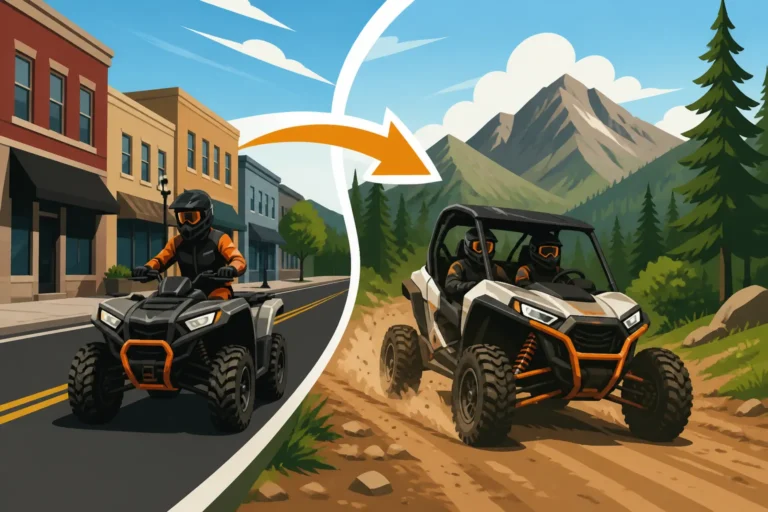
You rode a dusty forest road into town, your stomach is growling, and the café you want sits on a main street lined with pickups, diagonal stalls and a few hopeful pedestrians. Now what? Can a side-by-side take a regular parking space, does the meter apply, and what keeps your gear from walking off? This guide walks through parking a UTV in an Idaho trail town without a ticket or a dirty look.
Why Parking Is the Part Nobody Explains
Most of the conversation about riding into Idaho towns centers on getting there legally. People talk about plates, stickers, insurance and which county roads are open. Very few people talk about the moment the engine shuts off in front of the hardware store. Yet that is exactly where riders get into trouble, because a parked machine is visible, stationary and sitting right where shop owners, deputies and city staff can look at it for as long as they like.
A Parked Machine Is Still a Vehicle
Here is the mindset that keeps you out of trouble: once a side-by-side is legally on a city street, it is treated like any other motor vehicle using that street. That cuts both ways. You get to use public parking like everyone else, but you also inherit every parking rule a car or pickup has to follow. Fire hydrant clearances, crosswalk setbacks, loading zones, handicap stalls, time limits and the direction you face along the curb all apply. A lot of riders assume a small machine gets a pass because it takes up less room. It does not.
Before you even think about parking, the machine has to be lawfully on that street. In Idaho that generally means a restricted vehicle plate, a current OHV sticker, liability insurance and a licensed operator. If any of those pieces is missing, the parking question is moot because you should not have ridden in. If you are fuzzy on the basics, read Idaho’s Restricted Vehicle Plate and Road Use before your next trip into town.
Towns Set Their Own Tone
Idaho state law sets the baseline, but cities and counties can add their own rules, and many of them do. One town may welcome machines on every street and even paint stalls for them near the visitor center. Another may allow you to cross Main Street but not park on it. Some towns quietly tolerate side-by-sides in the summer and get stricter once complaints pile up. That patchwork is frustrating, and it is the single biggest reason riders get surprised.
The practical answer is to look up the local rule before the trip rather than at the curb. Finding an Idaho County’s OHV Ordinance covers the county side of that research, and the same approach works for a city: the city clerk’s office or the city website usually posts the ordinance text, and the local police or county sheriff’s non-emergency line can tell you how it is actually enforced.
The Social Side of a Small Town
Even in towns that love OHV traffic, a parked machine sends a message. A clean, quiet side-by-side tucked neatly into a stall reads as a visitor spending money. A mud-caked machine idling on the sidewalk with a stereo running reads as a problem. Business owners in places like McCall, Stanley, Salmon and Wallace have seen both, and their tolerance shapes how the next city council meeting goes. The way you park is part of keeping these towns open to riders.
The Basic Rules of the Curb
Let us get specific. These are the parking rules that apply in most Idaho towns where OHVs are allowed on the streets. Local ordinances can add to them, but they rarely take any of them away.
Use a Real Stall and Face the Right Way
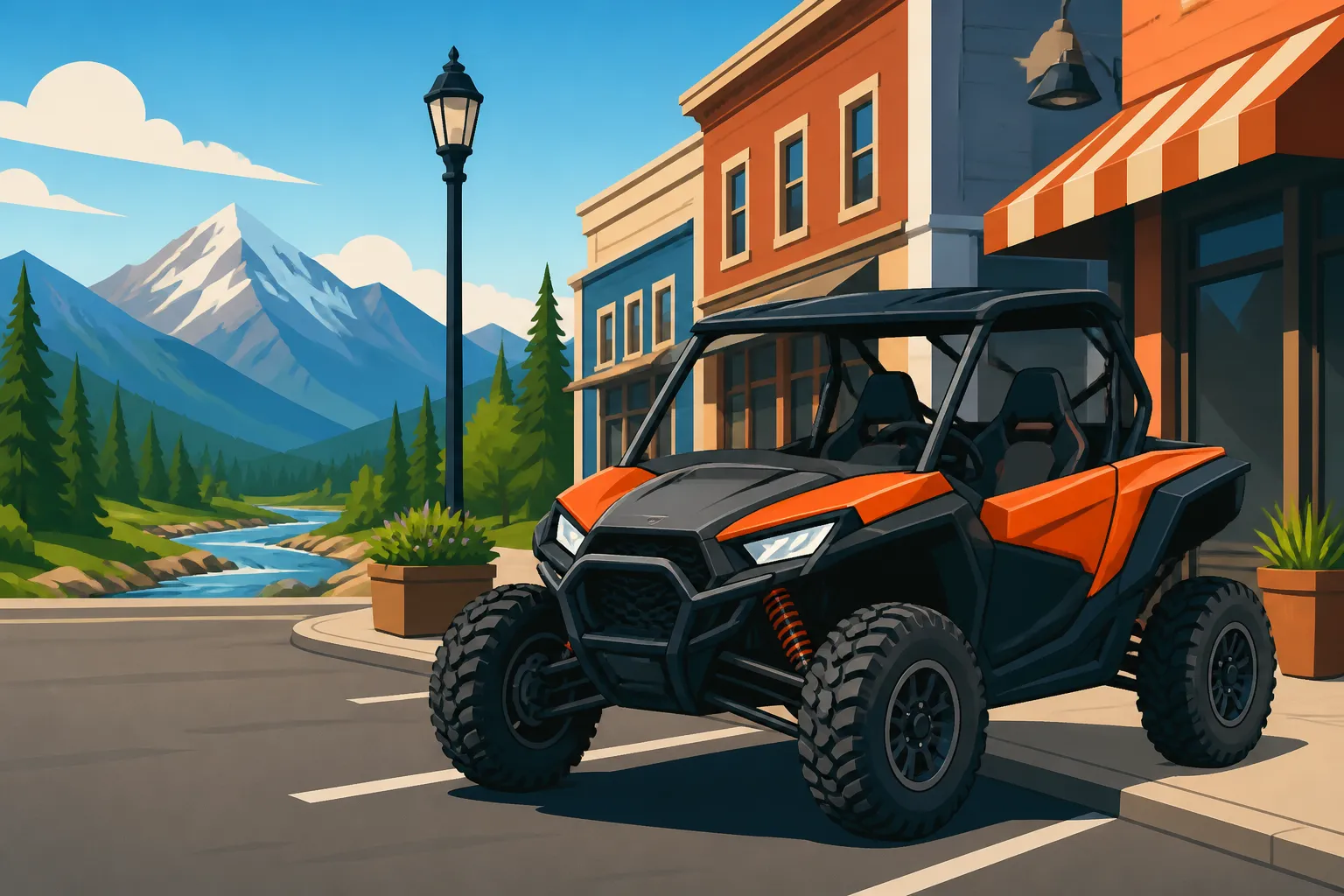
Park in a marked stall, one machine per stall. Do not wedge two side-by-sides into one space to save room unless the town has signed it that way; a meter or a time limit is written per space, and enforcement officers will treat the second machine as illegally parked. On a parallel-parking street, park with the flow of traffic and close to the curb, just as you would in a pickup. On a diagonal-parking street, nose in at the painted angle, leaving the back of the machine inside the stall line. A long four-seater can stick out farther than you expect, so check the tail before you walk away.
Never park on the sidewalk, in a planter strip, on a boardwalk or in a pedestrian plaza. It is tempting in towns where the curb is crowded and there is a wide boardwalk right in front of the shop, but this is the fastest way to earn a ticket and an angry shopkeeper. The same goes for alleys behind buildings unless you are clearly in a signed public lot.
Meters, Time Limits and Paid Lots
If a stall has a meter or a pay station, you pay it. Most Idaho mountain towns do not meter parking, but some busier downtown areas and resort districts do, and seasonal paid lots show up near popular waterfronts. Two-hour and four-hour limits are common on Main Street blocks in summer. A rider who parks at 11 a.m., eats lunch, wanders into three gift shops and then grabs ice cream can blow through a two-hour limit without noticing.
Paid and private lots deserve a careful read of the sign. Some lots near trailheads, marinas and hotels limit use to customers, prohibit trailers, or ban OHVs outright. A lot that belongs to a grocery store is private property even if it feels public, and the store can have your machine towed.
Keys, Brakes and Idling
Shut the engine off when you park. Idaho’s idling rules vary by town, but almost every trail community has fielded complaints about machines left running at the curb while riders grab coffee. Set the parking brake, put the machine in park, and pull the key. That last step matters for a reason beyond theft, which we get to below: an unattended machine with a key in it is an open invitation for a curious teenager, and you do not want to explain that one to an insurer.
Here is a quick checklist to run every time you park in town:
- Confirm the street is open to OHVs and that parking is not specifically prohibited.
- Pull fully into one marked stall, facing the correct direction.
- Read every sign within sight of the stall, including time limits and tow-away notices.
- Shut the engine off, set the brake and take the key with you.
- Secure or remove loose gear, helmets and electronics.
- Note the time so you can move before any limit expires.
Comparing Parking Options in a Trail Town
Not every stop calls for the same spot. A quick lunch, an overnight stay and a hardware run each have a better answer. This table lays out the common options riders use in Idaho trail towns and what to watch for with each.
| Parking option | Best for | Main advantage | What to watch for |
|---|---|---|---|
| Main Street stall | Short meals and shopping | Close to businesses, easy to keep an eye on | Time limits, crowding in summer, local ordinance limits |
| Side-street stall | Longer stops | Fewer limits, less traffic | Residential complaints, narrow streets, signs about overnight parking |
| Public lot | Groups and longer stays | Room for several machines | Paid parking, trailer rules, posted OHV bans |
| Business lot | Customers of that business | Owner may welcome riders | Private property, towing, customer-only rules |
| Trailhead or staging lot | Leaving the machine between rides | Built for trailers and OHVs | Theft risk, fee or pass requirements, overnight rules |
| Lodging lot | Overnight stays | Close to your room | Property rules, space limits, noise at night |
Main Street for a Quick Stop
For a meal or a stop at a single shop, a Main Street stall is ideal if the town allows it. You can see the machine from the window, it is out of the way of traffic, and the business you are spending money in can see you are a customer. Riding an OHV Into Downtown McCall and Riding to a Restaurant in Salmon cover what that looks like in two of the busier riding towns.
Side Streets and Public Lots for a Longer Visit
If you plan to spend the afternoon, shift to a side street or a public lot. A machine parked on a side street for three hours bothers far fewer people than one taking a prime stall in front of a busy café. That said, side streets often run through neighborhoods. Park in front of a business or a vacant lot, not in front of someone’s house, and keep the noise down when you come back.
Trailheads and Lodging Lots for Overnight
Overnight parking is where the rules get strict. Many towns prohibit overnight parking on streets entirely, especially once snowplows start running. If you are staying the night, park at your lodging and ask the front desk where they want machines. Riding Town to Trailhead in Idaho covers the ride between your room and the dirt, and Parking an OHV at a Trailhead Store is useful if you plan to leave the machine near a trail during the day.
Theft, Weather and Protecting What You Leave Behind
A side-by-side parked on Main Street is out in the open. The good news is that Idaho trail towns are not crime hot spots. The bad news is that machines are easy to drive off, gear is easy to grab, and a summer thunderstorm can soak a cab full of electronics in about ninety seconds.
Keeping the Machine Where You Left It
Taking the key is step one, but it is not enough on its own. Many side-by-sides can be started with a generic key, and a thief with a trailer can simply winch the machine onto a flatbed. A steering wheel lock is cheap and visible, which is half its value. A cable lock through the frame and around a fixed object helps where there is something to lock to. GPS trackers have become a common choice for riders with expensive machines, and the insurer may even ask about them.
If you have a full cab, lockable doors add a layer. Aftermarket companies like SuperATV sell doors and cab enclosures for many popular machines, and a door you can lock keeps casual hands out. It will not stop a determined thief, but it removes the opportunity theft that accounts for most problems. If the worst happens, Recovering a Stolen ATV walks through what to do next, including when to call your insurer.
Keeping Your Gear in Place
The more common problem is not losing the whole machine but losing what was in it. Helmets, radios, GPS units, phone mounts, coolers and bags all sit in plain sight in an open cab. Here are a few habits that reduce the risk:
- Carry valuables like a handheld GPS, a satellite messenger and your phone into the business with you.
- Lock helmets to the roll cage with a cable lock or take them inside.
- Use a lockable storage box in the bed for tools and recovery gear.
- Avoid leaving anything visible that hints at a bigger payoff, such as a rifle case or a camera bag.
Storage boxes are one of the more practical upgrades for town riding. SuperATV and other manufacturers make lockable cargo boxes for the bed of many machines, so a quick stop does not mean hauling an armload of gear into a restaurant.
Weather and Sun
Idaho’s high country can produce afternoon thunderstorms with little warning. If you park for a long lunch under a clear sky, you may come back to a soaked seat and a dash full of water. A roof and windshield help, but an open cab will still get wet. A cheap seat cover or a cab cover that stuffs into a small bag is worth carrying in the monsoon season. A rear window or full windshield, sold by SuperATV among others, keeps a lot of dust off the inside of the cab on gravel roads, which also means less grit on the seats you settle into after lunch.
Sun matters too. Summer sun in the high valleys around Stanley and Challis is intense, and dark seats can get hot enough to make you think twice. Park in the shade where you can, and keep a towel to throw over the seat.
Being a Good Neighbor in an OHV-Friendly Town
Idaho has a growing list of towns that welcome riders, and they keep that welcome open because visitors behave. Every rider who parks badly, revs an engine outside a café or leaves trash in a stall gives a council member a reason to reconsider. Idaho Towns That Welcome OHV Traffic covers where the welcome is warmest; this section covers how to keep it that way.
Noise When You Arrive and Leave
The loudest moment of any visit is the arrival and the departure. Slow down a block before your stop, roll in quietly and shut off the engine promptly. When you leave, start the machine, let it settle for a few seconds and pull out at walking speed. A big aftermarket exhaust that sounds great on a ridge sounds very different bouncing off brick storefronts. Idaho Noise Rules Near Mountain Towns explains the local limits that can apply, and some towns post their own quiet hours.
Music is the other noise problem. A sound bar that is fun on the trail is often unwelcome downtown. Turn it off before you reach the edge of town, and keep it off until you are back on the road out.
Dust, Mud and Trash
A machine fresh off a dirt road drops mud and dust when it stops. That is unavoidable to a point, but a few habits help. Knock off big clumps of mud at the trailhead before riding into town. Avoid parking right in front of a business’s entryway, where tracked-in dirt becomes the owner’s problem. Pack out every piece of trash, including the empty water bottles rolling around the floor of the cab.
Groups and Rally Weekends
Parking gets tricky when you ride in with a group. Six machines lined up in the six best stalls in front of a café leaves no room for local customers. Spread out across the block or use a public lot, and avoid blocking driveways and loading zones. On rally weekends and holiday weekends, towns like Wallace and Island Park can be packed with machines, so plan a meeting spot in a lot rather than trying to park as a single unit downtown. Riding Through McCall, Stanley and Salmon has more on what those busy weekends look like.
Tickets, Towing and the Paperwork on Board
Parking tickets are not the worst thing that can happen to a rider, but they are annoying and they create a paper trail. A tow is worse, and a stop that turns into a check of your paperwork is worse still.
What a Parking Ticket Looks Like
A side-by-side gets ticketed the same way a car does. The officer or parking enforcement officer records the plate number and leaves the citation on the machine. That is one more reason the restricted vehicle plate needs to be mounted properly and readable. A missing or hidden plate can turn a simple parking ticket into a second citation. Mounting a Restricted Plate on a Side-by-Side covers how to keep it secure and legible.
Pay or contest the ticket through the city or county that issued it, following the instructions on the citation. Do not ignore it; unpaid parking fines can follow the plate and create problems at renewal time.
When the Machine Gets Towed
Towing happens most often on private lots, in loading zones and in spots where the machine blocks a driveway or a fire lane. If you come back and your machine is gone, call the local police non-emergency line before assuming it was stolen. Towns often log tows, and the dispatcher can tell you where it went. Tow fees and storage fees add up fast, and a tow truck operator may not be set up to handle a side-by-side gently, so prevention is far better than recovery.
Paperwork That Should Stay With the Machine
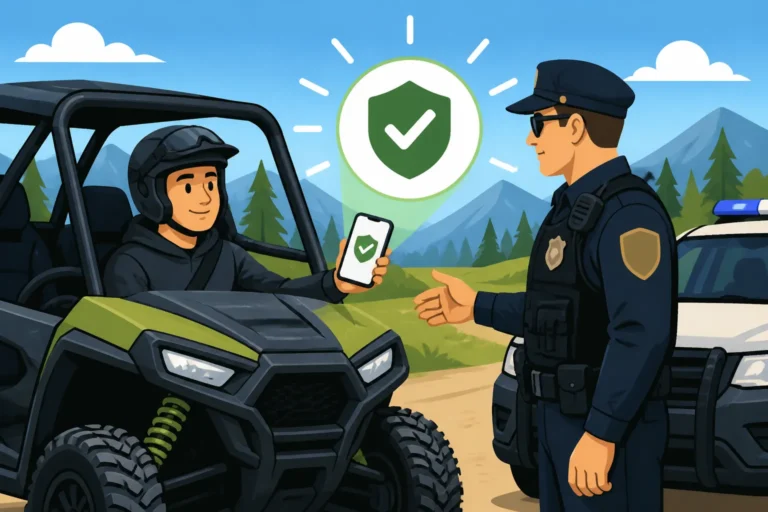
Any time your machine is parked on a public street, it may draw a look from an officer. If you are approached when you return, the officer may ask for your driver’s license, proof of insurance and registration. Keep proof of insurance and your registration in a waterproof pouch in the machine, but do not leave anything with your home address on display. Proving Insurance at a Traffic Stop goes deeper on what to expect.
Parking is the unglamorous part of riding into town, but it is where riders build or burn goodwill. Pick a legal stall, follow the signs, secure your gear and leave quietly, and you will be welcomed back in every Idaho trail town worth visiting.
Disclaimer
This article is for general informational purposes only and does not constitute professional advice. Laws, prices and regulations vary by location and change over time. Consult a qualified professional for guidance on your specific situation.