Do Licensed Trucks Need an Idaho Sticker?
It’s a common point of confusion when you’re navigating Idaho’s beautiful backcountry. You’re out enjoying the trails, maybe hauling your side-by-side on a trailer behind your pickup, and you start to wonder: does my licensed truck, the one I drive every day, also need one of those colorful Idaho OHV stickers? This guide will clear up that exact question, explaining the distinct differences between your trusty licensed truck and the off-highway vehicles that do require an Idaho sticker to legally hit the trails and specific roads.
Understanding Idaho's OHV Sticker Requirement
Idaho's Off-Highway Vehicle (OHV) sticker program is specifically designed for vehicles that operate off the paved road network – think ATVs, UTVs, dirt bikes, and even snowmobiles. The funds generated from these stickers go directly back into maintaining and expanding the vast network of trails we all love to ride across the Gem State. It's a way for riders to contribute to the very resources they enjoy.
What an OHV Sticker Covers
When you purchase an Idaho OHV sticker, you're essentially buying access. This sticker allows your designated off-highway vehicle to be legally operated on Idaho's public lands, including Forest Service roads, BLM trails, and designated OHV areas. It's crucial for compliance when you're exploring the wilder parts of our state. The sticker indicates that your machine is recognized by Idaho Parks and Recreation as ready for off-pavement adventure.
It's important to understand that this sticker is specific to the OHV itself, not the operator. So, if you own multiple ATVs, each one needs its own valid sticker. This helps ensure that every machine contributing to trail wear and tear also contributes to the funding for its upkeep. You can find more details about the cost and where this money goes in [What an Idaho OHV Sticker Costs Each Year].
Where OHV Stickers Are Required
The short answer is almost anywhere you're riding off-highway on public land. Whether you're tearing up the dunes near Bruneau, navigating the twisty trails in the Danskin Mountains, or just cruising a forest road to a favorite fishing spot, if it's an OHV and it's on public land, it needs that sticker. Even if you're just driving from a campground to a trailhead staging area on a dirt road, that sticker needs to be prominently displayed.
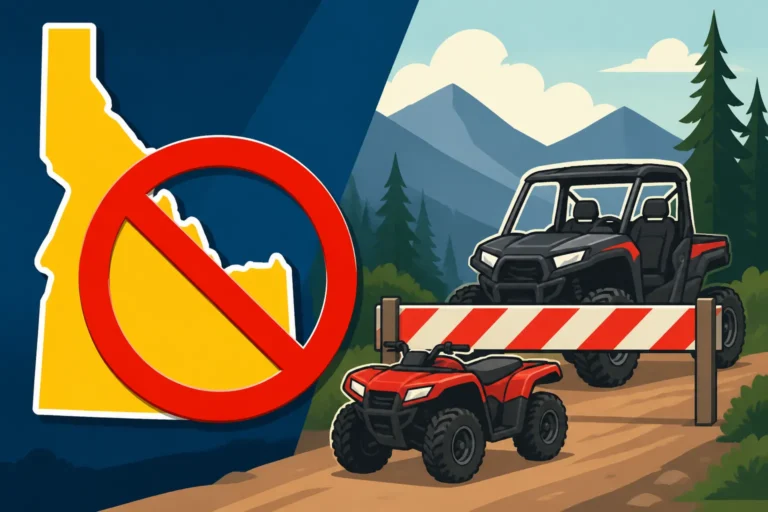
However, there are some exceptions. For instance, if you're riding exclusively on private land with the owner's permission, or on lands specifically exempt by Idaho law, you might not need a sticker. But for the vast majority of our riding adventures, especially those on federal or state lands, the sticker is a non-negotiable item. Without it, you could face penalties, which are outlined in resources like [Fines for an Unstickered OHV in Idaho].
The Distinction Between Licensed Trucks and OHVs
This is where the core of the confusion often lies. A licensed truck is fundamentally different from an off-highway vehicle in the eyes of Idaho law, and therefore has different requirements for registration and operation.
Why Your Truck Already Has Road Authority
Your standard pickup truck, SUV, or any vehicle with a full, unexpired license plate and registration, is already classified as a motor vehicle designed and approved for public road use. It has headlights, taillights, turn signals, mirrors, and meets all the safety and emissions standards required for highway travel. When you register your truck with the Idaho Department of Motor Vehicles and receive your license plates, you are paying fees that contribute to the maintenance of Idaho's paved and maintained road system.
Because your truck is already a fully street-legal vehicle, it doesn't need an additional "OHV sticker" to operate on county roads or other public roads where it is legally permitted. The OHV sticker is specifically designed to grant permission to vehicles not otherwise licensed for general road use. Your truck's license plate is its permission slip for the roads.
OHV Sticker vs. Restricted Vehicle Plate
It's easy to conflate the OHV sticker with an Idaho Restricted Vehicle (R) plate, but they serve different purposes. The OHV sticker is purely for off-highway use. The "R" plate, on the other hand, is for off-highway vehicles (like ATVs and UTVs) that want to gain limited access to specific county and Forest Service roads. If you have an ATV or UTV and want to ride it legally on a county road to connect trails or access services, you'll need the OHV sticker AND an "R" plate. This plate begins with an "R" and has unique requirements, which are detailed in [Idaho's Restricted Vehicle Plate Explained] and [Idaho Plates That Begin With R].
A licensed truck, by its very nature, is not an OHV requiring an "R" plate. It's already a road-legal vehicle. It doesn't need additional permission from the OHV program to use roads that are open to general vehicle traffic. The rules for [What Idaho Requires Before You Ride a County Road] apply to all vehicles, but a standard licensed truck already meets those basic registration criteria through its state-issued plate.
When a Truck's Role Might Blur the Lines
While a standard, licensed pickup truck doesn't need an OHV sticker, there are specific scenarios and types of vehicles that can lead to confusion. Understanding these nuances is key to staying compliant and avoiding issues.
Plated Jeeps and Similar Modified Vehicles
This is perhaps the most common area of overlap and confusion. Many enthusiasts modify Jeeps, Broncos, or other similar vehicles extensively for off-road use. They might lift them, add massive tires, winches, and even a roll cage. Even with these modifications, if the vehicle maintains its full street-legal registration and license plates, it's still considered a "truck" or passenger vehicle for road-use purposes. It does not need an OHV sticker. Its road-legal status covers its use on public roads.
However, these "plated Jeeps" often do travel on designated OHV trails and forest roads alongside ATVs and UTVs. On these trails, their fully street-legal status allows them access. This is different from a side-by-side that requires an OHV sticker to be on those same trails. The rules for these types of vehicles are often discussed in articles like [Plated Jeeps on OHV Trails], which clarifies their unique standing within Idaho's extensive trail system. While they share the trails, their legal classification for registration remains distinct.
Farm, Ranch, and Utility Exemptions
Idaho law provides specific exemptions for vehicles used primarily for agricultural purposes or for specific utility work. If your licensed truck is being used on a farm or ranch for legitimate agricultural activities, certain rules might be relaxed or different. For example, a pickup truck moving equipment between fields on a county road as part of farming operations would not suddenly need an OHV sticker just because it’s on a gravel road. Its primary function and licensed status dictate its use.
These exemptions are usually quite specific and don't grant general off-highway riding privileges. They are focused on the practical needs of agricultural and industrial operations. It's crucial not to confuse these work-related exemptions with recreational riding. For more details on these specific situations, you can look into resources like [Idaho OHV Registration for Farm and Ranch Machines] or [Farm Exemptions From Idaho OHV Rules]. For recreational riding, even on private timber land, a licensed truck retains its classification, while an OHV would still need its sticker for legal use on public portions.
Heavily Modified or "Homemade" Machines
There's another category of vehicles that can cause headaches: those that started life as one thing and became something else entirely. Imagine a highly customized rock crawler built on a truck frame, or a "buggy" that might use many automotive components but is clearly not street-legal without significant modification and inspection. If such a vehicle cannot be legally registered for standard road use (i.e., it can't get a standard license plate), then it might fall under the OHV classification.
In such cases, even if it has a truck engine or transmission, if it's primarily designed and used for off-highway travel and cannot obtain a standard license plate, it would likely require an OHV sticker for public land access. This is where the distinction becomes less about what parts are used and more about the vehicle's functional design and legal ability to operate on public highways. For machines that are built from scratch, or heavily modified beyond recognition, the process to get them legal, whether as an OHV or a street-legal custom, can be quite complex. Companies like SuperATV offer a wide range of parts and accessories that allow for extreme customization, which might push a vehicle into this "hybrid" classification, requiring specific attention to its registration.
To summarize the key differences:
| Feature | Standard Licensed Truck | Off-Highway Vehicle (ATV, UTV, Dirt Bike) |
|---|---|---|
| Primary Use | Road travel, hauling, daily commuting | Off-road recreation, trail riding, specific work |
| Idaho Registration | Standard license plate and vehicle registration | OHV Sticker (mandatory for public land) |
| Road Access | Full legal access on most public roads/highways | Limited access on designated county/forest roads (with "R" plate) |
| Safety Standards | Meets DOT standards for street-legal operation | Designed for off-road, may not meet DOT for street use |
| Sticker Requirement | NO OHV sticker needed | YES, OHV sticker required for public land use |
| Modifications (e.g.) | Lift kits, larger tires, but maintains road legality | Specialized off-road accessories (e.g., from SuperATV) |
In conclusion, your fully licensed and registered pickup truck, SUV, or other standard motor vehicle does not need an Idaho OHV sticker. Its license plate already grants it the necessary authority for road use. The OHV sticker program is specifically for those machines—ATVs, UTVs, dirt bikes—that don't have standard license plates and require separate permission to explore Idaho's incredible trail systems. Keep your OHVs stickered up, and your truck licensed and registered, and you'll be good to go for all your Idaho adventures.
Disclaimer
This article is for general informational purposes only and does not constitute professional advice. Laws, prices and regulations vary by location and change over time. Consult a qualified professional for guidance on your specific situation.