Idaho Roads Open by Default to Restricted Vehicles
It can be incredibly frustrating to feel like you're constantly guessing where you can and can't legally ride your ATV or UTV in Idaho. Many riders assume that once they get a restricted vehicle plate, the entire world of county roads opens up to them, only to find themselves confused by conflicting signs or local rules. This guide is here to cut through that confusion, explaining which Idaho roads are generally open by default for restricted vehicles and what you need to know to ride confidently and legally.
Understanding Idaho's Restricted Vehicle Designation
Before we dive into specific roads, it's crucial to grasp what Idaho means by a "restricted vehicle" and why this designation even exists. It’s not just about slapping a special plate on your side-by-side; it's about a specific legal framework designed to balance trail access with public safety on shared roadways. Misunderstanding this foundational concept is often where riders run into trouble.
The Legal Definition of a Restricted Vehicle
In Idaho, a restricted vehicle refers primarily to an Off-Highway Vehicle (OHV) – which includes ATVs, UTVs (side-by-sides), and dirt bikes – that has been properly equipped and registered with a special "restricted use" plate. This plate, often beginning with an 'R' (like [Idaho Plates That Begin With R]), signals to law enforcement and other drivers that your machine has met certain criteria allowing it to operate on specific public roads. It's a key identifier, but it doesn't automatically grant access to all roads.
The defining characteristic of a restricted vehicle is that it's designed primarily for off-highway use but can, under specific conditions, be legally operated on certain paved or gravel roads. Think of it as a conditional pass. These machines are distinct from standard street-legal vehicles because they generally don't meet all the stringent safety and emissions requirements of a typical car or truck, hence the "restricted" nature of their road use. This designation is a practical solution for riders who need to connect trails, access services, or simply enjoy a scenic backroad, without fully converting their machine to a highway-legal vehicle.
The Purpose Behind Idaho's Restricted Plate
The core purpose of Idaho's restricted plate is to provide a legal pathway for OHV riders to connect trails, access public lands, and enjoy limited road use without the full burden of street-legal conversion. Idaho is known for its vast backcountry and intricate trail systems, many of which require short segments of road travel to link up. Without this plate, riders would be forced to trailer their machines for even short road sections, significantly hindering the spontaneity and enjoyment of multi-day trips or exploring new areas.
Beyond convenience, the restricted plate also serves public safety. By requiring specific equipment like mirrors, turn signals, and a horn, it makes OHVs more visible and predictable to other motorists when they are on shared roadways. It also brings OHV operators under the purview of certain traffic laws, helping to regulate their behavior on roads. For example, [What Idaho Requires Before You Ride a County Road] outlines many of these necessities. This system allows Idaho to maintain its reputation as an OHV-friendly state while still attempting to mitigate potential conflicts and hazards that arise when off-highway machines share the pavement with other vehicles.
The Concept of "Open by Default" Roads
Now that we understand what a restricted vehicle is, let's tackle the heart of the matter: which roads are "open by default." This concept is a game-changer for Idaho riders, meaning you generally don't need a specific sign allowing OHV use; rather, roads are considered open unless explicitly closed by an ordinance or regulation. This is a crucial distinction from states where every road requires positive signage for OHV access.
County Roads: The Primary "Open by Default" Network
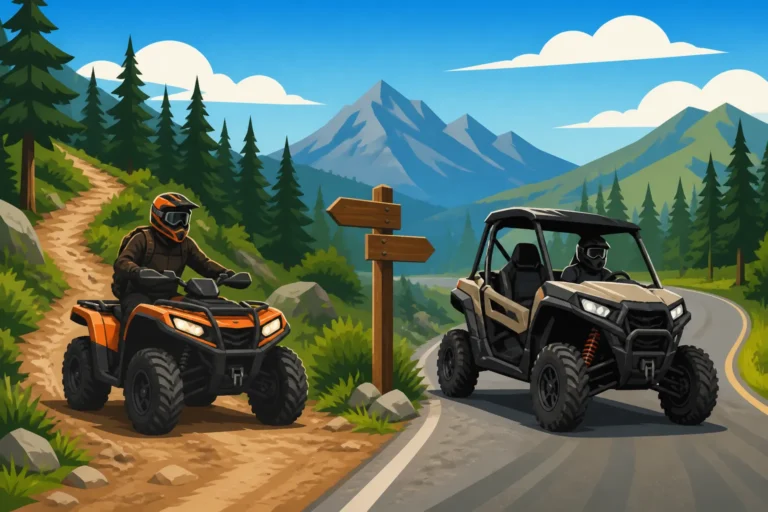
For most Idaho OHV riders with a restricted vehicle plate, county roads are your bread and butter. The Idaho state statute generally designates county roads as "open by default" for properly equipped and stickered OHVs, provided they possess the restricted vehicle plate. This means that if you're on a county road and you don't see a sign explicitly prohibiting OHVs, you're usually good to go. This widespread access is what makes Idaho such a fantastic place for exploring on an ATV or UTV.
Imagine you're out near Cascade or Lowman, wanting to ride from your cabin to a trailhead a few miles down a gravel county road. With your restricted plate, this short transit is typically permissible. The beauty of the "open by default" rule on county roads is that it empowers riders to make these connections without second-guessing every intersection. However, it's vital to remember that "open by default" doesn't mean "anything goes." You still need to adhere to all traffic laws, speed limits, and the specific equipment requirements for your machine. This flexibility often allows riders to explore vast networks, connecting logging roads and smaller community paths, such as riding [Riding a Gravel Road Into Idaho City] or exploring routes near Stanley.
Forest Service and BLM Roads: Federal Land Access
When it comes to accessing vast tracts of public land in Idaho, Forest Service (FS) roads and Bureau of Land Management (BLM) roads often operate under a similar "open by default" principle for restricted vehicles. These federal agencies manage millions of acres in Idaho, and their network of unpaved and sometimes paved roads is a lifeline for outdoor recreation, including OHV riding. Generally, if an FS or BLM road is open to licensed highway vehicles, it's also open to properly equipped and stickered OHVs with a restricted plate.
However, there's a critical layer of detail here: Motor Vehicle Use Maps (MVUMs). These maps, provided by the Forest Service and BLM, are the definitive guide for motorized travel on federal lands. While many roads are open by default, MVUMs explicitly show which roads and trails are open to which types of vehicles (e.g., highway legal, OHV, ATV only, motorcycle only) and during what seasons. So, while the default is often "open," it's always best practice to consult the most current MVUM for the specific area you plan to ride. For example, when you're planning to ride [The Magruder Corridor and Idaho Backcountry] or explore [Idaho's Sawtooth National Forest Trails], an MVUM will clarify access. These maps are designed to prevent conflicts, protect sensitive areas, and inform riders about closures due to wildlife, fire, or seasonal conditions.
Roads That Are NOT Open by Default
It's just as important to understand which roads are not open by default. Assuming universal access can lead to fines, citations, or worse, dangerous situations. Idaho is quite clear about its restrictions on higher-speed, higher-traffic roadways.
State highways, often identified by route numbers like ID-55, ID-21, or US-95, are generally closed to OHVs, even those with restricted plates. These roads are designed for faster-moving traffic, and OHVs typically lack the speed and safety features to integrate safely. While you might be able to cross a state highway at a designated intersection, riding along it is almost universally prohibited. For clarity, consider the rules around [Crossing an Idaho Highway on an OHV]. Similarly, interstate highways (I-84, I-15) are strictly off-limits to OHVs for obvious safety reasons.
Additionally, while county roads are largely open by default, specific cities and towns within those counties often have their own ordinances that restrict or prohibit OHV use on city streets. A bustling main street in a town like McCall or Salmon, even if technically a county-maintained road, might have specific local rules. Always check local ordinances for any municipalities you plan to ride through. The "open by default" rule is powerful, but it's not absolute, and local control often takes precedence within municipal boundaries.
Equipping Your OHV for Restricted Road Use
Just getting an Idaho restricted vehicle plate isn't enough; your machine needs to be properly equipped to legally navigate those "open by default" roads. This isn't just about avoiding a ticket; it's about making your OHV safer and more visible when sharing the road with other vehicles. Think of it as preparing your machine for a whole new environment.
Mandatory Safety Equipment for Road Riding
To qualify for and use an Idaho restricted vehicle plate on public roads, your ATV or UTV must be fitted with several pieces of essential safety equipment. These aren't optional upgrades; they are requirements designed to bring your off-highway machine closer to the safety standards of a conventional street vehicle. This usually includes:
- Headlights and Taillights: These must be operational, especially for riding during dawn, dusk, or night. Your headlights need to project a certain distance, and your taillights must be visible from the rear.
- Brake Lights: These are crucial for signaling your deceleration to vehicles behind you, preventing rear-end collisions.
- Mirrors: You need at least one rearview mirror, typically mounted on the left side, to provide adequate visibility of traffic approaching from behind. Many riders opt for two mirrors for better situational awareness.
- Horn: A working horn is necessary to alert other drivers or pedestrians to your presence.
- Turn Signals: Functional front and rear turn signals are mandatory for signaling your intentions to other motorists, just like any car.
- Spark Arrester and Muffler: Your exhaust system must be equipped with an approved spark arrester to prevent wildfires and a muffler to keep noise levels within acceptable limits. [Idaho Muffler and Exhaust Noise Limits] provides more detail on this.
- DOT-Approved Tires: While not always explicitly stated as a conversion requirement, many deputies interpret the spirit of road-legality to include tires that are safe for paved surfaces, rather than solely aggressive off-road treads.
Meeting these requirements ensures your machine can communicate its presence and intentions to other road users, significantly reducing accident risk. Without this essential gear, even with a restricted plate, you're not legally prepared for road use.
The Idaho Restricted Vehicle Plate Itself
Obtaining and correctly displaying the Idaho restricted vehicle plate is the final puzzle piece for road legality. This special plate, often beginning with an 'R', signifies that your machine has been registered for limited road use. It's not a standard license plate, but it carries similar weight when you're on a public road. The process involves titling your OHV (if it's not already) and then applying for the restricted plate through the Idaho Department of Parks and Recreation (IDPR).
Once you have the plate, proper display is critical. It must be mounted securely and visibly on the rear of the machine, typically where a conventional license plate would go. Obscuring the plate with mud, gear, or even an overly enthusiastic flag could lead to a citation. Remember, this plate is what tells law enforcement at a glance that your OHV has taken the necessary steps for road access. For specifics on the process, look up [Ordering an Idaho Restricted Plate] or [How Long an Idaho R Plate Takes to Arrive]. While you're waiting for it to arrive, you might even be able to ride with temporary paperwork, as discussed in [Riding While You Wait for the Plate].
SuperATV and Aftermarket Compliance
Many riders find that their stock OHV doesn't come with all the necessary components for Idaho's restricted road use straight from the factory. This is where aftermarket companies like SuperATV come into play. They offer a wide range of conversion kits and individual components designed to help you meet the specific requirements for street legality, whether it's for an Idaho restricted plate or a full street-legal conversion in another state.
SuperATV, for example, provides turn signal kits, rearview and side mirrors, horns, and even full glass windshields that might be desired for road comfort and protection. When considering aftermarket parts, it's crucial to ensure they are designed for durability and meet any relevant Department of Transportation (DOT) standards where applicable, especially for items like tires or windshields. While some kits combine many required items, always double-check Idaho's specific statutes to ensure every single box is ticked. Investing in quality aftermarket equipment from reputable brands not only ensures compliance but also enhances the safety and functionality of your machine for shared road environments.
Navigating Exceptions and Local Ordinances
Even with the "open by default" rule for many Idaho roads, it’s vital to understand that exceptions and local ordinances can—and often do—override this general principle. What might be perfectly legal in one county or town could be strictly prohibited just a few miles down the road. This patchwork of rules can be a major source of frustration for riders, but being prepared makes all the difference.
City and Town Specific Ordinances
This is perhaps the most significant area where the "open by default" rule for county roads gets complicated. While a county road leading into a town might be open to your restricted vehicle, the moment you cross into city limits, a different set of rules often applies. Many Idaho cities and towns have enacted their own ordinances to regulate or prohibit OHV use on their municipal streets. This is often due to concerns about noise, traffic congestion, pedestrian safety, or conflicts with local residents.
For instance, a rural county road might allow OHVs, but as you approach the downtown core of a place like Coeur d'Alene, McCall, or Ketchum, you might find signs explicitly prohibiting OHVs or restricting them to certain routes. Some towns, like Stanley or Salmon, are much more OHV-friendly, often designating specific routes that allow riders to access businesses, fuel, and lodging, as explored in [Riding Through McCall, Stanley and Salmon] and [Idaho Towns That Welcome OHV Traffic]. It’s always best practice to check the local city or town website for their specific OHV ordinances before planning a ride that takes you through a developed area. A quick phone call to the local police department or city hall can save you a lot of hassle and potential fines.
County-Specific Road Closures
While Idaho state law generally allows restricted vehicles on county roads by default, individual counties retain the authority to close specific roads or areas to OHV traffic through their own ordinances. These closures might be for environmental reasons, public safety concerns (e.g., roads with heavy logging truck traffic), or simply in response to local resident complaints. These are not as common as city ordinances, but they do exist and can catch unaware riders off guard.
A county might, for example, designate certain roads within residential subdivisions as closed to OHVs to mitigate noise complaints. Or, a county commissioner board might decide to close a particular stretch of road that has become a problem area for illegal riding or resource damage. These closures must be clearly signed to be enforceable. So, while the default is "open," always keep an eye out for official signage that might indicate a specific county road segment is closed to OHVs. Ignorance of an ordinance, even if well-signed, is not typically a valid defense against a citation. When planning a trip, particularly to a new county, a quick search for "[Finding an Idaho County's OHV Ordinance]" can provide crucial information.
State and Federal Highway Restrictions
As mentioned earlier, state and federal highways are generally not open by default to restricted vehicles, and this is a hard rule with very few exceptions. These high-speed roadways are simply not safe for OHVs due to speed differentials, lack of crash protection, and inability to keep up with traffic flow. You might find explicit signs, or simply the absence of any signage allowing OHVs, which effectively means they are closed.
The key exception is often the ability to cross a state highway at an intersection. This allows riders to connect two separate trail systems or county roads. However, even these crossings often come with specific rules: you must cross as directly and safely as possible, yielding to all highway traffic, and often only at a designated intersection. You cannot ride along the shoulder or use the highway to travel any significant distance. It's a fundamental distinction: crossing versus traveling. Any attempts to travel on these prohibited routes, such as [Riding the Shoulder of an Idaho Road], will almost certainly result in a citation and could put you in serious danger.
Rider Responsibilities and Best Practices
Having a restricted plate and an equipped machine is only part of the equation. To truly ride safely and legally on Idaho's "open by default" roads, you also need to embrace a set of rider responsibilities and best practices. This isn't just about following rules; it's about being a courteous, informed, and safe member of the public sharing the road.
Driver's License, Insurance, and Safety Course Requirements
Operating a restricted vehicle on Idaho roads requires more than just machine readiness; it demands rider readiness too. Crucially, anyone operating an OHV on a public road, including those "open by default" county roads, must possess a valid driver's license. This isn't just a suggestion; it's a legal requirement. A learner's permit typically isn't sufficient for independent road operation, although some rules exist for supervised minors on certain roads, as discussed in [Idaho Road Rules for Young Riders]. This requirement ensures that riders have a basic understanding of traffic laws and safe driving practices.
In addition to a driver's license, liability insurance is also mandatory for OHVs operating on public roads. This protects you and others in case of an accident. While your personal auto insurance might not cover your OHV for all types of incidents, a specific OHV or powersports policy often will. Always confirm your coverage with your insurance provider. For younger riders, or those under 16, a certified OHV safety course might also be required, particularly when operating on certain public lands or roads. [Idaho's OHV Safety Course for Young Riders] delves into these age-specific requirements. Carrying proof of your driver's license, registration, and insurance is always a smart move, as a deputy may ask for them during a traffic stop, as detailed in [What an Idaho Deputy Asks a Rider For].
Safe and Courteous Riding on Shared Roads
When you take your OHV onto an "open by default" road, you're sharing that space with cars, trucks, bicycles, and sometimes even pedestrians or horses. This requires a shift in mindset from trail riding to road etiquette. The responsibility to ride safely and courteously falls heavily on the OHV operator. This means:
- Obeying Traffic Laws: All standard traffic laws apply, including speed limits, stop signs, yield signs, and lane markings. Don't assume that because you're on an ATV, these rules are flexible.
- Maintaining a Safe Speed: While your OHV might be capable of higher speeds, many county roads are narrow, winding, or have blind curves. Always ride at a speed appropriate for conditions and within posted limits, understanding that [Idaho Speed Limits for Restricted Vehicles] may differ from what a car is allowed.
- Riding Single File: On narrow roads, ride in a single file line, especially when encountering oncoming traffic or cresting hills.
- Minimizing Dust and Noise: Be mindful of kicking up excessive dust on dry gravel roads, particularly when passing homes or other vehicles. Likewise, respect local noise ordinances and the comfort of residents and other recreators. Your aftermarket exhaust might sound great on the trail, but it can be intrusive on a county road, as discussed in [Idaho Noise Rules Near Mountain Towns].
- Yielding to Other Traffic: Always be prepared to yield to larger vehicles, oncoming traffic, and any non-motorized users like cyclists or hikers.
- Maintaining Distance: Keep a safe following distance from vehicles ahead, especially since many OHVs can stop more quickly or unpredictably than a car.
By adhering to these practices, you contribute to a positive perception of OHV riders and help maintain access to these valuable "open by default" routes for everyone.
Penalties for Non-Compliance
Ignoring Idaho's OHV road rules, whether it's riding on a prohibited road, lacking the proper equipment, or failing to have a driver's license or insurance, can lead to a range of penalties. These aren't just minor inconveniences; they can significantly impact your wallet and your riding privileges.
Common penalties include fines, which can vary depending on the specific violation and the county. For instance, [Idaho Penalties for a Missing Restricted Plate] or [Fines for an Unstickered OHV in Idaho] can add up quickly. Beyond financial penalties, more serious infractions, especially those involving reckless operation or causing an accident, could lead to your OHV being impounded, points on your driver's license, or even the temporary or permanent loss of your riding privileges. Law enforcement, including county sheriffs and Idaho Parks and Recreation (IDPR) officers, regularly patrol these areas, and they are empowered to enforce these regulations, as outlined in [Sheriff Enforcement on Idaho Back Roads]. Understanding these potential consequences should serve as a strong motivator to ensure your machine is compliant and your riding behavior is responsible.
Here's a quick comparison of different road types and their typical default status in Idaho:
| Road Type | Typical "Open by Default" Status for Restricted Vehicles | Common Exceptions/Considerations | Key Regulations |
|---|---|---|---|
| County Roads | YES (Generally open) | City/Town ordinances may close sections within municipal limits. | Full suite of road-legal equipment, valid DL, insurance, traffic laws. |
| Forest Service Roads | YES (Generally open) | Subject to Motor Vehicle Use Maps (MVUMs), seasonal closures, specific restrictions. | MVUM compliance, spark arrester, noise limits, safety equipment. |
| BLM Roads | YES (Generally open) | Subject to Motor Vehicle Use Maps (MVUMs), seasonal closures, specific restrictions. | MVUM compliance, spark arrester, noise limits, safety equipment. |
| State Highways | NO (Generally closed) | Crossing at intersections usually allowed. | Absolutely no traveling along the highway. |
| Interstates | NO (Strictly closed) | No exceptions for OHVs. | Never permitted. |
| City/Town Streets | NO (Often closed by local ordinance) | Some towns designate specific OHV routes; always check local rules. | Varies widely; check local ordinances, may require all road-legal gear. |
Understanding which Idaho roads are "open by default" to restricted vehicles is empowering, but it comes with the responsibility of equipping your machine correctly and riding responsibly. Idaho offers an incredible playground for OHV enthusiasts, and by following these guidelines, you can ensure your adventures are both thrilling and legal, connecting trails and towns with confidence.
Disclaimer
This article is for general informational purposes only and does not constitute professional advice. Laws, prices and regulations vary by location and change over time. Consult a qualified professional for guidance on your specific situation.