Idaho Permit Rules on Public Land
Idaho’s public-land rules can feel confusing because an OHV sticker, a land-use permit and permission to ride a particular route are not the same thing. The right paperwork depends on who owns or manages the land, where you plan to ride and whether you’re a resident or visitor. This guide explains how to sort those requirements out before you unload.
Start by separating the sticker from land permission
An Idaho OHV sticker is a registration requirement for many machines ridden on public land. It is not a blanket permit to enter every public-land unit, use every road or ride wherever a trail looks open. The land manager’s rules still decide where motorized travel is allowed.
That distinction is the key to avoiding a frustrating surprise at the trailhead. A machine can have the correct sticker and still be on a closed route. It can also be on an open route but lack required registration or another document.
Think of your requirements in three layers:
- Machine requirements: registration or an OHV sticker, and any applicable road-use equipment or plate requirements.
- Rider requirements: age-related safety training, supervision, and any other rider rules that apply to your trip.
- Land and route requirements: whether the managing agency allows motorized travel there, whether seasonal closures apply, and whether your particular activity requires a special permit.
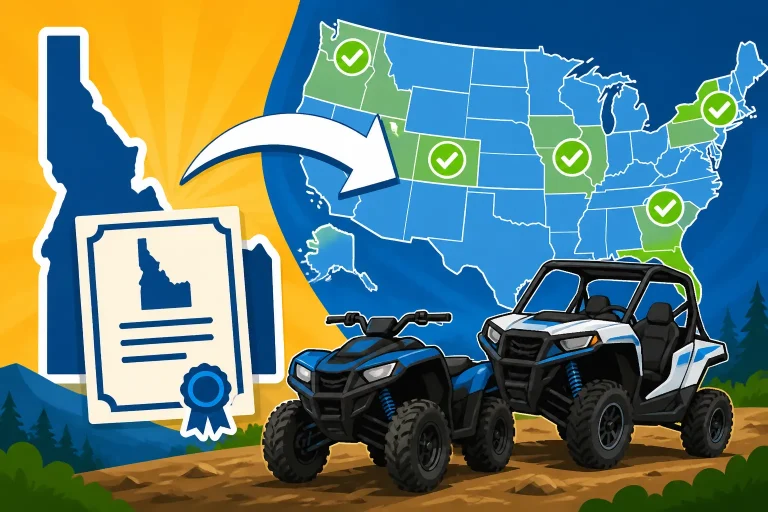
For many trail rides, the basic machine requirement is the first thing to check. Idaho generally requires an OHV to have valid registration when operated on public land, subject to applicable exemptions and machine-specific rules. Residents and out-of-state visitors may follow different registration paths. Do not assume an out-of-state registration or sticker is accepted in Idaho; check the current nonresident rules for your machine and trip. Idaho’s Non-Resident OHV Sticker
The sticker does not replace a separate authorization when one is required. For example, an organized event, commercial guided trip, or activity on a particular parcel may trigger requirements from the land manager even if every machine is properly registered. Likewise, an agency’s approval for a special event does not automatically make an otherwise closed road open to regular riding.
Here is a practical summary:
| What you are checking | What it answers | What it does not answer |
|---|---|---|
| Idaho OHV registration or sticker | Is the machine registered as required for this kind of riding? | Is this route open to motorized use? |
| Land-manager map or order | Is this road or trail open to the machine type and use you have in mind? | Is the machine properly registered? |
| Special-use or event permit | Is an organized, commercial or otherwise regulated activity authorized? | Can you ride outside the permit’s approved area or conditions? |
| Rider safety certificate and supervision rules | Does the rider meet applicable training or supervision requirements? | Does the land manager allow the route? |
| Road-use requirements | Can the machine use a particular road section, and what equipment or credentials are needed? | Is the road open to OHVs at that time? |
A common mistake is to call all of these things a “permit.” In casual conversation, a rider might say, “I’ve got my permit,” when they mean a sticker. An agency employee may use “permit” to mean formal authorization for an event, commercial operation or particular activity. Ask what document is required and who issues it rather than relying on the label.
A road plate also should not be treated as a universal substitute for OHV registration. Road use and off-highway use can involve different requirements, and the answer depends on the machine and where it is being operated. If you have an Idaho restricted vehicle plate, review what that plate covers and what other registration may still be necessary. What Idaho’s $3 Restricted Use Plate Covers
Identify who manages the land before you plan the route
“Public land” is not one set of rules. In Idaho, a ride may involve federal land, state-managed land, local land, or roads crossing more than one jurisdiction. A trail that begins on one agency’s land can cross into another agency’s area, or connect to a county road with its own rules.
Start by identifying the land manager for the place you want to ride. Depending on the location, that could be the U.S. Forest Service, the Bureau of Land Management, Idaho state agencies, a county or city, or another public entity. Some areas have more than one authority involved: one office manages the land, while a county or another agency controls a road, crossing or access point.
Do not infer access from ownership alone. Public ownership does not necessarily mean motorized access is allowed. A public parcel may be open to hiking but closed to OHVs, or it may allow motorized travel only on signed and designated routes. Seasonal restrictions, fire closures, maintenance work and resource-protection orders can change access after you have looked at an older map.
Federal land
Forest Service and BLM lands have route designations and management rules that can differ from one area to another. Some routes are open only to certain vehicle classes or widths. Some have seasonal dates, and others may be closed to motorized use altogether. A route shown on a general road map is not necessarily approved for an OHV.
On Forest Service land, check the applicable Motor Vehicle Use Map and any current local notices. A map may show which routes are designated for motorized travel and may include dates or vehicle restrictions. The rules can be specific: a road may be open to highway-legal vehicles but not to an off-highway machine, or an OHV route may be open only during a stated season. See Reading an Idaho Motor Vehicle Use Map and Forest Service Permits Idaho Riders Need.
BLM-managed areas also have route designations, closures and possible activity-specific requirements. Check the local BLM office’s current route information and notices rather than assuming that a road open in one BLM area is open in another. For a deeper look at when an additional authorization may apply, see BLM Permit Rules in Idaho.
State and local land
State-managed ground may have its own access rules, including rules tied to a particular property, recreation area or use. A sticker does not necessarily provide permission to cross leased ground, enter a posted area or use a route that the state agency has closed. County and city ordinances may also restrict OHVs on roads or within local boundaries.
When a ride includes county roads, road access is a separate question from land access. A road may cross public land yet be closed to OHVs by a local ordinance. Conversely, a county road may allow certain OHV use under conditions even though the adjoining land is closed to cross-country travel. Confirm the route, not just the broad area name. What Idaho Requires to Ride a County Road
Private land within a public-land ride
A route can pass near private property, cross an easement, or use a road with access conditions. A map line alone does not prove that you have permission to ride across private land. Follow posted closures and property boundaries, and obtain permission when access depends on a landowner’s approval.
This matters particularly on long backcountry rides. A route planner may connect two public roads with a line that looks continuous, while the actual connection crosses private ground or a restricted section. If you cannot verify the connection, plan a legal alternate route rather than treating the gap as an invitation.
Know which sticker or registration applies to your machine
For a typical ride, the first paperwork question is whether the machine has the right Idaho OHV registration for its owner and use. Residents generally follow Idaho’s resident registration process; nonresidents should check the applicable nonresident sticker rules. Details can differ by machine type, prior registration and intended use, so check the current official requirements before you travel.
A visitor’s home-state registration is not a safe substitute for checking Idaho’s rules. Reciprocity has changed, and the fact that a machine is registered at home does not by itself establish that it meets Idaho’s requirements. If you are bringing a machine from another state, start with Idaho’s Non-Resident OHV Sticker and confirm whether an exception applies to your situation.
The sticker requirement is also separate from the machine’s title. A title is evidence of ownership; a registration or sticker addresses permission to operate under the relevant registration system. A bill of sale, title or trailer paperwork does not automatically function as a trail sticker.
For Idaho residents, make sure the registration is current for the riding period. Idaho OHV registration follows a calendar-year cycle, so check whether a sticker from the previous season remains valid before assuming it does. Idaho OHV Registration Runs January to December
If the machine is newly purchased, borrowed or rented, ask who is responsible for its registration. A seller may have handled paperwork for a new machine, but do not assume that registration automatically transfers with a private sale. A friend may lend a machine that is properly registered—or may not know whether the sticker is current. Rental operators may handle registration for their fleet, but verify that before you take a rental onto public land. Stickers for a Borrowed Machine
A few distinctions are worth keeping straight:
- The title identifies ownership. It is not the same as the sticker or a route permit.
- The OHV sticker addresses machine registration. It does not grant access to a closed route.
- A restricted plate may address certain road use. It does not necessarily eliminate other registration requirements.
- A land-use permit is tied to its conditions. It may apply only to a specified activity, area, date or group.
- A safety certificate relates to the rider. It is not registration for the machine.
If you ride both trails and roads, check the requirements for each part of the trip. An OHV sticker may be needed for off-highway use, while a road segment may require additional equipment, a plate, insurance or other credentials. The fact that you can legally ride a machine on one portion of a route does not automatically authorize it on the next.
When you are unsure whether your machine is registered correctly, gather its identification details and contact the relevant Idaho registration office before the trip. Do not wait until you are at a remote staging area to discover that the seller’s paperwork, a plate or an old sticker does not match the way you intend to ride.
Check whether the trip needs a separate permit
Most ordinary recreational rides on designated public routes do not become special-permit events simply because they are on public land. But a separate authorization may apply when the activity goes beyond normal individual recreation.
Common situations to investigate include:
- A guided trip offered for compensation
- A club ride, race, poker run or other organized event
- A commercial filming or photography project
- A large group using a managed site
- An activity that occupies a staging area or changes normal public access
- A request to use a closed route or conduct an activity outside ordinary rules
- A business operation involving machines on public land
The exact permit, if any, depends on the land manager and the activity. An event on one unit of public land may require a different process from a guided trip on another. Contact the office responsible for the area early, explain what you plan to do, and ask what applications, insurance documents, maps or lead time are needed. A verbal assumption from a participant or a permit issued for a past event is not enough to confirm that this year’s activity is authorized.
For commercial guided trips, do not assume that a business can simply take paying customers onto any open route. Outfitter or special-use requirements can apply, and the relevant agency may need to approve the operation. See Idaho Permit Rules for Guided Trips for more on that distinction.
A permit is not necessarily a general pass. Read its conditions carefully. It may specify:
- The approved route, area or staging location
- The dates and times of use
- The number of machines or participants
- Where machines may be parked
- Required safety measures
- Rules for signs, barriers or route marking
- Limits on public access or event activity
- Insurance, reporting or cleanup obligations
Keep the permit available as directed by the issuing agency, and make sure all participants understand its limits. If your group splits up, the people at the back should know which routes are authorized and what to do if the planned route is blocked.
A permit for one kind of activity does not override unrelated rules. For instance, event approval does not necessarily waive machine-registration rules, youth supervision requirements, road-use restrictions or a temporary closure. Treat the permit as one layer in the plan, not as permission to ignore the rest.
Check route access, closures and boundaries on the day you ride
A route that appears on an old map may be closed today. Weather, fire, maintenance, erosion, wildlife protection and other conditions can change access. Before you leave, verify both the route designation and the current status.
A reliable pre-ride check should include:
- Choose the exact route. Record the route name, road number or trail designation, not only the destination.
- Find the managing agency. Identify who manages each segment, including any connector roads and crossings.
- Check the official route map. Confirm that motorized travel is allowed for your machine type and that any width or seasonal limits fit your machine.
- Look for current closure notices. Check for fire restrictions, washouts, work closures or temporary orders.
- Confirm local road rules. If the route uses a county or town road, check whether OHV use is allowed there.
- Save the information offline. Cell coverage can disappear quickly in the backcountry.
- Make a backup plan. Pick an alternate route that is legal for your machine, rather than improvising around a closure.
A navigation app can help you follow a route, but it may not show current restrictions or distinguish a legal OHV route from a road intended for other vehicles. Use a current agency map as the authority for route designation and check notices for short-term changes. Checking Idaho Trail Status Before You Drive
If you use a GPS device or phone, download maps before leaving service. A paper map can still be useful when batteries fail or a screen is damaged. If you print or buy a map, compare its publication date and coverage with the current land-manager information. Amazon may have paper maps, map cases or battery packs, but those tools do not replace current agency route maps or closure notices.
Pay particular attention to wilderness boundaries and other areas closed to motorized travel. A trail can run close to a boundary, and a small navigation error can take a rider onto a route where motorized use is prohibited. Stay on the authorized route, do not cut switchbacks, and do not ride around a gate or barrier. Idaho Wilderness Boundaries and OHVs
Do not treat a closed gate as a temporary inconvenience to solve by going around it. It may mark a seasonal closure, private property, a safety hazard or a legal boundary. If signs conflict with an old map, follow the current on-site restriction and contact the land manager for clarification. A map may be outdated, or the sign may reflect a newer closure.
For remote rides, share your intended route and expected return time with someone who is not riding with you. Carry navigation that works without cell service, plus enough water, food and basic repair gear to manage a delay. Amazon can be a source for practical items such as a paper map case or a compact first-aid kit, but select equipment that fits the trip and make sure you know how to use it before relying on it in the backcountry.
Account for rider age, supervision and equipment rules
The permit question is not only about the machine or the land. Riders may have their own requirements, especially if they are under 16. Idaho’s youth rules can include safety-course and supervision requirements, and the details may depend on where the child is riding and the circumstances. Check the current rule for the rider’s age and route rather than assuming that an adult nearby makes every trip compliant.
If a young rider needs a safety certificate, complete the approved course before the trip and carry proof as required. Do not assume a course card from another state will be accepted without checking Idaho’s recognition rules. Nor should you assume the requirement disappears because the ride is on a forest road rather than a marked trail. Idaho OHV Safety Course Requirements
Supervision rules need practical planning. If the supervising adult is on another machine, can they maintain the required proximity and respond quickly? If a group spreads out, does the child remain with a qualified adult? A loose plan such as “we’ll meet at the next junction” may not satisfy a direct-supervision requirement. Review Idaho Supervision Rules and the 300-Foot Rule and the specific age rules that apply to the ride.
Also confirm that the machine is appropriate for the rider. A child who meets the minimum training requirement may still be too small or inexperienced for a machine’s size, power, passenger setup or terrain. Make sure the rider can reach and operate controls and understands how to stop, turn and handle a slope. Keep the route within the rider’s ability and leave room for rest, weather changes and a quick turnaround.
Equipment requirements vary with the kind of riding. A road segment may have separate lighting, helmet, eye-protection or insurance requirements. A public-land trail may have its own restrictions on machine width, mufflers, spark arresters or other equipment. Check the rules for the actual route and machine rather than treating a helmet or sticker as proof that everything else is covered.
Before the ride, confirm that every participant knows:
- Which routes are allowed and which are off-limits
- How to recognize boundary markers, gates and closure signs
- What to do if the group becomes separated
- Who is supervising any young rider
- What documents must be carried
- How to contact help if there is an incident
- Where the group will stop if the route is blocked or conditions deteriorate
A short briefing can prevent the common problem of one rider taking a tempting side road while the rest of the group continues on the planned route.
Common situations and what to verify
The paperwork can look different depending on the ride. These examples show how to organize the checks without assuming one document covers everything.
An Idaho resident taking a quad to a Forest Service trail
Confirm the machine’s registration is current, then check the Motor Vehicle Use Map and current Forest Service notices for the route. Verify that the machine’s width and type are allowed. If the route reaches a county road, check that road’s OHV rules as well. A valid sticker does not make an unmarked or closed trail legal.
A visitor arriving with an out-of-state UTV
Check Idaho’s current nonresident registration rules before leaving home. Do not rely only on the home-state plate, registration or sticker. Then confirm the route and any local restrictions. If the UTV is too wide for a particular route, registration will not make it fit the designation. For a summary of the visitor sticker issue, see Idaho’s Non-Resident OHV Sticker.
A family ride with a young operator
Verify the child’s training and supervision requirements, the machine’s suitability and the helmet or other safety rules that apply. Keep the child with the responsible adult throughout the ride. Choose a route with a clear turnaround point, and avoid a plan that depends on the child navigating a long route alone.
A club ride or organized event
Contact the relevant land manager well before advertising or collecting registrations. Ask whether an event authorization is needed, what route or staging area can be used, and whether the manager requires an operating plan or other documents. Make sure the approved conditions reach all participants, including any riders who join late.
A guided or paid ride
Ask the operator which land-use authorizations apply and whether the planned route is approved for commercial use. Do not assume the guide’s business license, the customer’s sticker or a normal recreational route designation is sufficient by itself. Permit requirements can depend on the agency, location and activity.
A ride that crosses several jurisdictions
Break the route into segments. Record the managing agency or road authority for each one, and verify access independently. This is especially important where forest roads meet county roads, where a route approaches private property, or where the trail network crosses a boundary between federal and state land.
For all of these situations, keep proof organized before departure. A photo of a sticker may help you remember its details, but it may not replace a required physical sticker or document. Follow the issuing agency’s directions about what must be displayed, attached to the machine or carried by the rider.
A simple pre-ride checklist
Use this checklist when you are planning a public-land ride. If one answer is unclear, resolve it before you travel.
Machine and registration
- Is this machine an OHV under the applicable rules?
- Does it have the current Idaho registration or sticker required for this rider and use?
- If it is from another state, have you checked Idaho’s nonresident requirements?
- If it is borrowed or rented, have you confirmed who is responsible for registration?
- Does the machine need additional equipment or credentials for any road segment?
Rider
- Do any riders have age-based safety-course or supervision requirements?
- Is the required certificate available to carry or show?
- Are helmets and eye protection appropriate for the route and riders?
- Is the machine suitable for each rider, including any passenger?
Land and route
- Who manages each segment?
- Is each road or trail open to motorized use?
- Is the route suitable for the machine’s width and type?
- Are seasonal restrictions or temporary closures in effect?
- Does the route cross private land or a jurisdiction with separate rules?
- Is a special-use permit needed for an event, guided trip or commercial activity?
Trip preparation
- Have you saved the map and closure information offline?
- Does someone outside the group know your route and return plan?
- Do you have a legal alternate route?
- Are your documents, water, navigation and basic repair supplies ready?
If you need to check where to purchase or renew a sticker, use the appropriate Idaho registration information rather than treating a store receipt or old sticker as proof of current registration. Where Idaho Sells OHV Stickers For background on how registration revenue supports riding opportunities, see Where Idaho Sticker Money Is Spent.
The safest working rule is simple: carry the correct machine registration, meet the rider requirements, and confirm that the route is open under the rules of the agency or local authority that manages it. None of those checks replaces the others. A few minutes spent verifying the route and paperwork at home can save a long detour—or a citation—after you have hauled the machine into the mountains.
Disclaimer
This article is for general informational purposes only and does not constitute professional advice. Laws, prices and regulations vary by location and change over time. Consult a qualified professional for guidance on your specific situation.