Guiding OHV Trips for Pay
Turning a favorite Idaho riding route into a paid tour involves more than choosing machines and meeting clients at a trailhead. You need to sort out outfitter licensing, land-use permission, commercial insurance, and the OHV rules that still apply to the machines and riders. Here’s how those pieces fit together, and what to confirm before you advertise or take a group out.
What it takes to guide OHV trips for pay
Idaho requires operators who guide OHV tours for pay to secure an outfitter and guide license through the Idaho Outfitters and Guides Licensing Board (IOGLB). That business-level authorization is separate from registration for the vehicles and from permission to use particular land. Treat them as distinct requirements, not interchangeable paperwork.
The board’s licensing requirement applies to paid guiding. A recreational OHV permit, a customer’s own registration, or a machine’s road-use equipment does not by itself authorize you to operate a guiding business. For the licensing process and how it applies to a planned service, contact the Outfitter Licensing in Idaho agency before committing to a route or launch date. The related overview of Idaho Permits for a Guided Trip can help you identify questions to ask.
You also need to arrange commercial liability insurance. The Idaho Outfitters and Guides Licensing Board and USDA Forest Service specify that commercial liability insurance must list the U.S. Government as an additional insured when operating on public forest lands under the described requirements. Confirm the coverage language with your insurer and the land manager; do not assume that a personal policy, a customer’s policy, or a generic business policy meets the requirement.
A paid tour may involve different layers of permission:
| Requirement | What it addresses | What to confirm |
|---|---|---|
| Outfitter and guide license | Authorization to guide OHV trips for pay | Requirements with the Idaho Outfitters and Guides Licensing Board |
| Land-use permission | Whether your business may use the route or property | The relevant land manager or private owner |
| Commercial liability insurance | Coverage for the guiding operation | Required terms, including additional-insured wording where applicable |
| Vehicle registration or permit | The machine’s OHV status | Correct registration, sticker, and use for each machine |
| Route and access rules | Where and how the group may ride | Current restrictions, closures, and vehicle limits |
These requirements answer different questions. A license does not grant access to a trail, and land access does not automatically authorize paid guiding. Similarly, having a registered machine does not mean a particular route is open to your vehicle or commercial use.
Start by describing the actual service you plan to provide: whether you lead customers on their own machines or provide machines, where the trip will go, and which land manager controls the route. Those details can affect what you must arrange. Ask the licensing board and the relevant land manager about the proposed operation rather than relying on a general assumption that guided riding is allowed wherever recreational riding is allowed.
Get land access and route approval before selling the trip
Idaho riding routes can cross land with different owners and managers. Permission for one segment does not necessarily cover the rest of the route, and a route shown on a map is not proof that a paid group may use it. Before advertising a tour, identify the land along the entire route and ask the appropriate owner or agency about commercial use, required permits, operating conditions, and any seasonal restrictions.
For public forest land, the Idaho Outfitters and Guides Licensing Board and USDA Forest Service identify a Forest Service special use permit as an example of a specialized land-use permit that may be required. Read the conditions for the specific area and activity. A general recreational access rule, trail map, or sticker should not be treated as permission to conduct a commercial trip.
If your route involves Bureau of Land Management land, check with the relevant office about the activity and the route you intend to use. The BLM Permit Rules in Idaho overview is a useful starting point, but confirm the applicable requirements for a paid guiding operation directly with the land manager. For Forest Service land, see Forest Service Permits Idaho Riders Need and verify whether commercial use requires a permit for your exact trip.
Private property requires its own attention. The Idaho Department of Parks and Recreation says users must obtain permission before entering private lands. For a guided business, get permission from the owner or authorized representative and make sure it covers the route and activity you actually plan to offer. A customer’s permission to ride on one property does not establish access across neighboring land.
Check route conditions and restrictions close to the trip date, too. The Idaho Department of Parks and Recreation advises users to check with the appropriate government offices about public-land restrictions; it also notes that roads and trails within National Forest boundaries may be subject to motor vehicle use restrictions. A Motor Vehicle Use Map can provide motor vehicle access information, and riders can inquire at a local Forest Service Office. Use the current information for the relevant area instead of relying solely on an old map, a customer’s memory, or a route drawn in a mapping app.
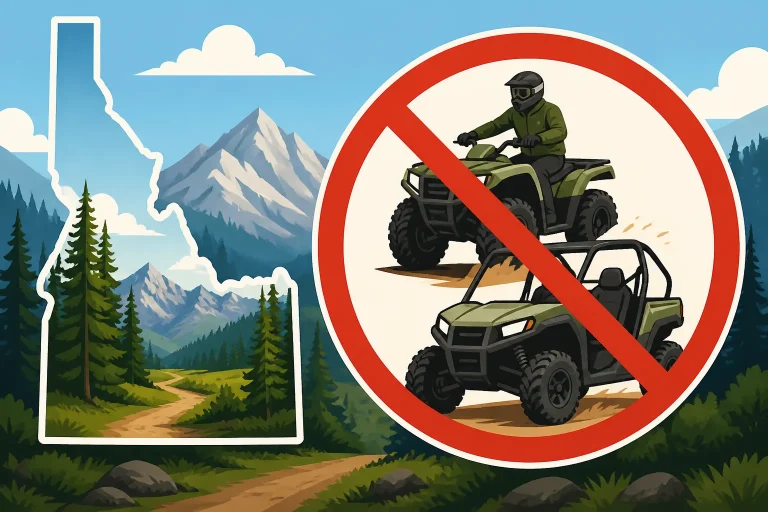
The Idaho Department of Parks and Recreation publishes mapping applications and riding information. Those tools can help with initial route planning, but they do not replace land-manager permission or confirm that commercial guiding is allowed. Pay particular attention to the route’s vehicle suitability, boundaries, and closures. For example, the Idaho Department of Parks and Recreation says motorized ATVs and OHVs are not permitted on the Ashton-Tetonia Trail. The broader Where to Ride an ATV in Idaho overview may help you compare possible destinations, but you still need to verify access for your specific operation.
Before putting a route on a booking page, make a route file or written description for your own use that identifies the land manager and access status for each segment. Record the conditions you were given and any limits on group size, timing, equipment, or route choice. If the land manager has not clearly approved the paid activity, pause the sale of that trip until you have an answer.
Keep machine and rider rules in the plan
Commercial guiding does not remove ordinary OHV requirements. The Idaho Department of Parks and Recreation says every motorbike, ATV, UTV, or specialty off-highway vehicle operated on public or private land must be numbered by January 1 each year. Confirm that each machine used in the business has the appropriate current registration or permit and display it as required. The Idaho Permit Rules on Public Land and Idaho OHV Sticker Rules at a State Park pages may be helpful when checking trip-specific questions, but verify rules for the location you will use.
The machine requirements can vary by vehicle and use. Do not assume that a UTV, ATV, motorbike, and specialty off-highway vehicle are treated identically for every purpose. The Idaho Department of Parks and Recreation says off-highway vehicles operating in Idaho must have a muffler and spark arrester and cannot exceed 96 dB during sound testing. Confirm equipment and sound requirements for the vehicle and land where you plan to ride; the Mufflers and Spark Arresters article offers more detail on those topics.
Route access also depends on the type and width of machine allowed. A trail open to some OHVs may not suit every machine in your fleet. Match the vehicle to the route and check land-manager information before taking clients out. If you are planning a trip that uses a county road or other road section, do not assume that an OHV sticker alone makes that road legal. The separate What Idaho Requires to Ride a County Road article explains why road access needs its own check.
For younger participants, build supervision and training into the operation rather than treating them as last-minute details. According to the Idaho Department of Parks and Recreation, Idaho Code 49-302 requires a licensed adult operator who is at least eighteen years old to supervise a person under sixteen operating an ATV, UTV, specialty off-highway vehicle, or motorbike on certain roads. If the supervising adult is on the ground, the Idaho Department of Parks and Recreation says the adult must remain within three hundred feet of the unlicensed operator. The rule applies to specified roads, so check the relevant requirements for the planned location and activity.
The Idaho Department of Parks and Recreation provides the Responsible Riders course for ages six and up. The agency says a parent must be present for riders under sixteen, and participants must bring their own ATV with a current IDPR registration sticker. Course completion meets Idaho’s OHV education requirement outlined in Idaho Code 49-302; the Idaho Department of Parks and Recreation says it does not currently recognize ASI or MSF certificates. Do not promise that a different certificate will meet Idaho’s requirement without confirming that with the agency.
For the course, the Idaho Department of Parks and Recreation requires a DOT-approved helmet, goggles or a face shield, over-the-ankle boots, OHV-type riding gloves, long pants, and a long-sleeved shirt or jacket. Those are course-specific requirements, but they also give a practical baseline for discussing rider preparation. If your tour includes children, confirm the machine is suitable for each rider and that any applicable supervision, safety-course, and protective-equipment requirements are covered. The related Idaho Age Rules for Riders Under 16 and Idaho Supervision Rules and the 300-Foot Rule pages can help you prepare questions.
Make the customer briefing clear about what the tour includes and what it does not. Explain the route’s general demands, the vehicle each rider will use, the safety gear expected, and what happens if the group needs to stop or turn back. Avoid promising access to a road or trail until you have confirmed the route and any conditions with the relevant authority.
A practical pre-launch checklist
A written checklist makes it easier to keep licensing, land access, insurance, and vehicle paperwork from getting mixed together. Use it before accepting bookings, then review it again when you change routes, machines, or the type of service.
- Define the paid service. Be specific about whether customers bring their own machines or use yours, where the tour operates, and what the guide will provide.
- Check the outfitter requirement. Contact the Idaho Outfitters and Guides Licensing Board about the license needed for the service you intend to offer.
- Confirm land-use permission. Contact each relevant private owner or public-land manager. Ask whether commercial guiding is permitted and whether a special use or other land-use permit is required.
- Verify insurance wording. Ask your insurer and the land manager about commercial liability coverage and whether the policy must list the U.S. Government as an additional insured.
- Check the whole route. Identify land boundaries, access restrictions, closures, vehicle limits, and road sections. Obtain current Motor Vehicle Use Map information where relevant and contact a local Forest Service Office when needed.
- Confirm each machine’s paperwork. The Idaho Department of Parks and Recreation says machines operated on public or private land must be numbered by January 1 each year. Check that the registration or permit is current and appropriate.
- Review the equipment. Confirm required equipment and sound limits for the machines and locations in your plan. Match every vehicle to the route rather than assuming all OHVs can use the same trails.
- Plan for young riders. Check age, supervision, education, and equipment requirements for the location and riders you accept. Be clear about whether your business can accommodate those requirements safely.
- Set customer expectations. Explain required protective gear, route conditions, permitted areas, and any limits on the trip before taking a booking.
- Keep records together. Store licenses, land-use approvals, insurance documents, route notes, and machine registration details where staff can access them when preparing for a trip.
If the plan changes, revisit the approvals. Switching from a private trail to public forest land, adding a new route segment, or using a different type of machine can raise a different access or compliance question. Confirm the revised plan with the relevant board, insurer, and land manager before taking customers onto it.
A paid Idaho OHV tour is best treated as a regulated guiding service, not simply a recreational ride with a fee attached. Secure the outfitter and land-use approvals, carry the required commercial insurance, and keep the ordinary vehicle and rider rules in view. That groundwork helps you avoid selling a trip you are not authorized to run and gives customers a more reliable picture of what the outing involves.
Sources
- Idaho Department of Parks and Recreation — All Terrain Vehicle – (ATV) Course ID:1004 (checked November 3, 2026)
- University of Idaho Extension — FINAL-OHV-ECON-STUDY-SUMMARY-1.pdf (checked November 3, 2026)
- Idaho Department of Parks and Recreation — id_ohm_sm.pdf (checked November 3, 2026)
- Idaho Department of Parks and Recreation — ID_OHV_LE_Guide.pdf (checked November 3, 2026)
- Idaho Department of Parks and Recreation — OHV_BOOKLET.pdf (checked November 3, 2026)
Disclaimer
This article is for general informational purposes only and does not constitute professional advice. Laws, prices and regulations vary by location and change over time. Consult a qualified professional for guidance on your specific situation.