Idaho Penalties for a Missing Restricted Plate
It's incredibly frustrating when you're trying to do everything right, following all the rules to legally ride your ATV or UTV on Idaho's beautiful county roads, only to run into trouble over something as seemingly simple as your restricted plate. Many riders find themselves confused about exactly what's required and the steep consequences if that little "R" plate isn't where it needs to be. This guide will walk you through the specifics of Idaho's restricted use plate, the penalties you could face for not displaying it properly, and practical steps to ensure you're always in compliance, so you can ride with peace of mind.
Understanding Idaho's Restricted Use Plate and Its Purpose
Idaho offers a specific type of plate for off-highway vehicles (OHVs) that allows them to legally access certain county and secondary roads. This isn't your standard vehicle registration; it's a special designation that comes with its own set of rules, and understanding it is key to avoiding penalties. We call it the "R" plate, or the restricted use plate, and it's a vital piece of the puzzle for many riders who want to connect trails or access services in a mountain town.
Why the Restricted Plate Exists
The main reason Idaho created the restricted use plate was to bridge the gap between trail riding and road access. Many incredible trail systems are spread out, and sometimes the only way to get from one section to another, or to reach a trailhead from a campground or town, is to utilize county roads. Before this plate existed, it was often a confusing and legally ambiguous situation for OHV riders. The "R" plate provides a clear, legal pathway for ATVs, UTVs, and even dirt bikes to operate on designated public roads, giving riders more freedom to explore the state's vast trail networks. It's a pragmatic solution that acknowledges the reality of how people use their machines for recreation and access. This plate, in conjunction with your [What an Idaho OHV Sticker Costs Each Year], signals to law enforcement that your machine is recognized by the state for this specific type of limited road use.
What the Restricted Plate Allows You to Do
Having an Idaho restricted plate doesn't mean your OHV can just cruise down any highway. Oh, if only it were that simple! Instead, it permits you to operate your OHV on county roads that have been explicitly opened to OHV use by local ordinance, or on roads where such use is allowed by default, like many Forest Service and BLM roads. These plates are crucial for connecting segments of trails, traveling from a campground to a trailhead, or perhaps running into a small trail town for gas or a bite to eat. It means you can often ride legally from your base camp directly to the dirt, rather than having to load and unload your machine from a trailer every time. However, it's vital to remember that state and federal highways, like US-95 or Interstate 90, are generally off-limits for restricted vehicles, except for very specific crossings. Always check local ordinances and maps, such as a [Reading an Idaho Motor Vehicle Use Map], before you ride, because rules can change from one county line to the next.
Key Requirements Beyond the Plate
Just affixing that restricted plate isn't the only step to being road-legal. Idaho has several other requirements that go hand-in-hand with the "R" plate to ensure safe operation on public roads. For instance, your OHV needs to meet certain equipment standards that are more stringent than those just for trail riding. This often includes things like a horn, mirrors, headlights, taillights, brake lights, and turn signals. Think of it like making your machine a mini-car for short distances on less-trafficked roads. You also need a valid driver's license (not just a learner's permit for adults), and liability insurance that meets the state's minimum requirements, much like a regular car. These additional layers of compliance are all about safety, not just for you, but for other road users. Ignoring any of these can lead to fines, even if your plate is perfectly displayed. You can find more details in articles like [Four Things Idaho Riders Must Carry on a Road] and [Idaho Liability Insurance Minimums for Riders].
The Consequences: Penalties for Not Displaying Your Idaho Restricted Plate
Nobody wants to get a ticket, especially when you're out trying to enjoy Idaho's stunning backcountry. But failing to properly display your restricted use plate can quickly turn a scenic ride into a costly lesson. Law enforcement takes these rules seriously because the plate is a primary indicator of your machine's legal status for road use.
What Constitutes a "Missing" Plate?
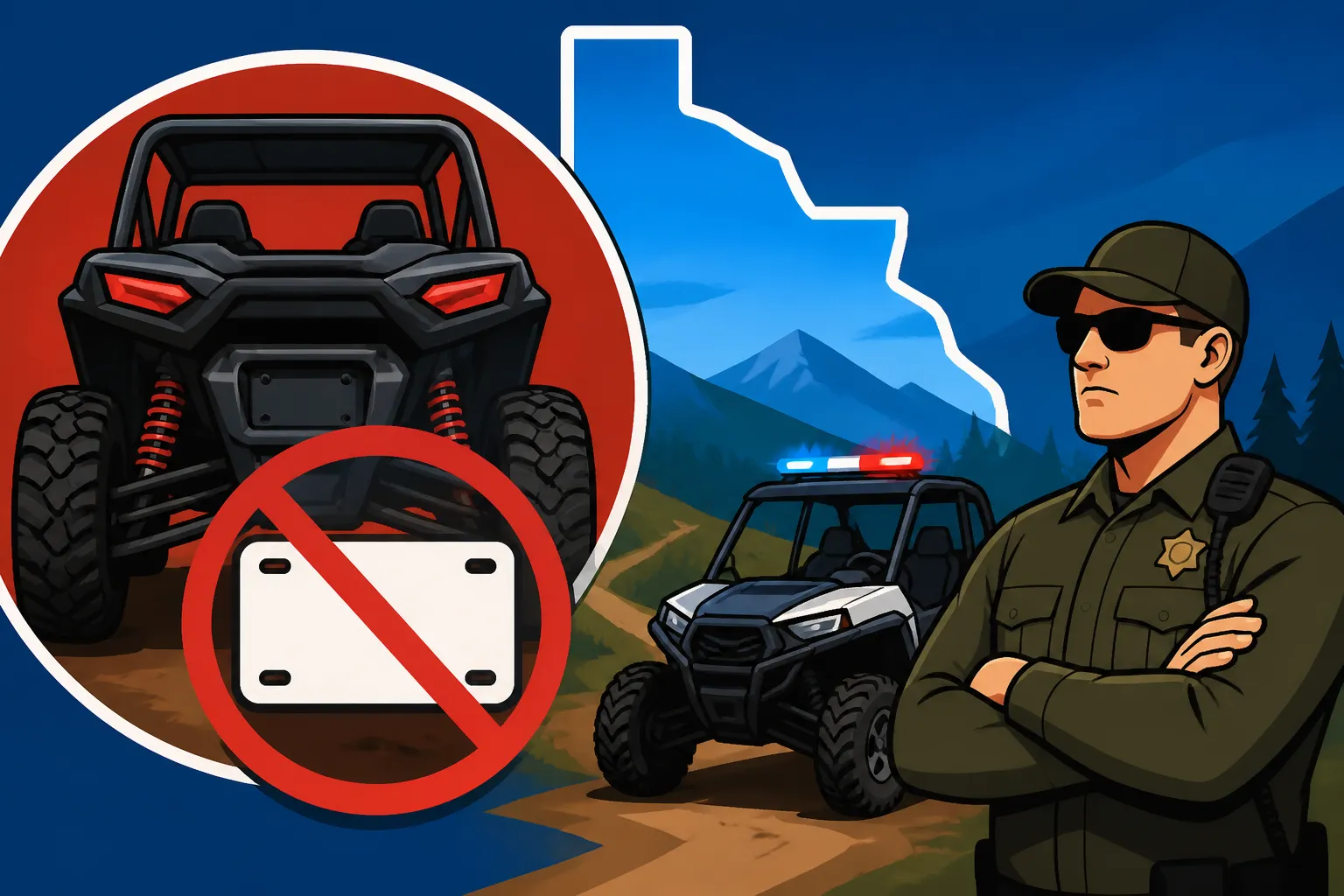
A "missing" plate isn't just about literally not having one. It encompasses several scenarios that can still land you in hot water. For example, if you have the plate but it's tucked under your seat, covered in mud and unreadable, or improperly mounted where it's not clearly visible from the rear, that's often considered the same as not having one at all. The plate needs to be securely fastened, oriented correctly, and unobstructed, so an officer can easily see the number and the "R" designation. Think about driving your car; if your license plate was obscured, you'd expect to get pulled over. The same principle applies here. This means ensuring your plate isn't hidden by cargo, a spare tire, or even a piece of gear that has shifted during your ride. Understanding [Displaying a Sticker on an Idaho R Plate] goes hand-in-hand with plate visibility.
Common Penalties and Fines
The penalties for not displaying your Idaho restricted plate typically start with a citation and a fine. While specific dollar amounts can change, you should expect it to be a noticeable hit to your wallet, potentially hundreds of dollars. This isn't usually just a warning ticket; it's a formal violation. Beyond the financial impact, repeated offenses could lead to more severe consequences, though for a single missing plate violation, the primary concern is generally the monetary fine. It's an incentive to ensure compliance and reinforce the importance of these legal requirements for road-legal operation. These fines are often similar to other equipment violations you might receive in a regular vehicle, reflecting the state's commitment to regulating OHV use on public roads.
Other Potential Issues Beyond the Fine
A missing restricted plate can unfortunately open the door to other problems. If an officer stops you for a plate violation, they're likely to check for other compliance issues as well. This means they'll verify if you have your valid driver's license, proof of insurance, and that your machine meets all the required equipment standards (horn, mirrors, lights, etc.). If any of these are also missing, you could face multiple citations, compounding your fines significantly. Imagine getting pulled over for a missing plate, only for the officer to discover you also don't have insurance or a working brake light. That single initial stop can quickly snowball into a much more expensive encounter. It’s also important to remember that such stops, while perhaps starting with a minor equipment issue, are also opportunities for law enforcement to ensure machines haven't been stolen. An officer might run your VIN to check for outstanding warrants or theft reports, linking back to processes like [Checking a Used Machine for Theft].
Avoiding a Ticket: Best Practices for Restricted Plate Display and Compliance
The best way to deal with penalties is to avoid them altogether. For the Idaho restricted plate, this means a combination of preparation, diligence, and understanding the rules. It's about being proactive so you can focus on the ride, not on potential legal issues.
Proper Mounting and Visibility
The cardinal rule for your restricted plate is visibility. It needs to be mounted securely on the rear of your OHV, typically in a dedicated plate bracket. It should be illuminated if you plan to ride after dark. The plate must be free from obstruction – no mud, no cargo, no tree branches hanging over it. Imagine a law enforcement officer needing to read your plate from a reasonable distance, both day and night. If they can't clearly see the plate number and the "R" designation, you're inviting trouble. Consider using a sturdy, aftermarket license plate frame that offers additional protection and ensures the plate stays flat and visible. Don't just zip-tie it; use proper bolts and nuts to prevent it from rattling loose or falling off on rough terrain. Even a small detail like the angle matters; it shouldn't be tilted so far up or down that it's hard to read. You want it perpendicular to the ground and centered if possible. For insights on where other crucial identification goes, check out [Where the VIN Sits on a Side-by-Side Frame].
Regular Checks Before You Ride
Make checking your restricted plate part of your pre-ride routine, just like checking your tire pressure or fuel level. A quick glance at the rear of your machine will confirm it's still there, clean, and properly mounted. On a long or particularly bumpy ride, the vibrations and jostling can loosen bolts or even cause the plate to bend or detach. If you've been splashing through mud, take a moment to wipe the plate clean. This simple habit can save you a significant amount of hassle and money. It's also a good idea to carry a small cleaning cloth and a basic tool kit with you. If a bolt loosens, you can tighten it on the spot, rather than risk losing the plate entirely miles from the trailhead.
Keeping Documentation Handy
While the plate itself is the primary visual cue, having your supporting documentation readily accessible is also crucial. This includes your driver's license, proof of insurance, and ideally, a copy of your OHV registration. While you typically don't need to carry your actual [Titling and Registering an ATV in Idaho] on the trail, having your registration card provides quick proof that the plate belongs to your machine and that you're the registered owner. Keep these documents in a waterproof bag or container, stored securely on your person or in a compartment on your machine. When an officer pulls you over, being able to quickly produce all requested documents demonstrates compliance and can often lead to a smoother interaction, even if you did have a minor issue with your plate display. [What an Idaho Deputy Asks a Rider For] provides a good overview of what they typically ask for.
Understanding Road Rules for OHVs
Beyond the plate, remember that when you're on a county road, you're sharing it with other traffic, and you need to obey all standard traffic laws. This includes speed limits, stop signs, yielding, and signaling. Your restricted plate is your ticket onto these roads, but it doesn't exempt you from the rules of the road. Failing to adhere to traffic laws can result in citations that are far more severe than a missing plate fine, and it can also jeopardize the future of OHV access on public roads in Idaho. Treat these roads with respect, and always assume there might be other vehicles, cyclists, or pedestrians around the next blind curve. For a deeper dive, read [Riding an ATV on the Road in Idaho].
Dealing with a Violation: What to Do If You're Cited for a Missing Plate
Even with the best intentions and diligent checks, sometimes things go wrong, or misunderstandings happen. If you find yourself pulled over and cited for a missing or improperly displayed restricted plate, knowing how to handle the situation can make a difference.
Professional Conduct During a Stop
If a law enforcement officer pulls you over, the most important thing is to remain calm, courteous, and cooperative. Pull over safely and turn off your engine. Keep your hands visible, and don't make any sudden movements. Listen carefully to the officer's instructions and questions. Provide your driver's license, registration, and proof of insurance when requested. Arguing or becoming defensive will rarely improve the situation and can often escalate it. If you believe there's a misunderstanding, explain your side politely and factually, but do so without being argumentative. Sometimes, an officer might be willing to clarify the situation or offer advice if you approach them respectfully. Remember, they are doing their job, which includes ensuring all riders are in compliance with state laws to keep everyone safe.
Understanding Your Citation
Once you receive a citation, take the time to read it thoroughly. It will detail the specific violation, the date and time, the location, and instructions on how to respond. This usually involves either paying the fine by a certain date or appearing in court. Pay close attention to the deadline for your response; missing it can lead to additional penalties, such as increased fines or even a warrant for your arrest in some circumstances. If you're unsure about any part of the citation, you can usually contact the court listed on the ticket for clarification. Don't just shove it in your glove box and forget about it; that's a recipe for bigger problems down the road.
Deciding Whether to Pay or Contest
After reviewing your citation, you'll generally have two options: pay the fine or contest it in court.
- Paying the Fine: If you know you were in violation, or if the effort and time required to contest it outweigh the cost of the fine, paying the fine might be the most straightforward option. This usually involves mailing in payment or paying online by the due date. Paying the fine typically means you are admitting guilt to the infraction.
- Contesting the Citation: If you genuinely believe you were not in violation, or if there were extenuating circumstances, you have the right to appear in court and explain your case to a judge. For example, if your plate fell off moments before you were stopped and you have proof you just ordered a replacement [Ordering an Idaho Restricted Plate], you might present that. Gather any evidence you have, such as photos of your properly mounted plate taken before the ride, or receipts for replacement parts. It's often helpful to consult with a legal professional if you're seriously considering contesting a citation, especially if you have concerns about how it might affect your driving record or insurance. They can offer advice on the strength of your case and guide you through the court process.
Learning from the Experience
No one enjoys getting a ticket, but a citation can serve as a valuable learning experience. Use it as an opportunity to review Idaho's OHV rules, ensure your machine is fully compliant, and improve your pre-ride checks. Maybe you need a more robust mounting system for your plate, or perhaps you realized you've been lax about cleaning mud off it. Taking proactive steps after a citation can prevent future issues and help you ride more confidently in the future. Remember, the goal is to enjoy the trails and roads safely and legally, and sometimes a minor setback can help reinforce the importance of these regulations for everyone's benefit.
Table of Common OHV Road Violations and Potential Consequences
Here's a general overview of common violations related to OHV road use in Idaho, and the types of consequences you might face. Remember, specific fines and actions can vary.
| Violation Category | Examples of Specific Offenses | Potential Consequences (General) | Key Prevention Strategies |
|---|---|---|---|
| Plate & Sticker Compliance | Missing Restricted Plate | Citation, Monetary Fine | Proper mounting, regular checks, clean plate |
| Obscured or unreadable plate | Citation, Monetary Fine | Keep clean, ensure clear visibility | |
| No OHV Sticker displayed | Citation, Monetary Fine | Purchase and affix annual sticker [Where Idaho Sells OHV Stickers] | |
| Equipment Requirements | No working headlight/taillight | Citation, Monetary Fine, Order to Fix | Pre-ride inspection, maintenance |
| Missing mirrors | Citation, Monetary Fine | Install required mirrors, check for damage | |
| No horn | Citation, Monetary Fine | Test horn function, replace if faulty | |
| Inadequate muffler/spark arrestor | Citation, Monetary Fine | Use approved exhaust, regular maintenance | |
| Driver & Insurance | No valid driver's license | Citation, Monetary Fine, Possible Impound | Always carry valid license, ensure it's current |
| No proof of liability insurance | Citation, Monetary Fine, Possible Impound | Carry current proof of insurance [Insuring an ATV in Idaho] | |
| Underage operator (without supervision/permit for road use) | Citation, Monetary Fine, Parental liability | Understand [Idaho Rules for Riders Under 16 on Roads] | |
| Road Rules | Operating on prohibited roads (e.g., state highways) | Citation, Monetary Fine, Possible Impound | Consult MVUMs and local ordinances [Which Idaho Roads Are Open to OHVs] |
| Speeding or reckless operation | Citation, Monetary Fine, Points on license | Observe speed limits, ride defensively | |
| Alcohol/drug impairment (DUI) | Severe Fines, License Suspension, Jail Time | Never operate under the influence [Idaho Alcohol Limits for OHV Operators] |
Remember, this table provides general guidance. Always refer to current Idaho Statutes and local ordinances for the most precise and up-to-date information on penalties.
Disclaimer
This article is for general informational purposes only and does not constitute professional advice. Laws, prices and regulations vary by location and change over time. Consult a qualified professional for guidance on your specific situation.