Rules for a Machine Used at a Resort
A resort’s permission to ride an ATV or UTV on its property does not automatically cover nearby public trails, roads or other land. In Idaho, the rules depend on where the machine goes and how it is used. Here’s how to sort out stickers, road access, commercial permits and rider responsibilities before a resort ride.
Start by identifying where the machine will be used
“Resort” can mean a privately owned property, a lodging base near public trails, or a business that runs guided rides on public land. Those settings can involve different rules. Before relying on a resort’s instructions, ask which specific routes are included and who manages the land each route crosses.
A machine used only on private resort property generally raises different registration questions from one ridden on public land. But a ride that leaves the property may enter land managed by a federal, state or local agency. A public trailhead, forest road or county road can have requirements that do not apply inside the resort’s private riding area.
Ask the resort for a route map or a clear description of the permitted area. If the route uses public land, check the relevant land manager’s rules as well. Resort staff may be familiar with their usual routes, but route access and closures can change. A route described as “near the resort” is not necessarily on resort-owned land.
| Where the machine is ridden | What to clarify before riding |
|---|---|
| Private resort property only | Whether the resort allows the machine and whether its own operating rules apply |
| Public trail or forest road | Whether an Idaho OHV sticker and other land-use requirements apply |
| County road | Whether the road is open to OHVs and what equipment and operator rules apply |
| State or federal highway | Whether OHV travel is prohibited, with only specific crossings or exceptions allowed |
| Commercial guided route | Whether the business has the required land-use authorization, in addition to rider and machine requirements |
For public OHV routes, do not assume that an Idaho resident’s registration, an out-of-state plate or a resort rental agreement takes the place of an Idaho sticker. Residents and visitors can have different sticker processes, so confirm which applies to the machine and rider. Idaho’s Non-Resident OHV Sticker explains the visitor requirement, while When an Idaho Rider Needs No Sticker covers situations where a sticker may not be needed.
A sticker is also not the same thing as a road-use plate. A machine may be properly registered for OHV use and still not be allowed on a particular road. For the distinction, see Idaho’s Restricted Vehicle Plate and Road Use and What Idaho Requires to Ride a County Road.
Check what the resort’s permission does and does not cover
A resort can set rules for its own property, rental fleet and services. It can also tell guests which routes it recommends. That does not necessarily give it authority to approve riding on public land or override rules set by the agency responsible for a road or trail.
Before riding, get specific answers to these questions:
- Does the route stay on resort property, or does it enter public land?
- If it crosses public land, which agency manages that part of the route?
- Does the machine already have the sticker required for the ride?
- Is the route open to the machine’s width and type?
- Are there road sections, crossings or local restrictions?
- Is the ride self-guided, or is it a commercial guided trip?
- What rider, passenger and safety rules apply?
These questions matter whether the machine belongs to you, the resort or a rental company. A resort’s sticker on its own vehicle, for example, does not necessarily satisfy the rules for another machine in your group. For a rental, ask the shop or resort directly whether the machine’s paperwork covers the planned route. Do not infer that coverage from the fact that the machine is available to rent.
Public-land access can also involve requirements beyond an OHV sticker. Commercial use, organized events and guided activities may require land-use authorization from the relevant agency. A resort that takes customers onto public land should clarify who is responsible for securing any required business permits. A customer’s sticker does not serve as a commercial permit, and a business permit does not automatically replace individual machine or rider requirements.
For more detail on business use, see Idaho Permits for Guided Trips, Forest Service Permits Idaho Riders Need and BLM Permit Rules in Idaho. If a resort advertises a guided trip, ask whether the itinerary stays on its property or uses public land, and which operator is responsible for permits.
Treat road access as a separate question
A route that includes a road section can bring additional rules into play. The answer depends on the road and its managing authority—not simply on whether the resort says the route is suitable for ATVs or UTVs. Some county roads may be open to OHVs under local rules; others may be closed. State and federal highways have separate restrictions, and a machine’s ability to cross a highway does not mean it can travel along it.
A restricted vehicle plate may be part of the requirements for certain road use, but it does not grant blanket access to every road. Riders still need to check whether the specific road is open and meet the applicable equipment and operator requirements. Idaho Roads Open by Default to Restricted Vehicles and Finding an Idaho County’s OHV Ordinance can help with county-road questions. For highway restrictions and crossings, see Why Idaho Bars OHVs From State Highways and Crossing an Idaho Highway on an OHV.
If a resort ride starts on private land and then joins a public road, ask where that transition happens. Confirm the route before riding, rather than deciding at a junction. A resort map may show a road, but the map alone does not establish that OHV travel is permitted there. Check signs and current local rules, and do not enter a closed route.
The same care applies to machines with road-use plates. A plate is not a substitute for checking local access, and a machine that can legally use one road may not be allowed on another. Riders also need to follow any applicable operator, equipment and insurance rules. Driver’s License and Insurance on an Idaho Road Ride explains issues that may apply when a ride uses public roads.
For groups, make sure every rider understands the route and what to do if it is unclear or blocked. Do not split off onto a different road because it appears to connect to the resort. When route access is uncertain, stop and confirm with the resort or land manager.
Confirm the machine and rider are ready for the route
The person responsible for a machine can vary. An owner riding their own ATV, a resort employee operating a work machine and a guest using a rental are not in exactly the same position. Even so, every rider should understand where the machine is allowed and what requirements apply to the planned ride.
If you are bringing your own machine, confirm that its sticker and any road-use equipment match the route. If you are renting, ask the provider whether the sticker is attached and current, whether the machine is permitted on the planned route, and whether there are restrictions on width or trail type. A rental provider may limit where its machines can go even when a route is otherwise open to OHVs.
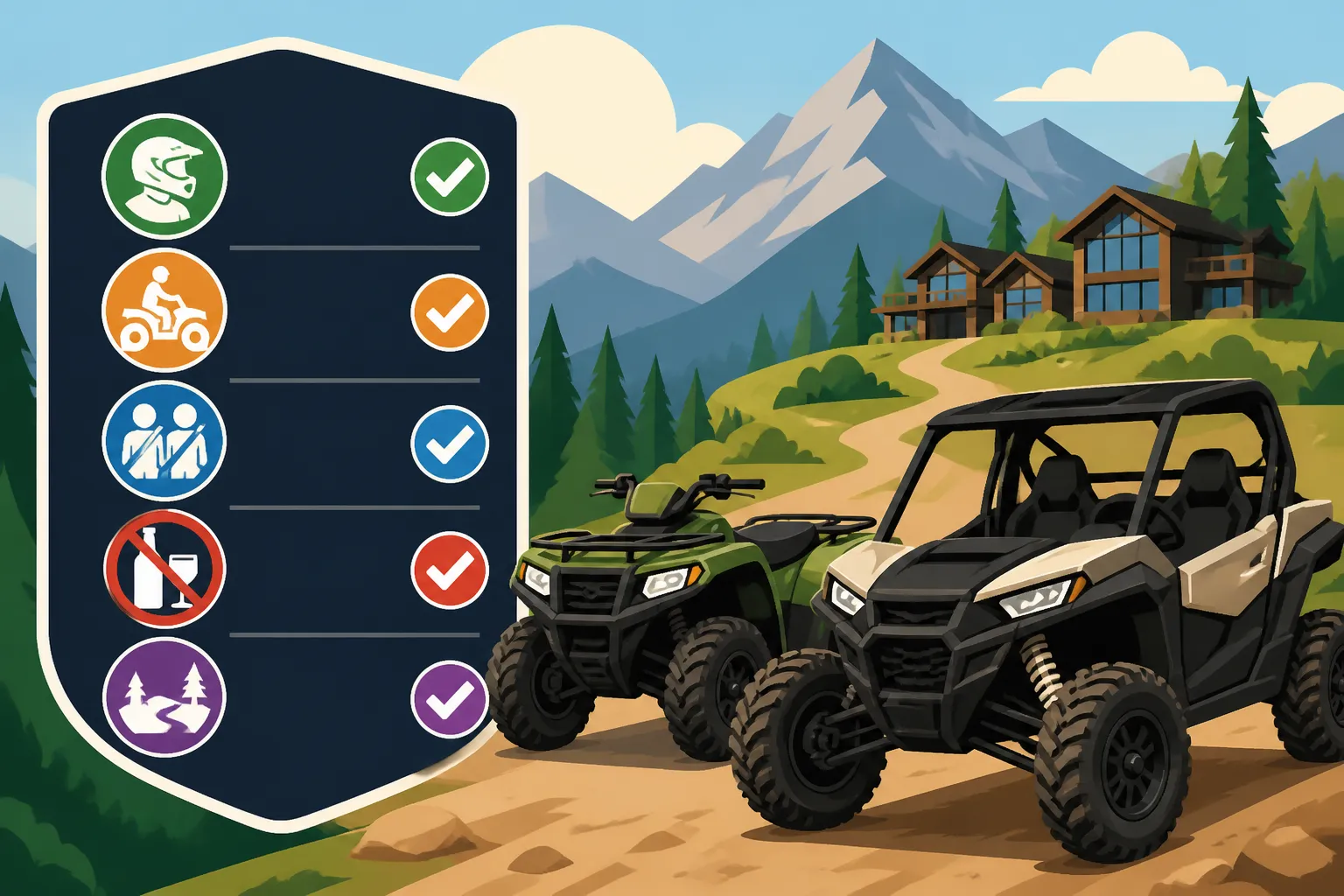
For young riders, check supervision and safety-course requirements that may apply to the route. Requirements can depend on the rider’s age and where the machine is operated; a resort’s permission is not a substitute for state or land-manager rules. Idaho’s OHV Safety Course for Young Riders and Idaho Supervision Rules and the 300-Foot Rule are useful starting points. Check helmet and passenger rules as well, especially when a child will ride or be carried as a passenger.
Before leaving, use this checklist:
- Identify whether the entire route is on resort property or includes public land or roads.
- Confirm which agency or local authority manages any public route.
- Check that the machine has the required Idaho sticker for the route and rider.
- Verify that any road section is open to the machine and that the machine meets applicable road-use requirements.
- Ask whether a guided or organized commercial ride requires a separate land-use permit.
- Confirm age, supervision, passenger and safety requirements for everyone in the group.
- Review the route and current closures before setting out.
If the answer to any of these is unclear, pause and ask the resort for the route details, then verify public-land or road rules with the responsible authority. Sorting this out before the ride is simpler than discovering at a trail junction that the resort’s permission covers only part of the route.
Disclaimer
This article is for general informational purposes only and does not constitute professional advice. Laws, prices and regulations vary by location and change over time. Consult a qualified professional for guidance on your specific situation.