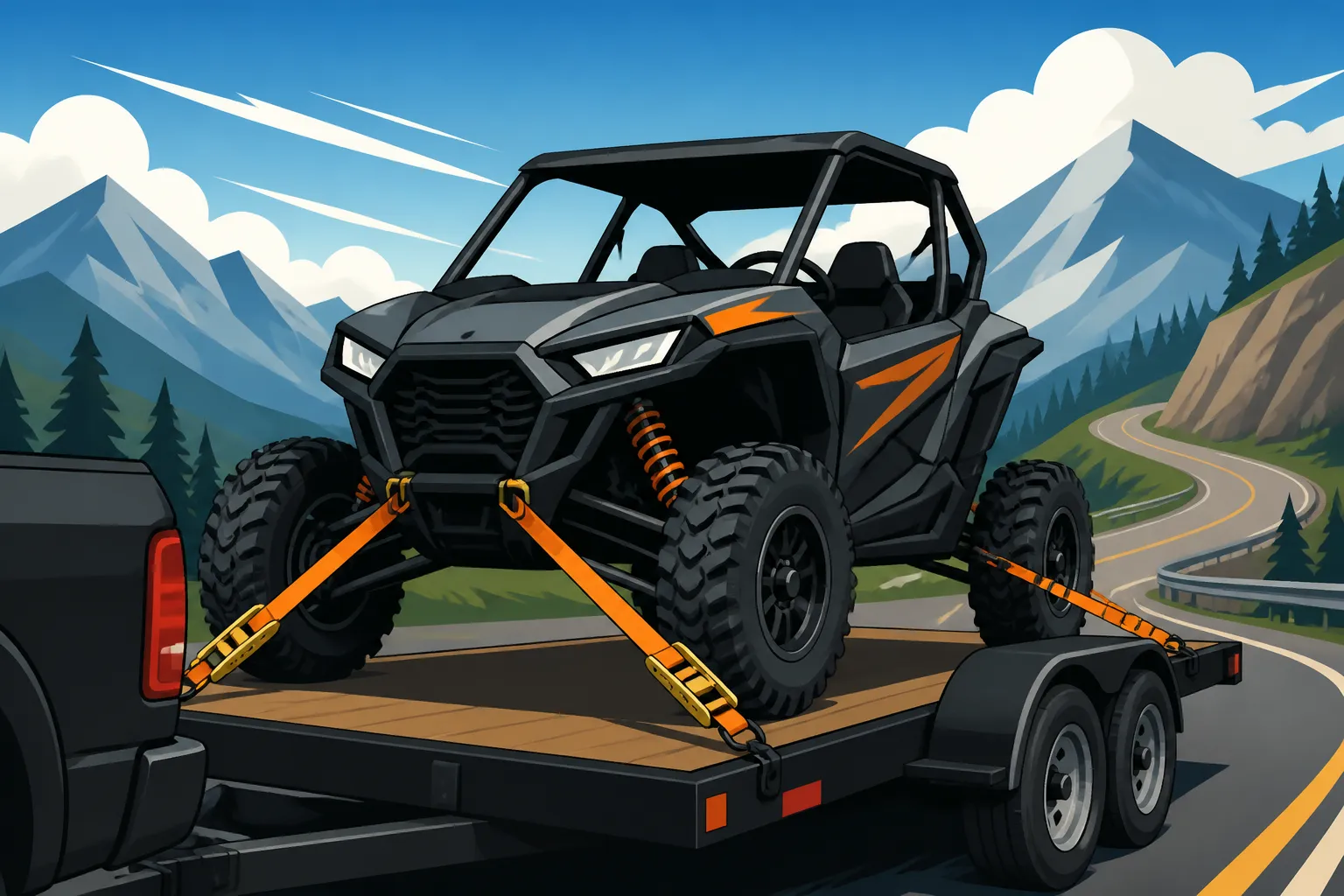
Strapping a Machine Down for a Mountain Highway
The open road through Idaho’s stunning mountain passes is an incredible experience, but it can quickly turn nerve-wracking if you glance in your rearview mirror and see your precious ATV or UTV shifting on the trailer. The worry of an unsecured machine becoming a hazard on a winding highway is a real one that keeps many of us up at night. This guide is all about giving you the peace of mind and the practical knowledge to strap down your off-road vehicle safely and securely, ensuring it arrives at the trailhead just as you loaded it, ready for adventure.
The Unique Challenges of Idaho Mountain Highways for OHV Transport
Idaho's mountains are beautiful, offering breathtaking vistas and incredible riding opportunities. However, these very features—the winding roads, steep grades, and sudden turns—are also a formidable test for anyone towing an off-road vehicle. This isn't just about flat, predictable highway travel; it's a dynamic environment that constantly challenges the stability of your load and the effectiveness of your tie-down strategy.
Understanding the Forces at Play
It's easy to think of strapping down a machine as simply preventing it from rolling off the trailer. But the reality is far more complex. As you navigate the ever-changing terrain of an Idaho mountain highway, your ATV or UTV is subject to a relentless barrage of physical forces. Gravity pulls it downwards on descents, trying to stretch your straps. Inertia wants to keep it moving forward when you brake hard, or push it backward when you accelerate up a steep climb. Centrifugal force pushes it outwards as you round a tight corner, trying to make it lean and shift. These forces aren't static; they constantly change in intensity and direction, and they are significantly magnified on rough pavement, sudden dips, or uneven surfaces, creating continuous opportunities for your machine to shift.
The Dangers of Inadequate Securing
Imagine this scenario: you're halfway up White Bird Hill, navigating a steep, winding grade, when you feel a sudden, unsettling lurch from your trailer. Looking back, you see your side-by-side has shifted significantly, its tire now dangerously close to the fender, or worse, a strap has snapped. Not only does this put your expensive machine at risk of damage, but an unsecured load is an extreme hazard to other drivers on the road. A loose ATV or UTV can swerve, collide with other vehicles, or even detach completely, creating a major accident. The mere thought of an OHV coming loose on a busy highway is enough to send shivers down any rider's spine, and for good reason. Idaho law enforcement takes the safe transport of loads very seriously, and a shifting or unsecured machine can quickly lead to citations or worse.
Essential Gear for Secure OHV Transport on Idaho Roads
Just as you wouldn't head out onto a challenging Idaho trail without the right safety gear and recovery equipment, you absolutely shouldn't attempt to transport your off-road vehicle without the proper tie-down equipment. This is not the place to economize or rely on old, frayed, or undersized straps. Investing in quality gear for transport is just as critical as your riding gear.
Choosing the Right Tie-Down Straps
The foundation of secure transport begins with your straps. Not all straps are created equal, and choosing the wrong type or rating can compromise your entire setup.
Ratchet Straps vs. Cam Buckle Straps
- Ratchet Straps: For securing ATVs and UTVs, heavy-duty ratchet straps are overwhelmingly the preferred choice. Their design allows you to apply significant tension, effectively "cinching" your machine firmly to the trailer. When selecting ratchet straps, always look at the working load limit (WLL), not just the breaking strength. The WLL is the maximum weight a strap is designed to safely handle in regular use. For most ATVs, you'll want straps with a WLL of at least 1,000 lbs each, and for heavier UTVs, consider 1,500 lbs or more per strap. Remember, you'll be using multiple straps, distributing the load, but each strap needs to be individually strong enough to handle a significant portion of the force exerted during transport.
- Cam Buckle Straps: While incredibly easy and quick to use, cam buckle straps don't offer the same cinching power as their ratchet counterparts. They rely on friction to hold tension, which can be less reliable under the constant vibrations and shifts of highway travel, especially on mountain roads. While they might be suitable for securing lighter items like coolers, spare tires, or fuel cans, they are generally insufficient for the primary tie-down of a heavy OHV that's constantly being subjected to dynamic forces.
Importance of Hook Types and Material
The type of hooks on your straps and the material of the webbing itself are also crucial considerations. Common S-hooks are simple but can sometimes bend under extreme load or vibrate loose from anchor points. J-hooks or flat hooks, designed to be more secure, often provide a better and more positive connection to D-rings, stake pockets, or other strong anchor points on your trailer. Always ensure the hooks are stout and not bent or rusted. For the webbing, look for polyester material. Polyester is known for its excellent strength, resistance to stretching (which is critical for maintaining tension), and superior durability against UV rays, moisture, and general wear compared to nylon. Before every trip, and periodically throughout the year, make it a habit to inspect all your straps for any signs of cuts, fraying, damaged stitching, or bent hardware. A compromised strap is a dangerous strap.
Beyond Straps: Chocks, Wheel Nets, and More
While straps are the workhorses of secure transport, other accessories can significantly enhance the safety and stability of your load, especially when traversing challenging Idaho terrain. Think of them as complementary tools in your secure hauling arsenal.
Wheel Chocks and Blocks
For larger UTVs or machines placed on a flat-deck or enclosed trailer, wheel chocks are an excellent way to prevent any forward or backward movement of the tires against the trailer deck. These can be commercially made plastic or rubber chocks, or even sturdy wooden blocks securely wedged against the tires and ideally fastened to the trailer deck. They provide an extra layer of stability, particularly useful when your trailer is parked on an incline or if you hit a sudden bump, preventing even minor shifts that could otherwise loosen your primary tie-down straps over time.
Wheel Nets and Tire Bonnets
These systems are gaining significant popularity, especially for UTVs and larger, heavier ATVs. Rather than hooking directly to the frame, wheel nets or tire bonnets wrap around or over the tires themselves. This method secures the machine by its heaviest and most stable part—the wheels—and allows the vehicle's own suspension to continue working slightly. This reduces the strain on the machine's frame and suspension components, as well as on the straps, by absorbing some of the road shocks. They are particularly effective for long hauls over varied terrain and are often seen as one of the most secure ways to transport an OHV.
Trailer Tie-Down Points and Condition
Before you even consider placing your machine on the trailer, take a moment to inspect the trailer itself. Are your D-rings, E-track sections, or other anchor points sturdy, free from rust, and securely fastened to the trailer frame? Are they rated for the weight of your machine and the forces it will exert? A good general rule is to utilize at least four dedicated tie-down points, one at each corner of the machine, positioned to pull the machine both downwards and outwards (forward/backward) to provide multi-directional resistance. Ensure the trailer decking is sound and that any ramps are securely stowed. Remember, the strongest straps are only as good as the weakest anchor point on your trailer. If you're considering a new trailer or upgrading an old one, think about the [Idaho Trailer Plate Cost for an ATV Trailer] and the long-term investment in safety.
Step-by-Step: Strapping Down Your ATV or UTV Like a Pro for Idaho Highways
Now that you've got the right gear, let's walk through the actual process of securing your off-highway vehicle. This methodical approach will ensure your machine stays put, whether you're making a quick run down the valley or embarking on a long journey to the Magruder Corridor or the Panhandle trails.
Positioning the Machine on the Trailer
Proper placement of your ATV or UTV on the trailer is the first and perhaps most critical step for stable towing. Get this wrong, and even the best tie-downs will struggle to compensate.
Optimal Weight Distribution
The golden rule of towing is to ensure proper tongue weight. For most utility trailers, aim to position your machine so that approximately 60% of its weight is situated in front of the trailer's axle(s) and 40% behind. This creates sufficient downward force on your tow vehicle's hitch, known as tongue weight, which is absolutely crucial for stable towing and preventing dangerous trailer sway, especially at highway speeds, when cornering, or when dealing with crosswinds. Too much weight behind the axle can lead to the "tail wagging the dog" effect, causing erratic and dangerous handling. If you're hauling multiple machines, strategically place the heaviest one in the optimal position first, then arrange the others to maintain this critical balance. For tandem-axle trailers, try to center the main load over the forward axle for the best stability.
Parking Brake and Gear
Once you've carefully driven or winched your OHV into its optimal position on the trailer, take a moment to secure its initial stance. If your UTV has a parking brake, engage it firmly. For ATVs, place the machine in a low gear (usually first or reverse). This provides immediate mechanical resistance to any accidental movement while you're busy attaching your straps. Additionally, turning the steering wheel straight or slightly into the direction you're about to pull from the front can help preload the tires and reduce any tendency for side-to-side shift before the straps are even tightened.
The Four-Point Tie-Down Method
This is the widely accepted gold standard for securely transporting ATVs and UTVs. It involves using at least four heavy-duty ratchet straps to create opposing forces that lock the machine in place.
Securing the Front
Begin by attaching two straps to robust, structural points on the front of your ATV or UTV. Ideal anchor points include the A-arms (if they are strong enough), a factory-installed bumper that's bolted to the frame, or direct frame components. Avoid attaching to plastic bodywork, control arms, or anything that isn't designed to withstand significant pulling force. Angle these two front straps forward and outward to dedicated anchor points on your trailer. This creates a triangulated force that simultaneously prevents forward movement and resists side-to-side sway. Cinch them down firmly using your ratchet straps, taking up all the slack. While you want them tight, avoid over-compressing your machine's suspension to its absolute limit; allowing a small amount of suspension travel helps the machine absorb road bumps and vibrations, reducing stress on both the straps and the OHV's frame. Some experienced riders aim for about 50% suspension compression.
Securing the Rear
Repeat the same process at the rear of your machine. Select equally robust frame points for attachment. Angle these two rear straps backward and outward to anchor points on the trailer. Just like the front straps, these will prevent any backward movement and provide additional resistance against lateral shifts. Double-check that all four straps are taut, completely free of any twists or kinks in the webbing, and not rubbing against any sharp edges on your machine or trailer that could cause fraying. The goal here is to immobilize the machine relative to the trailer, creating a cohesive unit that moves together, rather than allowing independent movement that could cause straps to loosen.
Double-Checking and Redundancy
You've strapped it down, great! But your job isn't done until you've performed a thorough final check. This crucial step is often overlooked in the rush to hit the road.
The "Shake Test" and Strap Inspection
Before you even consider pulling out of the driveway or staging area, perform the "shake test." Grab a sturdy part of your ATV or UTV and try to rock it. Does it move independently of the trailer? Is there any noticeable wobble or play? If so, you need to tighten your straps further. While you're doing this, visually inspect every strap and hook. Ensure each hook is fully seated in its anchor point. Check the webbing again for any twists, which can weaken a strap's effectiveness, and ensure it's not rubbing against sharp edges. Any slack will inevitably translate into uncontrolled movement during your drive, especially on [Idaho Roads Closed by Local Ordinance] or other bumpy routes. This is also the time to make sure any ancillary items in the bed of your UTV, like toolboxes, coolers, or extra fuel cans, are also properly secured or removed to prevent them from becoming projectiles.
Adding Extra Security (Optional but Recommended)
For ultimate peace of mind, particularly on very long hauls, extremely rough roads, or when traversing high-traffic mountain passes like the Lolo Motorway or those leading into the Sawtooths, consider adding extra security. This could mean employing two additional straps for a six-point tie-down, or using wheel nets in conjunction with your traditional frame straps. This redundancy ensures that even if one strap were to fail, others are still holding the machine securely. If you're transporting a particularly heavy side-by-side, consider the potential liability you might face if something were to go wrong. Having a clear record of your machine's ownership, perhaps with an [ATV Bill of Sale Wording Buyers Should Insist On] generated via a service like LawDepot, can be incredibly useful. Or, if you're transporting a friend's machine, a simple written agreement to clarify responsibilities, which LawDepot can help template, offers significant peace of mind for all parties involved.
Common Mistakes to Avoid and Advanced Tips for Idaho Roads
Even seasoned haulers can sometimes overlook details, and those small oversights can lead to big problems when you're navigating Idaho's challenging roads with a valuable OHV in tow. Let's cover the most frequent errors and offer some expert advice tailored for our unique Idaho conditions.
Don't Fall for These Trapping Errors
Avoiding these common mistakes is just as important as following the correct tie-down procedure. A moment of carelessness can have lasting consequences.
Over-Tightening Straps and Incorrect Anchor Points
While the goal is to secure your machine firmly, there's a point of diminishing returns, and even danger, with over-tightening. Applying excessive force with ratchet straps can deform plastic components, bend light-duty bumpers, or even cause damage to suspension parts. The aim is firm tension that eliminates movement, not brute force that squashes the machine. Equally important is the choice of anchor points. Never attach straps to plastic fenders, control arms (unless specifically designed for it), axles (which can damage axle boots), or exhaust pipes. These are weak points that can bend, break, or cause the strap to slip, leading to a catastrophic failure. Always identify and use the robust, load-bearing parts of your machine's frame. If you're unsure where to find these, familiarizing yourself with [Where the VIN Sits on a Side-by-Side Frame] can give you a better understanding of the core structural components.
Forgetting to Check Straps During the Trip
This is arguably the most common and dangerous mistake. Road vibrations, changes in elevation and temperature, and the subtle movements of your machine's suspension can all cause straps to loosen over time. Never assume your straps will remain as tight as they were when you left. Make it a mandatory practice to stop after the first 10-15 miles of your trip, and then every 50-100 miles (or every time you stop for fuel or a break, whichever comes first), to physically check and re-tighten all your straps. A quick tug on each strap and a visual inspection takes only moments but can prevent a disaster. This habit is even more critical when traversing the long, winding, and sometimes rough roads that crisscross Idaho's mountains.
Neglecting the Small Details
Security isn't just about the machine itself. Are your trailer ramps securely stowed or latched so they can't bounce loose? Is your spare tire for the trailer properly inflated and easily accessible? Are any loose items in the bed or cargo area of your UTV (tools, coolers, spare parts) secured or removed from the machine entirely? Even small, seemingly innocuous items can become dangerous projectiles in the event of a sudden stop or a sharp turn. Don't forget to double-check your hitch connection – ensure the coupler is fully engaged and locked, and that your safety chains are properly crossed and attached to your tow vehicle. These often-overlooked details complete a truly secure transport setup.
Advanced Tips for Idaho's Unique Conditions
Idaho's diverse geography presents unique challenges for anyone towing an OHV. From the steep ascents of the Rockies to the undulating plains, adapting your driving and preparation is key.
Adapting to Steep Grades and Curves
When you're climbing a pass like Bogus Basin Road out of Boise, or descending the twists and turns of Highway 12 along the Lochsa River, the forces acting on your tow rig are immense. The number one rule is to slow down. Do not push your truck's limits, especially with a heavy load. On descents, use deliberate and controlled braking, engaging engine braking where possible to reduce wear and heat buildup on your service brakes. Maintain extra following distance, as your braking distance with a trailer is significantly increased. The stability of your entire load is directly tied to how smoothly and cautiously you drive. This attention to detail can extend to all aspects of your journey, even how you manage paperwork related to your tow vehicle, like ensuring you're aware of the [Idaho Trailer Plate Cost for an ATV Trailer] if you're upgrading or registering.
Dealing with Weather and Road Conditions
Idaho weather can be notoriously unpredictable, especially in mountain environments. Rain, snow, ice, or even just high winds can dramatically impact towing stability and safety. Reduce your speed even further in adverse conditions. Wet roads decrease braking effectiveness and increase the likelihood of trailer sway. If you're transporting your machine in winter, be mindful of how snow or mud buildup on your OHV can affect its weight and balance, and ensure your straps are free from ice. Always check local weather forecasts and be aware of any [Idaho Trail Closures in Fire Season] during the summer, as these can lead to unexpected detours onto unfamiliar, potentially less maintained roads, adding unforeseen stress to your hauling setup.
Transporting Multiple Machines
If you're hauling two quads, or a side-by-side and a dirt bike, pay even closer attention to weight distribution. Always place the heaviest machine closest to and over the trailer's axles for optimal balance. Lighter machines can be positioned elsewhere as long as the overall tongue weight remains within the safe operating range. Each machine must be individually secured with its own set of four (or more) straps. Never rely on one strap to hold multiple machines or assume that adjacent machines will support each other. For group trips, coordinating vehicles might involve some informal agreements; a basic template from LawDepot could even come in handy for clarifying who is transporting which machine and any associated responsibilities, especially if machines are borrowed or shared.
Legality and Documentation
Beyond physically securing your load, it's crucial to carry all necessary documentation. This includes your valid driver's license, proof of insurance for your tow vehicle, and a copy of your OHV's registration or title. An Idaho deputy might ask for [What an Idaho Deputy Asks a Rider For] if you're pulled over, even if you're simply transporting the machine. Having your [Idaho OHV Title Application at the County Assessor] or a clear [Proof of Ownership for an Idaho OHV Title] readily available is not just good practice, it's often legally required. Proper documentation ensures a smooth interaction with law enforcement and helps establish ownership, which can be critical in the rare but unfortunate event of an accident or theft.
By taking the time and effort to properly secure your ATV or UTV for transport, you're not just protecting your significant investment; you're also ensuring the safety of yourself, your passengers, and everyone else on Idaho's beautiful, yet sometimes challenging, mountain highways. Never rush the process, and always double-check your work before you roll out. Safe travels, and enjoy the trails!
Disclaimer
This article is for general informational purposes only and does not constitute professional advice. Laws, prices and regulations vary by location and change over time. Consult a qualified professional for guidance on your specific situation.