Do You Carry the Title on an Idaho Trail?
There's a common misconception among Idaho ATV and UTV riders that you need to carry your vehicle's physical title with you every time you hit the trails or venture onto designated county roads. Many riders stash their valuable title in a glove box, under a seat, or even in a backpack, constantly worrying about it getting lost, stolen, or damaged by the elements. This guide will put those worries to rest by explaining exactly what paperwork Idaho law requires you to carry while riding your off-highway vehicle (OHV), and why your original title is much safer at home.
The Straight Answer: No, You Don't Need Your Physical Title on the Trail
Let's cut right to the chase: no, you do not need to carry your ATV or UTV's actual paper title with you while riding on Idaho trails or roads. This is a huge relief for many riders who’ve been needlessly stressing about keeping such an important document safe while navigating bumpy terrain, crossing streams, or simply enjoying a sunny day out. The title is a document that proves legal ownership, similar to the deed to your house or the title to your car. It's crucial for transactions like buying or selling, but it’s not something you’re expected to produce during a routine stop on the trail.
Understanding Idaho's Core Requirements
Idaho law is quite specific about what riders do need to have on hand. The emphasis is typically on proving your machine is legally registered for public land use and that you, as the operator, are authorized to be there. This typically revolves around your OHV sticker and, for road use, your restricted vehicle plate. The physical title is the foundation of ownership, but not the day-to-day proof of legal operation. Think of it like this: you don't carry the deed to your house in your wallet, but you might carry your driver's license to prove you're allowed to drive your car.
For most casual trail rides, as long as you have your current OHV sticker properly displayed and, if you're riding a machine that requires it, a restricted use plate, you're generally good to go. The sticker signals to law enforcement and land managers that your machine is legally registered and that you've contributed to the [Idaho Trail Fund and Sticker Revenue]. This funding directly supports the maintenance and development of the trails we all love to ride. Without that sticker, you risk significant fines and unwanted hassle.
The Difference Between a Title and Registration
It's easy to confuse a vehicle title with its registration, especially with OHVs, but they serve distinct purposes. Your OHV title, which in Idaho is required for most machines over 50cc, is a legal document that formally establishes who owns the vehicle. It includes key information like the Vehicle Identification Number (VIN), make, model, and the owner's name and address. When you buy or sell a machine, this is the document that gets signed over to transfer ownership. If you're going through the process of [Titling an ATV in Idaho], you'll definitely be dealing with this document.
Registration, on the other hand, is the process of officially recording your vehicle with the state for the purpose of identifying it and collecting fees for public land use. In Idaho, this is primarily done through the purchase and display of an OHV sticker. When you renew your OHV sticker online or [Buying an Idaho Sticker at a County DMV], you're renewing your registration. This sticker indicates that your machine is permitted to operate on public lands, including designated trails and county roads where OHV use is allowed. It typically includes an expiration date, often December 31st, regardless of when you purchased it, as explained in [Idaho OHV Registration Runs January to December]. The registration card that often comes with your sticker is a small, easy-to-carry document that proves your current registration.
Why Your Original Title Is Better Off Safely Stored at Home
While it's natural to want all your ducks in a row, carrying your original OHV title out on the trail is actually a practice best avoided. There are several very compelling reasons why this valuable document should remain in a secure location, such as a locked safe or a secure file cabinet at your home.
Risks of Loss, Theft, and Damage
Imagine a perfect riding day in the Danskin Mountains. You hit a whoop a little too hard, and your backpack, which you thought was securely latched, bounces open. Your title, along with your lunch and water bottle, goes flying. You might not even notice it's gone until you're miles down the trail. Now you're faced with the headache and expense of [Replacing a Lost Idaho OHV Title]. This isn't just a hypothetical scenario; it happens more often than you'd think. Trails are dusty, wet, muddy, and rugged environments. Paper documents are simply not designed for such conditions. A single splash from a creek crossing or a quick downpour can render your title illegible or even destroy it. Even tucked away in a waterproof bag, there's always a risk of compromise.
Beyond the elements, there's also the very real concern of theft. While most riders are honest, leaving valuable documents in an unattended machine at a trailhead, or even a visible document within a vehicle parked at a remote campsite, could invite trouble. An OHV title in the wrong hands could potentially complicate matters if your machine were to be stolen, making it easier for thieves to attempt to sell it, even if they don't have the machine itself. Better safe than sorry when it comes to such an important document.
Protecting Your Personal Information
Your OHV title typically contains sensitive personal information, including your full name and address. In an age where identity theft is a constant concern, leaving such a document exposed or vulnerable to loss is an unnecessary risk. If your title falls into the wrong hands, it could be used for illicit purposes, potentially compromising your personal security.
Consider a situation where you've parked your side-by-side at a trailhead in the Boise National Forest to take a quick hike. If someone breaks into your machine and finds your title, they now have your name and home address. This isn't just a concern for the machine itself, but for your broader personal safety and privacy. Keeping your title in a secure, private location at home minimizes this risk significantly. You want to enjoy your ride, not worry about your identity.
What Idaho Law Actually Requires You to Carry While Riding
Now that we've established why your original title is best left at home, let's focus on what you are legally obligated to have with you when you're out enjoying Idaho's incredible OHV trails and designated county roads. These are the items that Idaho Fish and Game officers, Forest Service rangers, or county deputies will typically ask to see.
Essential Documents for Trail and Road Use
When you're out riding, whether it's on a designated OHV trail or a county road where OHVs are permitted, you should always have a few key documents or proofs readily accessible.
Here’s a breakdown of what you need:
| Document/Proof | Purpose | Where to Carry It |
|---|---|---|
| OHV Sticker | Proof of current registration for public land use. | Permanently affixed to the machine, visible. |
| Restricted Vehicle Plate | Required for road-legal OHVs, displays sticker. | Permanently affixed to the rear of the machine, visible. |
| Driver's License | Required when operating on any public road (county, city, highway crossing). | On your person (wallet, fanny pack). |
| Proof of Insurance | Required when operating on any public road (county, city, highway crossing). | On your person, or a copy in a waterproof bag on the machine. |
| OHV Safety Certificate | Required for riders under 16, or if mandated for certain roads. | On your person, or a copy in a waterproof bag on the machine. |
| Registration Card/Copy | A small card often issued with your OHV sticker, proving valid registration. | On your person, or a copy in a waterproof bag on the machine. |
For machines that meet the requirements for road use, an [Idaho's Restricted Vehicle Plate Explained] is essential. This plate, often starting with an "R" (as in [Idaho Plates That Begin With R]), designates your OHV as street-legal for certain county and city roads, and it's where your annual OHV sticker is typically displayed. If you're going to be riding on any county roads, even just to get from your campsite to a trailhead, then you absolutely need to comply with [What Idaho Requires Before You Ride a County Road], which includes having a valid driver's license and proof of liability insurance. [Insuring an ATV in Idaho] is a critical step many riders overlook for their road-legal machines.
Younger riders also have specific requirements. If you're under 16, you generally need to have an OHV safety certificate on hand, especially when riding on designated trails or roads. This ensures you've completed the necessary training to safely operate your machine. Details on [Idaho OHV Safety Course Requirements] are vital for parents and young riders to understand.
Proof of Ownership in Practice
While the title itself isn't required, you should still be prepared to demonstrate that the machine you're riding actually belongs to you, or that you have permission to operate it. This becomes particularly important in situations involving a stolen machine, an accident, or if law enforcement has reason to question your possession of the OHV.
Here are some practical ways to establish proof of ownership without carrying your original title:
- Registration Card: As mentioned, the registration card that comes with your OHV sticker is a small, wallet-sized document that identifies your machine and verifies its current registration. This is one of the most practical items to carry. It lists the owner's name, which serves as a direct link to you.
- Photo of Your Title: A clear photograph of your title stored on your smartphone can be an excellent backup. While not a legal document itself, it shows all the critical information—VIN, owner name, etc.—that a deputy might want to cross-reference if they have questions. Just ensure your phone is charged!
- Copy of Your Title (Paper or Digital): If you're truly concerned, you can make a photocopy of your title and keep it in a waterproof bag on your machine. Or, save a digital copy to cloud storage so you can access it from your phone if needed. Just remember, the original is what matters for official transfers.
- Bill of Sale: If you bought your machine from a private seller, having a robust bill of sale on hand, or at least a copy, can be incredibly helpful. It demonstrates the transaction history and usually includes the VIN, buyer, and seller information. Websites like LawDepot offer templates to create comprehensive legal documents, ensuring all necessary details about your purchase are officially recorded. For guidance, you can also check out [ATV Bill of Sale Wording Buyers Should Insist On]. This is especially useful if you've recently purchased a machine and are waiting for the title to be formally transferred to your name.
- Lien Release Document: If you recently paid off your OHV, carrying a copy of the lien release document can prove you now have full ownership, especially if the title still shows a previous lender. This is often necessary for [Lien Release After the Last Payment].
- Knowledge of Your Machine's VIN: Know where your VIN is located on your machine – typically on the frame, as discussed in [Where the VIN Sits on a Side-by-Side Frame]. Being able to point it out and recite it can quickly establish your familiarity and legitimate possession.
The goal here isn't to create a mountain of paperwork to carry, but to have easily accessible proofs that you are the rightful owner or operator. A deputy generally wants to confirm the machine isn't stolen and that it's legally registered for use.
What to Do If a Deputy Stops You on the Trail
Even when you're fully compliant, a stop by law enforcement can feel a little unnerving. Knowing what to expect and how to respond can make the encounter smooth and stress-free, allowing you to get back to enjoying your ride quickly.
Common Questions from Law Enforcement
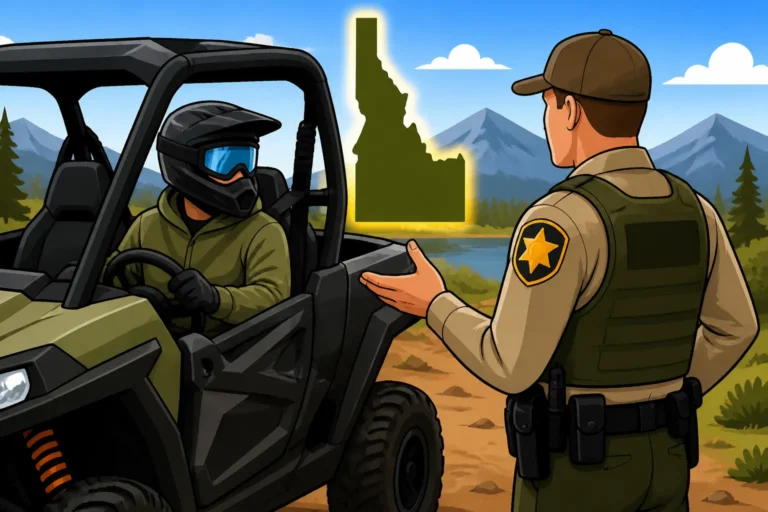
If a sheriff's deputy, forest ranger, or Fish and Game officer stops you on an Idaho trail or designated road, their primary goal is usually to ensure public safety, trail integrity, and compliance with state and federal regulations. They are not out to ruin your day. What an officer typically asks for on the trail is straightforward, as outlined in [What an Idaho Deputy Asks a Rider For].
Here's what you can generally expect them to inquire about:
- Your OHV Sticker: They will check for a current and properly displayed OHV sticker on your machine. This is non-negotiable for public land use. If you don't have one, you could face [Penalties for an Unstickered OHV in Idaho].
- Your Driver's License: If you are operating on a county road or crossing a highway, they will ask for your driver's license to verify you are a legal driver.
- Proof of Insurance: Again, for any road riding, liability insurance is required, so be ready to show proof.
- OHV Safety Certificate: If you appear to be under the age of 16, they will likely ask for your safety certificate.
- Your Name and Identity: They will want to confirm your identity, matching it to any documents you provide.
- Your Machine's VIN: In some cases, especially if they have a reason to suspect the machine might be stolen or improperly registered, they may ask for the VIN and verify it against their records or your registration card.
During the stop, always be polite, cooperative, and provide the requested documents promptly. Keep your hands visible and avoid making sudden movements. Remember, they are doing their job to keep our trails safe for everyone.
How to Demonstrate Ownership Without the Title
If for some reason an officer expresses concern about ownership (which is rare if your sticker and registration card are in order), you can still confidently demonstrate that the machine is yours even without the physical title.
Here's how:
- Provide Your Registration Card: This is your first line of defense. The registration card typically has your name on it as the registered owner and the machine's VIN. This is usually sufficient proof for an officer to confirm legitimate possession.
- Show a Photo or Copy of Your Title: If you have a photo on your phone or a photocopy in a waterproof bag, you can offer to show it. Explain that you keep the original safely at home to prevent loss or damage. This often satisfies any lingering questions, as it provides all the pertinent details without risking the original document.
- Explain Your Bill of Sale: If you recently purchased the machine and the title transfer is pending, a copy of the bill of sale can be very helpful. It shows a legitimate transaction and provides a paper trail for the vehicle. If you used a service like LawDepot to draft your bill of sale, it will be comprehensive and professional, lending more credibility.
- Point Out the VIN: Being able to quickly and accurately locate the VIN on your machine demonstrates your familiarity with the vehicle, which can reinforce your claim of ownership. An officer can then run the VIN through their dispatch to check for stolen vehicle reports or registration issues.
- Offer to Provide Further Information: If necessary, offer to provide additional contact information or details that could verify your ownership, such as the name of the dealer you purchased it from, or details about when and where you titled it.
The key is to remain calm, be forthcoming with the information you do have, and show that you understand the importance of proper documentation. Most officers will appreciate your preparedness and common sense in leaving the original title at home. Enjoy your rides, knowing your important documents are safe and sound!
Disclaimer
This article is for general informational purposes only and does not constitute professional advice. Laws, prices and regulations vary by location and change over time. Consult a qualified professional for guidance on your specific situation.