Idaho Noise Rules Near Mountain Towns
Idaho's mountain towns offer some of the most breathtaking scenery and incredible trail access for ATV and UTV enthusiasts. Yet, the very tranquility that draws people to these beautiful places can often clash with the exhilarating, but sometimes noisy, nature of off-highway vehicles. It's a real frustration for riders who want to enjoy the backcountry but also respect the peace of the local communities. This guide is here to demystify Idaho's OHV noise rules, helping you understand how to ride responsibly and keep those mountain town welcomes warm.
Understanding the "Why" Behind Noise Regulations
Before diving into the specifics, it's helpful to understand the core reasons behind noise regulations for off-highway vehicles, especially in and around Idaho's cherished mountain communities. It’s not about stifling fun, but about creating a sustainable coexistence between recreation and residential life.
Protecting Community Serenity
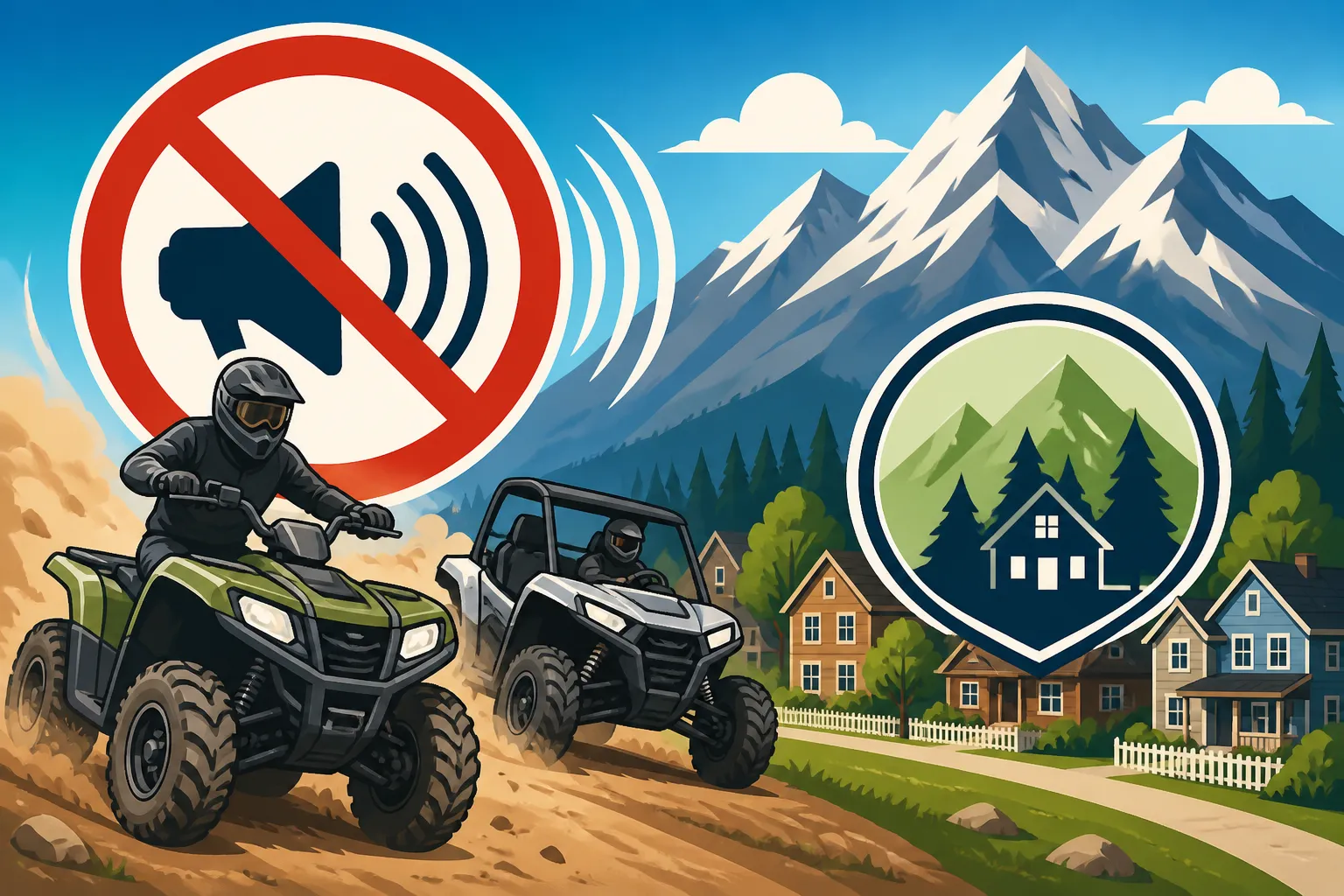
Imagine a peaceful morning in a quaint Idaho mountain town, perhaps Stanley or McCall, where residents and visitors are enjoying a quiet cup of coffee on their porch, listening to the birds, or simply relishing the stillness. The sudden roar of an unmuffled UTV can shatter that tranquility, creating genuine frustration and impacting the quality of life for those who live and visit there. These towns often thrive on tourism, and a significant part of their appeal is the serene, natural environment. Excessive OHV noise can deter visitors seeking peace, harm local businesses, and strain relationships between the riding community and residents. The goal of noise regulations is to preserve that essential quiet character, ensuring that everyone can enjoy what Idaho has to offer, albeit in different ways.
Environmental Considerations
Beyond human comfort, noise pollution has a documented impact on wildlife. Our beautiful Idaho backcountry is home to a diverse array of animals, many of whom are sensitive to sudden or sustained loud noises. Excessive sound can disrupt their natural behaviors, from foraging and breeding to communication and predator avoidance. For instance, wildlife near popular trailheads or town access points might become stressed, alter migration patterns, or avoid critical habitats if subjected to constant loud disturbances. While a single pass might not seem significant, the cumulative effect of many machines over time can subtly but profoundly alter ecosystems. Regulations aim to minimize these disturbances, allowing both humans and wildlife to coexist with a bit more harmony.
Balancing Access and Impact
Idaho is incredibly fortunate to have vast stretches of public land accessible for OHV recreation. The state genuinely wants to provide opportunities for riders to explore these areas. However, this access comes with the responsibility to minimize negative impacts. Noise regulations are a key tool in this balancing act. They represent an effort to allow riders to continue enjoying trails and connecting towns while addressing the legitimate concerns of residents, other recreationists (like hikers or equestrians), and environmental stewards. It's about finding that sweet spot where a vibrant OHV community can thrive without encroaching too heavily on the peace and quiet that define many parts of our state. Without these rules, the risk of losing access to certain areas due to public outcry or environmental damage becomes much higher.
Idaho's Baseline OHV Noise Laws
When you hit the trails in Idaho, whether you're ripping through the Danskin Mountains or cruising near the Lolo Motorway, you're expected to comply with certain statewide rules. These are the fundamental expectations for how loud your machine can be, no matter where you are in the state.
State-Level Decibel Limits
Idaho's statewide regulations for OHV noise levels are fairly straightforward, though measurement can be a bit technical. The general rule of thumb is that any OHV operating on public lands or public access roads must not exceed 96 decibels (dB) when measured using a specific sound test procedure. This test typically involves measuring the sound at 20 inches from the exhaust outlet, at a 45-degree angle, with the engine running at a specified RPM, often half of the maximum rated RPM.
Now, what does 96 decibels actually sound like? It's roughly equivalent to a power lawnmower or a heavy truck passing by. While this might seem loud, it's a standard that allows for the operation of most factory-equipped ATVs and UTVs. The problem arises when riders make modifications to their exhaust systems that push them over this limit. An open exhaust, a removed muffler baffle, or a poorly maintained system can easily tip the scales beyond what's legally allowed, making your machine sound significantly more aggressive than stock.
Mufflers and Spark Arresters
Crucial to meeting those decibel limits, and for general safety, are your machine's muffler and spark arrester. Idaho law explicitly requires every OHV operating on public land or routes open to OHVs to be equipped with a muffler that is in good working order and effectively limits engine noise. This isn't just a suggestion; it's a non-negotiable requirement. A muffler's job is to reduce the sound pressure created by the engine's exhaust gases, taming that roar into a more acceptable purr. If your muffler is damaged, has holes, or has been intentionally modified to be louder, you're likely in violation.
Equally important, and often overlooked, is the spark arrester. This device, usually integrated into the muffler or added as an attachment, prevents hot carbon particles from exiting the exhaust system and potentially igniting dry vegetation – a critical concern in Idaho's fire-prone landscapes. A spark arrester must be U.S. Forest Service approved and in working condition. Running without one isn't just illegal; it's incredibly dangerous and irresponsible. Many riders purchase aftermarket exhaust systems without realizing they need to ensure both sound compliance and spark arrestor functionality. When looking at upgrades, ensure they meet both requirements. [Mufflers and Spark Arresters]
Penalties for Violations
Ignoring Idaho's OHV noise laws can lead to more than just a stern talking-to. The penalties can be quite significant, hitting you in the wallet and potentially impacting your ability to ride. If a law enforcement officer, such as a county sheriff or a Forest Service ranger, determines your machine exceeds the noise limits or lacks a proper muffler or spark arrester, you could face a citation.
Fines for these violations can vary, but they are designed to be a deterrent. In addition to the monetary penalty, an officer might order you to cease operation of the vehicle until the issue is resolved. In some cases, repeated offenses or extremely egregious violations could even lead to the impoundment of your machine, leaving you stranded on the trail and facing additional costs to retrieve it. This isn't just about a one-time ticket; it’s about upholding the integrity of OHV recreation for everyone. No one wants to see areas closed off because a few riders continuously flout the rules. It's always cheaper and less stressful to ensure your machine is compliant before you hit the trail. [Idaho Fines for Illegal Road Riding]
Local Ordinances: The Wild Card in Mountain Towns
While Idaho has state-level noise regulations, the real complexity often arises when you approach or enter specific mountain towns. These communities, often nestled in quiet valleys or alongside popular recreation areas, have the authority to implement their own, often stricter, rules.
How Local Rules Supersede State Guidelines
It's a common misconception that if you're legal on a state trail, you're legal everywhere. This is simply not the case, especially when it comes to noise. Idaho state law provides a baseline, but counties and incorporated cities have the power to enact more restrictive ordinances concerning OHV operation, including noise levels, specific operating hours, and even which roads or streets are open to OHVs. This local control allows communities to tailor regulations to their unique character, protecting residential areas, commercial districts, and other sensitive zones.
For instance, a state highway might have a general speed limit, but a city within that highway's path could designate specific zones, like school areas, with lower limits. The same principle applies to OHV noise. A town might decide that while 96 dB is acceptable on a remote forest road, it's far too loud for its main street or residential neighborhoods. This means that a muffler perfectly legal under state law could still be considered a nuisance, or even illegal, under a local ordinance. The onus is always on the rider to know and abide by the most restrictive rule that applies to their specific location. [Idaho City and County Ordinances That Close Roads]
Examples of Specific Town Restrictions
Let's consider some hypothetical, yet realistic, scenarios you might encounter in Idaho's mountain towns. Take McCall, for example. With its beautiful lake and vibrant downtown, the city council might implement a noise ordinance specifically for OHVs operating within city limits, perhaps reducing the allowable decibel level to 90 dB or even lower. They might also enforce "quiet hours," prohibiting OHV operation on city streets between 10 PM and 7 AM to protect residents' sleep. You might find designated OHV routes that bypass residential areas, funneling riders directly from trailheads to services without disturbing neighborhoods.
In Stanley, a gateway to the Sawtooths, the emphasis might be on maintaining the town's quiet, rustic charm. They could have very strict rules about passing through the core of town, perhaps requiring extremely slow speeds and minimal acceleration to keep noise levels down. Some towns might prohibit any modified exhaust systems within their boundaries, regardless of state compliance, if they are deemed "excessively loud" by local standards. And don't be surprised if towns like Salmon or Garden Valley have signs explicitly stating "No Unmuffled OHVs" or "Quiet Zones Ahead." These aren't just polite suggestions; they carry the weight of local law. [Riding Through McCall, Stanley and Salmon]
Finding Local Ordinances
The crucial, albeit sometimes tedious, step for any responsible rider is to research the specific local ordinances for any town you plan to ride near or through. Relying solely on a general understanding of state law is a recipe for potential citations and disgruntled locals.
So, how do you find this information?
- Town or County Websites: Most incorporated cities and counties in Idaho have official websites. Look for sections labeled "City Ordinances," "County Ordinances," "Codes," or "Municipal Code." You might need to use the search function on their site for terms like "OHV," "ATV," "UTV," "noise," or "off-road vehicle."
- Contact Local Law Enforcement: If you can't find clear information online, a quick, polite call to the local sheriff's office or city police department can often provide the answers you need. They are typically happy to clarify local rules, as it means fewer enforcement issues for them later.
- Local Visitor Centers: These centers are goldmines of information for travelers. Staff at visitor centers in towns like McCall, Stanley, or Salmon are often well-versed in local OHV rules, especially concerning town access and noise, as they deal with questions from riders regularly.
- Local OHV Clubs: Joining or contacting local riding clubs can be incredibly beneficial. Members often have firsthand knowledge of specific town rules and can share insights on how to navigate local access points respectfully.
It's always better to do your homework before your trip than to learn about a local ordinance the hard way. [Finding an Idaho County's OHV Ordinance]
| Regulation Aspect | Idaho State Law (General) | Hypothetical Mountain Town Ordinance (Example) | Key Difference / Impact |
|---|---|---|---|
| Decibel Limit | Max 96 dB (measured at 20", 45°, half-max RPM) | Max 90 dB (within city limits) | Town is 6 dB stricter than state law. A state-legal machine might be illegal locally. |
| Muffler/Exhaust | Required, functional, spark-arrested | Required; no "excessively loud" aftermarket systems allowed | Local interpretation can be more subjective or specific about aftermarket parts. |
| Operating Hours | Generally no statewide restriction | No OHV operation 10 PM – 7 AM (residential/downtown) | Restricts when you can ride through town, regardless of noise level. |
| Road Access | Varies by county/road designation | Designated OHV routes only; no Main Street access | Forces riders onto specific roads, often to bypass sensitive areas. |
| Enforcement | State Patrol, County Sheriff, FS Rangers | City Police, County Sheriff | Local police are the primary enforcers of town-specific rules. |
Minimizing Your OHV's Noise Impact
Being a responsible rider isn't just about following the law; it's about being a good neighbor and preserving access for everyone. Proactively minimizing your OHV's noise output is a fantastic way to ensure positive interactions with locals and fellow outdoor enthusiasts.
Maintaining Your Exhaust System
One of the easiest and most effective ways to keep your OHV's noise level in check is through diligent maintenance of your exhaust system. Over time, mufflers can degrade, welds can crack, and internal baffling can break down. Any of these issues can lead to increased noise output, often an irritating rattling or tinny sound in addition to a louder roar.
Regularly inspect your exhaust pipe, muffler, and header for any signs of damage, rust, or loose connections. Look for cracks, holes, or areas where the exhaust might be leaking. A small leak can create a surprisingly loud whistling or hissing noise, in addition to the regular exhaust sound. Ensure all bolts and clamps are tight, as vibrations from riding can loosen them over time, leading to rattles and leaks. If you notice any issues, address them promptly. Replacing a worn-out muffler or patching a small crack can make a significant difference in your machine's sound profile. Think of it like taking care of your car's muffler – a well-maintained system runs quieter and more efficiently.
Aftermarket Exhaust Systems
The world of aftermarket exhaust systems for ATVs and UTVs is vast, offering everything from performance-boosting pipes to systems designed for specific sound profiles. However, this is also where riders most commonly run into trouble with noise regulations. Many aftermarket exhausts are designed with performance and aggressive sound in mind, often pushing decibel levels well beyond state limits, let alone stricter local ordinances.
If you're considering an aftermarket exhaust, do your homework. Look for systems that are explicitly advertised as "Forest Service Approved" or "SAE J1287 Compliant" (which refers to the industry standard for OHV sound testing). Some manufacturers, like those offered by SuperATV, develop exhaust systems with an eye towards reducing noise while maintaining reasonable performance gains, or offer slip-on mufflers that are designed to quiet stock systems. Always verify that any aftermarket exhaust you choose still incorporates a functional, U.S. Forest Service approved spark arrester. Without these certifications, you're taking a gamble, and that gamble could cost you a citation or even damage your reputation as a responsible rider. Remember, raw power isn't always worth the noise complaint. [Aftermarket Exhaust and Where You Can Ride]
Riding Etiquette Near Populated Areas
Beyond the hardware, your riding style plays a huge role in how your machine's noise is perceived, especially when you're passing through or near populated areas. Even a perfectly legal, stock machine can sound excessively loud if ridden aggressively.
When you're approaching or riding within a mountain town, a campground, or near residential properties, it's time to ease off the throttle. Slow down considerably – often well below the posted speed limit, especially on dirt roads where dust and noise carry further. Avoid rapid acceleration or "blips" of the throttle, which create sudden, jarring noises. Shift into a higher gear if possible, as this often lowers the engine's RPM and consequently reduces exhaust noise. Maintain a steady, gentle pace.
Think about how you'd drive your car through a quiet neighborhood. You wouldn't rev the engine or peel out. Apply that same courtesy to your OHV. A simple wave to a local, coupled with a respectful, quiet pass, can go a long way in fostering goodwill and ensuring that OHVs continue to be welcome in these beautiful Idaho communities. Your actions reflect on the entire riding community, so let's make that reflection a positive one. [Riding Slowly Past Roadside Homes]
Navigating Roads and Trails Near Towns
Understanding the rules and managing your machine's noise is one thing, but knowing where you can and cannot ride, especially when connecting trails to town amenities, is another critical piece of the puzzle. Idaho's approach to OHV access often involves a careful designation of routes.
Designated OHV Routes and Town Access
Many Idaho mountain towns recognize that OHV riders are a valuable part of their visitor economy, bringing business to gas stations, restaurants, and lodging. To accommodate this, some communities and counties have established specific, designated routes that allow OHVs to enter and exit town, connect to trailheads, or access essential services. These routes are usually marked with clear signage, guiding riders along specific streets or roads that are deemed least disruptive to residential areas.
The purpose of these routes is twofold: to provide convenience for riders and to channel traffic away from sensitive areas, minimizing noise and safety concerns. It’s absolutely vital to stick to these designated routes. Veering off course, even unintentionally, can lead to fines, anger local residents, and jeopardize future access. Always look for "OHV Route" or similar signage. If you don't see one, assume the road is not open to OHVs unless you've confirmed otherwise through local ordinances. These routes are a privilege, not a right, and respecting them is paramount to maintaining good relations with the community. [Riding Town to Trailhead in Idaho]
Understanding Road Closures
The relationship between OHV noise and road access is a direct one: persistent noise complaints are a leading cause of road closures to off-highway vehicles. When residents or other land users repeatedly report excessive noise, local authorities or land managers (like the Forest Service or BLM) will often respond by restricting or even prohibiting OHV use on those specific roads or areas. This isn't done lightly, but rather as a measure to protect public peace and prevent ongoing conflict.
A county commission, for example, might receive numerous complaints about loud OHVs on a particular gravel road leading into a residential area. After review, they could pass an ordinance closing that road to OHVs entirely, or at least restricting hours of operation or imposing even stricter noise limits. These closures can be frustrating for riders, especially if they've used that route for years. However, they are a direct consequence of a lack of respect for noise regulations. Every time a rider ignores noise rules, they increase the risk of access being curtailed for everyone. Be proactive, be quiet, and help preserve the access we currently have. [How an Idaho County Closes a Road to OHVs]
Parking and Staging Considerations
Your interaction with a mountain town doesn't just begin when your wheels hit the pavement; it starts the moment you pull your rig into a staging area or parking lot. The noise generated during loading, unloading, and engine warm-ups can be just as disruptive as riding, especially if your staging area is close to homes or other quiet zones.
When choosing a place to park your truck and trailer, try to select designated staging areas that are explicitly set aside for OHV use. These areas are typically located away from residences and have been designed to handle the noise and activity associated with OHV preparation. If you're parking in a town, use public parking lots or designated OHV parking if available, and avoid residential street parking unless absolutely necessary and permitted.
Once parked, be mindful of your actions. Avoid revving engines excessively. If your machine is cold, allow it to warm up gently. Keep conversations at a reasonable volume. When loading or unloading, try to do so efficiently and with as little commotion as possible. Remember, early mornings and late evenings are often the most sensitive times for noise. A little consideration during these crucial moments can significantly contribute to positive community relations and ensure that you, and other riders, are always welcome. [Parking an OHV at a Trailhead Store]
Disclaimer
This article is for general informational purposes only and does not constitute professional advice. Laws, prices and regulations vary by location and change over time. Consult a qualified professional for guidance on your specific situation.