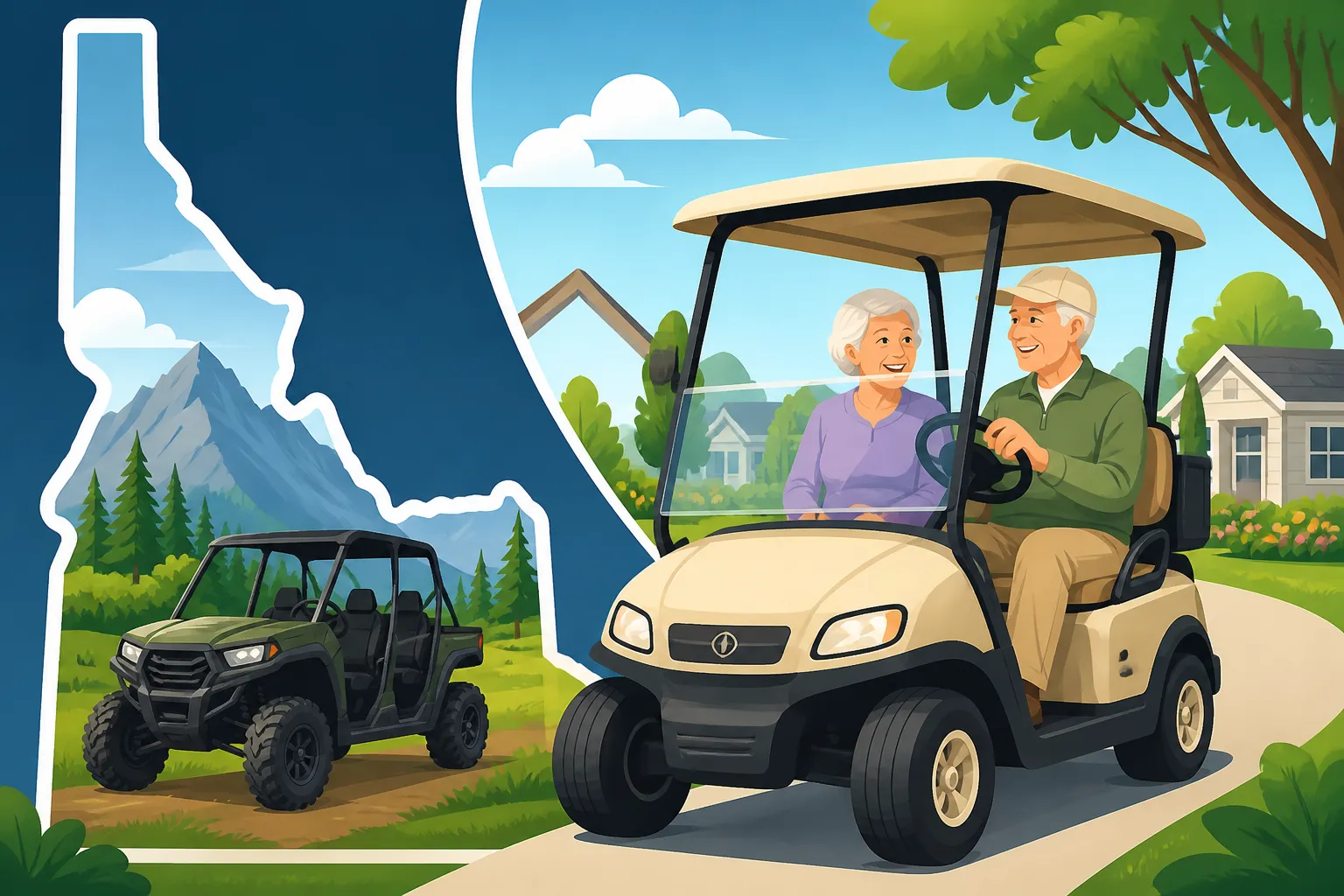
Golf Carts in a Retirement Community
One of the great joys of settling into an Idaho retirement community is the slower pace of life, often accompanied by the convenience of a golf cart. You see your neighbors zipping around, heading to the community center, the clubhouse, or just visiting friends down the street. It seems like the perfect, easy-going solution for getting around. But then you hear whispers of rules, conflicting information about where you can and can't ride, and whether your trusty golf cart is truly "street legal" the moment it leaves a private path. It can be incredibly confusing to sort through, leaving you wondering if you're risking a citation just by heading to the mailboxes. This guide is here to clarify Idaho's laws regarding golf carts, how they differ from other off-highway vehicles, and what it truly takes to ride legally, both within your community and on public roads.
The Appeal of Golf Carts in Idaho Retirement Communities
There's no denying the charm and practicality of a golf cart when you're living in a retirement community. They embody a certain lifestyle—relaxed, accessible, and community-focused. However, this ease of use within a defined community often leads to a bit of a headache when the lines blur between private community property and public thoroughfares.
Why Golf Carts Are So Popular in These Settings
For many residents, a golf cart isn't just a vehicle; it's an extension of their social life and independence. Imagine the convenience: you can hop in your cart and be at a friend's house in minutes, carry your groceries home from a small community market, or simply enjoy a leisurely drive around the neighborhood on a sunny afternoon. They're typically quieter than cars, easier to park, and for many, represent a simpler way of navigating their daily routines.
They also offer a sense of freedom, especially for those who might prefer not to drive a full-sized car for short distances. The compact size and maneuverability make them ideal for the often narrower streets and pathways found in planned communities. Plus, they can be customized with personal touches, becoming a fun expression of individual style, even if they aren't built with the rugged durability you'd find in an off-road utility vehicle from, say, SuperATV.
The Gray Area: Where Private Roads Meet Public Ones
This is where much of the confusion begins. Within the confines of a truly private, gated retirement community where all roads are privately owned and maintained, the rules regarding golf carts are typically set by the Homeowners Association (HOA) or community management. On such roads, your golf cart might be perfectly legal for general transportation as long as you follow the community's specific guidelines.
The challenge arises when these communities have roads that are publicly accessible, even if they feel like part of the private property. Or, more commonly, when residents want to take their golf cart just a little further—perhaps to a nearby grocery store, a doctor's office, or even a public park that's just outside the community gates. The moment your wheels touch a public road, county road, or state highway, even for a short distance, you transition from community rules to Idaho state and local traffic laws. This shift can catch many off guard, leading to fines or even more serious issues if the vehicle isn't compliant with state regulations. Understanding this distinction is the first critical step to avoiding unforeseen problems.
Idaho's Legal Landscape: Golf Carts vs. OHVs vs. LSVs
Navigating Idaho's vehicle laws can feel like threading a needle, especially when you're trying to figure out where your golf cart fits in. The state makes clear distinctions between different types of vehicles, and it's essential to understand these categories to ensure you're operating legally. A golf cart is not an OHV, and neither is it automatically a Low-Speed Vehicle (LSV) without specific modifications. Let's break down these important definitions.
What Officially Defines a Golf Cart in Idaho
In Idaho, a "golf cart" generally refers to a motor vehicle that is designed and manufactured for operation on a golf course. Its primary purpose is to transport people and golf equipment. By design, golf carts are not typically equipped with all the safety features required for regular public road use. They usually have a top speed of less than 20-25 miles per hour and lack things like proper headlights, taillights, turn signals, or seatbelts that are standard on street-legal vehicles.
Crucially, Idaho law specifies that a golf cart, in its standard form, is generally prohibited from operating on public streets and highways. There are exceptions, but they almost always involve local ordinances explicitly permitting their use on specific, designated roads, usually under very strict conditions like low-speed limits and crossing points. Without such a local ordinance, your golf cart is confined to private property, golf courses, or private community roads as defined by your HOA. It's not unlike the rules you'd encounter for [Golf Carts and Low-Speed Vehicles in Idaho].
The Critical Difference: OHVs (ATVs/UTVs) Are Not Golf Carts
This is a point of significant confusion. Many people see side-by-sides (UTVs) zipping around and assume their golf cart can follow suit, or that it falls under similar "off-highway vehicle" rules. This is absolutely not the case. Off-Highway Vehicles (OHVs) in Idaho include ATVs, UTVs, and dirt bikes. These machines are built for rugged, off-road terrain. They have powerful engines, robust suspensions, and specialized tires designed for dirt, rocks, and mud.
OHVs typically require an OHV registration sticker to be ridden on designated trails and, with the proper [Idaho Restricted Vehicle Plate], can sometimes access specific county roads for short distances to connect trails or access services. A golf cart, by contrast, is not designed for off-road use, nor does it qualify for an OHV registration or restricted plate. Attempting to get an [Idaho Plate That Begins With R] for a golf cart would be fruitless, as those plates are specifically for OHVs meeting Idaho's road-access criteria. While you can deck out a UTV with heavy-duty parts from companies like SuperATV for extreme trail riding, a golf cart cannot be similarly "upgraded" to meet OHV requirements. The two types of vehicles serve entirely different purposes and fall under distinct legal frameworks.
| Feature | Standard Golf Cart | Off-Highway Vehicle (OHV) | Low-Speed Vehicle (LSV) |
|---|---|---|---|
| Primary Use | Golf courses, private communities | Off-road trails, some county roads | Public roads with speed limits |
| Top Speed | Typically < 20-25 mph | Varies greatly, often 50+ mph | 20-25 mph (by definition) |
| Street Legal? | No (unless specifically exempted) | No (unless modified for R-plate) | Yes, with proper equipment/reg. |
| Required Title? | Generally no | Yes, if over 50cc | Yes |
| Required Plate? | No | OHV sticker + Restricted Plate (R) | Standard Vehicle Plate |
| Driver's License? | Not on private property | No (on trail), Yes (on public road) | Yes |
| Insurance? | Not always required (private use) | Recommended, often required for road | Yes, required |
| Safety Features | Minimal (lights optional) | Some (roll cage, seatbelts on UTVs) | Headlights, taillights, turn signals, mirrors, seatbelts, windshield |
The "Low-Speed Vehicle" (LSV) Path to Road Legality
If you genuinely want to drive your golf cart on public roads in Idaho, even within or just outside your retirement community, the most viable path is often to convert it into a "Low-Speed Vehicle" (LSV). An LSV is a street-legal class of vehicle that, while resembling a golf cart, must meet specific federal and state safety standards. It's essentially a golf cart that has been properly outfitted and registered for road use.
To qualify as an LSV in Idaho, a vehicle must be capable of a top speed of at least 20 miles per hour but not more than 25 miles per hour. Critically, it must be equipped with a comprehensive list of safety features that a standard golf cart often lacks. These include headlamps, taillamps, stop lamps, turn signal lamps, reflex reflectors, an exterior mirror on the driver's side and either an exterior mirror on the passenger's side or an interior rearview mirror, a parking brake, a windshield, a vehicle identification number (VIN), and seatbelts for all designated seating positions.
Once a golf cart is modified to meet these requirements, it can be titled and registered as an LSV with the Idaho Department of Motor Vehicles. This process typically involves an inspection to ensure all safety equipment is present and functional. Only then can it legally operate on public roads with a posted speed limit of 35 miles per hour or less. This is a crucial distinction, as LSVs are generally prohibited from roads with higher speed limits, meaning they are not permitted on state highways or most main arterial roads. [Registering a Low-Speed Vehicle in Idaho] is the administrative step that seals its legal status for public road use.
Making Your Golf Cart "Street Legal" Beyond the Greens
So, you've decided you want to take your golf cart beyond the private paths of your community, perhaps to the local coffee shop or to visit a friend in a neighboring development. The journey from a standard golf cart to a fully street-legal Low-Speed Vehicle (LSV) involves a commitment to upgrades and a clear understanding of the regulatory hurdles. It's not a quick fix, but it's the only way to ensure legality and safety on public roads.
Essential Equipment for LSV Conversion
Converting your golf cart into an LSV isn't just about adding a few lights; it's about meeting a specific set of safety standards. You'll need to equip your cart with the following:
- Headlights and Taillights: These must be functional and meet federal lighting standards, ensuring visibility during dawn, dusk, or adverse weather.
- Stop Lamps (Brake Lights): When you hit the brakes, these lights need to illuminate clearly for drivers behind you.
- Turn Signal Lamps: Front and rear turn signals are mandatory for indicating your intentions to other motorists.
- Reflex Reflectors: Strategically placed reflectors enhance visibility, especially from the sides.
- Mirrors: You must have at least one exterior mirror on the driver's side, and either a passenger-side exterior mirror or an interior rearview mirror. This provides crucial visibility of traffic around you.
- Windshield: A compliant windshield is necessary to protect the occupants from debris.
- Seatbelts: Every designated seating position must have a functional seatbelt. This is a fundamental safety requirement.
- Parking Brake: A reliable parking brake is essential for securing the vehicle when stopped.
- Horn: A working horn is needed to alert pedestrians or other drivers to your presence.
- Vehicle Identification Number (VIN): If your golf cart doesn't already have a manufacturer's VIN (which many do), you might need to apply for a state-issued VIN. This unique identifier is critical for titling and registration.
While you might find a plethora of aftermarket parts for ATVs and UTVs from companies like SuperATV that focus on performance and off-road capability, the parts for LSV conversion are specifically designed to meet road safety regulations. It's important to source quality components that will pass inspection. Thinking you can just bolt on a few things and call it good isn't enough; the modifications must be robust and reliable.
The Registration and Licensing Process for an LSV
Once your golf cart has been properly outfitted to meet LSV standards, the next step is the administrative process. This involves titling and registering your newly converted LSV with the Idaho Department of Motor Vehicles.
First, you'll need to apply for a title for the vehicle. This may require proof of ownership (like a bill of sale) and documentation of the VIN. After obtaining a title, you can proceed with registration. During the registration process, the vehicle will likely undergo an inspection to verify that it meets all the equipment requirements for an LSV. This inspection ensures that all the mandatory safety features are present and functioning correctly.
Upon successful inspection and payment of fees, your LSV will be issued a standard Idaho license plate, not an OHV sticker or a restricted plate. This plate must be displayed prominently on the rear of the vehicle.
Furthermore, just like driving any other street-legal vehicle, the operator of an LSV must possess a valid driver's license. [Driver's License and Insurance on an Idaho Road Ride] are non-negotiable for operating an LSV on public roads. You also must carry valid liability insurance that meets Idaho's minimum requirements. Without these, even a fully equipped LSV is not legally allowed on public roads.
Local Ordinances and Their Impact on Golf Cart Use
Even with a fully converted and registered LSV, you're still beholden to local ordinances. Idaho law gives individual cities and counties the authority to regulate or even prohibit the use of golf carts and LSVs on public roads within their jurisdiction. This means that while your LSV might be perfectly legal according to state law, a specific city or county could have an ordinance that restricts or bans its use on certain streets, or even all public roads within their boundaries.
It is absolutely crucial to check with your local city hall or county sheriff's office for any specific rules that might apply to your area, especially around your retirement community. What's allowed in one Idaho town might be strictly forbidden just a few miles down the road. For example, some communities might designate specific low-speed roads where LSVs are permitted, while others may opt for a blanket prohibition. This local control is why you'll find varying rules regarding [Idaho City and County Ordinances That Close Roads] or restrict certain vehicle types. Always verify the rules for the specific roads you intend to travel to avoid fines for illegal operation.
Riding Smart and Staying Safe in Your Community
Once you understand the regulations for your golf cart or LSV, the next step is to operate it responsibly and safely. Even in the most tranquil retirement community, accidents can happen, and being prepared means understanding insurance, practicing safe driving habits, and making informed choices about your vehicle.
Understanding Insurance Needs for Your Golf Cart
Whether your golf cart is confined to private community roads or has been upgraded to an LSV for public street use, understanding your insurance coverage is paramount. For golf carts strictly used on private property, your homeowner's insurance policy might offer some liability coverage if an accident occurs on your property. However, this coverage is often limited and may not extend to incidents off your immediate property, even if still within the community's private roads. It's crucial to contact your insurance provider to clarify what, if any, coverage you have for your golf cart. You might find you need a separate policy to adequately protect yourself from liability in case of an accident.
If your vehicle is a registered LSV, then carrying appropriate liability insurance is not just a recommendation—it's a legal requirement for operating on public roads in Idaho. This insurance protects you financially if you're found at fault for an accident that causes injury or property damage to others. The minimum requirements for [Liability Insurance Idaho Road Riding Requires] are the same for LSVs as they are for cars. Just like you wouldn't drive your car without insurance, don't drive your LSV without it. Some people might invest in insurance for their trail-ready UTVs, especially if they've put significant money into aftermarket parts from SuperATV, but a golf cart, even a basic one, needs its own dedicated thought process when it comes to coverage.
Best Practices for Safe Operation Within the Community
Regardless of your golf cart's legal status or the roads you're on, practicing safe operation is key to preventing accidents and enjoying your rides.
- Follow Posted Speed Limits: Even if your cart can go a bit faster, adhere to the speed limits, especially within the community. These limits are often set for the safety of pedestrians, other vehicles, and pets.
- Yield to Pedestrians: In a retirement community, you'll encounter many walkers, joggers, and people with pets. Always give them the right-of-way.
- Be Aware of Other Vehicles: Even on "private" roads, you'll share the space with cars, delivery vehicles, and other golf carts. Drive defensively and anticipate others' movements.
- Use Signals: Even if your cart doesn't have official turn signals, use hand signals to indicate turns. Clear communication prevents misunderstandings.
- Avoid Distractions: Keep your focus on the road and your surroundings. Avoid using your phone or other distractions while driving.
- Keep Your Cart Maintained: Regularly check your tires, brakes, lights, and steering. A well-maintained cart is a safer cart.
- Never Overload: Respect the manufacturer's passenger and weight limits. Overloading can affect stability and braking.
- Children and Passengers: Ensure any passengers, especially children, are seated properly and understand safety rules. While [Idaho Helmet Rules for Riders Under 18] are generally for motorcycles and OHVs, always err on the side of caution with young passengers.
Remember, even at low speeds, a collision can cause serious injury. Treat your golf cart with the same respect and caution you would any other vehicle on the road.
When to Consider an ATV or UTV Instead of a Golf Cart
Sometimes, the desire to explore beyond the immediate community extends to more rugged terrain. If your vision involves hitting actual dirt trails, exploring forest roads, or using your vehicle for light utility work around a larger property, then a golf cart, even an LSV, simply isn't the right tool for the job. This is when an Off-Highway Vehicle (OHV) like an ATV or a UTV (side-by-side) truly shines.
OHVs are built specifically for durability and performance on varied terrain. They have stronger suspensions, more powerful engines, and tires designed for traction on unpaved surfaces. For instance, if you're planning to ride the [Danskin Mountains OHV Area Near Boise] or take advantage of [Idaho's Sawtooth National Forest Trails], you'll need an ATV or UTV, not a golf cart. Many riders customize these machines with robust aftermarket parts from reputable brands like SuperATV to enhance their capabilities, whether it's for lift kits, stronger axles, or specialized tires for extreme conditions.
While golf carts offer a leisurely way to navigate paved community paths, OHVs provide the gateway to Idaho's vast backcountry. If your dream involves more adventure and less pavement, it's worth exploring the world of ATVs and UTVs, understanding their specific registration requirements, and recognizing that they operate under a completely different set of rules than their golf course cousins. For many, the choice depends entirely on their intended use—gentle cruises around the block or exhilarating rides through the mountains.
Disclaimer
This article is for general informational purposes only and does not constitute professional advice. Laws, prices and regulations vary by location and change over time. Consult a qualified professional for guidance on your specific situation.