Idaho Rules Where a Forest Road Becomes a Highway
There's nothing quite like the freedom of exploring Idaho's vast network of forest roads and trails on your ATV or UTV. You're out in nature, the air is fresh, and the scenery is breathtaking. But then, almost out of nowhere, that familiar gravel path you've been cruising on suddenly changes. The pavement starts, the speed limit signs shift, and you see that dreaded green sign: a state highway. The sudden shift from remote wilderness to a more regulated thoroughfare can be incredibly confusing and honestly, a bit intimidating. It leaves many riders scratching their heads, wondering, "Am I still legal here? What are the rules now?" This guide will clear up that common confusion, helping you understand Idaho's specific regulations for OHVs when a seemingly endless forest road transitions into a state or federal highway.
Understanding Idaho's Road Classifications for OHVs
Idaho's diverse landscape means a similarly diverse range of roads, from the most rugged two-track in the backcountry to bustling interstates. For OHV riders, understanding these classifications isn't just about following rules; it's about staying safe, avoiding hefty fines, and ensuring your machine is legally equipped for whatever pavement or gravel you encounter. The lines between what's open and what's restricted can sometimes feel blurred, especially in those transition zones, making it crucial to know exactly what you're riding on.
The Fuzzy Line: Forest Roads vs. State Highways
One of the biggest frustrations for OHV riders is the sometimes-subtle shift between different types of roads. You might start your day deep in the [Idaho's Sawtooth National Forest Trails] on a designated forest road, feeling completely free. These roads are often unpaved, maintained by the Forest Service or Bureau of Land Management (BLM), and generally have more lenient rules for OHV access, provided you have your current Idaho OHV sticker. They often feel like an extension of the trail system.
However, as you travel, these forest roads can, and often do, connect to larger county roads, and eventually, state or federal highways. The transition isn't always marked with flashing lights and a welcoming committee. Sometimes, a forest service road might simply turn into a paved county road for a stretch, and then that county road might intersect with, or even become, a state highway. Riders often get into trouble because they don't recognize these transition points, assuming "once a forest road, always a forest road." This misidentification can lead to inadvertently riding on a restricted highway, which carries significant legal implications. The very essence of these roads changes, from a focus on recreation and resource management to one of high-speed public transit, and with that change comes a whole new set of rules you absolutely must follow.
What Makes a Road a "Highway" in Idaho?
In Idaho, a "highway" generally refers to roads maintained by the state (state highways, typically numbered like Highway 55 or Highway 21) or the federal government (U.S. routes like US-95 or interstates like I-84). These roads are designed for high-speed, multi-lane vehicle traffic, connecting towns and cities across the state and beyond. They are distinguished by specific signage – typically green signs with white numbering for state highways and white shield-shaped signs for U.S. routes. You'll also notice a distinct difference in road construction, typically paved, with wider shoulders, and often higher speed limits than your average forest or county road.
The key distinction for OHV riders is that, with very few exceptions, OHVs are not allowed on Idaho state or federal highways. This is a critical rule that can't be stressed enough. These roads are built for cars, trucks, and commercial vehicles, not for the unique handling characteristics and slower speeds of ATVs and UTVs. The dangers of mixing OHVs with high-speed traffic on these routes are substantial, leading to serious accidents. While you might be able to ride an OHV on certain county roads with the proper [Idaho's Restricted Vehicle Plate Explained] and equipment, this privilege almost never extends to state or federal highways. Knowing [Can You Ride an OHV on an Idaho State Highway?] is paramount for avoiding dangerous and costly mistakes.
Navigating the Transition Zone: Rules and Requirements
Navigating Idaho's vast network of roads on your OHV can be a fantastic experience, but it requires vigilance and a solid understanding of the rules, especially when you're transitioning from a remote forest road to more populated areas or higher-classification roads. This isn't just about avoiding a ticket; it's about your safety and the safety of others on the road.
Legal Requirements for Riding on County Roads (Before the Highway)
Before you even think about encountering a state highway, you'll likely pass through sections of county road. Many forest roads feed directly into these county-maintained routes. The good news is that Idaho allows OHVs on many county roads, unless specifically prohibited by local ordinance. However, this privilege comes with a strict set of requirements you must meet to be street legal.
First and foremost, your machine needs to be properly registered and stickered. This means having a current Idaho OHV sticker displayed, and if you plan to ride on any county roads open to OHVs, you'll need an [Idaho's Restricted Vehicle Plate Explained]. This "R" plate signifies that your machine is equipped and registered for limited road use.
Beyond registration, your OHV must be equipped with specific safety features to operate on county roads. These typically include:
- Headlights and taillights: Operational and visible from required distances.
- Brake lights: Functional when you hit the brakes.
- Horn: An audible warning device.
- Mirrors: At least one, mounted to provide a clear view to the rear. Many riders choose a high-quality rearview mirror from a brand like SuperATV for their UTVs to ensure optimal visibility and compliance.
- Turn signals: For signaling lane changes or turns. [Turn Signals on an Idaho Restricted Vehicle] covers this in detail.
- Muffler and spark arrester: To control noise and prevent fires.
- DOT-approved tires: Designed for road use, not just off-road.
Furthermore, the operator must hold a valid driver's license, and the machine must be insured with at least the state's minimum liability coverage. For a deeper dive into what’s needed, make sure you've read [What Idaho Requires Before You Ride a County Road] and [Driver's License and Insurance on an Idaho Road Ride]. These requirements are crucial, as a forest road might transition into a county road long before it ever touches a highway, and you need to be legal for that intermediate stretch.
Identifying the "No OHV Zone" – Crossing or Joining a Highway
The critical moment comes when you approach a state or federal highway. The goal is simple: avoid riding on them. Idaho law is quite clear that OHVs are generally prohibited from traveling on these major arteries.
So, how do you know when you've reached this "no OHV zone"?
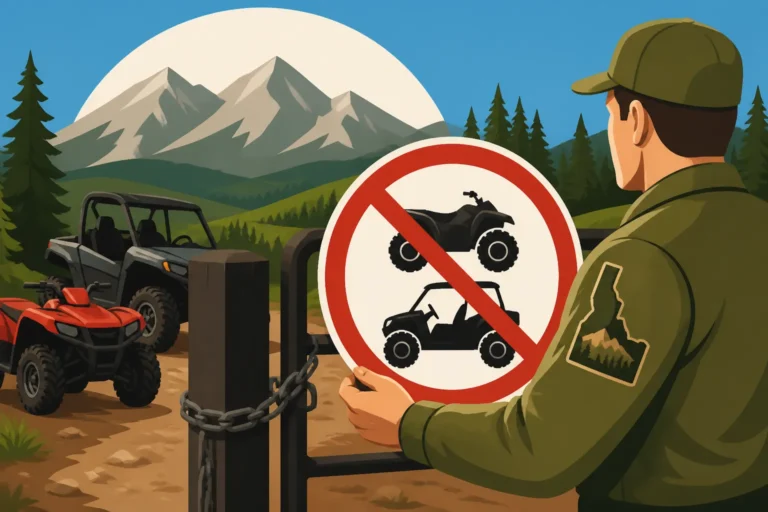
- Signage: Look for the unmistakable green signs marking state highways (e.g., "ID-55") or the shield-shaped signs for U.S. routes (e.g., "US-95"). You'll also often see "No OHV" or "No ATV" signs specifically posted at these intersections.
- Road Surface: A sudden transition from gravel or dirt to well-maintained pavement, especially with multiple lanes, is a strong indicator you're on a highway.
- Traffic Volume and Speed: Highways typically have much higher traffic volumes and significantly higher speed limits. The sheer speed differential makes it incredibly dangerous for OHVs.
- Mile Markers: State and federal highways have distinct mile markers that differ from county road markers.
When you encounter a highway, you generally have two main options:
- Turn Off: The safest and most common approach is to turn onto another legal route – often another forest road, a county road, or a designated OHV trail – that runs parallel or away from the highway. This requires good route planning.
- Perpendicular Crossing: In very specific, limited circumstances, Idaho law may allow you to cross a state or federal highway at an intersection, typically where a county road or designated OHV route intersects it at a right angle. This is not an invitation to ride along the highway. It is a quick, direct crossing from one legal OHV route to another. Even then, you must yield to all highway traffic and ensure it is safe to cross. Always check local ordinances and signage, as [Crossing an Idaho Highway on an OHV] details the strict rules for this maneuver. Remember, you cannot drive down the shoulder or use it as a bypass.
Ignoring these transition points can lead to serious legal consequences and put you in a very dangerous situation.
Equipment Considerations for Borderline Riding
When you're riding in areas where forest roads might transition to county roads and potentially border highways, having your machine properly equipped isn't just a suggestion—it's a legal and safety imperative. Many riders invest in aftermarket parts for enhanced performance and durability, and these can also contribute to street legality. Companies like SuperATV offer a wide range of accessories, from enhanced lighting kits to full glass windshields, that can help bring your off-road machine closer to road-legal standards.
Here's a closer look at crucial equipment:
- Lighting: Beyond basic headlights and taillights, ensure your brake lights are bright and clearly visible. If you’re riding near dusk or dawn, or during inclement weather, having robust lighting is non-negotiable. Many UTVs, especially those used in areas bordering roads, benefit from additional amber or white lights for improved visibility to other motorists.
- Mirrors: While Idaho requires at least one mirror for road use, having two side mirrors in addition to a rearview mirror can greatly improve your situational awareness, especially when entering or crossing roads with faster-moving traffic. [Mirrors on a Road-Legal Side-by-Side] provides more insight.
- Turn Signals: Integrated turn signal kits are essential for clearly communicating your intentions to other drivers on county roads. Trying to signal with hand gestures on an OHV is often ineffective and less safe.
- Horn: A loud, functional horn is critical for warning pedestrians, cyclists, or even other vehicles of your presence.
- Tires: If you intend to ride on paved county roads, consider tires that are DOT-approved. While knobby off-road tires are great for mud and rocks, they wear quickly on pavement and can negatively affect handling and braking performance on hard surfaces.
- Windshield and Wipers: While not always strictly required for all county roads, a windshield offers significant protection from debris, and wipers can maintain visibility in rain or mud, especially if you're traveling faster on a county road. SuperATV offers various windshield options, from full to half, that can enhance safety and comfort.
- Seatbelts/Restraints: Ensure all passengers are properly secured with factory-installed or equivalent seatbelts. For UTVs, many also utilize door nets or full doors for added security against accidental ejection.
Having these items in working order helps ensure you meet the legal requirements for county road travel and prepares you for any sudden transition that might require quick, clear communication with other drivers. It’s an investment in both compliance and safety.
Enforcement, Penalties, and Staying Safe
The beauty of Idaho's diverse terrain comes with the responsibility of understanding and adhering to its specific OHV laws. When you're out exploring, especially in areas where forest roads meet highways, the stakes are higher. Ignorance of the law is never an excuse, and enforcement agencies, from local sheriffs to state police and forest rangers, take these regulations seriously for everyone's safety.
Common Violations and Their Consequences
Riding an OHV on a restricted state or federal highway in Idaho is a serious offense, and the consequences can be significant. It's not just a minor slap on the wrist. Here are some of the common violations and their potential repercussions:
- Operating on a Prohibited Highway: This is the most direct violation. If an officer spots you riding your ATV or UTV on a state or federal highway where OHVs are expressly forbidden, you're looking at a citation. Fines can vary but are often substantial, and repeat offenses can escalate the penalties.
- Improper Equipment: Even if you're on a county road where OHVs are allowed, failing to have the required equipment (like a horn, mirrors, turn signals, or a restricted plate) can lead to a ticket. This falls under the umbrella of not having a "street legal" machine for road use.
- No Driver's License or Insurance: Operating any motor vehicle, including a road-legal OHV, without a valid driver's license or proof of insurance is a serious offense, often carrying fines, points on your driving record, and potentially even license suspension.
- Reckless Operation: Riding an OHV unsafely, regardless of the road type, can result in charges for reckless endangerment or operation. This is particularly dangerous on roads shared with other vehicles.
The penalties for these violations can range from hundreds of dollars in fines to the impoundment of your machine. An impoundment can incur significant towing and storage fees, adding insult to injury. Furthermore, illegal operation can affect your insurance coverage in the event of an accident. If you're involved in a crash while illegally operating on a highway, your personal liability could be astronomical, as your insurance company might deny coverage due to illegal activity. [Idaho Fines for Illegal Road Riding] provides a clearer picture of what you might face. These consequences are a stark reminder that staying informed and compliant isn't just about avoiding a hassle; it's about protecting your wallet, your machine, and your freedom to ride.
Planning Your Route and Using Resources
The best defense against accidental highway excursions and legal trouble is thorough pre-trip planning. You wouldn't venture into the deepest wilderness without a map, and you shouldn't navigate Idaho's roads without understanding where you can and cannot ride.
Here are essential resources and strategies for smart route planning:
- Motor Vehicle Use Maps (MVUMs): These maps, provided by the U.S. Forest Service and BLM, are your absolute best friend when riding on federal lands. They clearly designate which roads and trails are open to motorized use, and often, which specific types of vehicles are allowed (e.g., full-size vehicles, OHVs under 50 inches, motorcycles only). MVUMs are legally binding, so always have the most current version. You can often download them or pick them up at ranger district offices. Knowing [Reading an Idaho Motor Vehicle Use Map] is a foundational skill for any Idaho OHV enthusiast.
- GPS Apps and Devices: Modern technology can be a huge asset. Apps like [onX Offroad for Idaho Trails] provide detailed maps that often overlay MVUM data, showing you in real-time where you are relative to legal trails, roads, and restricted areas. Many dedicated GPS units also offer similar features. Always download offline maps before you head out, as cell service is spotty or nonexistent in many parts of Idaho's backcountry.
- County Ordinances: While state law broadly prohibits OHVs on highways, local counties have the authority to open or close their own county roads to OHV traffic. Always check the specific county's OHV ordinance for the area you plan to ride. What's open in one county might be closed just over the line. [Idaho City and County Ordinances That Close Roads] highlights this variability.
- Local Ranger Districts and Sheriff's Offices: When in doubt, call the local authorities. The Forest Service ranger district covering your intended riding area can provide invaluable, up-to-date information on trail status, closures, and specific road classifications. Similarly, the county sheriff's office can clarify rules for county roads. These are the folks on the ground who know the specific nuances of their jurisdiction.
- Physical Maps: Don't underestimate the value of a good old-fashioned paper map, especially as a backup. Batteries die, and signals drop. A detailed physical map can literally be a lifesaver.
- Community Forums and Clubs: Local OHV clubs and online forums are fantastic resources for current trail conditions, known problem areas, and local "hot tips" on routes that safely connect different areas without hitting restricted highways.
By diligently using these resources, you can plan your rides to intentionally avoid restricted highways, ensuring a safe, legal, and stress-free adventure. Remember, [Four Things Idaho Riders Must Carry on a Road] include your driver's license, proof of insurance, OHV registration, and a safety certificate if required, so always have your paperwork in order.
Disclaimer
This article is for general informational purposes only and does not constitute professional advice. Laws, prices and regulations vary by location and change over time. Consult a qualified professional for guidance on your specific situation.