Carrying a Safety Certificate
Carrying a Safety Certificate
If you ride an ATV or UTV in Idaho, it can be hard to tell whether a safety certificate is required, who needs one, and what proof to have with you. The safest approach is to check the rule for the rider and riding area before leaving, then carry the certificate or other accepted proof where it can be found quickly.
What an Idaho safety certificate proves
An Idaho OHV safety certificate is proof that a rider completed an approved off-highway vehicle safety course. It is not the same thing as a registration, OHV sticker, restricted vehicle plate, driver’s license, or permission to use a road or trail.
That distinction matters during a ride. A machine can have its required sticker and still be operated by someone who needs to meet a separate safety-course rule. Likewise, a rider’s certificate does not make a closed road or trail legal to use.
Idaho’s course requirements depend on the rider and the circumstances. They are especially important for riders under 16, but the exact rule can depend on where and how the machine is being operated. Check the current Idaho Parks and Recreation guidance rather than assuming that a course is required for every rider—or that it is never required for a rider who is accompanied by an adult. For a starting point, see Idaho OHV Safety Course Requirements and Who Must Take the Idaho Safety Course.
A certificate can be useful even when a rider is not legally required to complete a course. It demonstrates that the rider has received safety instruction and gives a family a clear way to document a young rider’s completion. It can also help avoid confusion when a rider visits a new riding area, joins a group, or is asked about training during an encounter with an officer or land manager.
Keep the certificate separate in your mind from these other items:
- Registration or an OHV sticker: Shows that the machine meets the relevant registration or sticker requirement. It does not prove the operator completed a safety course.
- Restricted vehicle plate: May be relevant to a machine’s permitted road use, but it does not replace operator training.
- Driver’s license: May be required for some road use, but it is not a safety-course certificate.
- Land access permission: A certificate does not grant permission to ride private property, enter a restricted area, or use a closed route.
The paperwork for a ride can vary by machine and location. If you are sorting out all the requirements, What Idaho Riders Need Before They Ride is a useful companion to this certificate-focused checklist. For road sections, also review Four Things Idaho Riders Must Carry on a Road; the documents and equipment relevant to road use are not necessarily the same as the items required on a trail.
Who needs to complete the course
Do not decide whether a course is required based only on the machine, the family’s usual riding habits, or whether an adult is nearby. The rule is about the operator and the riding circumstances. Idaho has specific requirements for young riders, and the details should be checked before the ride.
For a rider under 16, confirm all of the following:
- The rider’s age on the day of the ride. Age-based requirements may change when a young rider reaches a particular age. Do not rely on a rule that applied last season without checking whether it still fits.
- The type of area. Public land, a forest road, a county road, private property, and a managed riding area may have different requirements. A rule for one setting should not be assumed to apply everywhere.
- Whether the rider will operate the machine. A passenger and an operator are not interchangeable for course rules. Passenger age and safety requirements can be separate.
- Whether an adult will supervise. Supervision rules are specific. Do not assume that an adult’s presence automatically replaces a course certificate or other requirement.
- Whether a local or land-manager rule adds conditions. A trail operator, event organizer, or rental business may require training or proof even when a state rule does not require it for that particular rider.
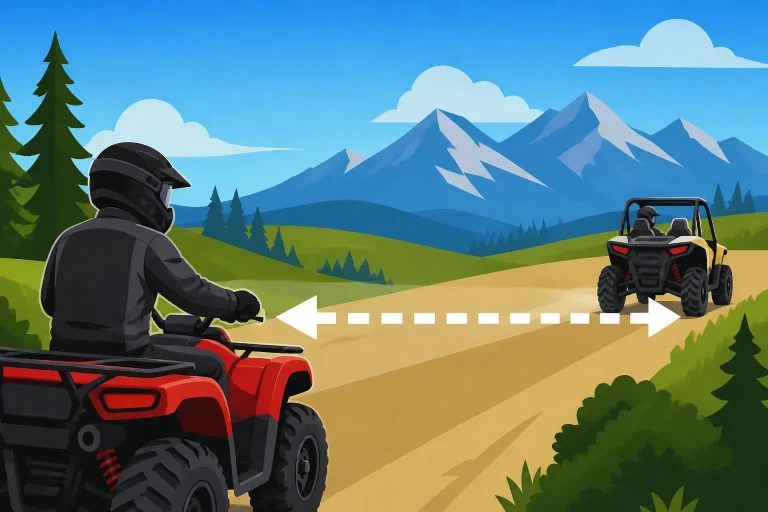
Idaho also has supervision provisions that can matter to young operators. The terms and circumstances matter: a responsible adult nearby is not necessarily the same as meeting a legal definition of direct supervision. Read Idaho Supervision Rules and the 300-Foot Rule and The 300-Foot Supervision Distance before treating distance or visibility as an easy substitute for a course.
A good family rule is to complete the course when it applies, save the certificate, and carry proof whenever the rider is operating away from home. That avoids the stressful version of the question—trying to establish course completion after a stop or incident, with the paperwork back at the house.
Out-of-state riders and certificates
Visitors should not assume that an out-of-state course card is accepted automatically, or that a home-state credential removes every Idaho requirement. Course recognition can depend on the issuing program and the rule at issue. Before traveling, confirm whether Idaho accepts that specific certificate for the rider’s situation. The page on Out-of-State Certificates Idaho Accepts addresses that question.
The same caution applies to nonresident permits and stickers. A sticker is about the machine and its access requirements; a course certificate is about the operator’s training. Neither should be treated as a substitute for the other. If your trip includes public land, check the separate rules in Idaho Permit Rules on Public Land.
What to carry and how to store it
If the rider needs a safety certificate, carry proof in a format that the relevant authority accepts. If you cannot confirm that a digital copy is accepted, take the physical certificate or an official replacement document. A photo on a phone is a helpful backup, but it should not be your only proof unless you have confirmed that it is sufficient.
Before the trip, make sure the document is readable and identifies the rider. A blurry image, a cropped screen capture, or a certificate belonging to a sibling can create avoidable confusion. Check the name and any identifying details against the rider who will be operating the machine.
A practical document setup has three parts:
- A primary copy: Carry the original or official document if available and appropriate. Keep it in a place where it will not get wet, torn, or lost.
- A backup copy: Save a clear photo or scan on a phone, or keep a second paper copy with the trip paperwork. Treat this as backup, not as proof that a digital format will be accepted.
- A consistent storage spot: Keep the document with the rider’s other ride paperwork so that another adult can find it if needed.
A small waterproof pouch can protect paper from dust, rain, mud, and spilled drink. It can be kept in a pack or another secure spot that stays with the rider or supervising adult. Outdoor shops and general retailers, including Amazon, offer document pouches, but the important point is simply to choose one that closes securely and does not interfere with safe storage. Do not put paperwork somewhere that could obstruct controls, become a projectile, or get trapped in moving parts.
Some families keep a copy with the machine’s documents; others keep it in the adult’s pack. Choose a system that makes sense for your ride, and tell the supervising adult where it is. If several machines and riders are involved, label each document sleeve with the rider’s name. Do not assume a certificate kept in one vehicle will be available if the young rider changes machines during the day.
The certificate is not a document to leave permanently in an exposed storage compartment. Heat, moisture, and repeated handling can damage paper. A phone can also lose power, break, or have no service in remote terrain. Carrying both a protected paper copy and a digital backup reduces the chance that a single problem leaves you without proof.
For broader advice on what to keep with the machine and what can remain at home, see Carrying the Certificate in the Machine and Keeping Paperwork on the Machine. The safety certificate is only one part of the paperwork picture, and not every document should be handled or stored in the same way.
Before relying on a digital copy
Digital proof is convenient, especially when a family rides several machines or travels from out of state. But convenience is not the same as acceptance. Before relying on a phone image, check with the relevant Idaho agency or the managing authority for the riding area.
Ask a direct question: “For this rider and this type of ride, will a clear phone image of the certificate count as proof?” If the answer is unclear, carry the paper document or an official duplicate. Do not wait until a trailhead, roadside stop, or remote area to find out that the phone is dead or the file is not accessible.
If you use a digital backup, save it for offline viewing. A cloud-only file may not open when there is no signal. Make sure the screen can display the full document, including the rider’s name and course information, without relying on a weak connection.
How to confirm the certificate is valid for your ride
The most reliable check is to match the rider, course, document, and ride area—not simply to glance at a certificate and assume it settles every question.
Use this process before leaving:
- Identify the operator. Write down who will actually drive each ATV or UTV. A certificate for one person does not prove another person completed the course.
- Check the age-related rule. If a rider is under 16, review the current Idaho guidance for the relevant type of operation. Start with Idaho Rules for Riders Under 16.
- Confirm the course is recognized. If the certificate came from outside Idaho, verify that the state accepts that specific course for the requirement you are trying to meet.
- Check the riding area. Find out whether the route includes public land, a forest road, a county road, private property, or a managed site. A change of location may mean a change in the rules.
- Check supervision separately. If an adult will accompany a young rider, confirm the applicable supervision rule instead of assuming that accompaniment changes the course requirement.
- Prepare acceptable proof. Carry the certificate in a format the authority accepts. If you cannot confirm a digital format, take a paper copy or official duplicate.
- Check the rest of the ride requirements. Verify the machine’s sticker or registration, road-use requirements, and route access independently.
This sequence helps avoid two common mistakes: treating a certificate as a general pass for the machine, and treating a sticker or plate as proof that the operator has met a training requirement. Each item answers a different question.
It is also worth checking the certificate before a long trip, not just on the morning of the ride. If a name is misspelled, a document is damaged, or the rider cannot locate it, there may be time to contact the course provider or request a replacement. Information about that process is available in Getting a Duplicate Safety Certificate.
If the certificate is from an online course, retain any completion confirmation and follow the course provider’s instructions for obtaining the final certificate. A confirmation page or email may be useful as a temporary record, but do not assume that it is equivalent to the official document. See Taking the Safety Course Online for more on online completion.
What to do if proof is missing or questioned
If a rider cannot find a certificate, do not bluff or substitute another document. Explain honestly what you have, show any backup proof, and follow the instructions of the officer, land manager, or event organizer. A phone image may help identify the course, but whether it meets the proof requirement depends on the applicable rule and the authority asking for it.
If you realize the certificate is missing before riding, pause and check whether the rider may legally operate without it. For a young rider, the conservative choice is to avoid having that rider operate until you have confirmed the requirement and obtained acceptable proof. An adult’s certificate cannot be used to cover a child, and an adult’s presence should not be treated as a guaranteed exemption.
If a certificate is lost, contact the course provider or the agency responsible for issuing or recognizing it. Ask what information is needed to locate the record and how to obtain an official duplicate. Keep a receipt or confirmation of the request, but do not assume that a request in progress counts as a certificate.
If the rider completed a course but the document appears incomplete or has a name mismatch, contact the issuer before the ride. Do not alter a document yourself. A correction made by the issuing organization is easier to verify than a handwritten change that could raise questions.
If an officer or land manager asks about the certificate, stay calm and respond directly. Have the document ready rather than searching through unrelated photos and messages. If you do not have it, say so and show the backup information you do have. An honest, organized answer is better than claiming that a registration, driver’s license, or another rider’s certificate proves course completion.
A safety certificate also does not resolve every issue that can arise during a stop. The operator may need to meet age, supervision, equipment, registration, sticker, or road-use rules independently. If the ride includes a road segment, consult What Idaho Requires to Ride a County Road and confirm that the specific road is open to OHV use.
Frequently Asked Questions
Does every Idaho ATV or UTV rider need a safety certificate?
No single answer covers every rider and every setting. Idaho’s course rules depend on the operator and circumstances, with particular requirements for young riders. Check current Idaho guidance for the rider’s age and intended riding area.
Does an adult supervising a young rider remove the course requirement?
Do not assume that it does. Idaho has specific supervision rules, and the relationship between supervision and course requirements depends on the situation. Verify both requirements rather than treating one as a substitute for the other.
Is a photo of the certificate on a phone enough?
It may be useful backup, but do not assume it will be accepted as the required proof. Confirm the accepted format with the relevant Idaho authority or land manager. If you cannot confirm digital acceptance, carry the official paper document or a duplicate.
Does an Idaho sticker prove that the rider completed the course?
No. A sticker or registration concerns the machine; a safety certificate concerns the operator’s course completion. Check each requirement separately.
Disclaimer
This article is for general informational purposes only and does not constitute professional advice. Laws, prices and regulations vary by location and change over time. Consult a qualified professional for guidance on your specific situation.